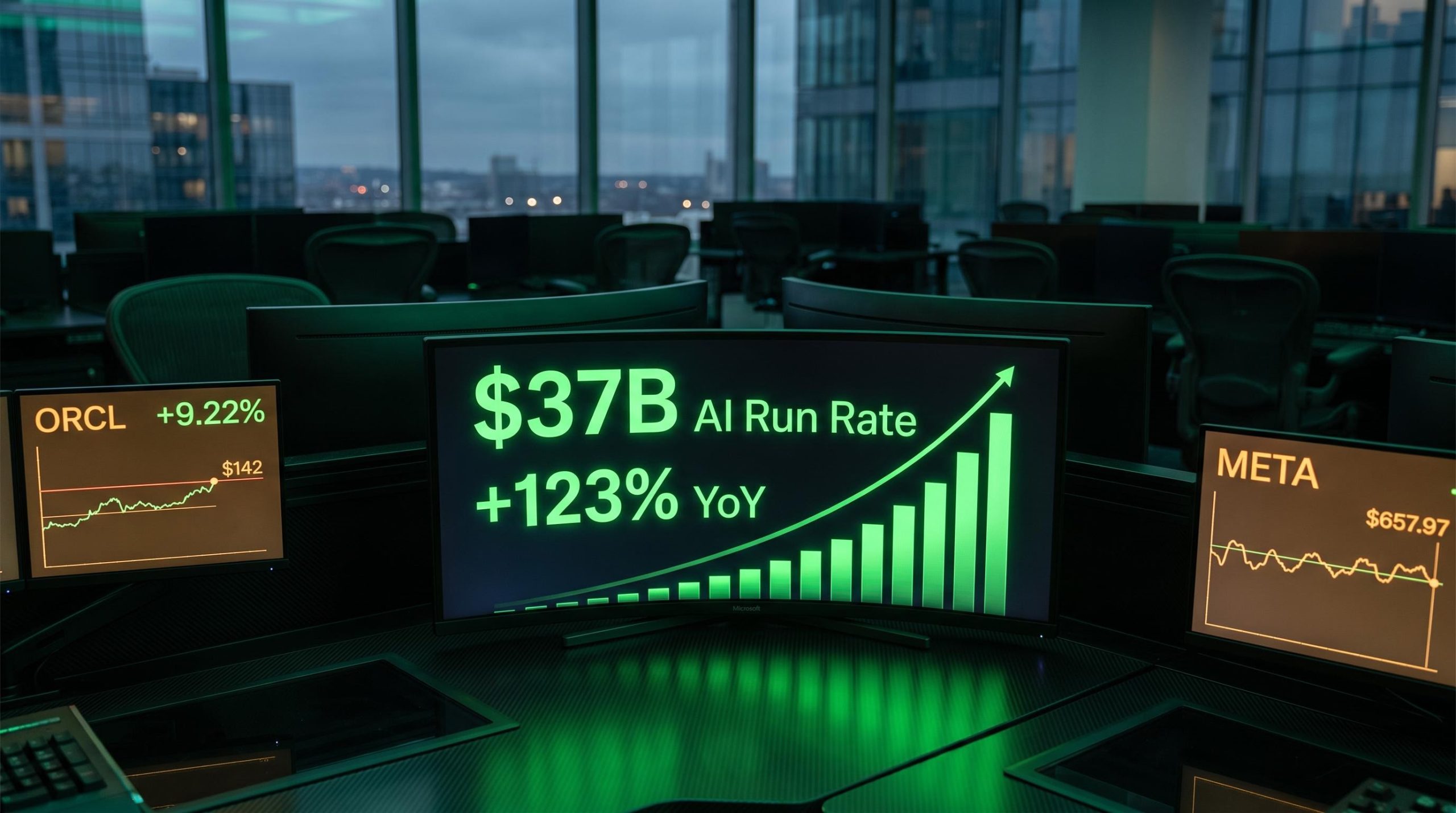
Microsoft just disclosed a $37 billion annualised AI revenue run rate growing at 123% year over year. That single figure made it the first mega-cap technology company to put a specific, audited number on what AI is actually worth to its business. In one earnings release, it changed the framing of the entire sector.
The disclosure triggered a broad rally across AI-exposed technology stocks. Oracle surged more than 9%. Meta caught a bid. Goldman Sachs issued an upgrade on Microsoft with a $640 price target. The question for investors now is whether the rally across all three names reflects genuine re-rating or borrowed conviction from a single earnings report.
This piece breaks down what Microsoft’s numbers actually confirmed, what they did not prove for Oracle and Meta, and what technical evidence would signal a sustained move versus a sentiment-driven fade. After reading, you will have a clear framework for treating these three AI monetisation stocks as distinct positions rather than a uniform basket.
What Microsoft actually proved about AI monetisation
The numbers from Microsoft’s fiscal Q3 2026 quarter (ended 31 March 2026) do not require interpretation. They speak for themselves:
- Revenue: $82.9 billion, up 18% year over year
- Operating income: $38.4 billion, up 20%
- Net income: $31.8 billion, up 23%
- EPS: $4.27, up 23%
- AI annualised revenue run rate: $37 billion, up 123% year over year
- Azure growth: approximately 40% year over year, with AI contributing double-digit percentage points to that figure
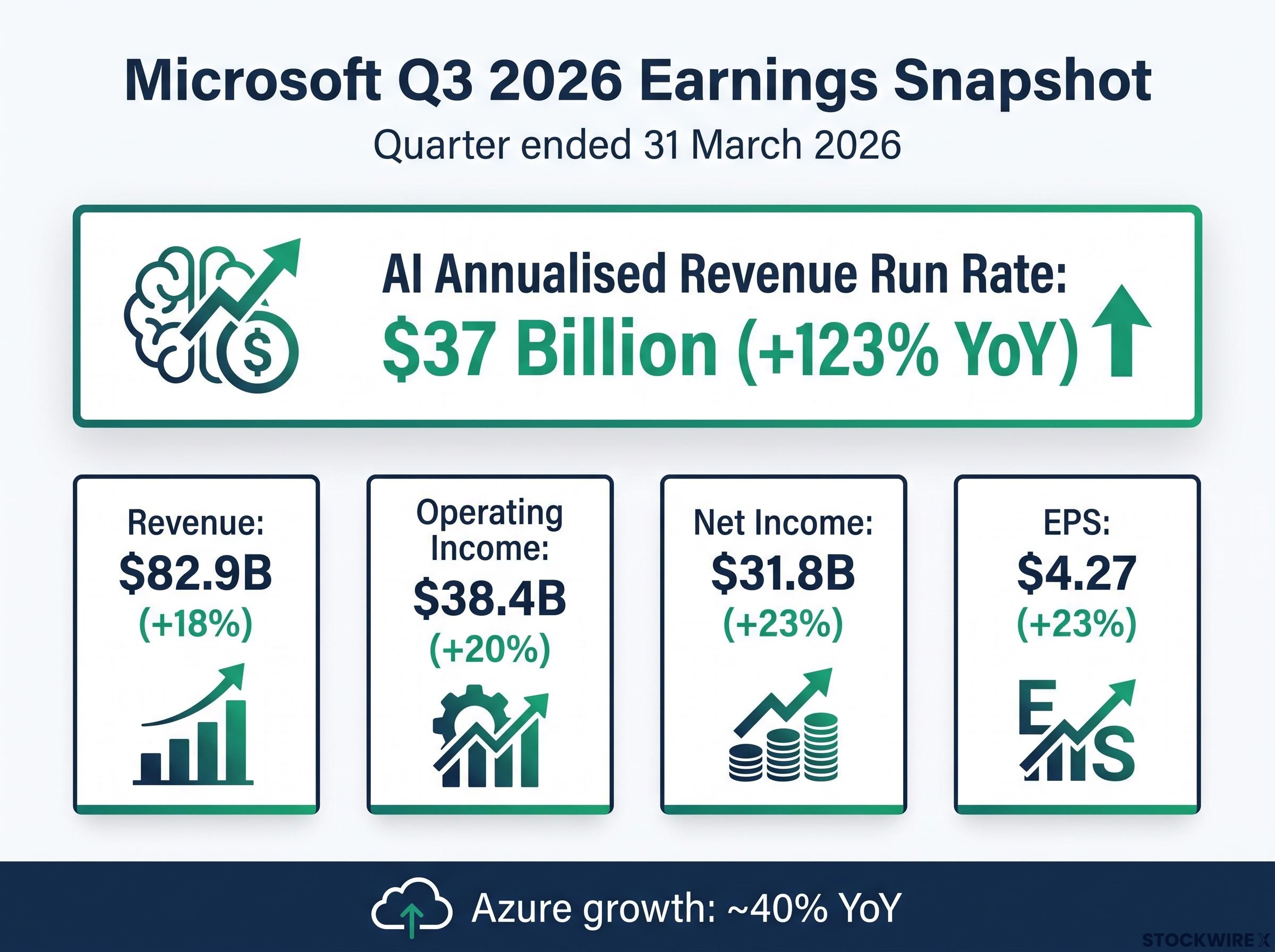
“Our AI business surpassed an annual revenue run rate of $37 billion, up 123% year-over-year.” — Microsoft management, FY2026 Q3 earnings release
That run rate is not guidance. It is not a total addressable market estimate. It is a disclosed figure covering Azure AI, frontier model customers, and Copilot, derived from revenue that has already been recognised.
The significance is not the absolute size of the number, though $37 billion is substantial. It is what the number eliminates. The core bear argument against large-cap AI spending has been that infrastructure investment is a cost centre without a corresponding revenue line. Microsoft has now supplied a figure precise enough to model against, which is exactly what institutional investors require before initiating or increasing positions at scale. For any investor still treating AI monetisation as speculative, that argument just lost its foundation.
When big ASX news breaks, our subscribers know first
Microsoft’s technical setup after a near-5% single-session move
The session’s 4.93% advance confirmed Microsoft’s re-entry into a long-term parallel channel that has contained price since November 2022, a move that validates the prior week’s price action and places the stock at a meaningful technical juncture.
Three price levels now define the setup:
- Near-term resistance: approximately $500, which marks the midpoint of the parallel channel, roughly halfway between its lower and upper boundaries
- Channel upper band: approximately $600 by November, where the top of the parallel projects by year-end
- Goldman Sachs price target: $640, a level that extends beyond the channel’s upper boundary and implies fundamental outperformance relative to the current technical range
The $640 target implies that Goldman’s analysts are embedding a scenario where fundamental outperformance forces a re-rating beyond the existing technical range. That is possible if AI execution continues at this pace. But it is not the base case the chart currently prices.
Following a gain of nearly 5% in a single session, the stock has returned to an overbought condition on the daily RSI, and the most likely near-term path involves a pause or pullback around the $500 midpoint before any further advance. Investors entering now are accepting elevated consolidation risk even if the multi-year thesis is sound. The distinction matters: buying into a proven story at a stretched price is a different risk-reward proposition from waiting for a consolidation toward $500 before the next leg.
Why Microsoft’s results are a borrowed catalyst for Oracle
The logic of the read-through is straightforward. Microsoft proved that monetising AI-ready cloud infrastructure under multi-year contract structures produces material, fast-growing revenue. Oracle is building the same kind of infrastructure, under the same kind of contracts. Proof that the model works at Microsoft raises the probability that Oracle’s backlog converts on schedule.
And the backlog is substantial. Oracle has disclosed that its cloud and AI contract commitments have reached record levels, though reported figures vary across sources. Some cite remaining performance obligations exceeding $500 billion; others reference an AI project backlog surpassing $600 billion. Both figures point to a record, but the exact amount should be verified against Oracle’s own reported disclosures rather than treated as a single confirmed number.
The session’s gain of roughly 9.22% for Oracle was the largest single-day advance among the three names covered here. But that outsized move also represents the highest-beta expression of Microsoft’s validation in this group, and that spread between performance and evidence means the position carries substantially more execution risk.
Three categories of risk separate Oracle from Microsoft:
- Execution risk: converting contracted backlog to high-margin recurring revenue on schedule
- Balance sheet risk: elevated debt levels tied to AI infrastructure expansion
- Evidence risk: no disclosed AI revenue run rate equivalent to Microsoft’s $37 billion figure
Investors who treat Oracle and Microsoft as interchangeable AI monetisation plays are accepting Oracle’s backlog as delivered revenue, which it is not yet. The distinction between contracted and recognised revenue is the most important analytical boundary in this comparison.
What confirmation looks like on Oracle’s chart
Oracle’s price action had previously broken beneath a long-term parallel channel that dates to September 2022, a channel that carried the stock from its base all the way to a prior peak in the region of $340 before the decline began. The recent rally has brought price back up to probe the lower boundary of that channel from below, with the session closing near approximately $142.
As technical analyst Drew Dosk noted on Trading the Close, retesting a parallel boundary after a breakdown is normal post-breakdown price behaviour. The question is whether the retest holds.
Reclaiming and sustaining price above $142 is the minimum condition for interpreting this move as a genuine trend shift rather than a short-lived test of resistance. Beyond that, the next significant overhead level is $165.12, and meaningful follow-through toward that target after establishing $142 as support would constitute the two-step confirmation sequence an investor should require before committing capital at scale. Until both conditions are met, the move should be treated as a retest of resistance rather than a confirmed reversal.
How AI spending drives Meta’s business without a revenue line to show for it
Meta spends heavily on AI infrastructure. Data centres, specialised silicon, and GPUs all power the systems that make Meta’s core business work. But the way AI generates value inside Meta is structurally different from the way it generates revenue at Microsoft, and understanding that distinction is worth pausing on.
AI inside Meta serves three primary functions:
- Advertising ranking: algorithms that determine which ads reach which users, and at what price
- Content recommendation: the systems that decide what appears in your Facebook, Instagram, and Reels feeds
- The Llama model family: Meta’s open-weight foundation models, positioned for potential enterprise and consumer monetisation but not yet a disclosed revenue contributor
None of these surfaces as a dedicated AI revenue line in Meta’s reported financials. AI is an embedded driver of engagement and ad pricing. It makes the existing advertising business more effective, but it does not appear as a separate line item the way Microsoft’s $37 billion run rate does.
For Meta investors, Microsoft’s results raise the probability that AI infrastructure investment pays off. But they do not tell you whether Meta’s specific implementation is lifting ad yields, improving revenue per user, or building a product that can sustain a premium multiple. That proof still needs to come from Meta’s own earnings. The relevant question is not whether AI monetisation works in general; it is whether Meta’s next report will supply its own version of the $37 billion disclosure.
This article is for informational purposes only and should not be considered financial advice. Investors should conduct their own research and consult with financial professionals before making investment decisions.
Meta’s technical setup and why the chart is the most constrained of the three
Meta’s chart has repeatedly failed to sustain price within its parallel channel, with three separate breakdowns occurring since late 2024. Each time price recovered back toward the channel boundary, the advance stalled. A declining trendline connecting successive pivot highs has now acted as resistance on three distinct occasions.
Two resistance levels define the setup:
- Parallel channel upper boundary: approximately $642, a level that has capped each recovery attempt
- Declining trendline: $657.97, which has turned back price on three separate tests with no sustained move through it
Two conditions raise the probability of a sustained breakout:
- Volume: strong buying volume during the breakout attempt
- Fundamental catalyst: a company-specific event, such as an earnings beat or clearer AI monetisation metrics from Meta itself
Having absorbed three rejections at the $657.97 trendline, the next test carries roughly equal odds of a genuine breakout or another failure, making it a genuine decision point for the chart rather than a predictable continuation.
Without Meta’s own AI revenue proof to provide the fundamental catalyst, the risk of a fourth rejection is meaningful. The binary nature of this setup means position sizing and entry timing matter more for Meta than for either of the other two names. An investor who understands $657.97 as a hard decision point can set a specific entry condition rather than chasing the sector bid.
Ranking the three setups by quality of AI monetisation evidence
The evidence quality across these three names is not equal, and neither is the risk. The table below maps the distinction.
| Company | Rally Basis | Near-Term Risk | Confirmation Signal | Evidence Quality |
|---|---|---|---|---|
| Microsoft | Delivered AI revenue ($37B run rate) | Overbought; consolidation likely near $500 | Already delivered | Confirmed |
| Oracle | Positive read-through; record backlog | Debt overhang; execution risk at $142 | Sustained closes above ~$142; follow-through toward $165.12 | Contracted, unconfirmed |
| Meta | Sector AI sentiment; indirect beneficiary | Most technically constrained; binary at $657.97 | Own AI monetisation proof in earnings or product traction | Embedded, undisclosed |
The hierarchy runs from delivered to contracted to embedded. Microsoft has supplied the number. Oracle has signed the contracts but not yet converted them to recognised revenue at scale. Meta benefits from AI internally but discloses no standalone revenue line.
Even Microsoft, the strongest fundamental story of the three, carries near-term consolidation risk after a session that added nearly 5% to a stock already re-entering a major channel. Whether institutional investors use any pullback toward $500 to add exposure, or allow it to give way, will be the clearest signal of whether the AI monetisation disclosure is being treated as a durable re-rating or a single-session catalyst.
Investors who treat all three names as equivalent AI monetisation bets are taking on different risk profiles under the same label. Ranking by evidence quality rather than price performance gives you a decision framework that survives the next session, because it is grounded in what has been confirmed rather than what the market is currently pricing in.
Past performance does not guarantee future results. Financial projections are subject to market conditions and various risk factors.
What to watch before treating this rally as a trend change
Three forward-looking variables will determine whether this AI monetisation rally extends or fades:
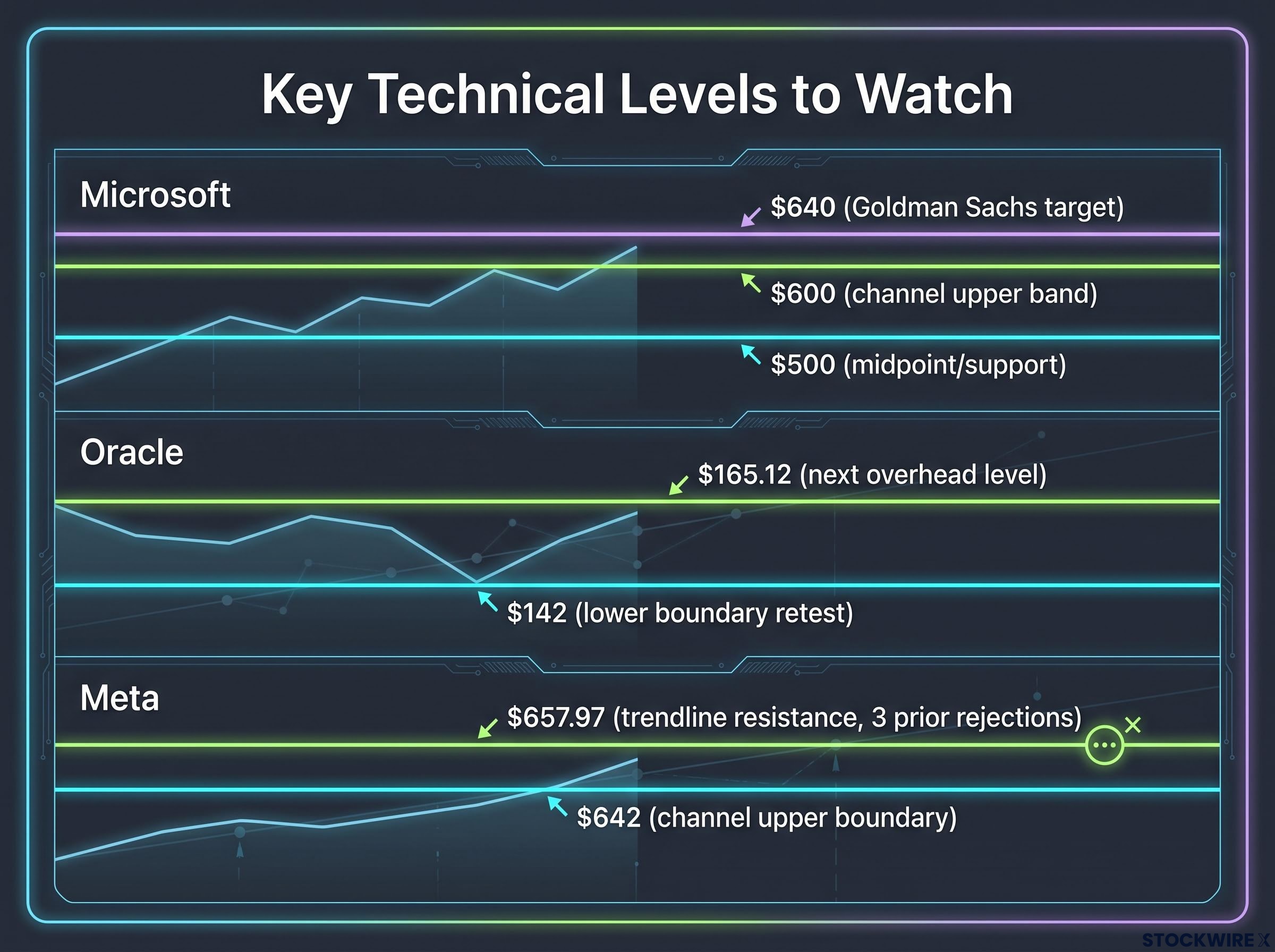
- Microsoft’s $500 consolidation behaviour. How price behaves around the $500 midpoint on any pullback will indicate whether institutional capital is treating the AI revenue confirmation as a structural re-rating event. Buyers defending that level on volume would suggest conviction; a clean break below it would raise questions about whether the session’s move was a durable shift or a short-lived reaction. That distinction carries significant implications for how much weight to assign to the unconfirmed setups at Oracle and Meta.
- Oracle’s ability to hold and close above $142. Establishing and maintaining daily closes above the lower channel boundary, followed by directional progress toward $165.12, is the sequence required to confirm a genuine trend reversal. If price fails to hold above $142, the retest will be classified as a failure, the channel will remain broken, and the existing debt and execution concerns will return to the foreground.
- Whether Meta produces its own fundamental catalyst before the $657.97 trendline is tested again. Having rejected price on three prior approaches, the trendline now presents a roughly even probability of a clean break or another failure on any subsequent test. A company-specific trigger (an earnings beat, clearer AI monetisation metrics, or improved product traction) ahead of that test would tilt the odds; without one, the outcome is close to a coin flip.
Beyond the chart levels, management guidance is the next major catalyst event. Microsoft has guided to continued double-digit revenue and operating income growth into FY27, explicitly tied to AI platforms and first-party AI applications. That guidance is the baseline that must hold for the sector narrative to remain intact.
The structural bull case remains real. A $37 billion run rate growing at 123% year over year is not a small or speculative number. If that trajectory continues, it reframes the total addressable market estimates that currently underpin Oracle’s and Meta’s AI valuations. But the trajectory has to continue, and each company has to supply its own proof.
The evidence hierarchy that separates durable re-ratings from sentiment rallies
Microsoft has moved the entire AI investment debate. The question is no longer “will AI generate revenue at scale.” It is “which companies will prove it next.” That shift in the burden of proof is the most significant structural change to emerge from this earnings cycle.
Oracle and Meta are the first two tests of the new standard Microsoft has set. Their chart setups function as real-time gauges of whether investors believe each company’s case. How Oracle holds or surrenders the $142 boundary reflects the market’s confidence in backlog conversion becoming recognised revenue. How Meta behaves at the $657.97 trendline reflects confidence in embedded AI value eventually emerging as a disclosed, standalone revenue contribution.
Strong AI monetisation from one company in a sector does not transfer that confirmation to peers who have not yet produced their own disclosed revenue figures.
The practical implication of Microsoft setting a quantified benchmark is that Oracle and Meta now face a higher evidentiary standard from the market than they did before this earnings release. Investors who recognise that asymmetry can position accordingly: conviction-weighted toward the company that has supplied the proof, conditional exposure toward the companies that have not.
That hierarchy, delivered to contracted to embedded, applies beyond this specific event. Any future AI monetisation rally across technology stocks can be evaluated using the same classification. It is a reusable analytical framework, not a one-time call. The work for investors is not to decide whether AI monetisation is real. Microsoft answered that. The work is to determine which of the other names will answer it next, and what price you are willing to pay while you wait.