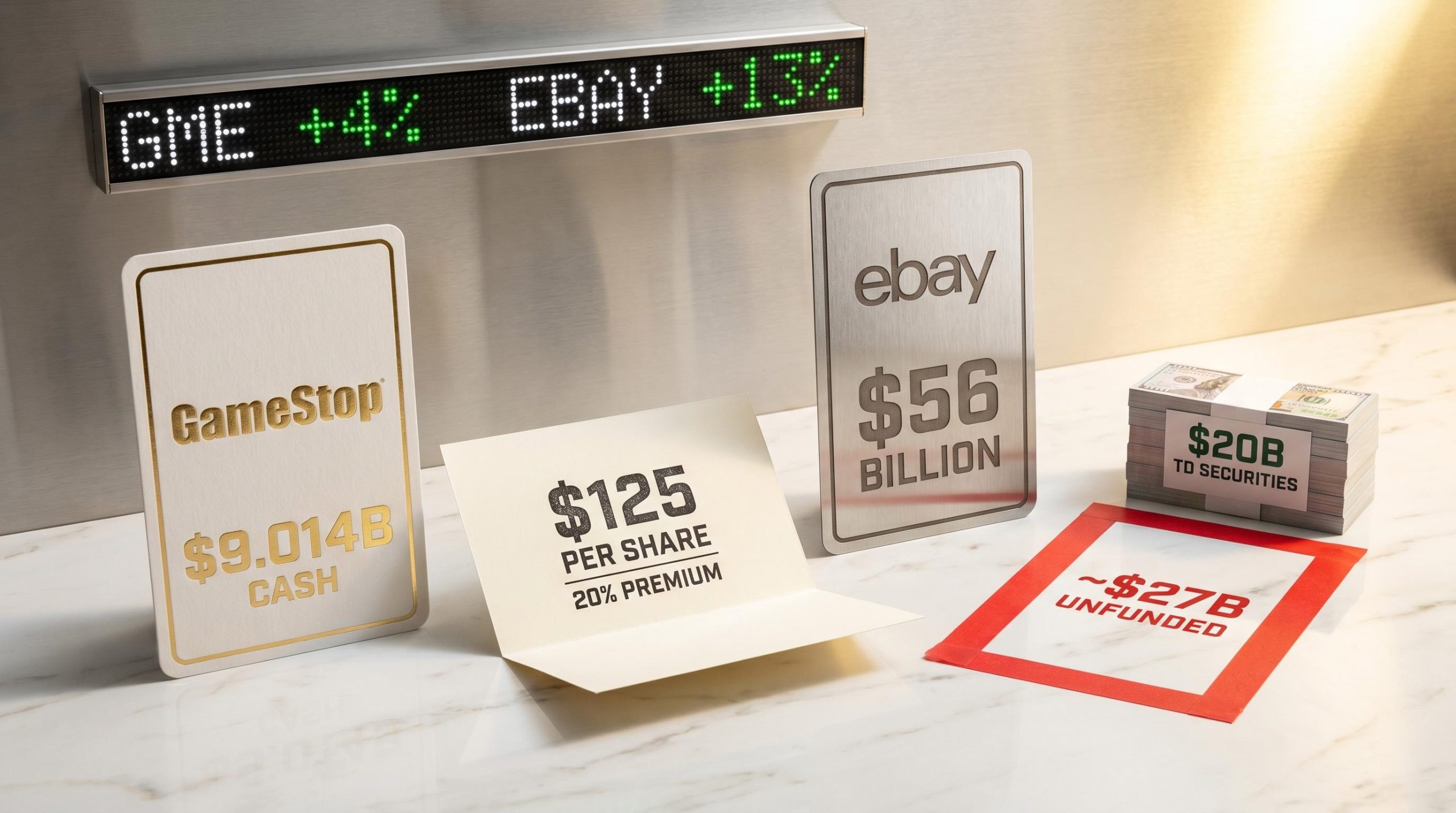
GameStop, a company closing nearly 500 brick-and-mortar stores in 2026, has placed an unsolicited $56 billion offer on the table for eBay, one of the world’s largest e-commerce marketplaces. The cash bid, priced at $125 per share, represents a 20% premium to eBay’s 1 May closing price and was publicly disclosed by CEO Ryan Cohen on 3 May 2026 via GameStop’s investor relations page alongside a letter to eBay’s board. The announcement sent eBay shares surging more than 13% and lifted GameStop shares approximately 4%, making this one of the most consequential M&A proposals in U.S. retail and e-commerce this year.
What follows breaks down what the deal is worth, how GameStop proposes to pay for it, what Cohen’s strategic logic is, and where the significant execution risks lie, giving investors in both companies a clear picture of what happens next.
Ryan Cohen’s $56 billion play: what the offer actually says
The number alone demands attention: $56 billion for a platform GameStop has no operational overlap with, funded by a company whose core business is contracting. But the terms beneath the headline figure are specific, and they matter.
Cohen’s letter to eBay’s board proposed $125 per share in cash, a 20% premium over eBay’s 1 May closing price of $104.07. The total valuation, based on approximately 449 million shares outstanding as of 31 December 2025, comes to roughly $56 billion. The proposal was made public through GameStop’s investor relations page on 3 May 2026, with Cohen discussing the rationale in a Wall Street Journal interview published the following day.
The core offer terms:
- Price per share: $125 cash
- Premium: 20% over eBay’s 1 May closing price of $104.07
- Total valuation: approximately $56 billion
- Deal structure: unsolicited, non-binding proposal
20% premium: The $125 offer represents a 20% markup to eBay’s last traded price before the announcement, a level substantial enough to move eBay’s stock but modest by the standards of contested takeover bids.
“Unsolicited” means eBay’s board did not invite the offer. “Non-binding” means neither party has a legal obligation to proceed. Together, these designations place the proposal at the earliest possible stage of any potential transaction: a public declaration of intent, not an agreed deal. eBay’s board has issued no response.
When big ASX news breaks, our subscribers know first
How GameStop plans to finance a deal it cannot yet fully fund
Two confirmed financing components underpin the bid. TD Securities (the investment banking arm of TD Bank) has provided a formal commitment letter for $20 billion in debt financing. GameStop itself holds $9.014 billion in cash and short-term investments as of 31 January 2026.
The arithmetic is straightforward.
| Financing Source | Amount | Status |
|---|---|---|
| TD Securities debt commitment | $20 billion | Committed via formal letter |
| GameStop cash reserves | $9.014 billion | Confirmed as of 31 January 2026 |
| Additional financing needed | ~$27 billion | Not yet disclosed |
Combined confirmed resources total approximately $29 billion. The deal price is $56 billion. That leaves roughly $27 billion with no confirmed funding source in current public disclosures.
The financing gap: Approximately $27 billion, more than half the total purchase price, remains unaccounted for. Resolution through additional debt, equity issuance, or other capital arrangements has not been publicly detailed.
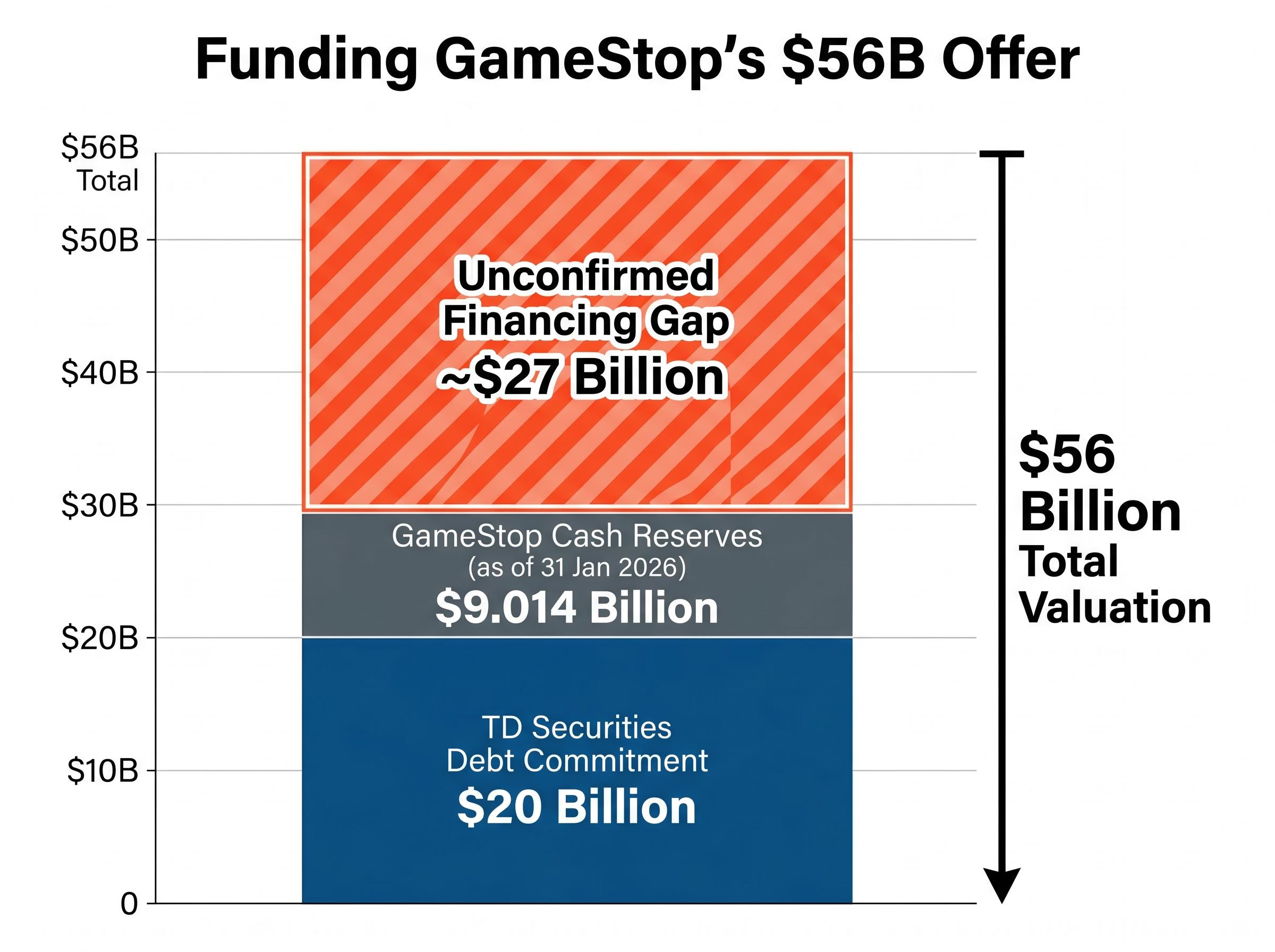
Whether that gap is closed through additional debt syndication, equity raises, asset sales, or some combination remains the single most concrete near-term question for investors evaluating the bid’s credibility.
Current leveraged loan market conditions complicate the financing calculus further: institutional loan origination fell sharply in Q1 2026 and capital is shifting away from syndicated loans toward private credit, meaning the market environment in which GameStop would need to place $27 billion in additional debt is tighter than headline indices suggest.
Why GameStop is making this move now
GameStop is not making this bid from a position of operational expansion. The company is closing nearly 500 stores in early 2026, accelerating a retreat from brick-and-mortar retail as physical game sales continue to decline. The legacy business model is contracting, and the $9 billion cash pile sitting on the balance sheet is an asset that depreciates in strategic value the longer it goes undeployed.
Cohen’s stated rationale reframes the bid as the logical next step for a company that has already accepted its retail future is shrinking:
- $2 billion in annualised cost reductions pledged within 12 months of closing
- Repositioning GameStop as a holding company anchored by eBay’s e-commerce marketplace
- A decisive shift from contracting physical retail into large-scale digital commerce
This is not an adjacency play. Cohen is attempting a full-scale strategic reinvention, using GameStop’s accumulated cash and his reputation as a capital allocator to acquire an operating platform that bears no resemblance to the company’s current business. Investors should evaluate the bid in that context rather than as a standalone financial transaction.
Cohen’s compensation incentives add a layer of personal financial logic to the bid: his pay package, worth up to $35 billion in GameStop stock, only activates if the company reaches a $100 billion market capitalisation, making a transformational acquisition far more than a strategic preference.
What eBay is, and why it matters as an acquisition target
For investors tracking GameStop rather than eBay, the scale of what Cohen is attempting to acquire deserves its own frame. eBay operates one of the world’s largest online marketplaces, connecting millions of buyers and sellers across dozens of countries. It is not a startup or a speculative platform; it is an established e-commerce infrastructure with decades of operational history.
The attributes that make eBay strategically relevant to Cohen’s stated vision:
- An established global marketplace with a large, active seller base
- Integrated payments infrastructure
- Significant brand recognition in consumer e-commerce
- Scale that would immediately reposition GameStop as a major digital commerce entity
eBay closed at $104.07 on 1 May before the offer surfaced. Shares outstanding stood at approximately 449 million as of 31 December 2025.
Market reaction: eBay shares surged approximately 13-14% following the announcement, reflecting investors pricing in the 20% premium even absent any board engagement or deal certainty.
That surge is itself a data point. eBay’s board has issued no official response as of 4 May 2026, and no negotiations are confirmed as underway. The premium currently priced into eBay shares is not backed by any agreement; it reflects market expectations, not deal certainty.
Market reaction and what analysts are saying about the risks
The immediate share price moves told a story of optimism. GameStop closed at $26.53 on 1 May, up 6.33% from the 30 April close of $24.95, as deal speculation circulated before the formal announcement. Post-announcement, GME shares rose approximately 4% further. eBay surged approximately 13-14% from its $104.07 close.
Analyst reception was more measured. Retail analyst Sucharita Kodali characterised the offer as not a “terribly good offer,” citing the debt burden the combined entity would carry.
Analyst view: Sucharita Kodali described the proposal as not a “terribly good offer,” pointing to the significant debt load that would accompany the acquisition.
The four primary risk categories flagged by analysts and commentators:
- Financing gap: More than half the purchase price (~$27 billion) has no confirmed funding source, raising questions about whether the full bid can be financed on terms acceptable to both companies’ shareholders.
- Non-binding deal status: Without eBay board engagement, there is no counterparty. The proposal cannot advance to formal negotiations unless eBay’s board chooses to respond.
- Regulatory and antitrust exposure: A $56 billion e-commerce transaction would almost certainly attract Federal Trade Commission (FTC) and Department of Justice (DOJ) scrutiny given its scale and implications for market concentration.
- Integration complexity: Combining a contracting retail operation with a large-scale global e-commerce marketplace presents operational and organisational challenges with no clear precedent.
The path forward: what needs to happen before this deal becomes real
The distance between a public proposal and a completed transaction is substantial. For this bid to become a deal, a specific sequence of events would need to unfold:
- eBay board engagement: The board must formally respond, whether by opening negotiations, rejecting the offer, or soliciting competing bids. No response has been issued as of 4 May 2026.
- Financing resolution: The approximately $27 billion gap must be addressed through additional debt commitments, equity issuance, or other capital arrangements, all of which would need to be disclosed publicly.
- Shareholder approval: Both GameStop and eBay shareholders would need to vote on any agreed transaction of this scale.
- Regulatory clearance: The FTC and DOJ would be expected to review the deal given its size and e-commerce market implications, though no formal actions have been reported.
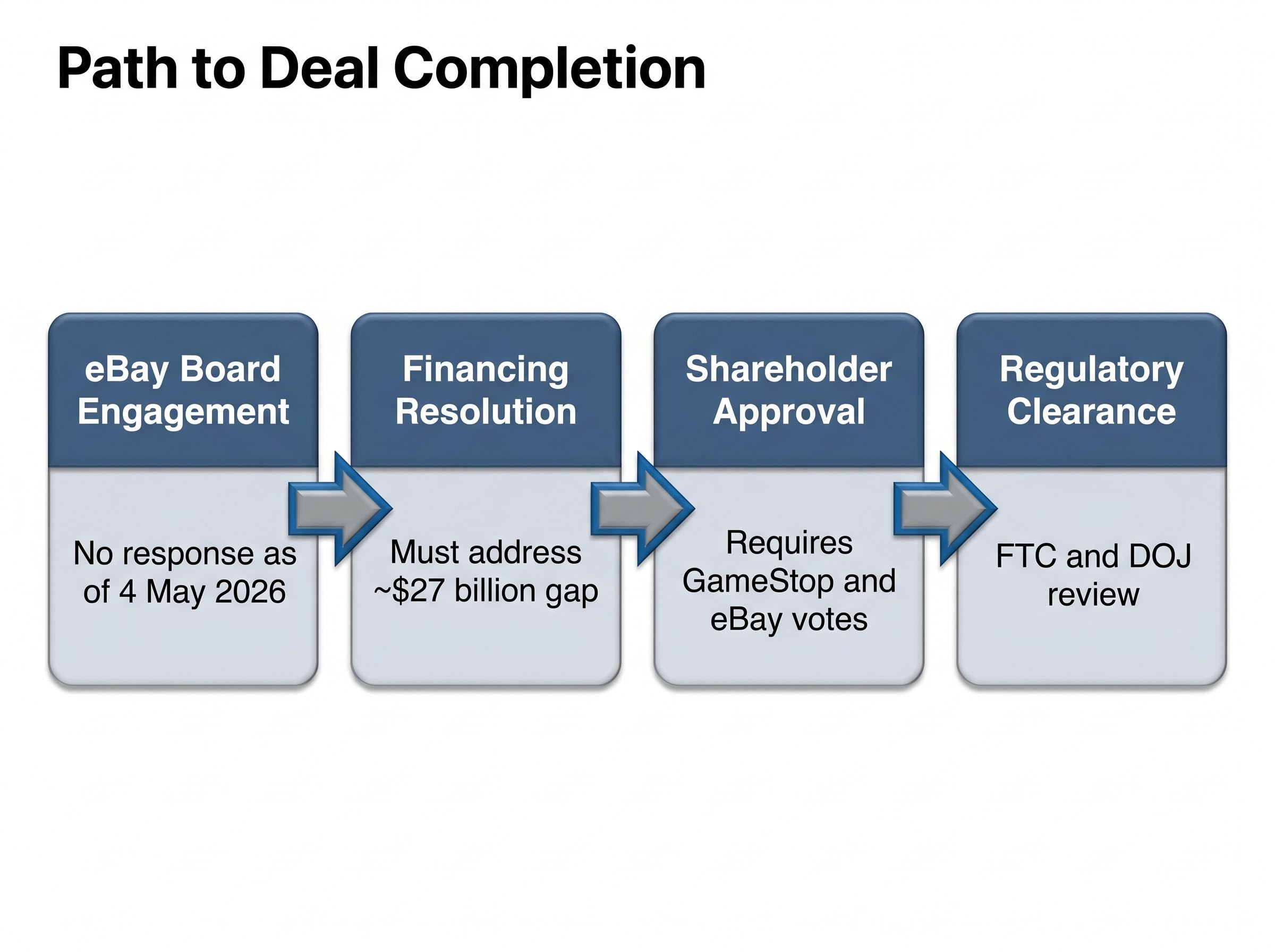
The current state of the proposal is a publicly stated ambition with confirmed partial financing, no counterparty engagement, and substantial execution uncertainty ahead. Each of these milestones represents a potential point of failure, and investors should interpret future developments, whether an eBay board response, a financing announcement, or a regulatory filing, as meaningful signals about the bid’s trajectory.
For investors wanting to understand what the formal regulatory process looks like if the bid advances, our full explainer on the deal’s regulatory roadmap covers the Hart-Scott-Rodino antitrust filing requirements, the timeline from initial filing to agency review, and why completion could be months or years away even if eBay’s board engages.
A $56 billion bet on reinvention: what this means for GameStop investors
The tension at the centre of this proposal is real. GameStop holds $9.014 billion in cash and has a CEO in Cohen whose capital allocation track record has attracted significant investor attention. Those are tangible assets. But the deal asks investors to accept a $27 billion financing gap, no seller engagement, and a strategic leap from a contracting retail chain into ownership of one of the world’s largest e-commerce platforms.
The market’s initial reaction, GME up approximately 4% and EBAY up 13-14%, reflects optimism about the strategic logic. It does not reflect confirmation that the deal closes.
Investors monitoring this situation should focus on a short list of leading indicators:
- eBay board response: Any formal communication from eBay’s board would be the first signal that the proposal has moved beyond a unilateral declaration
- Financing disclosures: Announcements regarding additional debt commitments or equity raises that address the $27 billion gap
- Regulatory filings: Any FTC or DOJ activity related to the proposed transaction
- Shareholder sentiment: Institutional investor commentary or proxy advisory positions on either side
Until those signals arrive, this remains what it was on 3 May: an ambitious, partially funded, unsolicited proposal from a company betting that reinvention is worth $56 billion.
This article is for informational purposes only and should not be considered financial advice. Investors should conduct their own research and consult with financial professionals before making investment decisions. These statements regarding deal completion, cost reductions, and strategic outcomes are speculative and subject to change based on market developments and company performance.