A company worth $10 billion is attempting to buy a company worth $46 billion. That is the arithmetic behind Ryan Cohen’s unsolicited $56 billion bid for eBay, which landed on Wall Street on 3 May 2026 and immediately sent both stocks moving in after-hours trading. Cohen, who serves as chief executive officer of GameStop, disclosed the offer through a Wall Street Journal report, proposing $125 per share in a cash-and-stock structure backed by a $20 billion debt commitment letter from TD Bank. The bid was unsolicited, meaning eBay had not agreed to talks before the offer became public. What follows is a breakdown of exactly what Cohen is proposing, how the deal would be financed, what happened to both stocks, and why analysts are questioning whether a takeover of this scale is remotely executable.
How the market moved when the bid went public
The numbers arrived first. eBay shares, which had closed the regular session on 1 May 2026 at $104.07 (up approximately 0.57% on the day), surged in after-hours trading to approximately $116.35, a gain of roughly $12.28 or 11.80%.
eBay after-hours surge: Shares climbed approximately 11.80% to $116.35 following the WSJ report on 3 May 2026.
GameStop moved upward in the same session, though the magnitude was less certain. Some sources cited gains of approximately 6.33%, while others reported a surge as high as 13%. The range itself tells a story: the market was pricing multiple scenarios simultaneously, not delivering a uniform verdict on deal probability.
| Ticker | Pre-announcement price | After-hours price/range | % change |
|---|---|---|---|
| EBAY | $104.07 (1 May close) | ~$116.35 | ~11.80% |
| GME | Pre-announcement level | Range reported | ~6%-13% |
Both stocks moving upward simultaneously might look like an endorsement. It is more accurately read as eBay shareholders pricing in a premium offer and GameStop shareholders pricing in the ambition, with neither group yet reckoning with the structural barriers between bid and close.
The market reaction on 1 May 2026 was itself driven by unverified bid reports, with no SEC filings or company statements in place at that stage; the formal offer disclosed via the Wall Street Journal on 3 May 2026 represented the first structured communication of Cohen’s actual terms.
When big ASX news breaks, our subscribers know first
What Ryan Cohen is actually proposing
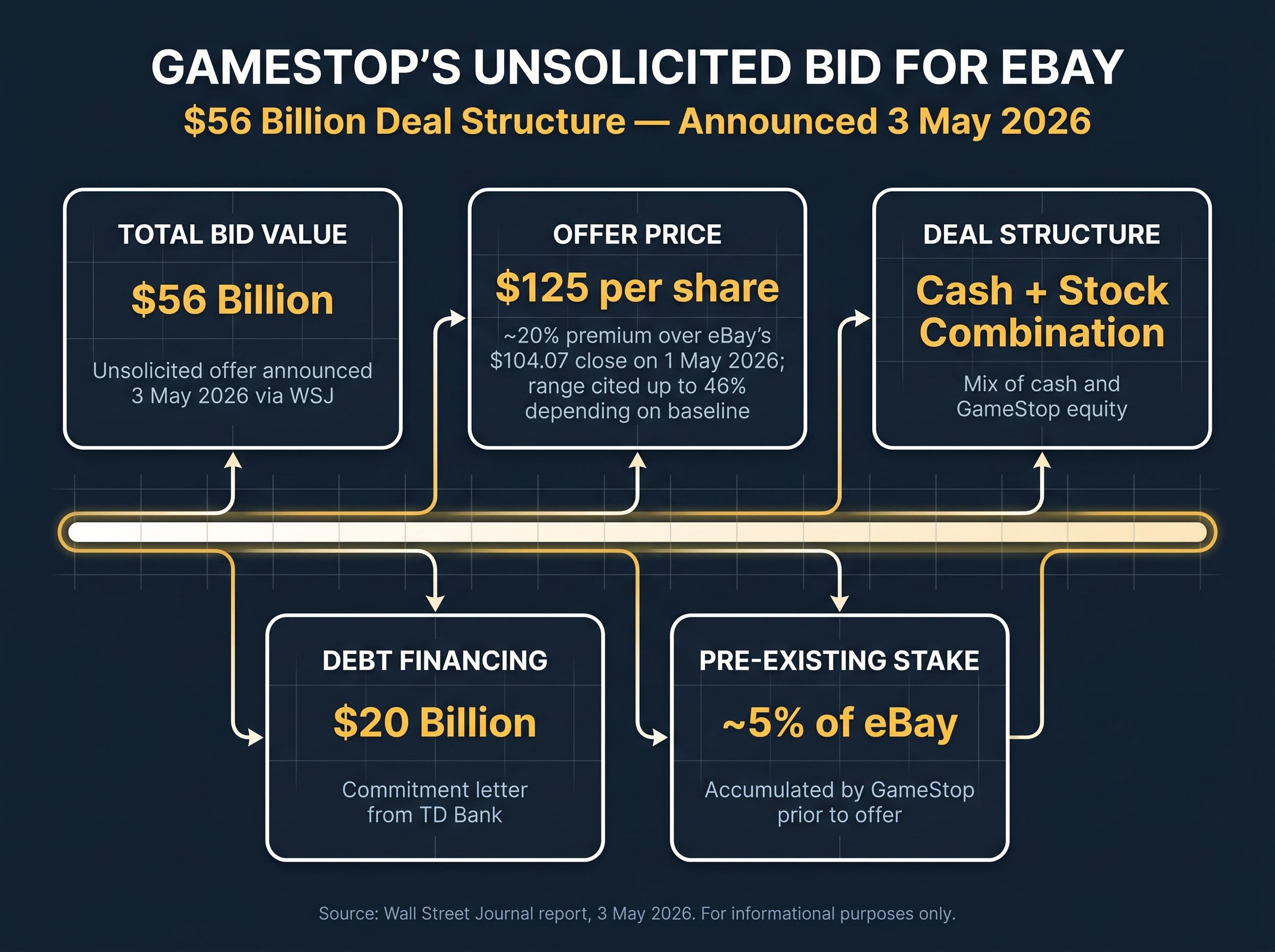
The offer, reported by the Wall Street Journal on 3 May 2026, contains five components that collectively define the deal’s shape and its financing risk:
- Total bid value: approximately $56 billion
- Per-share price: $125, representing roughly a 20% premium over eBay’s $104.07 closing price on 1 May (some reports cite a premium range of 20-46% depending on the baseline used)
- Structure: cash and stock combination
- Debt financing: TD Bank commitment letter for up to $20 billion
- Pre-existing stake: GameStop had accumulated approximately 5% of eBay shares ahead of the offer
The proxy fight lever
Cohen has stated a willingness to take the bid directly to eBay shareholders through a proxy fight if the board declines to engage. This is not a footnote. It signals that the offer is structured as a campaign, not a one-off approach, and that Cohen is prepared for a contested process.
The 5% ownership stake carries its own procedural weight. A holding of that size would typically trigger a Schedule 13D filing obligation with the Securities and Exchange Commission (SEC), a disclosure that would formally declare GameStop’s intent as an active investor rather than a passive holder. As of 4 May 2026, no such filing had been confirmed.
The SEC Schedule 13D filing requirements mandate that any investor crossing the 5% beneficial ownership threshold in a public company disclose their holdings and intent within ten days, a rule that would formally classify GameStop as an active investor rather than a passive holder the moment that filing is made.
Why Cohen says eBay needs to become an Amazon rival
Cohen’s stated rationale is direct: he intends to use eBay as a platform to build a credible competitor to Amazon in e-commerce. The framing, communicated through the WSJ report, positions the acquisition not as a financial trade but as a strategic repositioning of eBay’s marketplace infrastructure.
Cohen’s stated intent is to position eBay as a stronger rival to Amazon, reframing the acquisition as a strategic bet on e-commerce competition rather than a financial arbitrage.
eBay’s recent Depop acquisition, which brought Etsy’s resale platform and its Gen Z user base into eBay’s marketplace ecosystem, illustrates the kind of targeted strategic move Cohen would need to replicate at far larger scale to genuinely challenge Amazon across the full breadth of e-commerce.
The ambition is clear. The supporting detail is not. As of 4 May 2026, no formal press release, SEC filing elaborating on strategy, or additional interviews had been reported. The WSJ report remains the primary public communication. What that means for investors evaluating this bid is straightforward: the strategic thesis has been announced but not yet substantiated. Cohen’s vision for how a $10 billion company would operationally transform a $46 billion marketplace into an Amazon competitor remains, for now, a headline without a business plan.
The size problem that Wall Street cannot get past
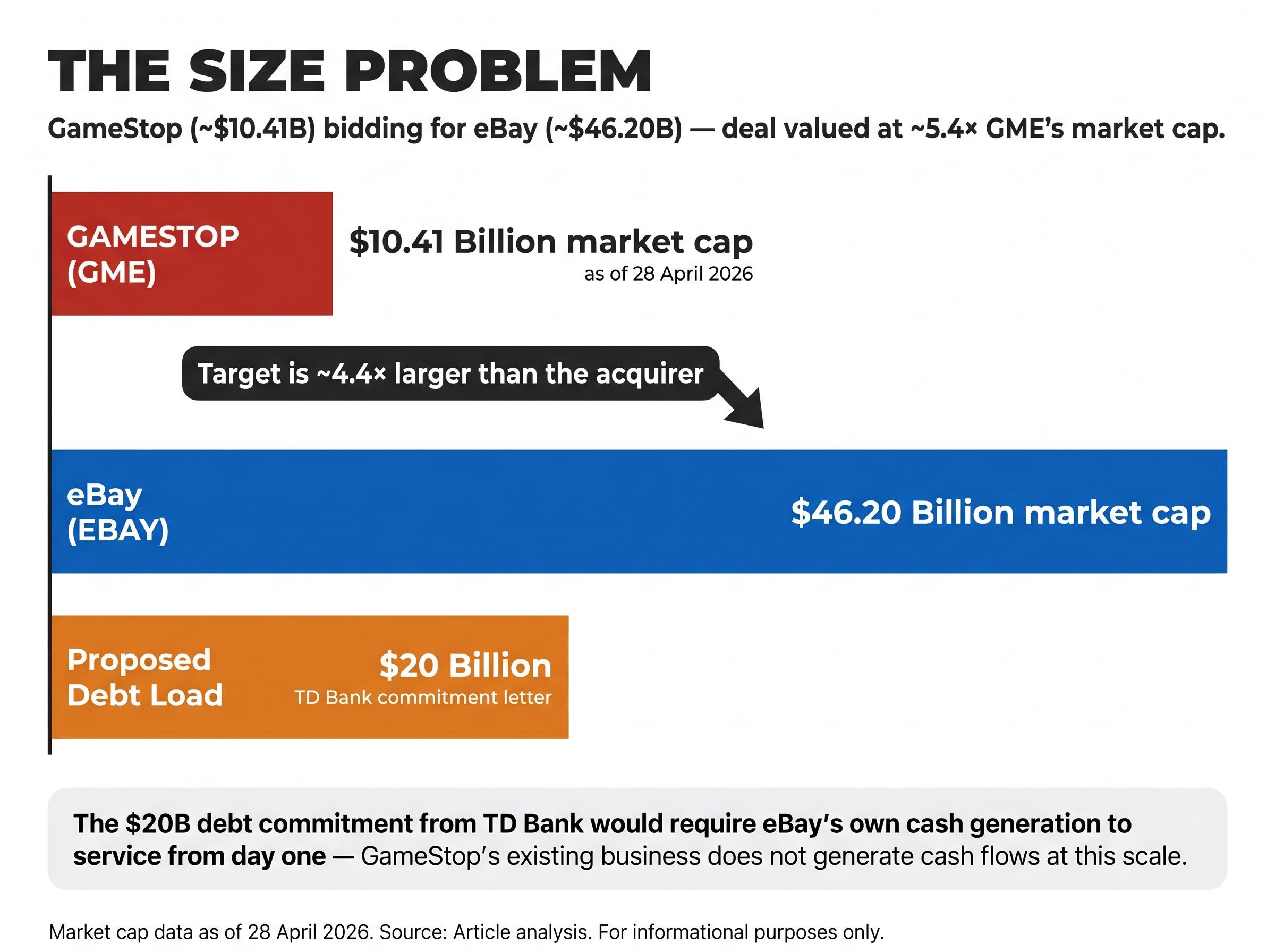
Start with the numbers. GameStop carries a market capitalisation of approximately $10.41 billion as of 28 April 2026. eBay sits at approximately $46.20 billion. The target is roughly 4.4 times larger than the acquirer.
| Metric | GameStop (GME) | eBay (EBAY) |
|---|---|---|
| Market capitalisation | ~$10.41 billion | ~$46.20 billion |
| Deal value relative to acquirer | ~5.4x GameStop’s market cap | |
| Debt financing proposed | $20 billion (TD Bank commitment) | |
In practical terms, the $20 billion debt commitment from TD Bank would represent a borrowing load that dwarfs GameStop’s operational scale. Servicing that debt would require cash flows that GameStop’s existing business does not generate, meaning the combined entity would need eBay’s own cash generation to carry the financing burden from day one.
Analyst scepticism centres on this structural mismatch. The concerns are not abstract: financing risk, shareholder dilution for GME holders if the stock component of the offer requires significant issuance, and the question of whether any board, eBay’s or GameStop’s, could credibly approve a transaction built on this arithmetic. The bid’s ambition is not in doubt. Its executability is.
Leveraged finance market conditions in 2026 add a further layer of uncertainty to the financing calculus: a $15 trillion corporate refinancing wall expected between 2026 and 2028 is already pressuring institutional lenders, which raises questions about the cost and availability of the additional debt capacity that a transaction of this scale would require beyond TD Bank’s $20 billion commitment.
What the regulatory and M&A process looks like from here
An unsolicited, non-binding offer is the beginning of a process, not a transaction. The distinction matters because it defines what each side is and is not obligated to do next. As of 4 May 2026, eBay’s board had issued no formal response: no acceptance, no rejection, no indication of willingness to engage.
The non-binding nature of the offer means neither party is locked in. GameStop retains the flexibility to revise or withdraw. eBay retains the flexibility to ignore the approach entirely without a legal obligation to negotiate.
If the bid were to advance toward a formal transaction, the procedural pathway would follow a defined sequence:
- eBay board response window: The board evaluates the offer, consults advisers, and issues a formal recommendation to shareholders (accept, reject, or negotiate).
- Proxy fight trigger: If the board declines to engage, Cohen has stated willingness to take the offer directly to eBay shareholders, initiating a contested solicitation process.
- Hart-Scott-Rodino (HSR) Act filing: At the $56 billion transaction scale, both parties would be required to file with the Federal Trade Commission (FTC) and the Department of Justice (DOJ) for antitrust review before any deal could close. The HSR Act requires pre-merger notification for transactions above certain thresholds, giving regulators time to assess whether the combination would substantially reduce competition.
- Shareholder vote: Both eBay and GameStop shareholders would need to approve the transaction.
Each of these steps carries its own timeline and uncertainty. Investors acting on the headline alone, without understanding that months or years may separate an unsolicited bid from any closing, risk mispricing the probability of completion.
For investors wanting to understand how proxy fights, board obligations, and regulatory intervention interact in practice, our full explainer on contested takeover mechanics covers a recent case where an independent board committee’s private rejection of a bid contradicted its public disclosures, resulting in regulatory orders that reshaped the takeover pathway.
What this means for eBay and GameStop shareholders right now
The two shareholder groups face distinct risk profiles, and conflating them would be a mistake.
For eBay shareholders:
- A premium of approximately 20% above the pre-announcement close is on the table
- The board has not responded, meaning no formal process has begun
- The financing structure raises questions about whether the offer could be completed at the stated price
- If the bid fails or is withdrawn, the share price may revert toward pre-announcement levels
For GameStop shareholders:
- The cash-and-stock structure implies potential equity dilution if significant new shares are issued to fund the deal
- The $20 billion debt commitment would materially alter GameStop’s balance sheet and risk profile
- A successful acquisition could create value if the strategic thesis proves correct, but the path to that outcome remains undefined
- Cohen’s proxy fight willingness means this story may play out over an extended timeline
The developments to monitor from here are specific: eBay’s formal board response, any SEC Schedule 13D filing from GameStop confirming the 5% stake and its intent, and any further public communication from Cohen elaborating on strategy or financing.
Ryan Cohen’s audacious $56 billion bet still has everything to prove
A $10 billion company has made an unsolicited bid for a $46 billion company, backed by $20 billion in proposed debt and a stated ambition to challenge Amazon. As of 4 May 2026, virtually nothing has been formally resolved. The eBay board has not responded. No Schedule 13D filing has been confirmed. No detailed strategy document has been released. The regulatory process has not begun.
What exists is an offer, a commitment letter, and a stated vision. The gap between those elements and a completed transaction is where the real story will unfold. For shareholders on both sides, the next chapter depends on filings, board decisions, and regulatory review, not headlines.
This article is for informational purposes only and should not be considered financial advice. Investors should conduct their own research and consult with financial professionals before making investment decisions.