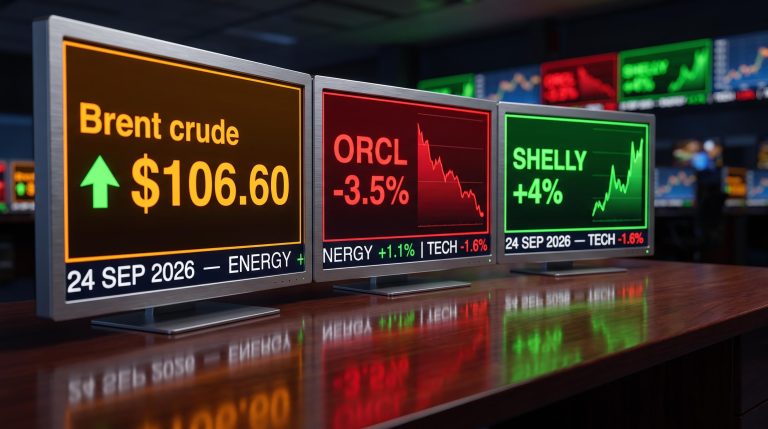
Crude oil prices fell sharply on 4 May 2026, the moment markets absorbed the possibility that 20% of the world’s daily oil supply could start flowing again through the Strait of Hormuz.
President Trump’s announcement of “Project Freedom,” a U.S. naval escort initiative designed to clear commercial vessels stranded in the strait, landed after months of price escalation driven by Iran’s blockade of the waterway. Brent crude had reached a record $144.42 as recently as 7 April 2026. The announcement reintroduced supply optimism into a market that had been running almost entirely on geopolitical fear, and both major benchmarks responded within hours.
What follows covers how crude prices moved, what Project Freedom actually involves, why the Strait of Hormuz holds outsized influence over global oil markets, and what the key risks are for investors tracking oil and energy assets as the initiative begins.
Brent and WTI both fall over 1.69% as Project Freedom hits the tape
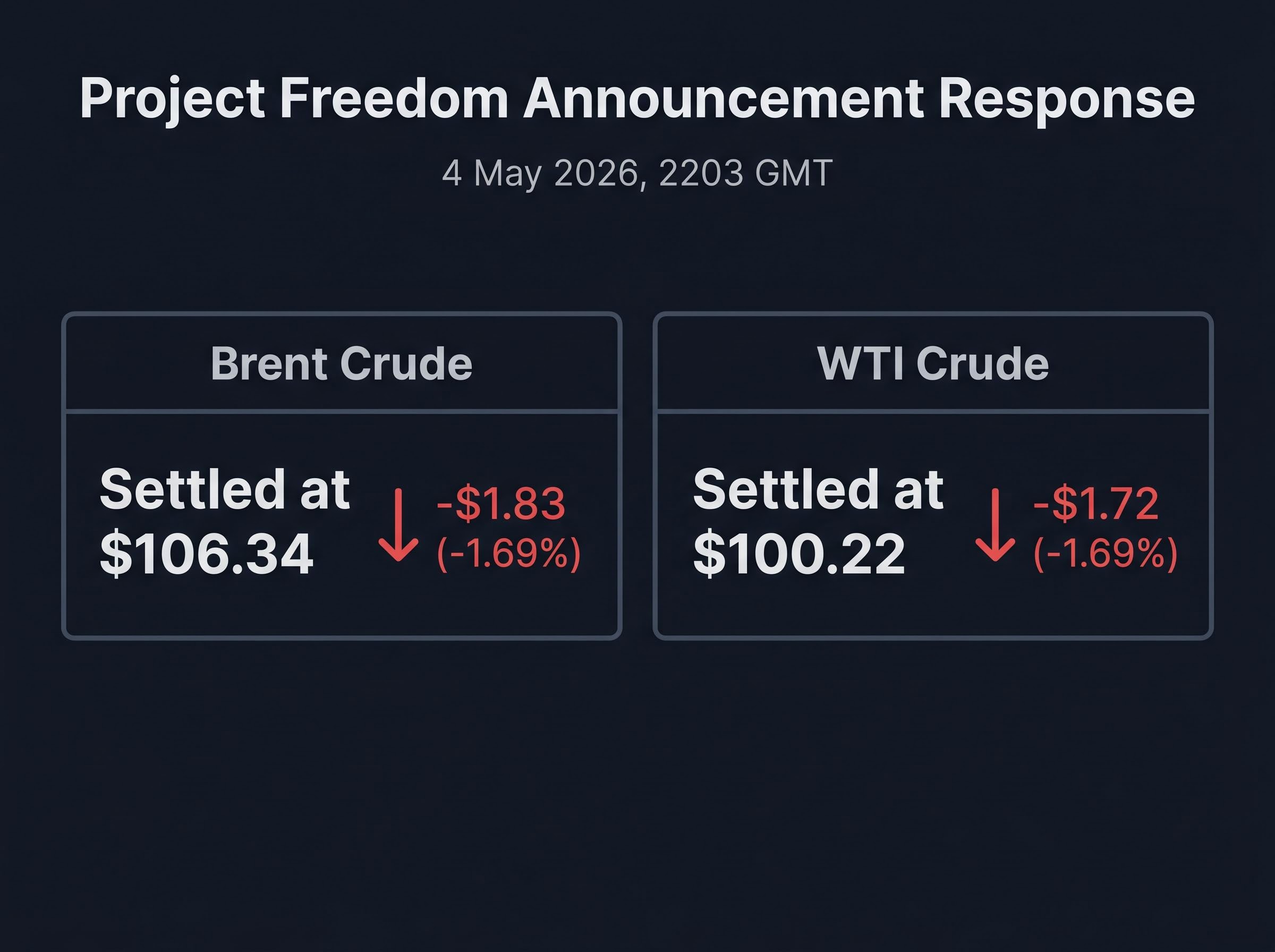
The drop was immediate and synchronised. At 2203 GMT on 4 May 2026, both major crude benchmarks had registered identical percentage declines:
- Brent crude fell $1.83 (1.69%) to settle at $106.34 per barrel
- WTI crude fell $1.72 (1.69%) to settle at $100.22 per barrel
$1.83 drop. 1.69% decline. Settling at $106.34 per barrel: Brent crude’s response to Project Freedom, 4 May 2026.
The symmetry across benchmarks pointed to a single catalyst rather than separate regional pressures. Futures markets priced the naval escort initiative as a credible supply-restoration signal before a single vessel had moved.
The speed of the decline, however, sits against a larger backdrop. Brent closed at $111.01 on 1 May 2026, just three sessions earlier. And the $106.34 settlement, while sharply lower, remains elevated by any pre-crisis standard. On 7 April 2026, Physical Dated Brent recorded an all-time high of $144.42, according to S&P Global Platts. The market gave back $1.83 in a session. It had gained more than $38 over two months.
Brent’s $125 intraday spike on 30 April 2026 came just four sessions before the Project Freedom announcement, and the $111.88 close that same day already signalled that futures markets were attempting to price contradictory diplomatic and supply outcomes at the same time.
For investors holding oil futures, energy equities, or commodity-linked ETFs, a synchronised 1.69% decline across both benchmarks in a single session signals a meaningful sentiment shift. Whether it holds depends on what happens next in the strait itself.
When big ASX news breaks, our subscribers know first
What Project Freedom is and how it intends to reopen the strait
From Truth Social to the strait: what the announcement covered
President Trump announced “Project Freedom” on 3 May 2026 via Truth Social. The White House and U.S. Navy subsequently confirmed the initiative, with operations set to begin on Monday, 4 May 2026, according to Axios.
The stated objective is specific: escort commercial vessels currently stranded in the Strait of Hormuz out of the blockade zone. Iran has been blocking strait shipping since 28 February 2026, and the backlog of tankers and cargo vessels has been a visible symbol of the supply disruption.
No independent analyst commentary on Project Freedom’s operational feasibility or market implications was available at the time of publication, given the announcement’s recency. That gap will close quickly as Reuters, Bloomberg, and energy-focused research desks publish their assessments.
What the initiative does not resolve
Project Freedom addresses vessel clearance. It does not address the underlying U.S.-Iran conflict, the Iranian blockade mechanism, or the U.S. naval blockade of Iranian ports that has halted significant Iranian oil exports.
Peace talks have stalled since the 7 April 2026 ceasefire proposal, which President Trump received via Pakistan, according to Axios. Al Jazeera reported on 27 April 2026 that oil prices continued rising amid the diplomatic impasse. The escort initiative is an operational intervention, not a diplomatic one.
Why the Strait of Hormuz is the single most sensitive chokepoint in global oil markets
A naval escort announcement moved a global commodity price by nearly 2% in one session. The reason lies in the geography of the Strait of Hormuz itself.
Approximately 20% of the world’s daily oil supply transits this narrow waterway between Iran and Oman. There is no viable bypass route for these volumes in the short term. When the strait is open, this concentration of supply flow is invisible to markets. When it closes, as it did on 28 February 2026, the effect on pricing is immediate and amplified because every barrel that cannot transit has no alternative path to market.
The blockade began after U.S.-Iran tensions escalated through early 2026. Iran moved to block commercial shipping; the U.S. enforced a naval blockade of Iranian ports, halting significant Iranian oil exports. The combined effect of the strait closure, reduced regional output, and stalled peace talks pushed Brent above $126 in April 2026 before the record $144.42 print on 7 April.
What markets were pricing on 4 May was not simply a naval escort but an escape from a triple-lock mechanism that had combined U.S. naval blockade operations, Iranian toll enforcement on non-U.S. vessels, and the near-total withdrawal of commercial war risk insurance, each layer independently capable of preventing commercial transit even after a ceasefire.
| Factor | Detail |
|---|---|
| Daily oil volume transiting strait | Approximately 20% of global daily supply |
| Blockade start date | 28 February 2026 |
| Primary actors | Iran (blocking shipping); U.S. (blockading Iranian ports) |
| Nearest alternative route | None viable for equivalent volumes in the short term |
| Brent at blockade onset | Rose sharply from pre-crisis levels, reaching $144.42 by 7 April 2026 |
Readers who understand why the strait functions as a structural price amplifier will be better positioned to interpret any future development, whether escalation or resolution, as it lands in markets.
J.P. Morgan’s forecast swing shows how drastically the market calculus has shifted
One institution’s evolving numbers tell the story of the 2026 oil market more clearly than any single price print.
On 27 February 2026, J.P. Morgan Global Research projected Brent averaging $60 per barrel for 2026. The forecast reflected expectations of a comfortable supply surplus, with global supply outpacing demand by an estimated 0.9 million barrels per day. Protracted disruptions were deemed unlikely.
Five weeks later, the same institution issued a starkly different assessment.
J.P. Morgan’s $150 warning via Reuters, published on 2 April 2026, established the upper bound of the crisis scenario that markets spent the following weeks pricing toward, with Physical Dated Brent reaching $144.42 just five days after the forecast was issued.
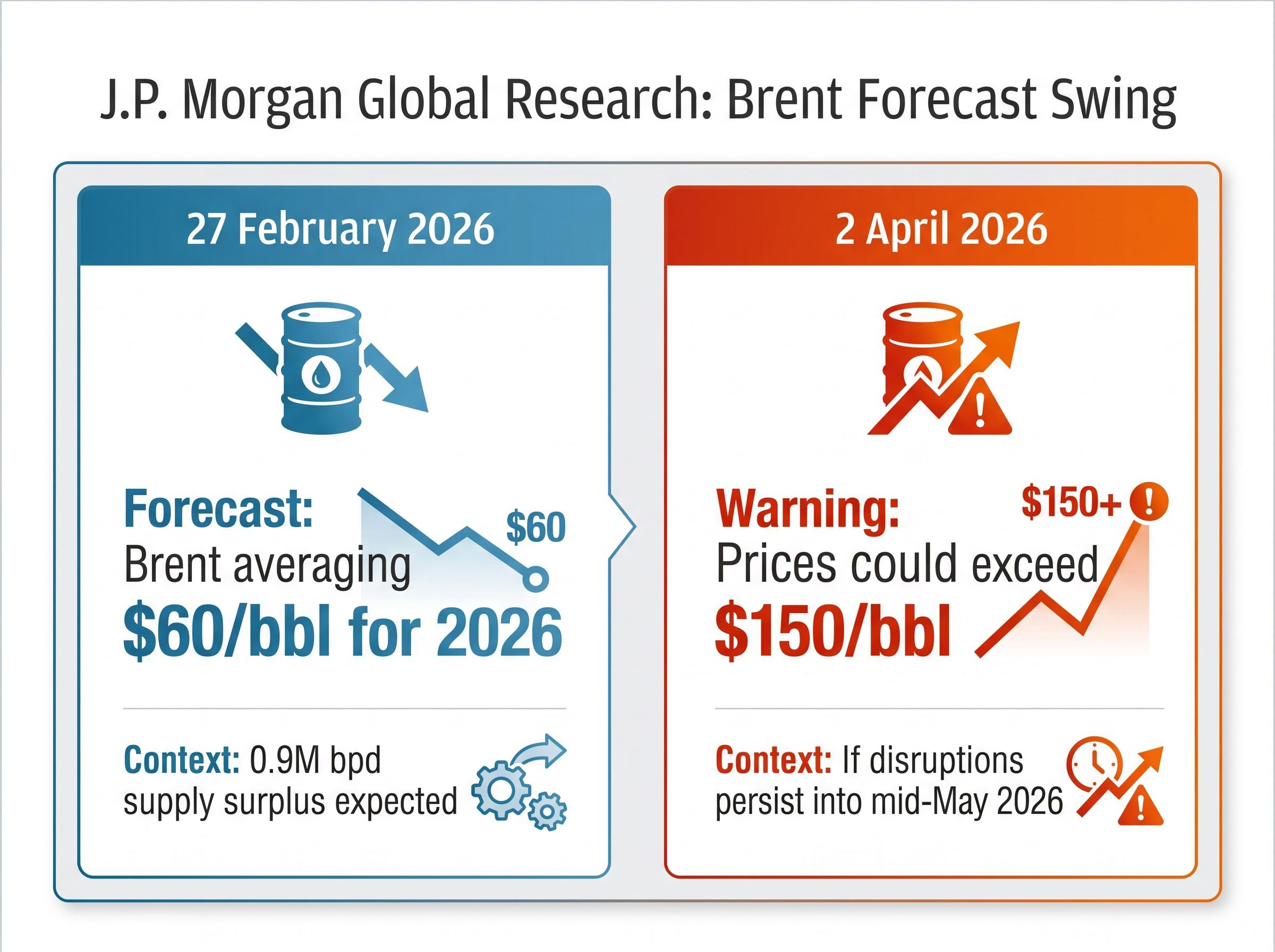
On 2 April 2026, J.P. Morgan warned that oil prices could exceed $150 per barrel if Strait of Hormuz disruptions persisted into mid-May 2026. Source: Reuters, 2 April 2026
Physical Dated Brent hit $144.42 just five days after that warning. The market came within striking distance of J.P. Morgan’s worst-case scenario.
| Date | J.P. Morgan Brent Forecast / Warning | Geopolitical Context |
|---|---|---|
| 27 February 2026 | Brent averaging $60/bbl for 2026 | Pre-conflict baseline; 0.9M bpd supply surplus expected |
| 2 April 2026 | Prices could exceed $150/bbl | Post-escalation; Hormuz blockade ongoing, peace talks stalling |
The swing from $60 to $150+ in five weeks illustrates how rapidly geopolitical risk can overwhelm fundamental supply-demand models. With Project Freedom now in motion, the question shifts: does the $150 scenario become less likely, or merely deferred?
For investors trying to quantify the macro stakes behind the Brent price trajectory, our full explainer on oil price transmission into recession examines the four simultaneous channels through which a 50% oil surge reaches household incomes, business input costs, Federal Reserve policy, and hiring decisions, drawing on Moody’s Analytics recession probability modelling and Morgan Stanley’s $150-$180 adverse scenario.
What investors should watch as Project Freedom moves from announcement to execution
What the market has already priced
The 1.69% drop across both benchmarks represents the market’s anticipation of improved supply flows. It does not represent confirmed supply restoration. No vessels had been escorted at the time of the price move. Markets priced in the initiative’s success before operational evidence existed.
What remains unresolved
Three variables will determine whether the 4 May decline marks the beginning of a sustained pullback or a single session of premature optimism:
- Operational progress of the escort mission: Whether U.S. naval forces successfully clear stranded vessels from the strait in the coming days and weeks
- Any Iranian response: Whether Iran escalates in response to the U.S. naval operation, potentially worsening the supply disruption rather than easing it
- Brent price sustainability below $110: Whether crude sustains the move lower or reverts toward recent highs as the announcement fades and execution uncertainty persists
No published analyst commentary on Project Freedom’s market implications was available as of 3 May 2026. That analytical gap means investors are currently operating on the announcement alone, without independent assessment of the initiative’s probability of success.
U.S.-Iran peace talks have been stalled since the 7 April ceasefire proposal, per Al Jazeera reporting on 27 April 2026. The escort mission does not restart those negotiations. Brent sat at $111.01 on 1 May; WTI was at $101.34 on 3 May. The distance between those pre-announcement levels and the post-announcement settlement is narrow enough that a single setback could erase it.
Investors holding oil-linked positions, energy stocks, or commodity ETFs face a decision point: the market has moved, but the outcome that justifies the move has not yet occurred.
A $1 drop in a single session, but the strait is still blocked
The price decline is real and it is significant. A synchronised 1.69% drop across both major benchmarks in a single session reflects genuine supply optimism entering a market that had been starved of it since late February.
Project Freedom is the most concrete intervention announced since the blockade began on 28 February 2026. No prior diplomatic effort produced a comparable price response.
The strait, however, remains physically blocked as of publication. No vessels have been escorted. Iran has not signalled acquiescence. Peace talks remain stalled. The three variables outlined above, operational progress, Iranian response, and Brent’s ability to hold below $110, will determine whether this session’s relief becomes a trend or fades into the next headline.
Continued price monitoring, rather than a decisive positioning call, remains the appropriate response while Project Freedom moves from announcement to execution.
Investors holding oil-linked positions, energy stocks, or commodity ETFs who want a framework for the broader repositioning challenge will find our dedicated guide to portfolio positioning in the energy shock, which covers why traditional safe havens including long-duration government debt and precious metals are underperforming in this stagflationary environment, and which asset classes are currently absorbing the defensive capital.
This article is for informational purposes only and should not be considered financial advice. Investors should conduct their own research and consult with financial professionals before making investment decisions. Past performance does not guarantee future results. Financial projections are subject to market conditions and various risk factors.