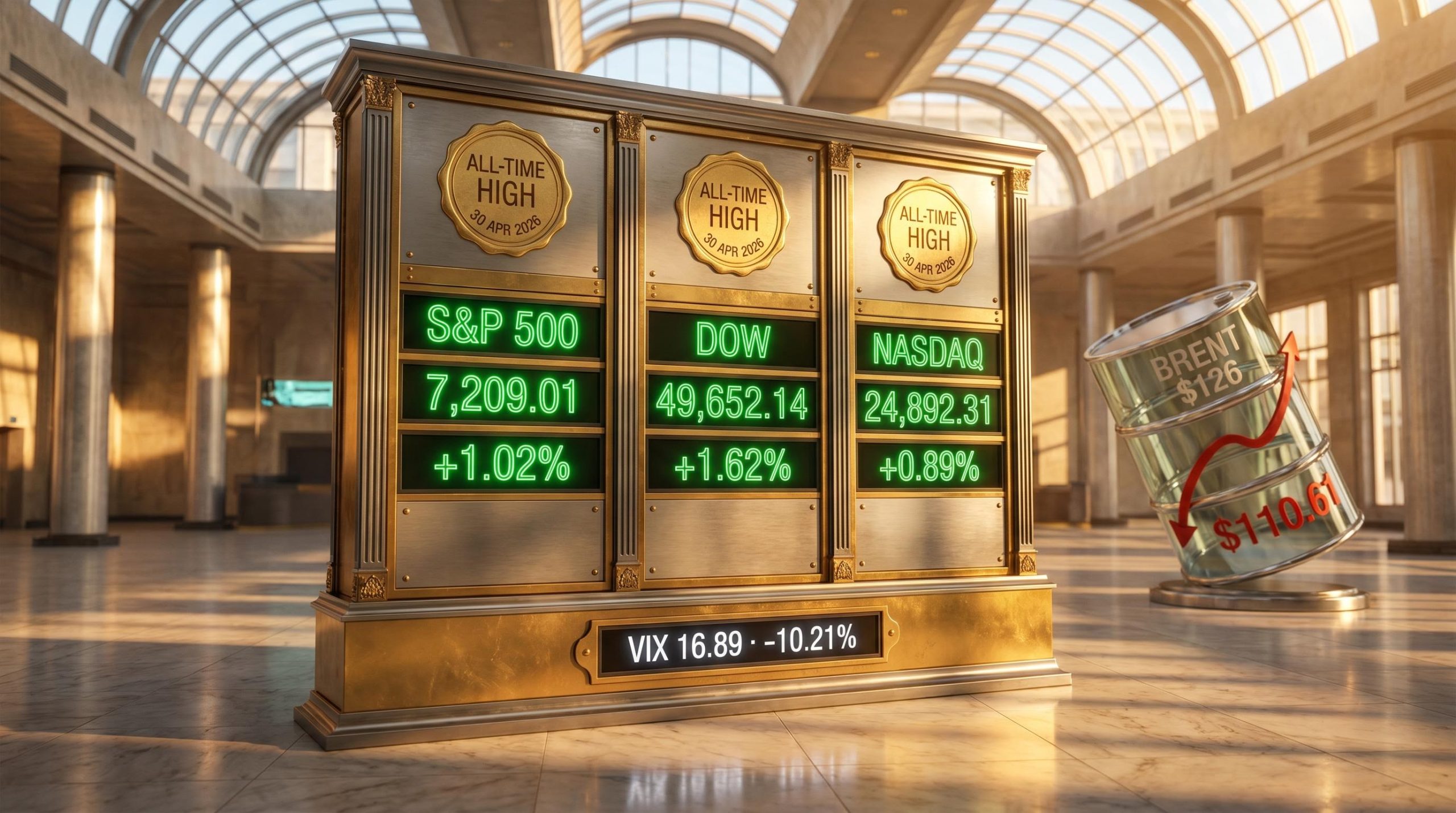
All three major U.S. equity indices closed at simultaneous all-time highs on 30 April 2026, with the S&P 500 settling above 7,200 for the first time on record. The session unfolded against a backdrop that should have rattled investors: Brent crude spiked above $126 per barrel on Strait of Hormuz fears before retreating sharply through the afternoon. Instead of flinching, markets absorbed the oil shock and pressed higher, powered by a wave of corporate earnings that beat expectations across sectors. The VIX, Wall Street’s primary measure of implied volatility (often called the market’s fear gauge), dropped more than 10% in a single session. What follows is a breakdown of what drove the stock market record high, which earnings reports moved prices most, what the oil whipsaw means for the outlook, and which companies report before Friday’s opening bell.
All three major indices set simultaneous records on April 30
The S&P 500 closed at 7,209.01, up 1.02%, crossing the 7,200 threshold for the first time in the index’s history. The Dow Jones Industrial Average delivered the session’s most forceful move, surging 790 points (1.62%) to finish at 49,652.14. The Nasdaq Composite added 0.89% to close at 24,892.31, also a new all-time high.
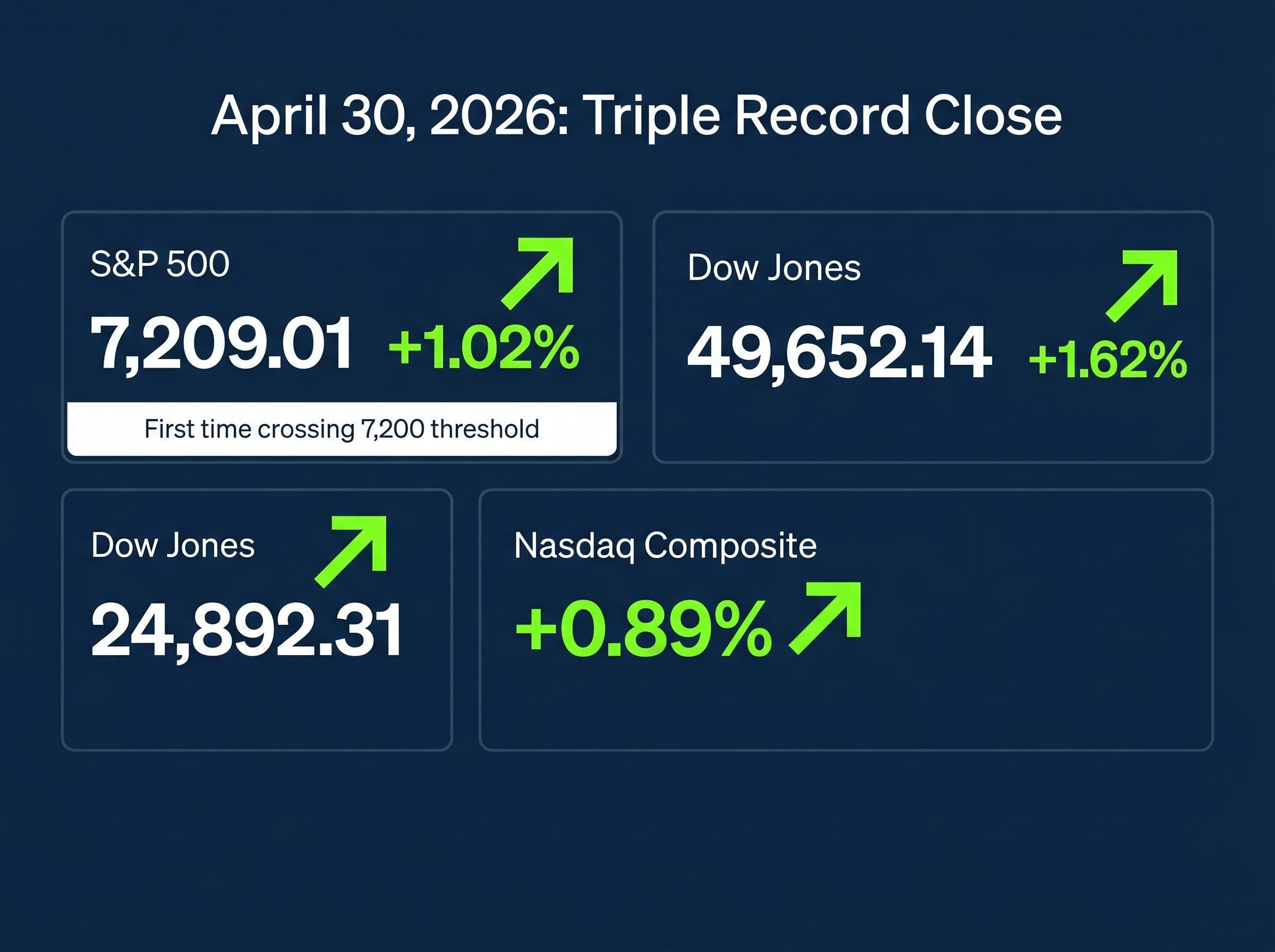
| Index | Closing Level | Point Change | % Gain |
|---|---|---|---|
| S&P 500 | 7,209.01 | +72.8 | +1.02% |
| Dow Jones | 49,652.14 | +790 | +1.62% |
| Nasdaq Composite | 24,892.31 | +219 | +0.89% |
The Dow’s outsized gain reflected broad industrial and earnings-driven strength rather than a narrow tech rally. Simultaneous records across all three indices are rare and signal unusually wide market participation.
The Dow’s broad industrial participation and the Nasdaq’s tech-inclusive gains give the session a healthy look on the surface, yet index concentration risk remains a structural reality: five mega-cap stocks controlled roughly 23% of the broad market index as of mid-April 2026, meaning any record close is still partly a verdict on a handful of names rather than the economy as a whole.
The S&P 500 VIX fell more than 10% to 16.89 on 30 April, the largest single-session fear reduction in weeks.
That VIX decline, down 1.92 points (10.21%), indicated market participants were actively pricing out near-term risk rather than simply chasing momentum. After-hours futures extended the move: as of 20:27 ET, S&P 500 futures traded at 7,258.0 (up 0.2%), Dow futures at 49,917.0 (up 0.2%), and Nasdaq 100 futures at 27,626.75 (up 0.1%), suggesting institutional positioning continued into the evening.
When big ASX news breaks, our subscribers know first
Apple and Reddit deliver the session’s most explosive earnings reactions
The record close was the headline. The after-hours tape added another chapter entirely.
Apple (AAPL) shares climbed approximately 4% after the bell following a quarter that removed any lingering doubt about iPhone demand durability. The company reported record earnings per share and all-time high total revenue, anchored by iPhone revenue growth exceeding 20% for a second consecutive quarter. Two straight quarters of that magnitude at Apple’s scale challenge the long-held view that smartphone upgrade cycles have plateaued; this is a company generating accelerating growth from a product line that ships hundreds of millions of units annually.
Reddit (RDDT) delivered the more dramatic move, surging close to 13% after hours. The catalyst was specific: Q1 daily active user counts exceeded analyst estimates, and overall quarterly results beat expectations. For a platform still in the early innings of proving its advertising and licensing revenue model to public market investors, user growth is the metric Wall Street watches most closely. The beat validated the thesis that Reddit’s engagement trajectory can sustain the monetisation runway its post-IPO valuation implies.
- Apple (AAPL): approximately +4% after hours; iPhone revenue growth above 20% for a second consecutive quarter; record EPS; all-time high total revenue
- Reddit (RDDT): approximately +13% after hours; Q1 daily active user count beat analyst estimates; overall Q1 results exceeded expectations
The contrast between a $3 trillion hardware-and-services giant and a social media platform still proving its business model speaks to the breadth of earnings strength the market rewarded on 30 April.
What earnings season tells us about the market’s resilience in 2026
Step back from the individual movers and the pattern sharpens. This earnings season has been strong enough to lift equities to records during an active geopolitical crisis, and the breadth of outperformance explains why.
Alphabet’s Q1 net income surged 81% year-over-year, sending shares up nearly 10% in a single session.
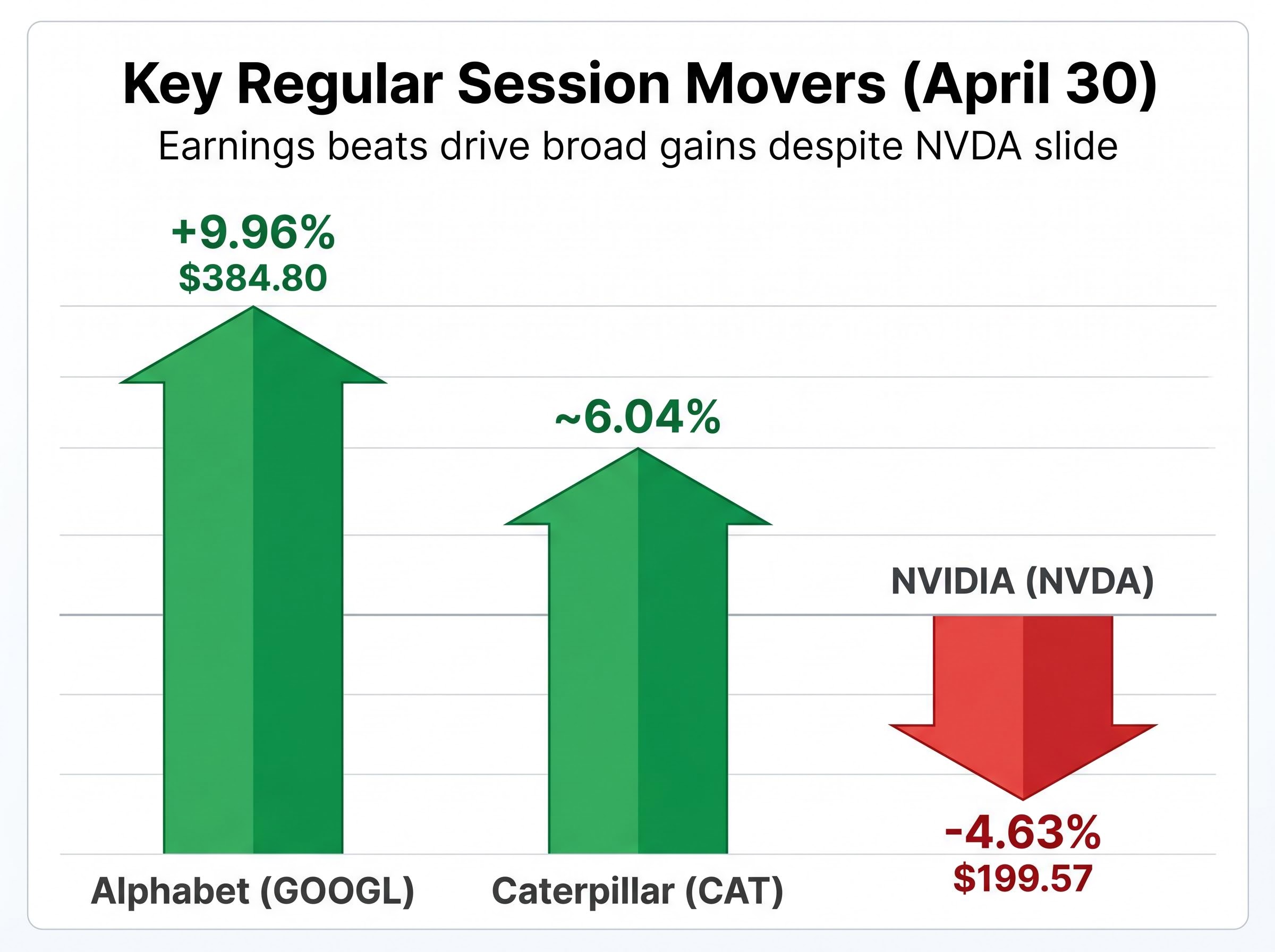
Alphabet (GOOGL) closed up 9.96% at $384.80 on 30 April, the session’s standout mega-cap performer. An 81% year-over-year jump in net income is not a marginal beat; it reflects the scale of advertising revenue recovery and cloud computing profitability that investors had been waiting to see confirmed in reported numbers.
The strength extended well beyond technology. Caterpillar (CAT) surged approximately 6.04% after Q1 results beat forecasts and backlog data pointed to sustained industrial demand. When both a digital advertising giant and a heavy equipment manufacturer rally on the same day for the same reason (earnings outperformance), the signal is one of broad economic health rather than sector-specific momentum.
- Alphabet (GOOGL): up 9.96% to $384.80; Q1 net income up 81% year-over-year
- Caterpillar (CAT): up approximately 6.04%; Q1 beat with positive backlog data
- NVIDIA (NVDA): the most actively traded stock at 212.30 million shares, closed at $199.57 (down 4.63%), a reminder that not every name participated
The macro foundation made these beats land harder. Jobless claims sat at lows not seen since 1969, and Q1 GDP came in at 2% annualised, slightly below estimates but still positive. Jobless claims measure the number of Americans filing for unemployment benefits each week; at multi-decade lows, the figure indicates an exceptionally tight labour market. Together, these data points told investors that corporate earnings were accelerating against a backdrop of employment strength and moderate economic growth, conditions that support continued equity upside when companies deliver.
Consumer spending durability is the variable sitting beneath every earnings beat in this cycle: Q1 GDP at 2% annualised and jobless claims at 1969 lows present a strong surface picture, but a personal savings rate of 4.0% suggests households are drawing down reserves rather than spending from income growth, a distinction that becomes meaningful the longer fuel costs stay elevated.
Oil’s wild session: why a $126 Brent spike did not derail the rally
The session’s most dramatic subplot played out in crude markets.
Brent crude spiked above $126 per barrel overnight, reaching a four-year peak as fears intensified over the Strait of Hormuz, which remained effectively closed as of 30 April, cutting one of the world’s most critical oil transport corridors. The price then retreated through the session, pulling back to approximately $114 before settling near $110.61-$111.88 by the close.
BNN Bloomberg’s April 30 oil market coverage confirmed that Brent crude briefly surpassed $126 per barrel intraday, with both Iran and the U.S. cited in reports on the Strait of Hormuz closure, details that shaped how energy traders and equity investors interpreted the intraday crude retreat.
- Brent crude: intraday high above $126; settled near $110.61-$111.88
- WTI crude: $105.86 per barrel, up 0.75%
- Gold futures: $4,630.49, consistent with safe-haven demand
- Silver futures: $74.67, up 0.87%
- U.S. Dollar Index: 98.032, up 0.07%
The Hormuz variable
The intraday pullback in crude reflected profit-taking and currency movements rather than any resolution of the underlying disruption. Iran’s warnings of severe retaliation against U.S. assets and reports that President Trump was receiving a military briefing on options represent a geopolitical backdrop that prevented the spike from being dismissed as noise.
Gold and silver prices remaining elevated alongside the equity rally confirmed that safe-haven demand was running in parallel, not in opposition, to risk appetite. The oil market’s behaviour on 30 April is the variable most likely to determine whether Friday’s session sustains record momentum: if Hormuz risk re-escalates overnight, energy cost pressure returns as a headwind for equities.
Chevron, Exxon, and AutoNation set to extend the earnings run on Friday
Three companies reporting before Friday’s opening bell will set the tone for the session before a single trade is executed.
| Company | Ticker | Sector | Reporting Time | Key Question |
|---|---|---|---|---|
| Chevron | CVX | Energy | Before market open | Do elevated crude prices translate directly to earnings upside, or does forward guidance flag demand risks? |
| Exxon Mobil | XOM | Energy | 8:30 a.m. CT earnings call | How does management frame the Hormuz disruption’s impact on production and margins? |
| AutoNation | AN | Consumer/Auto | Before market open | Are higher energy costs beginning to weigh on vehicle purchasing decisions? |
Chevron’s approximately $3.5 billion in Q1 earnings and Exxon Mobil’s morning call represent the energy sector’s first major reporting moments against a backdrop of crude prices above $100. Elevated Brent and WTI levels provide a favourable revenue environment for both, but forward guidance on capital allocation and production outlook will carry as much weight as the headline numbers.
Earnings guidance signals from Chevron and Exxon carry particular weight this week because approximately 44% of S&P 500 market cap, including the energy majors, reported results in a single five-day window, making forward commentary on capital allocation and production costs a primary input into how markets price the second half of 2026.
AutoNation’s results offer a different read: one on consumer demand and whether higher fuel costs are beginning to erode automotive purchasing power. Investors watching Friday’s open will want to know whether energy earnings validate the crude spike as a tailwind or whether guidance introduces caution about demand destruction.
Records set, but the Hormuz variable keeps the outlook honest
The simultaneous record close across all three indices, backed by broad earnings strength and a collapsing VIX, represents a genuine signal of investor confidence rather than speculative excess. The earnings breadth, from Alphabet’s 81% income growth to Caterpillar’s industrial beat to Apple’s after-hours surge, gave the session structural support that a single-stock rally could not provide.
The honest qualifier remains. The Strait of Hormuz is effectively closed, crude settled above $110, and overnight developments in the region could rewrite Friday’s narrative before futures reopen. Friday’s energy earnings and any Hormuz escalation are the two variables most likely to determine whether Thursday’s records become a launchpad or a short-term ceiling.
Record high warning signals were already accumulating before April 30: the S&P 500 closed at 7,173.91 on April 27 with the Strait of Hormuz still closed, Brent above $112, and gasoline at $4.25 per gallon, a price level that has historically preceded an average 11% index decline in the six months following every breach of $4.00 since 1993.
This article is for informational purposes only and should not be considered financial advice. Investors should conduct their own research and consult with financial professionals before making investment decisions. Forward-looking statements regarding earnings expectations and market direction are speculative and subject to change based on market developments and geopolitical conditions.