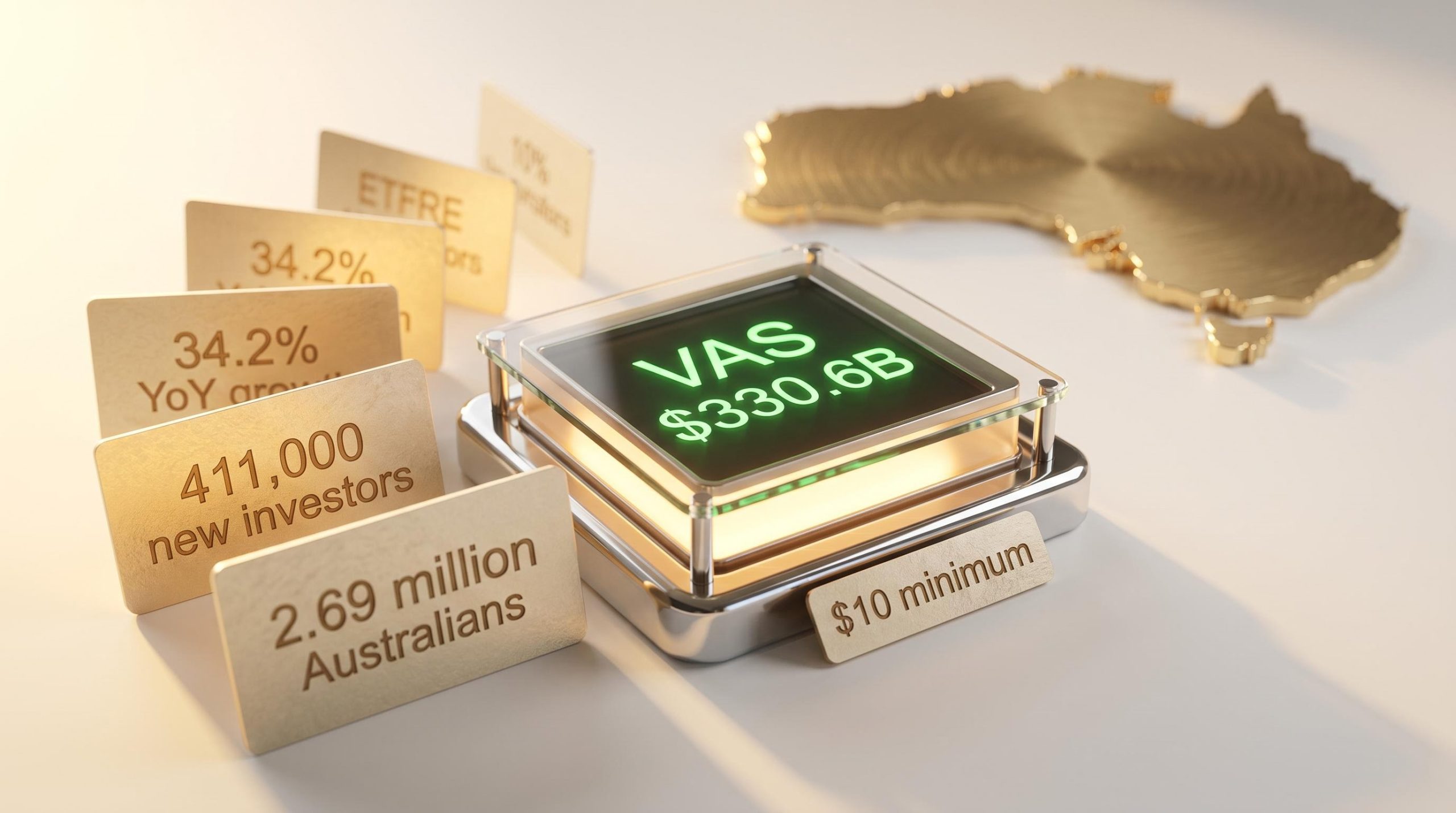
Some 2.69 million Australians now hold exchange-traded funds, according to the 2025 BetaShares and Investment Trends ETF Report. Of those, 411,000 entered the market for the first time in a single year. That figure alone signals something has shifted in how everyday Australians build wealth.
ETFs have moved from a niche product used by institutional portfolio managers to a mainstream investment vehicle accessible from as little as $10 and tradeable on the ASX through the same platforms used for ordinary shares. This guide, reflecting data current to 2025-2026, explains exactly what an ETF is, how it works on the ASX, why millions of Australians are choosing them, and what a first-time investor needs to know before placing a trade.
What an ETF actually is (and how it works on the ASX)
An exchange-traded fund (ETF) is an open-ended investment fund that holds a portfolio of assets and trades on the ASX like an ordinary share. It combines the diversification of a managed fund with the ability to buy and sell units at any point during market hours.
Most ETFs are designed to replicate a specific index, such as the ASX 200 or the S&P 500, by holding the underlying securities in those indices. The fund delivers the index’s returns minus a small management fee.
Three structural features define every ETF listed in Australia:
- Holds a portfolio of assets: A single ETF unit gives the investor exposure to dozens, hundreds, or thousands of individual securities at once.
- Trades on the ASX during market hours: Units can be bought and sold throughout the trading day, unlike unlisted managed funds that process transactions only at end-of-day prices.
- Assets held separately from the issuer: ETF assets are held on trust for unitholders by an independent third-party custodian, legally separate from the issuer’s own balance sheet.
ETF assets are not available to creditors of the issuer in the event of issuer default. In Australia, ETFs are structured as regulated unit trusts and carry the same level of investor protection regulation as traditional managed funds.
The price at which ETF units trade on the ASX can differ slightly from the net asset value (NAV), which is the per-unit value of the fund’s underlying holdings. Checking the indicative NAV before placing a trade helps investors avoid paying more than the underlying portfolio is worth.
Physical versus synthetic ETFs: what the distinction means for you
Physical ETFs hold the actual securities from the index they track. If the fund follows the ASX 200, it holds shares in the 200 companies that make up that index.
Synthetic ETFs, by contrast, use derivatives such as futures contracts to replicate index returns without holding the underlying securities directly. These products carry a higher risk profile because the investor’s return depends on the derivative counterparty honouring its obligations, not just on the performance of the underlying assets.
Australian regulations require any synthetic ETF to include the word “synthetic” in the fund name, making them straightforward to identify before purchase.
When big ASX news breaks, our subscribers know first
Why 2.69 million Australians have chosen ETFs (and what the data reveals)
The numbers tell the adoption story more clearly than any marketing brochure. In 2025, the total number of Australian ETF holders reached 2.69 million, up from approximately 2.2 million the prior year, according to data from BetaShares and Investment Trends. Some 411,000 of those were first-time ETF investors who entered the market within a single calendar year.
Roughly 300,000 additional Australians indicated they intended to invest in ETFs within the following 12 months, according to the same survey. The growth trend shows no sign of plateauing.
Australian ETF portfolio trends in early 2026 point toward continued growth, with assets under management estimated at $340-$350 billion by April and BetaShares forecasting the market will surpass $500 billion by end-2028, a trajectory that reflects both new investor entry and increasing allocations from existing holders.
When surveyed on their reasons for choosing ETFs, new investors consistently cited four motivations:
- Diversification: A single trade provides exposure across an entire market or asset class.
- Time efficiency: Index-tracking ETFs remove the need to research and select individual stocks.
- Ease of trading: ETFs are bought and sold on the ASX through the same brokerage account used for shares.
- Core portfolio suitability: Many investors use a small number of broad ETFs as the foundation of their entire portfolio.
The market’s total size reflects the same momentum. Australian ETF funds under management reached $330.6 billion at the end of 2025, according to BetaShares, representing 34.2% year-on-year growth and comfortably surpassing the $300 billion forecast made at the start of the year. Net inflows totalled $53 billion for the full year. To put the growth trajectory in context, the market has roughly quadrupled from approximately $71 billion in 2020.
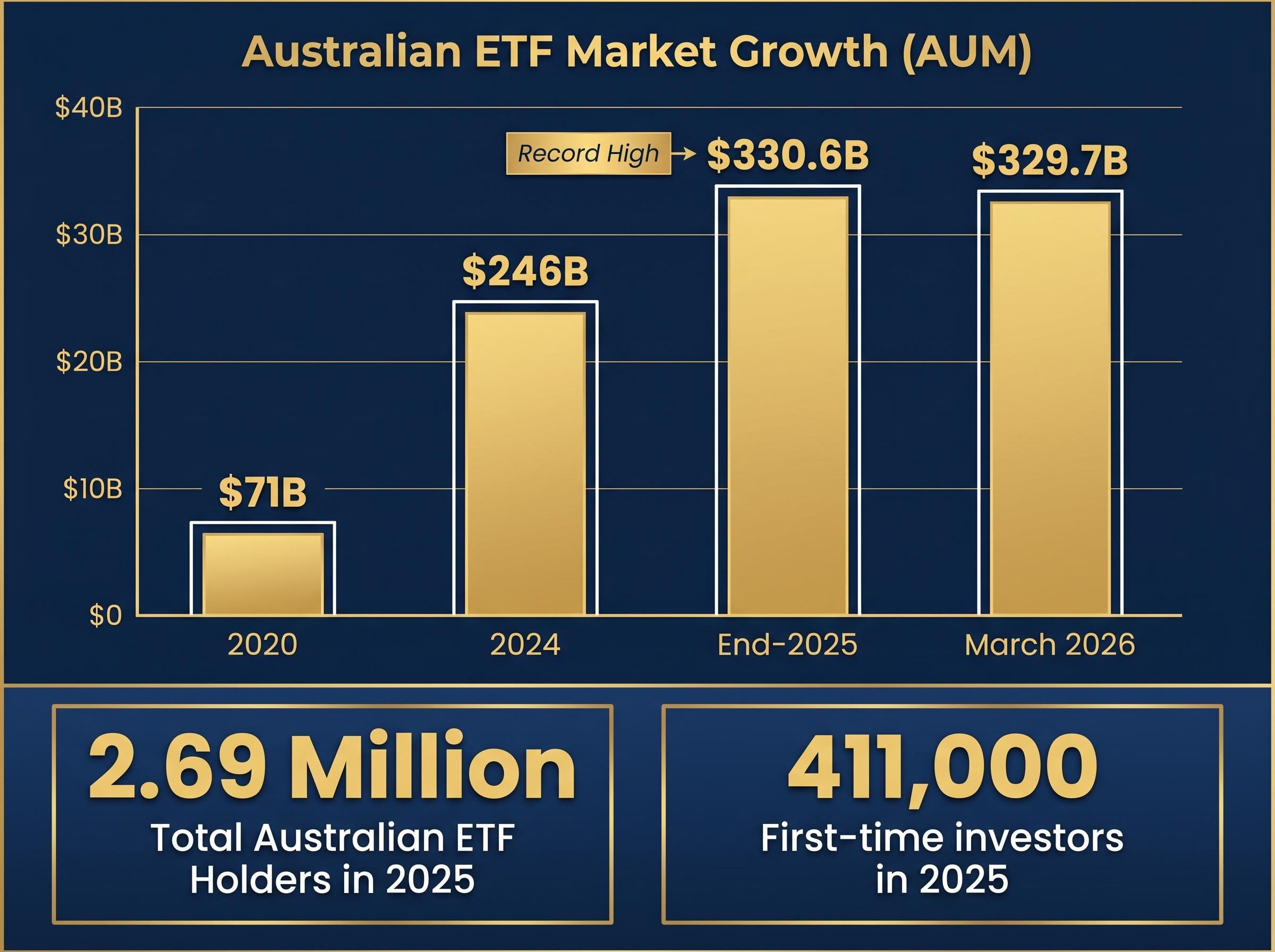
| Year | AUM (approx.) | Key Milestone |
|---|---|---|
| 2020 | $71 billion | Market baseline |
| 2024 | $246 billion | Pre-surge level |
| End-2025 | $330.6 billion | Record high; 34.2% YoY growth |
| March 2026 | $329.7 billion | Stable post-record |
For a new investor, the scale of adoption matters. ETFs are not an experimental product. They are the vehicle of choice for a large and growing share of Australian retail investors, backed by a deep and liquid market.
The full range of ETFs available to Australian investors
Hundreds of ETFs now trade on the ASX, spanning virtually every asset class an investor might want exposure to. The major categories include:
| Category | What It Holds | Typical Use Case |
|---|---|---|
| Australian equities | Shares in ASX-listed companies | Domestic market exposure; franking credit benefits |
| International equities | Shares in global companies (US, Europe, Asia) | Access to sectors underrepresented on the ASX (technology, healthcare) |
| Fixed income | Government and corporate bonds | Income generation; portfolio stability |
| Commodities | Gold, other physical commodities | Inflation hedge; safe-haven allocation |
| Diversified (multi-asset) | Mix of equities, bonds, and other assets | Single-product portfolio at a chosen risk level |
| Digital assets | Cryptocurrency exposure (e.g., Bitcoin, Ethereum) | Speculative allocation; emerging asset class |
For beginners, diversified ETFs deserve particular attention. These products bundle multiple asset classes into a single fund at a specified risk level (conservative, balanced, growth, or high growth), with the allocation managed by the provider. One purchase can deliver a complete, diversified portfolio.
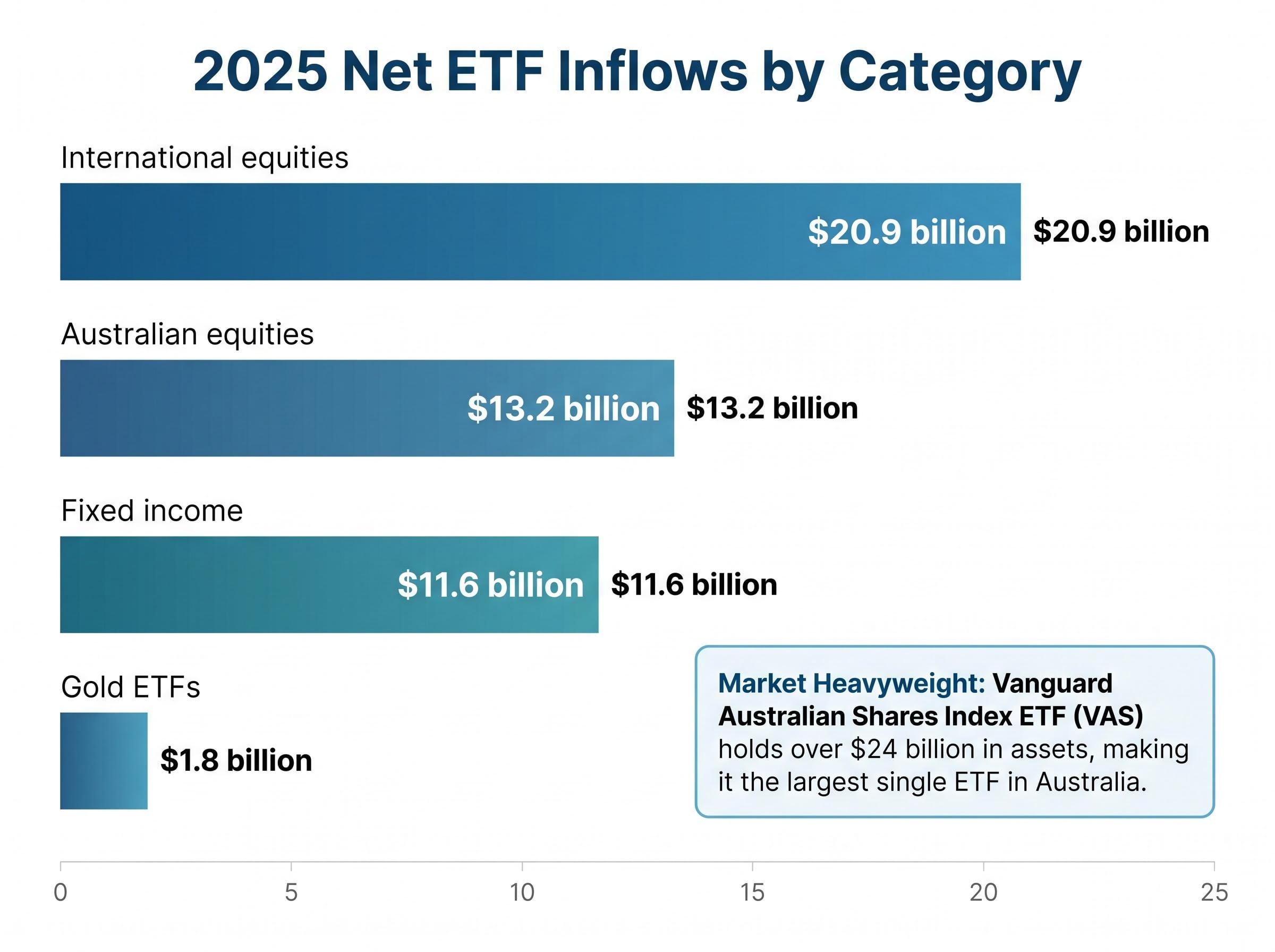
International equity ETFs attracted $20.9 billion in net flows during 2025, the largest of any category, up from $15.1 billion in 2024. Australian equities drew $13.2 billion, fixed income $11.6 billion, and gold ETFs a record $1.8 billion. The Vanguard Australian Shares Index ETF (VAS) alone holds over $24 billion in assets, making it the largest single ETF in Australia.
International ETFs overtaking domestic funds as the most purchased category on the Selfwealth by Syfe platform in Q1 2026 marked the first time this shift has occurred on record, with $6.9 billion flowing into international equity ETFs across the Australian market in that quarter alone, a volume that confirms the trend extends well beyond a single platform or demographic cohort.
Passive versus active ETFs: what the difference costs you
Passive ETFs replicate a market index, publish their full holdings daily, and charge lower management fees. Active ETFs employ portfolio managers who attempt to outperform a benchmark, typically charge higher fees, and disclose holdings less frequently.
In 2025, passive ETFs accounted for 74% of total flows, receiving $38.9 billion. Active ETFs attracted $6.3 billion, a notable rebound from net outflows the previous year. Research from S&P Global’s SPIVA scorecard, which covers over 21 years of performance data, provides a long-term benchmark for how active managers have performed relative to their index benchmarks, and investors can consult it when weighing this decision.
A diversified ETF fee comparison across the three main providers on the ASX reveals that the cost gap between BetaShares DHHF at 0.19%, Vanguard’s diversified range at 0.27%, and actively managed alternatives at 0.39% is narrow enough in dollar terms that index breadth, asset class coverage, and return targeting methodology can reasonably drive the selection decision for many investors.
The distinction matters because it directly affects fees and realistic return expectations over time.
What ETFs actually cost, and how costs compound over time
Every ETF investor faces three cost components:
- Management expense ratio (MER): An annual percentage fee deducted from the fund’s assets. The investor never sees this as a separate invoice; it is reflected in slightly lower returns relative to the index being tracked.
- Brokerage commissions: A fee charged by the trading platform each time units are bought or sold. Some platforms have eliminated this cost entirely for ETF trades.
- Bid-ask spread: The small difference between the price at which units can be bought (the ask) and the price at which they can be sold (the bid). This cost is incurred on each transaction.
ETFs carry no entry or exit fees, unlike many unlisted managed funds. The fee advantage over traditional actively managed funds, where annual charges can exceed 1%, is one of the primary reasons for the retail adoption surge.
On platforms such as BetaShares Direct, ETFs can be purchased with no brokerage fees and an entry point as low as $10. By comparison, unlisted managed funds typically require minimum initial investments of $5,000 or more. That accessibility gap is a significant driver of the shift toward ETFs among first-time investors.
Most standard brokerage accounts set a $500 minimum for the initial ETF purchase. For a long-term investor, the compounding effect of fee differences is material: the gap between a 0.07% passive ETF and a 1.2% actively managed fund, sustained over 20 years, can represent tens of thousands of dollars on a moderate-sized portfolio.
Fee compounding in managed funds works against investors in ways that are not always visible at the point of purchase: a 1% annual fee difference on a $50,000 portfolio held for 20 years produces a gap of approximately $32,000 in final value, which is the core arithmetic reason passive ETFs have drawn capital away from traditional active vehicles.
Your first ETF purchase in Australia: a step-by-step breakdown
Three channels are available for purchasing ETFs in Australia:
- Online brokerage platforms: The most common route for retail investors. Lowest cost, highest level of self-direction.
- Full-service brokers: Provide personalised trade execution and advice. Higher fees reflect the additional service.
- Financial advisers: Offer portfolio construction within a broader financial plan. ETF uptake within planning firms has been growing, and this option suits investors who prefer managed guidance.
For the majority of retail investors using an online broker, the purchase sequence follows these steps:
- Open a brokerage account with an ASX-connected platform.
- Receive a HIN (Holder Identification Number) under the CHESS sponsorship system, which registers ownership of securities in the investor’s name.
- Identify the ETF by its ASX ticker code (e.g., VAS for the Vanguard Australian Shares Index ETF).
- Check the ETF’s indicative net asset value (iNAV) and the current bid-ask spread.
- Set a limit order at the intended purchase price rather than using a market order.
- Review and confirm the trade.
No separate trading account or additional paperwork is required beyond the standard brokerage account already used for shares. ETFs are also eligible to be held within Self-Managed Super Funds (SMSFs) in the same manner as individual shares.
The limit order step is worth pausing on. A limit order ensures the trade executes only at the specified price or better, protecting against price slippage. BetaShares recommends avoiding trading in the first and last 10 minutes of the ASX session, when bid-ask spreads tend to be wider, and checking the indicative NAV before transacting.
That procedural clarity is often the difference between investors who act and those who remain indefinitely in the “thinking about it” phase.
The tax and risk considerations every Australian ETF investor needs to understand
Selling ETF units triggers a capital gains tax (CGT) event in Australia. The gain or loss is calculated as the sale proceeds minus the cost base, which includes the original purchase price plus any brokerage paid.
The 50% CGT discount is the most material tax consideration for ETF investors who hold for the medium to long term. Units held for at least 12 months qualify, meaning only half the net capital gain is included in assessable income.
ETF units held for at least 12 months qualify for the 50% CGT discount, meaning only half the net capital gain is included in assessable income.
Australian equity ETFs also pass through franked dividends from the domestic shares they hold. Franking credits can reduce the investor’s tax liability depending on their marginal tax rate, a structural benefit that applies to Australian equity ETFs but not to international equity or bond ETFs.
Distributions from ETFs can include several components, each with different tax treatment: dividends, interest income, and realised capital gains from the fund’s internal trading. Investors in US-domiciled ETFs face additional administrative requirements (W-8 BEN forms), but Australian-domiciled ETFs that invest internationally on the investor’s behalf avoid this complication entirely.
Understanding ETF risk: market exposure, not structural fragility
One of the most common misconceptions among new investors is that ETFs carry a unique product risk. They do not. The primary risk of an ETF is the risk of the underlying asset class it holds.
An Australian equities ETF will fall when the Australian market falls. An international equities ETF carries the same dynamic, with the addition of currency risk if the fund is unhedged, meaning movements in the Australian dollar relative to foreign currencies will affect returns independently of the underlying share prices.
The main risk categories to consider include:
- Market risk: The value of the ETF’s underlying assets can decline.
- Currency risk: Applies to unhedged international ETFs when the Australian dollar moves relative to the currency of the underlying holdings.
- Tracking error: The fund’s returns may differ slightly from the index it aims to replicate, due to fees, cash holdings, or rebalancing timing.
- Liquidity risk: Thinly traded ETFs may have wider bid-ask spreads, increasing transaction costs.
Detailed risk information for each ETF is contained in its Product Disclosure Statement (PDS), which investors should review before purchasing.
This article is for informational purposes only and should not be considered financial advice. Investors should conduct their own research and consult with financial professionals before making investment decisions. Past performance does not guarantee future results.
The data makes the case, but the decision is yours
ETFs have become Australia’s mainstream investment vehicle because they address the three barriers that historically kept retail investors in cash or single-stock portfolios: diversification, cost, and accessibility. A market that has grown from $71 billion to over $330 billion in five years reflects millions of individual decisions to solve those problems in the same way.
This guide has covered what an ETF is, the types available on the ASX, what they cost, how to buy one, and the tax and risk framework that applies. The practical checklist is complete.
The right ETF, however, depends on the individual investor’s goals, time horizon, and risk tolerance. The product diversity available on the ASX means there is no single correct choice for all investors. Reviewing the Product Disclosure Statement of any ETF before investing is a necessary step, and a financial adviser can assist with personalised portfolio construction where needed.