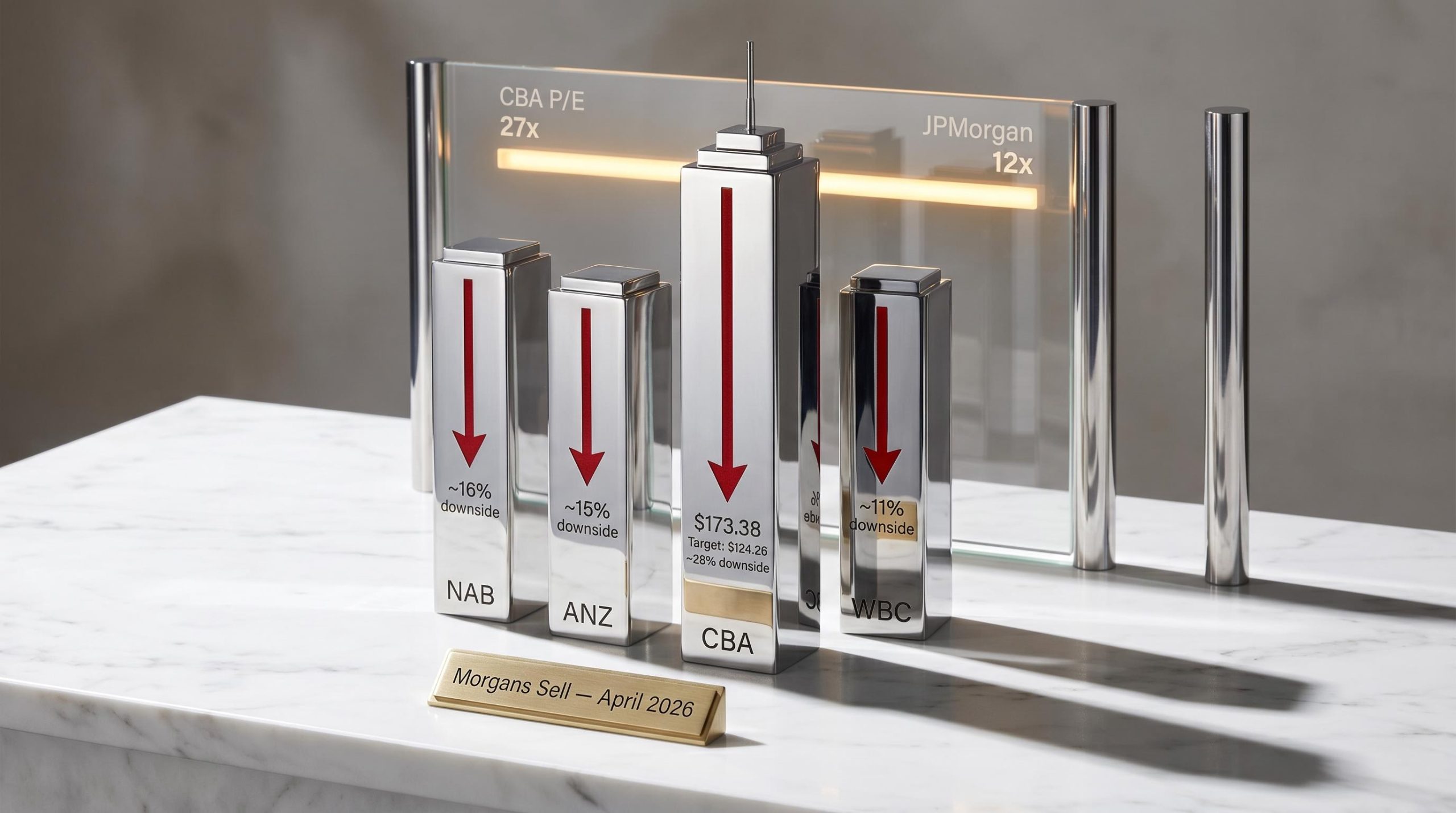
Commonwealth Bank trades at roughly 27x earnings. JPMorgan trades at approximately 12x. That gap, more than any single earnings result or dividend announcement, is the argument that has driven Morgans to issue sell ratings across all four of Australia’s big four banks as of late April 2026. The ratings arrive after a strong earnings season, not before it, with price targets implying downside ranging from 11% on Westpac to 28% on CBA. Record profits have not resolved the overvaluation question; according to Morgans’ framework, they have deepened it, as strong results were rewarded with higher share prices that widened rather than closed the gap to analyst targets.
What follows maps the specific downside projections for each bank, explains the valuation logic underpinning the bearish case, identifies where the consensus fractures (particularly around ANZ), and outlines the conditions that would need to change before sell ratings give way. For investors with bank stock exposure, the aim is a clearer framework for deciding whether to hold, trim, or reassess.
What Morgans is actually saying about each bank
The scale of implied downside across all four names is the place to start. Morgans issued or reiterated sell ratings in late April 2026, meaning these reflect the broker’s view after digesting a record-breaking earnings season.
| Bank | Share Price (30 Apr 2026) | Morgans Target | Implied Downside |
|---|---|---|---|
| CBA | $173.38 | $124.26 | ~28% |
| NAB | $41.25 | $34.56 | ~16% |
| ANZ | $36.30 | $30.72 | ~15% |
| WBC | $38.43 | $34.06 | ~11% |
CBA’s implied downside of approximately 28% is the most striking figure in the set, representing the largest gap between market price and broker target among the four.
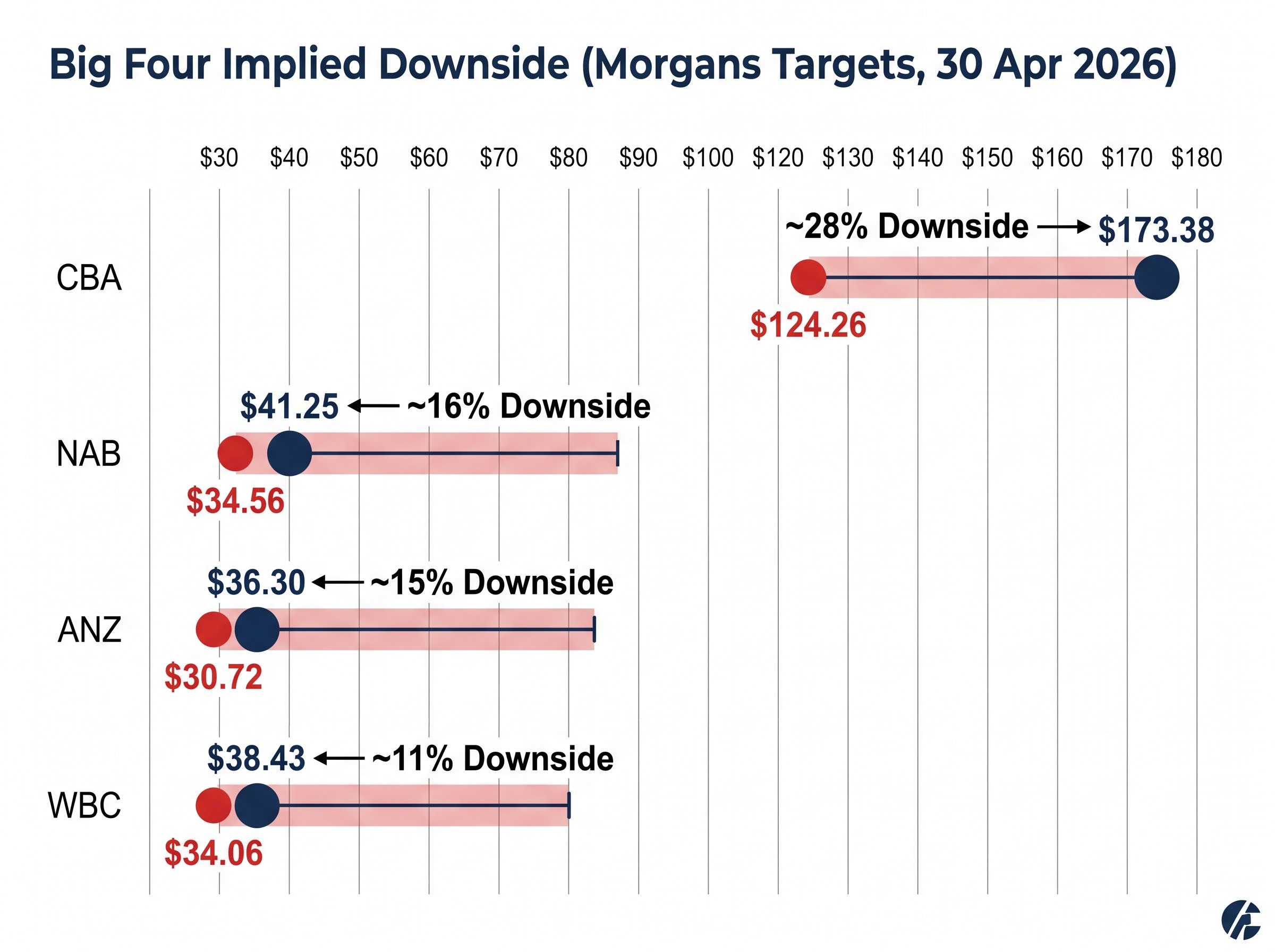
Recent share price weakness has not produced meaningful convergence toward any of these targets. In the final days of April alone, CBA fell 2.7%, NAB declined 3.1%, ANZ slipped 0.8%, and WBC dropped 2.4%. The broader ASX 200 declined approximately 1.13% over the same window. Bank-specific selling has been modestly heavier than the index, yet the gap to Morgans’ targets remains wide across all four names.
Morgans’ view does not sit in isolation: the broader analyst consensus across the Big Four shows sell or strong sell ratings on three of the four banks, with CBA drawing the most extreme bearish positioning, including a bear-case target of $90 that implies a potential 50% decline from late April 2026 prices.
When big ASX news breaks, our subscribers know first
Why valuations look stretched even after record profits
CBA reported a first-half FY26 cash profit of $5.45 billion, beating market expectations. Morgans responded by lifting its earnings per share (EPS) and dividend per share (DPS) forecasts. The sell rating stayed.
That sequence is the core of the valuation argument. Strong earnings have not changed the rating because the bar for a rating change is primarily price-driven, not earnings-driven. At current levels, Morgans models a total shareholder return (TSR) for CBA of approximately -24%, inclusive of an estimated 3% dividend yield. The problem is not the profit; the problem is the price being paid for it.
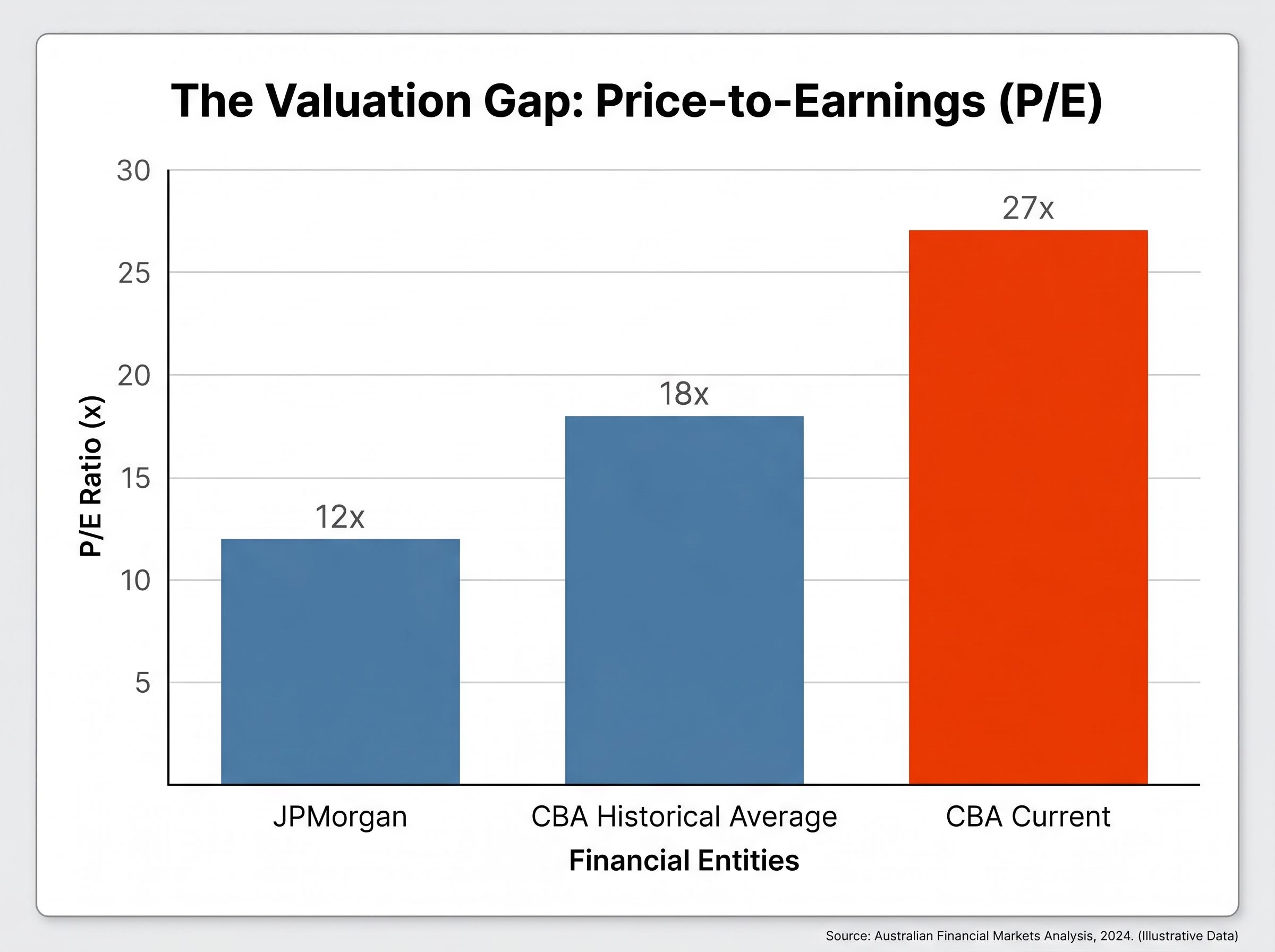
The valuation gap becomes clearer in comparative terms:
- CBA current price-to-earnings (P/E) ratio: approximately 27x
- CBA historical average P/E: approximately 18x
- JPMorgan comparable P/E: approximately 12x
Morgans models a total shareholder return for CBA of approximately -24% at current prices, inclusive of an estimated 3% dividend yield.
ASX financials rose approximately 5.1% following the February-March 2026 earnings season. That post-earnings rally is part of the problem Morgans identifies: strong results have been rewarded with higher prices, which pushes valuations further above targets rather than closing the gap. Each upward move on earnings momentum makes the sell case more emphatic, not less.
The valuation concern extends beyond individual stock selection into portfolio construction: ASX 200 index concentration risk means that superannuation funds and passive domestic equity holders are effectively running an undisclosed bet on four banks, given the sector represents roughly 25% of the index by market capitalisation.
Understanding price-to-earnings multiples and why they matter for bank stocks
A price-to-earnings ratio is one of the most widely referenced valuation measures in equity markets. For investors holding Big Four bank shares through superannuation or direct equity, it provides a straightforward way to evaluate whether the price being paid is proportionate to what the company earns.
- What the number represents: The P/E ratio divides a company’s share price by its earnings per share. A P/E of 27x means an investor is paying $27 for every $1 of annual profit the company generates.
- What a reference point looks like: CBA’s historical average P/E sits at approximately 18x. This long-run average provides a baseline against which the current 27x multiple can be measured. JPMorgan, a comparable global bank, trades at approximately 12x.
- What the gap implies: When a stock trades significantly above its historical multiple, the market is pricing in expectations of above-average growth, a permanent re-rating, or both. If neither materialises, the multiple tends to compress.
Peer-reviewed P/E ratio research on commercial banks supports the view that sustained premium multiples create compression risk when growth expectations fail to materialise, with mean reversion toward sector historical averages representing the base case outcome over multi-year holding periods.
The RBA cash rate remains at 4.35% as of March 2026. Sustained high rates have supported bank net interest margins (NIMs), the difference between what banks earn on loans and pay on deposits, contributing to elevated recent earnings. Analysts flag, however, that slowing credit growth represents a risk to the earnings base that underpins current multiples.
What mean reversion means for long-term holders
Mean reversion refers to the tendency for financial metrics to return toward their long-run averages over time. If CBA’s multiple were to revert to its historical average of approximately 18x without any change in underlying earnings, the implied share price would be materially lower than today’s $173.38.
This is not a prediction of imminent decline. It is a structural framing tool. Any stock trading at a significant premium to its own history carries the risk that the premium will not persist, and the longer it persists, the larger the potential adjustment if sentiment shifts.
ANZ stands apart from its peers
A simultaneous sell rating across all four banks suggests a uniform view, but the analyst community is genuinely split on ANZ. The divergence is worth examining rather than dismissing.
| Data Point | ANZ | CBA |
|---|---|---|
| Morgans Target Downside | ~15% | ~28% |
| Avg. Analyst Target Downside | ~4% | Strong sell consensus |
| Most Bullish Target | $43 | N/A |
| Implied Range | ~15% down to ~19% up | ~28% down (Morgans) |
Among 16 covering analysts, approximately 6 hold buy or strong buy ratings on ANZ. The average TradingView price target of approximately $34.75 implies only around 4% downside from the current $36.30, a far narrower gap than any of its peers face. One analyst target sits at $43, implying approximately 19% upside.
ANZ’s analyst split reflects genuine disagreement on the margin expansion trajectory following the Suncorp acquisition integration, with Q1 2026 net interest margin expanding 2 basis points to 1.56% and six of fourteen covering analysts holding buy ratings despite Morgans’ $30.72 target implying 15% downside.
Morgan Stanley has projected that ANZ could outperform CBA by approximately 20% in return terms during 2026, positioning it as the relative buy within the sector.
Morgans still holds a sell at $30.72, implying approximately 15% downside. The bearish case has not disappeared for ANZ, but the breadth of disagreement among analysts makes it the most contested valuation case in the group. For investors considering whether to reduce bank exposure uniformly, that distinction matters.
Income investors face a different calculation
Many Australian retail holders own Big Four bank shares primarily for yield. The capital return analysis above tells one story; the dividend profile tells a related but distinct one.
- WBC trailing dividend: $1.54 per share, with Morgans projecting $1.605 in FY26 and $1.64 in FY27. Approximate trailing yield: 3.85%.
- ANZ trailing yield: approximately 4.4%, partially franked.
- CBA dividend yield: approximately 3% under Morgans’ model.
- NAB continues paying dividends in line with sector norms, though specific forward projections were not updated in the most recent Morgans note.
WBC’s rising dividend trajectory and ANZ’s higher yield offer genuine income appeal. The complication is the capital side. Even with CBA’s 3% yield included, Morgans’ modelled TSR at current prices remains approximately -24%. A yield that covers a fraction of the projected capital decline does not make the total return equation favourable under this framework.
Dylan Evans of Catapult Wealth has noted that the current environment could be suitable for investors to realise gains on CBA holdings.
For income-oriented holders, the question becomes whether the dividend stream is sufficient compensation for remaining exposed to what Morgans frames as significant capital risk. The answer depends on time horizon and individual circumstances, but the gap between yield and modelled downside is not a narrow one.
The conditions that would flip the bearish case
Rather than treating the sell ratings as a final verdict, investors can monitor the specific conditions under which the bearish thesis would weaken. Four implicit reversal conditions emerge from the research:
- Material share price decline toward targets: Morgans has indicated that the primary condition for upgrading CBA is price-based. The stock would need to trade materially lower before the sell rating would be reconsidered, meaning near-term earnings beats alone are unlikely to shift the rating.
- Capital return or buyback programmes: Meaningful capital return programmes that unlock value currently constrained by CET1 requirements could improve the shareholder return equation.
- Sustained earnings upgrades beyond current forecasts: Continued credit quality strength and loan growth exceeding present expectations could, over time, justify higher multiples.
- RBA rate trajectory changes: Rate cuts could compress NIMs but simultaneously stimulate credit volume, creating an ambiguous scenario rather than a straightforwardly bullish one. The cash rate sits at 4.35% as of March 2026.
Why earnings beats alone may not be enough
Morgans’ post-1H26 CBA note is instructive. The broker lifted EPS and DPS forecasts following the record $5.45 billion result, yet the sell rating remained. The rating is anchored to price, not profit trajectory.
CBA’s CET1 capital tightness adds a further constraint. Even if earnings continue to beat, capital limits cap the DPS upside that would typically support a re-rating. With CBA having gained approximately 12.4% year-to-date into mid-April, the distance between the current share price and any Morgans target illustrates how much price normalisation would be required before the analyst community might shift to neutral.
The 2026 rally in ASX bank shares has been highly uneven at the stock level, with a 10.5 percentage point spread between the best and worst performer in the group, suggesting that sector-wide allocation decisions carry less analytical weight than individual bank selection in this environment.
The bar is high. The stock needs to fall substantially, not simply stop rising.
The gap between record profits and reasonable valuations is still wide
Australia’s Big Four have delivered strong earnings, continued dividend growth, and maintained credit quality through an extended high-rate environment. Analyst sell ratings have not only persisted through these results but deepened in conviction as prices remained elevated.
The income case for long-term holders is legitimate. A 3-4% yield is real money. It does not, however, offset a modelled -24% TSR at current prices under Morgans’ framework.
ANZ’s divergent analyst profile is worth treating as a genuine intra-sector distinction rather than a footnote. Investors reviewing Big Four positions may find that a uniform sell-everything conclusion is less useful than a bank-by-bank assessment of where the consensus actually sits.
The conditions for a ratings reversal are known and monitorable: price decline, capital returns, earnings upgrades beyond current forecasts, and shifts in the rate trajectory. That makes this a moment for active reassessment rather than passive continuation of existing positions.
This article is for informational purposes only and should not be considered financial advice. Investors should conduct their own research and consult with financial professionals before making investment decisions. Past performance does not guarantee future results, and financial projections are subject to market conditions and various risk factors.