
The alternative asset manager captured massive market attention in the first quarter of 2026 by reporting $69 billion in capital inflows. During this period, the firm explicitly positioned Blackstone AI investments and infrastructure development as its single biggest growth driver globally.
The company’s official SEC regulatory filings confirm this massive capital accumulation, providing the legal verification for a quarter that saw record deployment into technology assets.
Recent market speculation regarding a specialised “N1” branch has focused intense scrutiny on the firm’s West Coast operations. However, this breakaway narrative misrepresents the actual corporate strategy and the scale of the operation. The reality of this technology expansion is far more extensive than an isolated spin-off branch.
It integrates billion-dollar software stakes and massive physical infrastructure projects across established Private Equity and Tactical Opportunities divisions. Investors examining this shift will discover the actual scope of the technology portfolio, ranging from a roughly $1 billion stake in Anthropic to a $25 billion Pennsylvania data centre initiative. Understanding the executive structure driving this transformation provides important clarity on how institutional capital captures value in the current market cycle.
Mapping the West Coast Expansion and Tech Leadership Structure
The market noise surrounding a breakaway technology branch obscures the established, integrated hierarchy deploying capital in San Francisco. The firm operates its technology expansion as a deeply integrated firm-wide strategy rather than an isolated venture. This structural approach leverages the massive scale of existing divisions to execute acquisitions that require exceptional capital depth.
The Tactical Opportunities division manages approximately $34 billion in assets under management, focusing heavily on digital infrastructure. Its current Fund IV is sized at $5.2 billion, providing immediate liquidity for opportunistic technology investments. Additionally, the BXPE wealth management vehicle previously reported $10.2 billion in assets as of April 2025, offering further capital depth for these structural allocations.
To clarify the decision-making structure for founders and market analysts, the reporting lines remain distinct across major divisions. The leadership hierarchy operates with specific geographic and divisional mandates that prevent overlap.
Sachin Bavishi: Leads technology investments for the West Coast, having officially established the corporate private equity presence in San Francisco in August 2022. Jon Korngold: Continues his global role as the Head of Blackstone Growth, directing expansion-stage investments worldwide without a reported departure from the firm. * Jas Khaira: Serves as the Head of Americas for Tactical Opportunities, maintaining his regional oversight without a relocation to San Francisco.
When big ASX news breaks, our subscribers know first
Understanding Private Equity Market Mechanics in Emerging Technology
Traditional buyout firms are increasingly entering the technology software race, fundamentally shifting how late-stage companies secure capital. Early-stage venture capital typically funds unproven concepts and initial product development with smaller checks. In contrast, private equity growth investments focus on established enterprises requiring massive liquidity to scale their commercial operations globally.
This aggressive deployment of private equity capital arrives at a critical juncture for legacy software markets, which have recently experienced severe valuation adjustments as enterprises migrate away from headcount-dependent licensing models.
The current generation of generative software demands capital at a scale that traditional venture funds struggle to deploy single-handedly. Developing foundational models requires unprecedented funding rounds, driving enterprise valuations to historic highs.
The Capital Requirements of Generative Software
The immense cost of compute power and model training heavily favours institutional giants with billions in available dry powder. Market data values Anthropic at $350 billion, while OpenAI holds an $852 billion valuation mark. These substantial financial figures require the institutional backing that only global asset managers can reliably provide across multiple funding rounds.
By integrating these technology investments into broader wealth management strategies like the BXPE vehicle, private equity firms offer distinct advantages. They provide retail and institutional investors with direct exposure to the infrastructure layer of the digital economy. Consequently, the presence of massive buyout funds acts as a stabilising force for market liquidity in the broader technology sector.
Scaling the Portfolio with Foundational Models and Enterprise Platforms
The firm has deployed capital into generative technology platforms with high velocity over the past year. Rather than selecting a single winner, the asset manager has built a strategically diverse portfolio. This strategy spans core foundational models, enterprise solutions, and global infrastructure platforms to capture value across the entire digital ecosystem.
The investment timeline accelerated sharply in February 2026, demonstrating a rapid deployment of institutional reserves into high-conviction targets. The firm increased its commitment to Anthropic with a $200 million addition, bringing its total investment to roughly $1 billion for an approximate 0.29% stake. It also holds a smaller 0.4% stake in OpenAI, ensuring exposure to the primary foundational model developers.
Beyond the foundational models, capital has flowed rapidly into specialised applications and global infrastructure platforms. The geographic scope expanded significantly with a massive lead funding round of over $1 billion for Indian artificial intelligence platform Neysa in February 2026.
The firm also secured enterprise capabilities through a $300 million investment in data platform DDN. Furthermore, specialised vertical applications received backing, evidenced by a $50 million investment in legal tech company Norm Ai in November 2025.
Generative AI capabilities are completely redefining enterprise software valuations across the industry, driving massive funding rounds for platforms that successfully pivot from passive data management to active content generation.
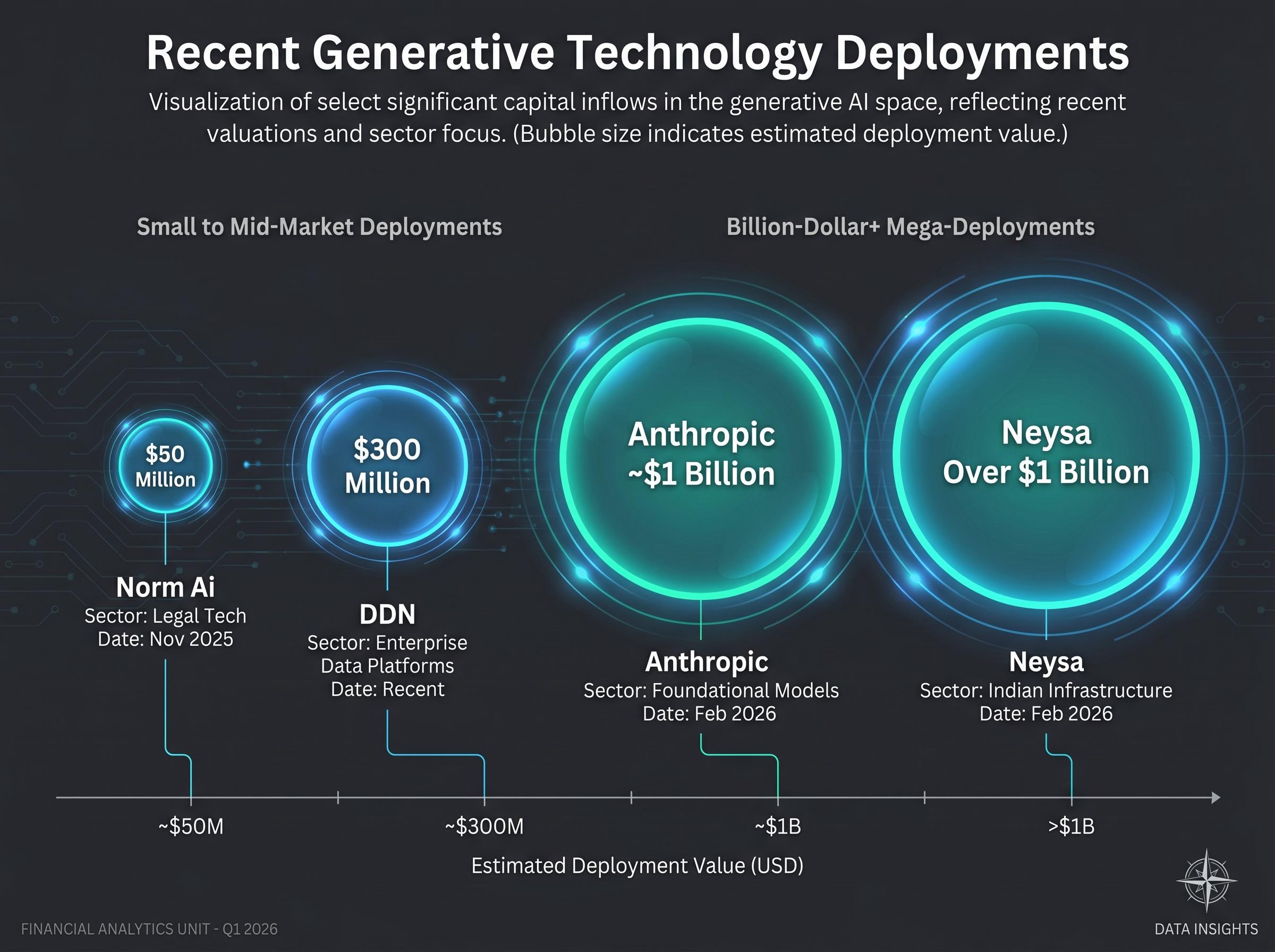
| Company | Investment Size | Sector | Date/Timeline |
|---|---|---|---|
| Anthropic | ~$1 billion (total) | Foundational Models | February 2026 (latest) |
| Neysa | Over $1 billion | Indian Infrastructure | February 2026 |
| DDN | $300 million | Enterprise Data Platforms | Recent Allocation |
| Norm Ai | $50 million | Legal Tech | November 2025 |
Real Estate Meets Tech With Multi-Billion Dollar Data Centre Hubs
Digital assets represent only one half of the investment equation for major private equity players. The firm is actively hedging the speculative nature of software investments by owning the physical concrete and power systems that make the technology function. This alternative, lower-risk strategy plays the technology boom through hard assets, demonstrating a highly diversified approach to the sector.
The intense demand for data center construction and physical hardware has fueled a historic semiconductor supercycle, prompting asset managers to secure tangible infrastructure assets rather than relying solely on software returns.
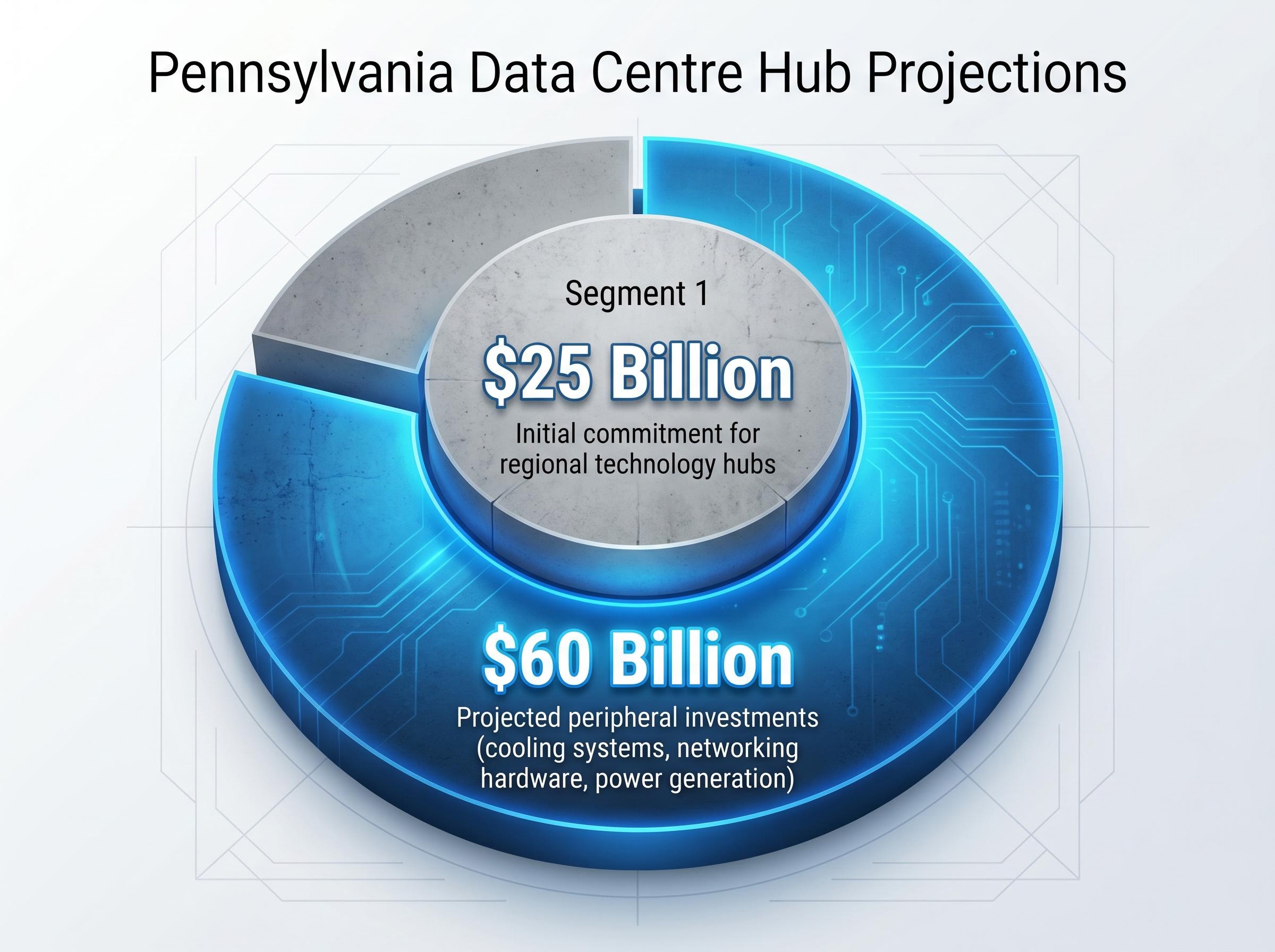
The cornerstone of this physical expansion is a $25 billion commitment to develop regional technology hubs across Pennsylvania. This massive development initiative serves the broader ecosystem by providing the fundamental underlying infrastructure required for large-scale compute operations. Market projections expect this initial commitment to attract an additional $60 billion in peripheral investments, covering advanced cooling systems, networking hardware, and power generation.
To capitalise further on this physical expansion, the firm is planning a new public vehicle designed specifically to acquire technology infrastructure.
Q1 2026 Strategic Vision “The artificial intelligence infrastructure build-out represents the single biggest growth driver for the firm globally,” stated President Jon Gray during the first-quarter earnings presentation.
This hard-asset strategy provides investors with tangible infrastructure exposure. It ensures the asset manager captures immense value regardless of which software provider ultimately dominates the consumer and enterprise markets.
The Long-Term Dominance of Institutional Tech Capital
The integration of billion-dollar software stakes with massive physical infrastructure projects establishes a dual-pronged approach to the digital economy. This strategy positions the firm as a dominant force against traditional Silicon Valley investors, who often lack the capital depth to fund both code and concrete simultaneously. The established San Francisco leadership team commands vast capital reserves, allowing them to execute at a scale that alters venture funding models.
Heading into the second half of 2026, this massive capital deployment signals a maturing technology investment environment. Institutional asset managers are no longer just participating in tech funding rounds. They are actively underwriting the physical and digital foundations of the industry, creating new avenues for sustained capital growth.
Market scrutiny surrounding escalating AI capital expenditures has forced many traditional tech giants to defend their spending against delayed commercial monetization, making Blackstone’s diversified hard-asset approach particularly timely.
This article is for informational purposes only and should not be considered financial advice. Investors should conduct their own research and consult with financial professionals before making investment decisions.
Past performance does not guarantee future results. Financial projections are subject to market conditions and various risk factors.