
Fair Isaac Corporation (FICO) shares fell approximately 22.7% over the week of 2 October 2026, and the trigger was not a soft earnings print or a market-wide pullback. It was a regulatory signal: reporting that the Federal Housing Finance Agency (FHFA) is preparing to cut the number of credit bureaus required for conforming mortgages from three to two.
The move, known as a bi-merge requirement, would reshape a core pipeline that FICO has long sat inside. FHFA Director Bill Pulte is expected to announce at the Mortgage Bankers Association (MBA) annual conference in Chicago on 12 October 2026 that Fannie Mae and Freddie Mac will direct lenders to pull data from two bureaus instead of all three, cutting the volume of mandatory scoring transactions embedded in every government-backed loan. This follows a near-49% collapse in FICO shares during September, set off by a separate FHFA decision to place VantageScore 4.0 on the same pricing grid as FICO Classic. The market is now pricing a cumulative structural threat, not a single event.
Here is what the proposal actually changes, where the analyst debate lands, and what the next two weeks could mean for anyone with exposure to FICO.
How FHFA’s expected announcement could reshape FICO’s mortgage pipeline
To understand why a rule about credit bureaus moved a stock by this much, start with how a conforming mortgage is scored today.
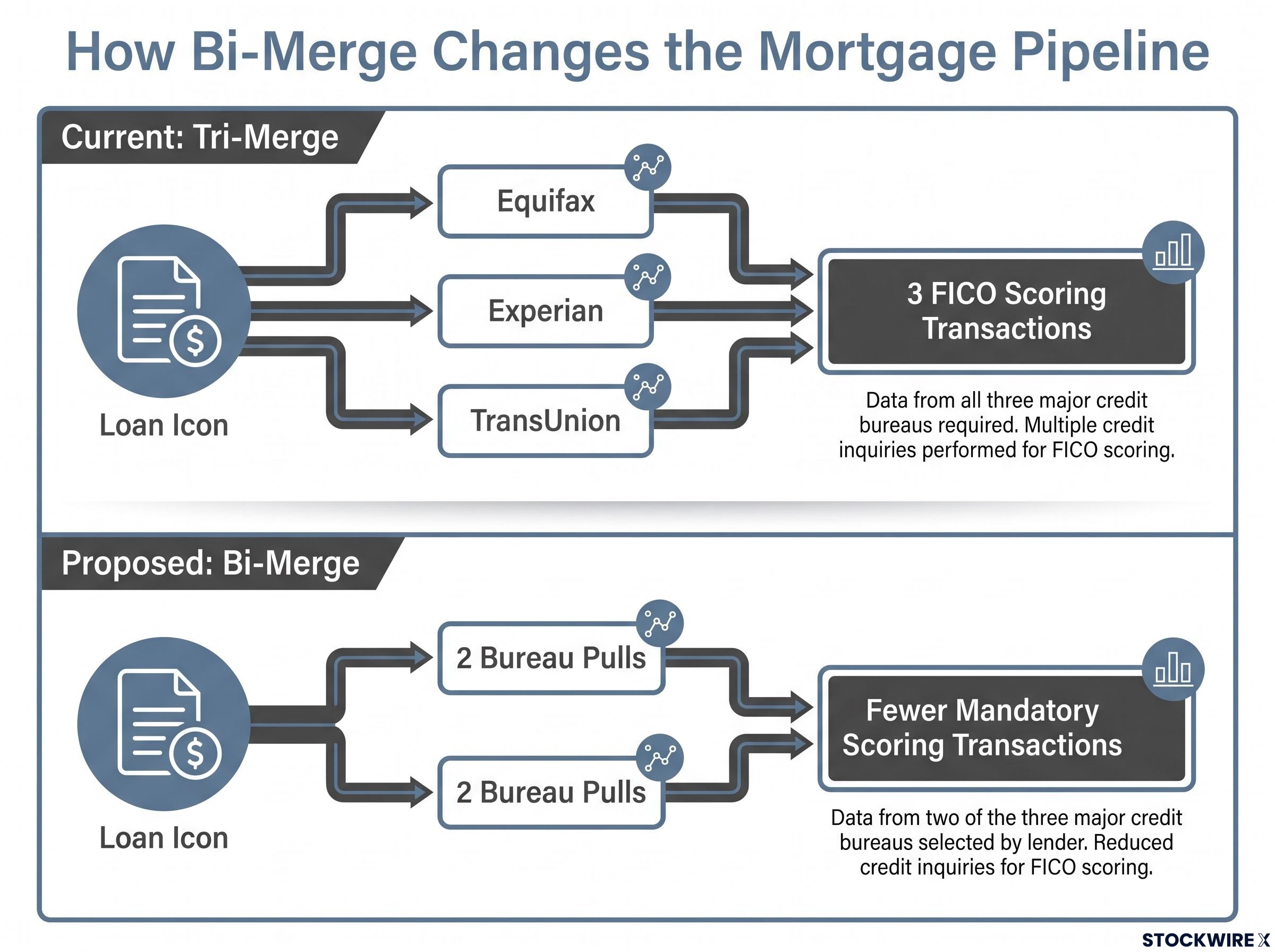
Under the current tri-merge system, a lender originating a loan for sale to Fannie Mae or Freddie Mac must pull credit data from all three major bureaus: Equifax, Experian, and TransUnion. A FICO score has long been the standard metric attached to each of those files. That means every single origination generates three bureau pulls and three associated FICO scoring transactions.
A bi-merge rule changes that arithmetic directly. Lenders would be permitted to pull from any two of the three bureaus, cutting the mandated files per loan.
The contrast is what matters:
- Tri-merge (current): three bureau pulls per loan, three FICO scoring transactions, no lender optionality on bureau count.
- Bi-merge (proposed): two bureau pulls per loan, fewer mandatory scoring transactions, and lenders gain the ability to route around the most expensive combinations.
That reduction is not an abstract policy shift. It is a direct compression of the transaction volume on which FICO’s mortgage-segment revenue depends. Fewer mandated pulls mean fewer fee-bearing score transactions and weaker pricing leverage across the pipeline. Any analyst reassurance has to be weighed against that mechanical fact first.
What 12 October in Chicago could set in motion
Pulte has already laid the groundwork in public. On 3 September 2026 he stated the agency was “seriously considering bi-merge,” and a day later criticised “the costs of consumer credit scores” in a Bloomberg segment.
National Mortgage News, citing a person familiar with the plans, reported on 2 October 2026 that FHFA intends to direct the GSEs “within weeks” to adopt the two-bureau requirement. The same reporting places implementation one to three months after a formal announcement, putting effectiveness in roughly the November 2026 to January 2027 window.
For now, nothing is formally in force. FHFA’s own credit-score policy page, updated 2 October 2026, states that current reporting requirements, including tri-merge and bi-merge rules, remain unchanged as of that date.
When big ASX news breaks, our subscribers know first
Why the market repriced FICO so severely, and what the numbers show
The scale of the damage is the story. FICO shares did not drift lower on uncertainty; they were repriced twice in five weeks.
The week of 2 October 2026 delivered the 22.7% weekly decline tied to the bi-merge reporting. The initial Bloomberg report on the Thursday sent FICO down roughly 7% in after-hours trading, confirmed by Ground News, Yahoo Finance, and Investing.com, before the stock partially recovered during the following regular session.
That drop landed on a stock already badly bruised. September had erased nearly 49% of FICO’s value, including a roughly 27% single-day collapse on 29 September 2026.
From its September peak through the bi-merge week, FICO lost close to two-thirds of its market value across two separate FHFA policy signals, a repricing of the company’s perceived moat rather than a reaction to anything in its own results.
The September trigger was distinct from the bi-merge news. On 29 September, FHFA placed VantageScore 4.0 on the same loan-level pricing grid as FICO Classic, giving a competing score model equivalent GSE acceptance for the first time. VantageScore is jointly owned by Equifax, Experian, and TransUnion, the same three bureaus whose pull economics bi-merge would reshape.
Together the two moves form a compounding pressure. VantageScore parity increases competition on the scoring side, while bi-merge cuts mandatory transaction volume on the origination side. Each attacks a different pillar of FICO’s mortgage franchise at the same time.
| Date | Triggering event | FICO price move | Policy actor | Status |
|---|---|---|---|---|
| 29 September 2026 | VantageScore 4.0 placed on same pricing grid as FICO Classic | Approx. 27% single-day drop | FHFA | Enacted |
| 2 October 2026 | Bloomberg report of planned bi-merge directive | Approx. 7% after-hours; 22.7% on the week | FHFA (Pulte) | Anticipated |
The compounding nature of the two hits, not either one alone, is what the week’s decline is actually reflecting.
Where analysts disagree on how deep the damage actually runs
The bearish case is the louder one, and it has the price action behind it.
Fewer mandatory bureau reports per loan weakens FICO on two fronts at once: the volume of fee-bearing transactions and the pricing leverage FICO holds over lenders and bureaus. September already demonstrated how fast FHFA policy can reprice the stock. The structural reading is simple: the regulator is dismantling the assumptions that made FICO’s mortgage dominance look untouchable.
Against that, TD Cowen analyst Jaret Seiberg offers a narrower argument worth evaluating on its own terms.
“What limits risk to FICO is the MBS market, which wants the FICO score,” said Seiberg, as reported by Investing.com.
His point is specific. Investors in mortgage-backed securities continue to require a FICO score on the loans they buy, so each loan is likely to carry a FICO score regardless of how many bureaus are pulled. In Seiberg’s framing, bi-merge may compress bureau-pull economics more than it reduces FICO’s ultimate score-usage volume.
Seiberg also flags a credibility issue he calls a “consistency problem.” FHFA’s new equivalence between FICO and VantageScore sits awkwardly against earlier pricing-grid data showing VantageScore overstated credit quality by roughly 20 points relative to FICO. That inconsistency, in his view, introduces policy risk that cuts both ways and makes the durability of any preferred-score status harder to predict.
The two camps break down cleanly:
- The bearish structural case: fewer pulls mean lower volume and weaker pricing leverage; FHFA has already shown it can reprice FICO equity in a single session; the regulator appears willing to act repeatedly.
- The constrained-downside case: MBS demand keeps a FICO score on nearly every loan; bi-merge hits bureau mix more than score usage; FHFA’s own consistency problem may slow or complicate further moves.
Seiberg’s MBS floor is not a clearance signal. It identifies one mechanism that limits total score displacement, but it does not address the volume and pricing compression that bi-merge introduces at origination. That tension remains unresolved.
What the GAO precedent means for regulatory durability and what to watch
A separate layer of this story has nothing to do with scoring mechanics and everything to do with whether any Pulte directive actually sticks.
What the Congressional Review Act means for any rule Pulte announces
On 1 October 2024, the Government Accountability Office (GAO) issued an opinion titled “Federal Housing Finance Agency: Applicability of the Congressional Review Act to FHFA Bi-Merge Requirement and Determination on Two New Credit Score Models.” It concluded that FHFA’s bi-merge requirement and its determinations on new credit-score models are subject to the Congressional Review Act (CRA).
That classification matters. It means a bi-merge directive counts as a formal rule, which Congress can review and potentially overturn. A legislative challenge sits on top of the timeline and implementation uncertainty already in play.
For investors, the risk picture is layered rather than binary:
- Announcement risk: the 12 October directive is anticipated, not confirmed.
- Implementation timeline risk: effectiveness is estimated at one to three months post-announcement, roughly November 2026 to January 2027.
- CRA challenge risk: a future Congress has a formal mechanism to unwind the rule.
- Equity repricing risk: the roughly 27% single-session collapse in September shows how fast FHFA signals move the stock.
Anyone pricing in a permanent structural shift should factor that durability uncertainty into the thesis. A rule can be announced, implemented, and still fail to survive legislative scrutiny.
12 October and the signals that matter now
The near-term calendar converges on one date. A formal bi-merge directive from Pulte at the MBA conference on 12 October 2026 would confirm the policy direction and start the implementation clock.
The absence of an announcement would be a signal too. It would point to either a delayed timeline or a scaled-back directive, and either reading would move FICO’s near-term trajectory.
For readers tracking FICO, the mortgage credit space, or the three major bureaus, these are the specific signals to watch:
- Whether Pulte formally announces bi-merge at the MBA conference on 12 October.
- Any formal FHFA rule filing, which would start the CRA review window.
- Which bureau combinations lenders choose once optionality exists, and whether FICO scores stay embedded regardless.
- MBS investor acceptance of VantageScore-scored loans, which would directly test Seiberg’s floor thesis.
- Any Congressional action triggering a CRA review.
As of 3 October 2026, FHFA’s credit-score page still shows no formal bi-merge rule issued. The 12 October event is what converts a widely reported expectation into either a policy reality or a notable non-event, and that distinction will move the market.
What this regulatory pattern means for FICO’s franchise going forward
Step back from the individual headlines and a pattern emerges. Within five weeks, FHFA has moved to equalise scoring models through VantageScore parity and is now signalling a reduction in mandatory bureau-pull volume through bi-merge. That is simultaneous pressure on both the competition and the transaction-volume dimensions of FICO’s mortgage moat.
FICO’s franchise has not been eliminated, but the assumption that it was structurally insulated from GSE policy is no longer defensible without qualification.
What remains intact is worth stating plainly. FICO scores are still embedded in the MBS market, no formal rule had been issued as of 3 October 2026, and the CRA durability question keeps the ultimate outcome genuinely open. Seiberg’s MBS-floor argument stands as the most concrete counterweight to the structural-erosion case.
The question that cannot yet be answered is the one that matters most for a long-term view: whether FHFA’s direction under Pulte is a one-cycle reset or the opening of a sustained campaign to reduce FICO’s dominance in the GSE market. The cumulative repricing, a near-49% September decline followed by a 22.7% weekly fall, shows the market is not waiting for the answer.
This article is for informational purposes only and should not be considered financial advice. Investors should conduct their own research and consult with financial professionals before making investment decisions. These statements are speculative and subject to change based on market developments and company performance.