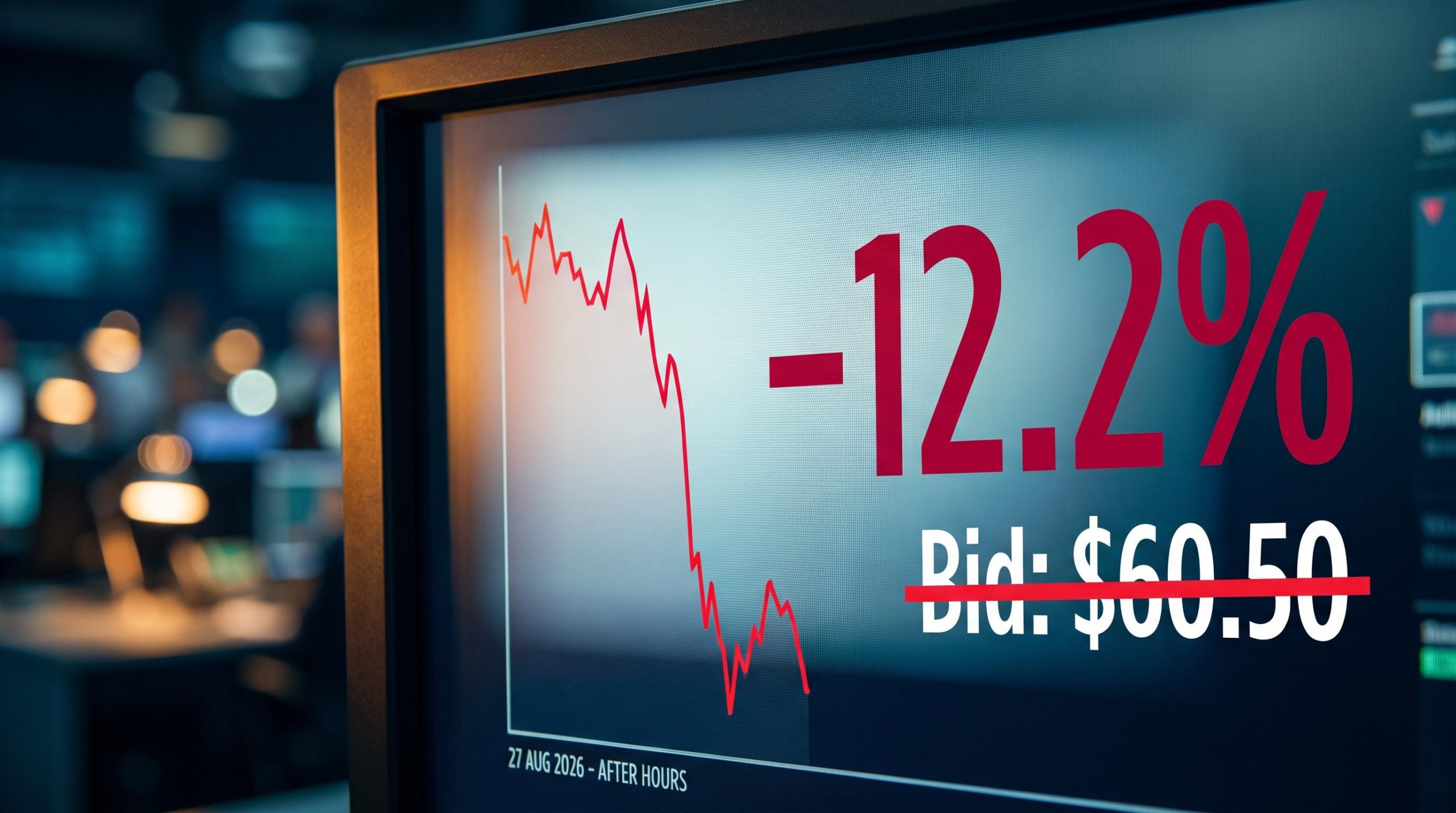
PayPal shares had been priced at levels reflecting a live acquisition when markets closed on 27 August 2026. By the time after-hours trading was done, they were approximately 12.2% lower. Bloomberg had confirmed that the Stripe–Advent International consortium walked away from its $60.50-per-share bid, and with it went every point of the takeover premium the stock had been carrying.
The collapse illustrates one of the most expensive mistakes retail investors make during takeover speculation: treating the gap between the current price and the offer price as a near-certain gain rather than a probability-weighted bet. The stock’s entire ascent from a 52-week floor of $38.46 had been built on deal expectations rather than any improvement in the underlying business. Anyone who bought into that move was holding a position whose value rested entirely on a transaction that has now ceased to exist.
What follows here is a practical framework built around the PayPal case for recognising when a stock’s price is being carried by acquisition hopes, understanding the risks of takeover speculation, and making a rational decision when those hopes disappear.
From $60.50 to nowhere: how PayPal’s acquisition unravelled
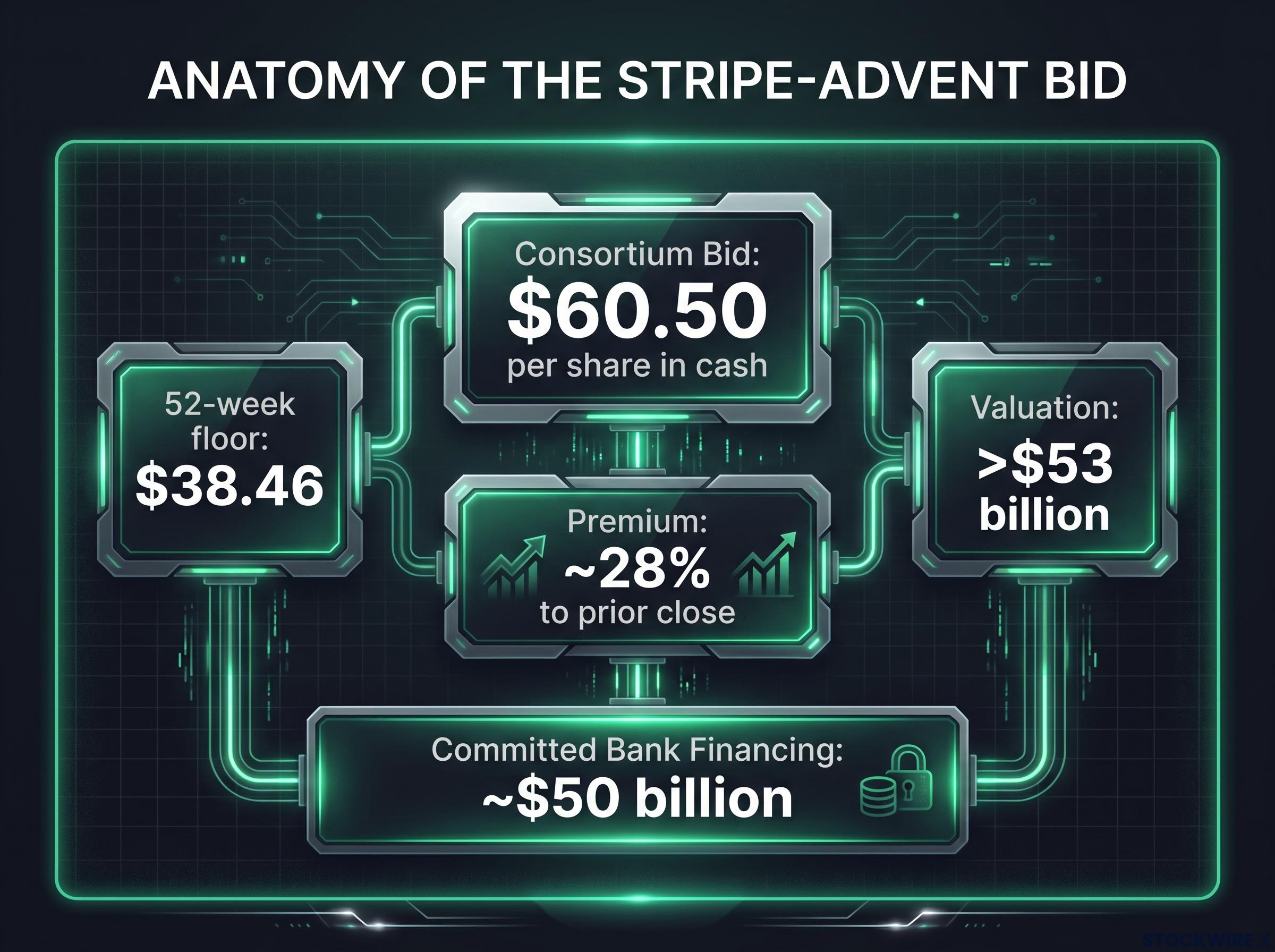
The sequence moved fast, even by deal standards. In April 2026, Block made an initial approach to PayPal, but exited before any formal offer materialised. By mid-July, a new consortium had taken shape: Stripe and private equity firm Advent International jointly offered $60.50 per share in cash, valuing PayPal at more than $53 billion. Behind the bid sat approximately $50 billion in committed bank financing, meaning the vast majority of the purchase price would have been funded with debt.
That level of committed financing signalled a deal that had moved well beyond exploratory conversations. Banks had underwritten the debt. Advisers were engaged. The machinery of a major acquisition was in motion.
Then the board pushed back. PayPal‘s directors, working with Goldman Sachs and Evercore, rejected $60.50 as inadequate and indicated they expected a higher offer. Reports through August suggested talks continued, and headlines hinted a revised bid might emerge.
The board’s confidence in rejecting $60.50 made more sense in the context of opening offer dynamics, where an unsolicited non-binding bid backed by committed financing is typically positioned as a floor, with analyst consensus including public commentary from Michael Burry pointing to a competitive auction range of $70-$100 per share.
It did not. On 27 August, Bloomberg confirmed that the consortium had dropped its pursuit of the company entirely. PayPal shares, which had declined just 0.55% during the regular session, shed approximately 12.2% in after-hours trading once the market was forced to price the stock on its own merits.
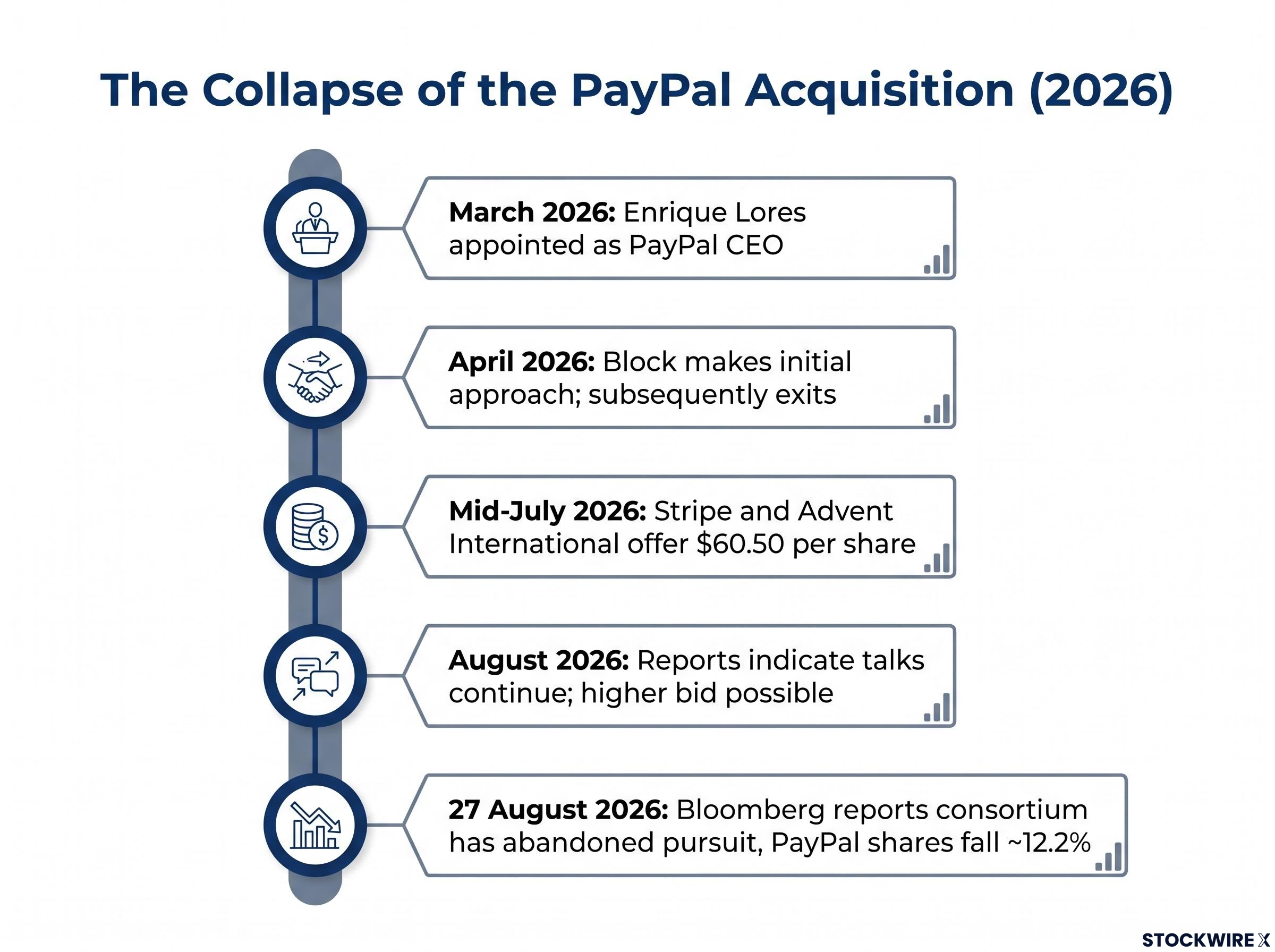
| Date | Event |
|---|---|
| March 2026 | Enrique Lores appointed as PayPal CEO |
| April 2026 | Block makes initial approach; subsequently exits |
| Mid-July 2026 | Stripe and Advent International offer $60.50 per share |
| August 2026 | Reports indicate talks continue; higher bid possible |
| 27 August 2026 | Bloomberg reports consortium has abandoned pursuit |
| 27-28 August 2026 | PayPal shares fall ~12.2% in after-hours trading |
The speed of the reversal is the signal worth sitting with. $50 billion in committed bank financing, formal board engagement, two major advisers, and months of negotiation produced nothing. “Advanced negotiations” and “committed financing” are not a closed deal, and the distance between the two is where the risk lives.
PayPal shares fell approximately 12.2% in after-hours trading on 27 August 2026, the moment Bloomberg reported the Stripe–Advent consortium had walked away.
When big ASX news breaks, our subscribers know first
What a takeover premium actually is, and why it can trap retail investors
A takeover premium is the additional value the market assigns to a stock once a credible acquisition bid becomes public. It reflects what an acquirer is willing to pay above the pre-rumour price for control of the company. In PayPal‘s case, the $60.50 bid represented approximately a 28% premium to the prior close when the offer was reported, and shares rallied sharply on the news.
That premium had done heavy lifting. Before deal speculation entered the picture, PayPal had bottomed at a 52-week low of $38.46. The climb back from that level owed nothing to stronger payment volumes or improving margins; it was sentiment around a potential sale that did the work. As the $60.50 figure became widely known, the stock gravitated toward prices that implicitly assigned a substantial probability to deal completion, with standalone business value a secondary consideration at best.
Professional merger-arbitrage funds operate in this gap between the market price and the offer price. They hedge their positions, model legal and regulatory risk, stress-test financing structures, and size their positions for the possibility of failure. Retail investors often imitate the behaviour without replicating the infrastructure, and the payoff profile punishes that imbalance:
The professional definition of risk that applies most directly to this situation is permanent capital loss, not price volatility; retail investors who bought PayPal near $58-59 on deal expectations did not face a small drawdown risk but the prospect of owning a position whose entire justification had ceased to exist.
- If the deal closes, the remaining upside is limited to the spread between the current price and the offer, often a few percentage points at most.
- If the deal breaks, the downside is large, sudden, and proportional to how much of the stock’s value was built on deal expectations rather than business performance.
- What the retail investor typically lacks is the hedging, legal analysis, and position-sizing discipline that professional arbitrageurs use to manage the second scenario.
Why the spread is not free money
The spread between a target’s current price and the offer price is not a guaranteed return waiting to be collected. It is the market’s probability-weighted estimate of deal risk, baked into the price by participants who are constantly modelling whether the transaction will close.
Merger-arb funds price this spread using legal, regulatory, and financing analysis that most retail investors cannot replicate. A retail investor who bought PayPal near $58-59 after the $60.50 offer was reported was not making a small, bounded bet on a $1-2 spread. They were implicitly underwriting the full risk of a deal that the board had already called inadequate, with no hedge attached.
Four signals that a stock is priced on deal hope, not underlying value
The PayPal case produced four observable signals that a stock’s price is being carried by acquisition speculation rather than business performance. Each one is something you can check against your own holdings.
- The biggest price moves track deal headlines, not earnings or operating updates. PayPal‘s sharp rally followed reports of the $60.50 bid and later stories that negotiations were intensifying. There was no equivalent operational catalyst, no sudden inflection in revenue growth or margin improvement, driving the same magnitude of moves.
- The price clusters near the rumoured offer. Once the $60.50 figure was widely reported, PayPal traded around levels that implicitly assumed a meaningful probability the deal would close. The stock’s behaviour was anchored to the bid, not to any consensus view of standalone value.
- Corporate language shifts to “strategic options” and “reviewing alternatives.” PayPal was working with advisers Goldman Sachs and Evercore to review strategic options while suitors circled. That language is a hallmark of active sale exploration, and it tells you the company itself is being positioned as a transaction, not just a business.
- Valuation looks stretched unless a control premium is assumed. At deal-driven prices, PayPal‘s implied valuation was justified mainly by the bid itself and expectations of a premium for control, not by consensus views of standalone earnings power.
If a stock passes all four of these tests, what you are buying is not a business at an attractive valuation. You are buying a deal at an uncertain probability. Those are fundamentally different risk profiles that require different decision-making frameworks.
The pattern is not unique to PayPal: unverified acquisition reports sent eBay shares surging more than 12% in after-hours trading on 1 May 2026, with no SEC filings or company statements confirming a formal offer existed, illustrating how rapidly markets price deal probability into share prices before any bid is confirmed.
Investors paying for deal probability, not the underlying business, face a payoff structure that is asymmetric by design: limited upside if it closes, large downside if it breaks.
Evaluating PayPal without the deal: what the fundamentals actually say
With the takeover premium stripped out, two types of PayPal holders face very different decisions.
If your thesis was always about PayPal‘s long-term standalone business, its payments infrastructure, its market position, its cash generation, then the deal collapse changes the timeline but not necessarily the investment case. The question is whether the post-withdrawal price now represents fair value for that business.
If your thesis was the deal itself, that thesis was invalidated on 27 August. Holding the stock on residual hope that another buyer will appear is speculation, not analysis, and the obstacles that stopped this deal apply equally to any future acquirer.
The board’s rejection of $60.50 as inadequate is worth interpreting carefully. It signals management’s belief that PayPal can be worth more over time if its standalone strategy succeeds. But that is a bet, not a guarantee, and you need to judge whether it is well-founded.
Four business variables now determine the standalone case:
- Payment volume growth and whether PayPal can hold or expand share against competitors
- Fee take rates and pricing power in an increasingly competitive market
- Margin trajectory as the company manages costs against slowing growth
- Venmo monetisation and whether this asset can become a meaningful revenue contributor
The regulatory and financing concerns that helped kill the deal also limit the probability of a quick replacement bidder. The heavy debt load required to fund a $53 billion-plus transaction, combined with the current antitrust environment, means investors should not default to “another buyer will come” as a base case. Stripe, Block, Apple Pay, and Google Pay remain the competitive reality PayPal must navigate as an independent company.
| Consideration | Deal-thesis holder | Fundamental-thesis holder |
|---|---|---|
| Current thesis validity | Invalidated; deal no longer exists | Unchanged; standalone case intact if metrics support it |
| Key variables to monitor | Whether a new bidder emerges (speculative) | Payment volumes, take rates, margins, Venmo monetisation |
| Appropriate next step | Re-evaluate on standalone fundamentals or exit | Assess whether post-drop valuation is attractive vs. peers |
This article is for informational purposes only and should not be considered financial advice. Investors should conduct their own research and consult with financial professionals before making investment decisions.
One question every investor should ask before the next deal rumour
The PayPal case distils into a single question worth carrying into every takeover situation you encounter: what is this stock worth without the deal?
“What is this stock worth without the deal?”
That question immediately reveals whether you are holding a business or holding a speculation. PayPal recovered from $38.46 on deal expectations. It shed approximately 12.2% in after-hours trading the moment those expectations disappeared. The gap between those two realities is the cost of not having answered the standalone-value question before buying.
Even well-resourced boards cannot guarantee deal outcomes. PayPal had Goldman Sachs and Evercore advising. It had a consortium with $50 billion in committed financing on the other side. None of it was enough.
Merger speculation is a recurring feature of markets, not a one-off event. The investors best positioned to navigate it are not the ones who monitor deal headlines most closely. They are the ones who can answer the standalone value question before they buy, and who recognise that the spread to an offer price is a probability, not a promise.
For investors wanting a step-by-step framework to answer the standalone value question before the next deal rumour arrives, our dedicated guide to margin of safety stock valuation walks through a 15% return hurdle methodology with worked examples for assessing whether any price, post-deal-collapse or otherwise, offers genuine downside protection.
Past performance does not guarantee future results. These statements are speculative and subject to change based on market developments and company performance.