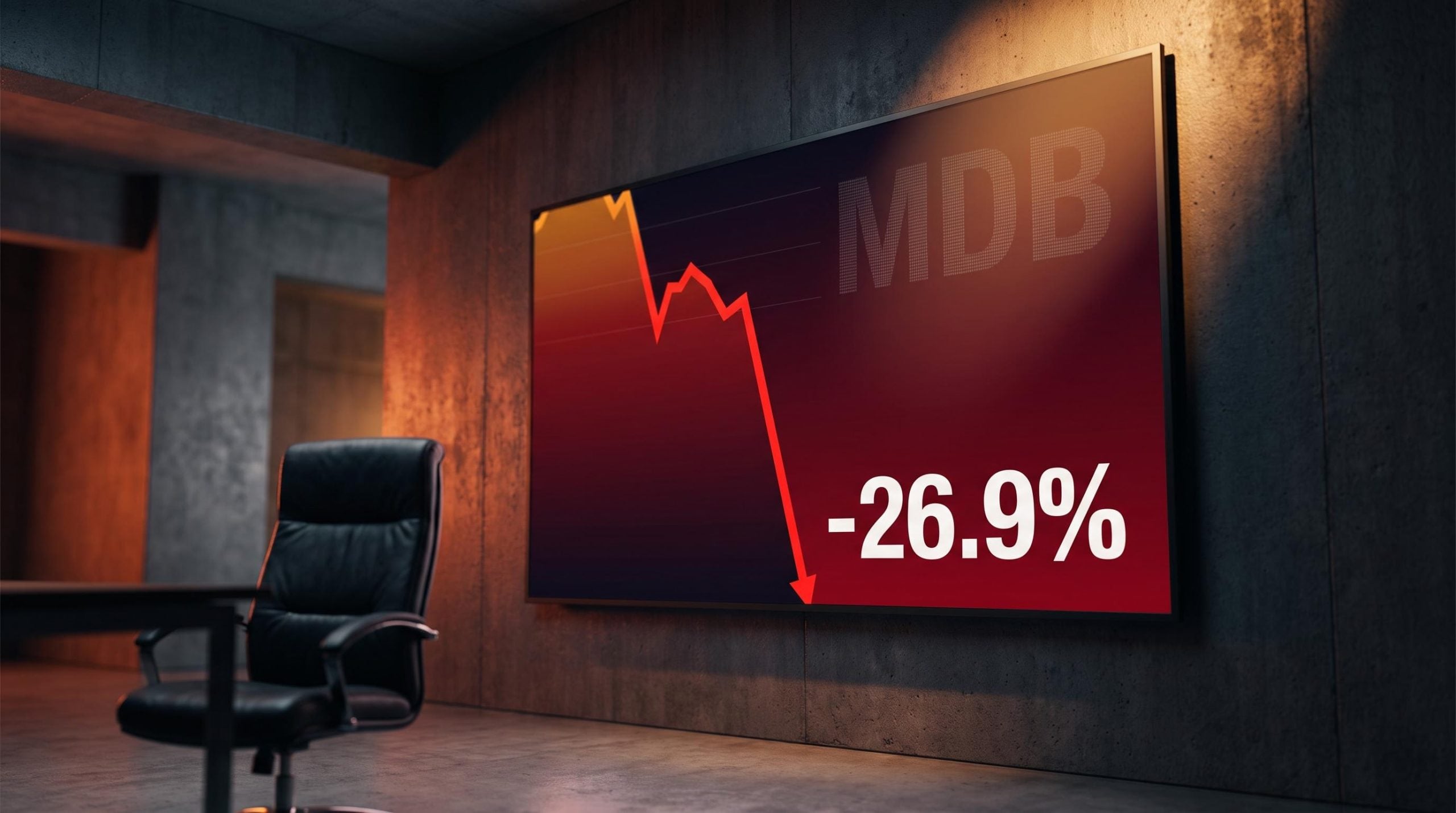
On 28 September 2026, MongoDB’s stock fell nearly 27% at its worst point in a single session. The company did not miss earnings. No product failed. No regulator knocked on the door. One executive simply decided to take a different job.
That is the entire trigger. A resignation letter erased more than a quarter of a company’s market value in a matter of hours, and the disproportion between cause and consequence is exactly what makes this episode worth understanding.
What happened at MongoDB is a real-time illustration of something markets underweight until it slaps them: executive identity risk, where investor confidence becomes so tightly bound to one person that their exit lands like a fundamental shock even when the business itself has not changed. Two amplifiers made this case extreme. The timing (one day before Investor Day) and the destination (Meta, a platform rival) turned an already jarring move into a rout.
Here is what you will walk away with: a way to tell the difference between a selloff driven by real business deterioration and one driven purely by sentiment and uncertainty, plus a concrete set of signals to check before you act on either interpretation.
One resignation letter, a 27% collapse: what actually happened at MongoDB
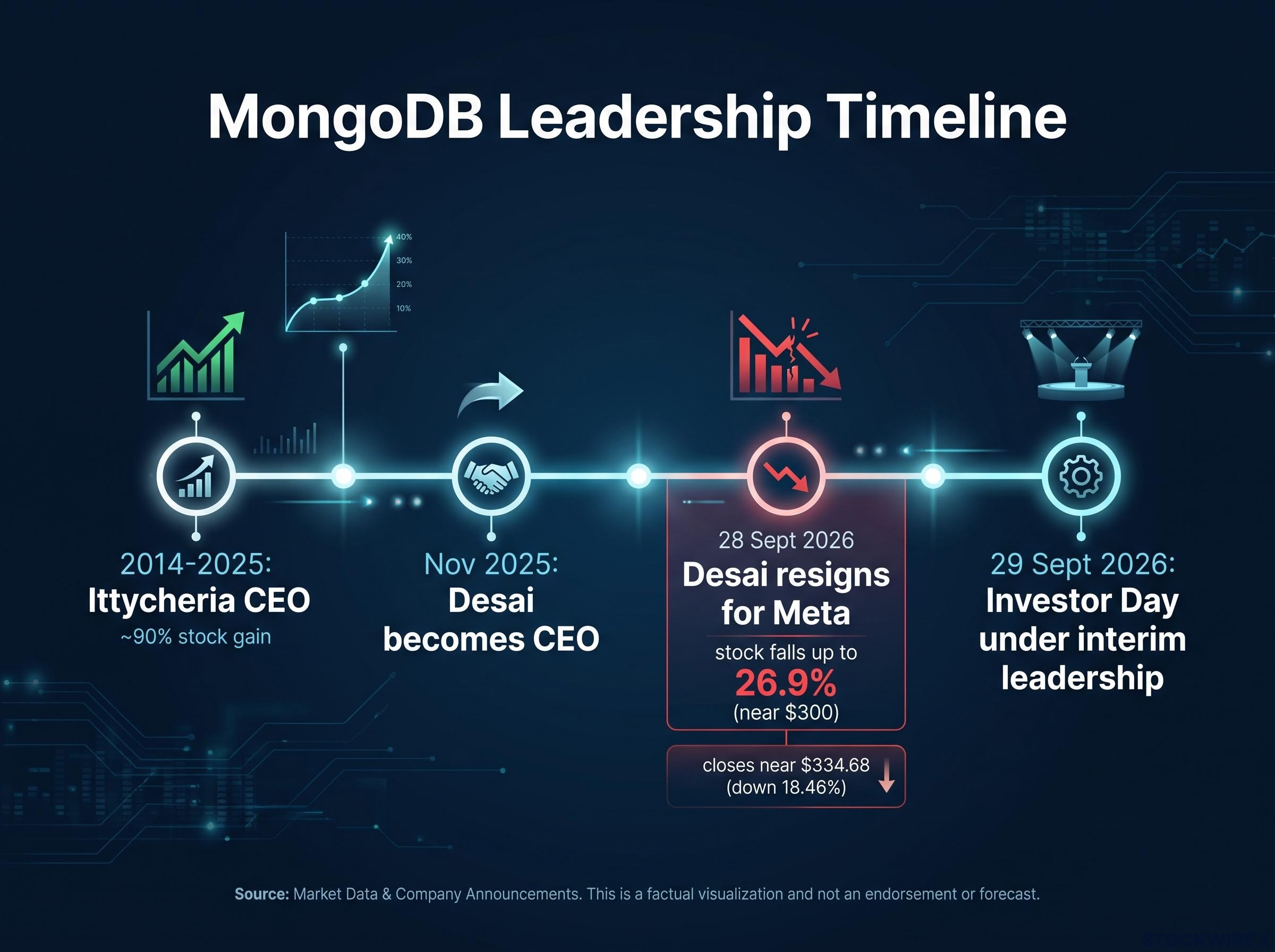
The story begins in November 2025, when Chirantan “CJ” Desai took over as president and chief executive of MongoDB, inheriting the role from Dev Ittycheria. He would hold it for less than a year.
On 28 September 2026, Desai resigned effective immediately. His destination was not retirement and not a quiet advisory seat. He was joining Meta Platforms as Chief Enterprise Platform Officer, reporting directly to Mark Zuckerberg, with a mandate focused on selling artificial intelligence and infrastructure solutions to enterprise customers. Zuckerberg confirmed the appointment in writing.
Then came the detail that turned a difficult announcement into a genuine shock. Desai walked out the door one day before MongoDB’s scheduled Investor Day at Nasdaq MarketSite, the exact event where investors expected to hear his strategic vision laid out in full.
The market’s response was violent. Shares opened down roughly 24%, then slid to an intraday low near $300, a decline of about 26.9% from the prior close. Buyers eventually stepped in, and the stock recovered around 13.5% off that bottom to close near $334.68, still down approximately 18.46% on the day.
| Intraday metric | Figure |
|---|---|
| Opening decline | Approximately 24% |
| Intraday low | Near $300 |
| Intraday low decline | Up to 26.9% |
| Recovery from low | Approximately 13.5% |
| Closing price | Approximately $334.68 |
| Closing decline | Approximately 18.46% |
To steady the ship, MongoDB’s board reinstated Ittycheria as interim president and CEO, effective immediately, while it searches for a permanent replacement. This is the same executive who ran the company from 2014 to 2025 and oversaw a stock gain of roughly 90% during that stretch.
| Date | Event |
|---|---|
| 2014 | Ittycheria begins tenure as MongoDB CEO |
| November 2025 | Desai becomes MongoDB president and CEO |
| 28 September 2026 | Desai resigns; Meta appointment confirmed; stock falls ~18.5% |
| 29 September 2026 | Investor Day proceeds under interim leadership |
A CEO who lasted under a year, leaving the day before a major investor event, is not a routine transition. Hold that framing, because everything that follows rests on it.
When big ASX news breaks, our subscribers know first
Why CEO departures hit stock prices so hard: the mechanics behind the shock
A CEO departure that wipes out a quarter of a company’s value feels irrational until you unpack the machinery underneath it. The severity is not random. It follows a logic shaped by how replaceable the executive looks, where they are going, and how abruptly they left.
Five factors compounded at MongoDB, each one making the drop worse than the last.
A CEO departure is almost always the final, public conclusion of a prolonged private board deliberation within the corporate governance hierarchy, meaning the announcement visible to markets is the last chapter of a process that insiders have been navigating for some time.
- Key-person risk: When a company’s strategic identity and growth story become publicly fused with one leader, their departure removes not just management capacity but the confidence premium the market attached to that individual.
- The unplanned-departure signal: An abrupt exit “effective immediately” gets read as a possible flag for undisclosed problems, board disagreements, or looming strategic change, even when none are confirmed.
- The destination effect: Desai did not retire. He moved to a direct platform competitor, which raises the spectre of proprietary knowledge migrating to a far larger rival.
- The timing amplifier: An exit announced one day before Investor Day injects leadership uncertainty at the precise moment investors are focused on future direction, spiking the uncertainty premium.
- Narrative disruption: The prevailing bullish story (new CEO, sharpening AI positioning, strong growth) snapped in an instant, forcing a rapid reset of expectations.
Academic research supports the intuition. Studies in the Journal of Financial Economics and related literature (a research direction rather than a confirmed single citation here) repeatedly find that markets react more sharply to unplanned CEO exits, particularly when the departing leader is seen as central to strategy. In that literature, unplanned changes behave less like ordinary news and more like regime shifts. Investors Business Daily captured the mood in one word, calling the news a “shocker.”
CEO turnover research from the New York Fed finds that equity volatility increases measurably after leadership changes, with forced departures and outside successions producing the sharpest market reactions, a pattern that maps directly onto the MongoDB episode.
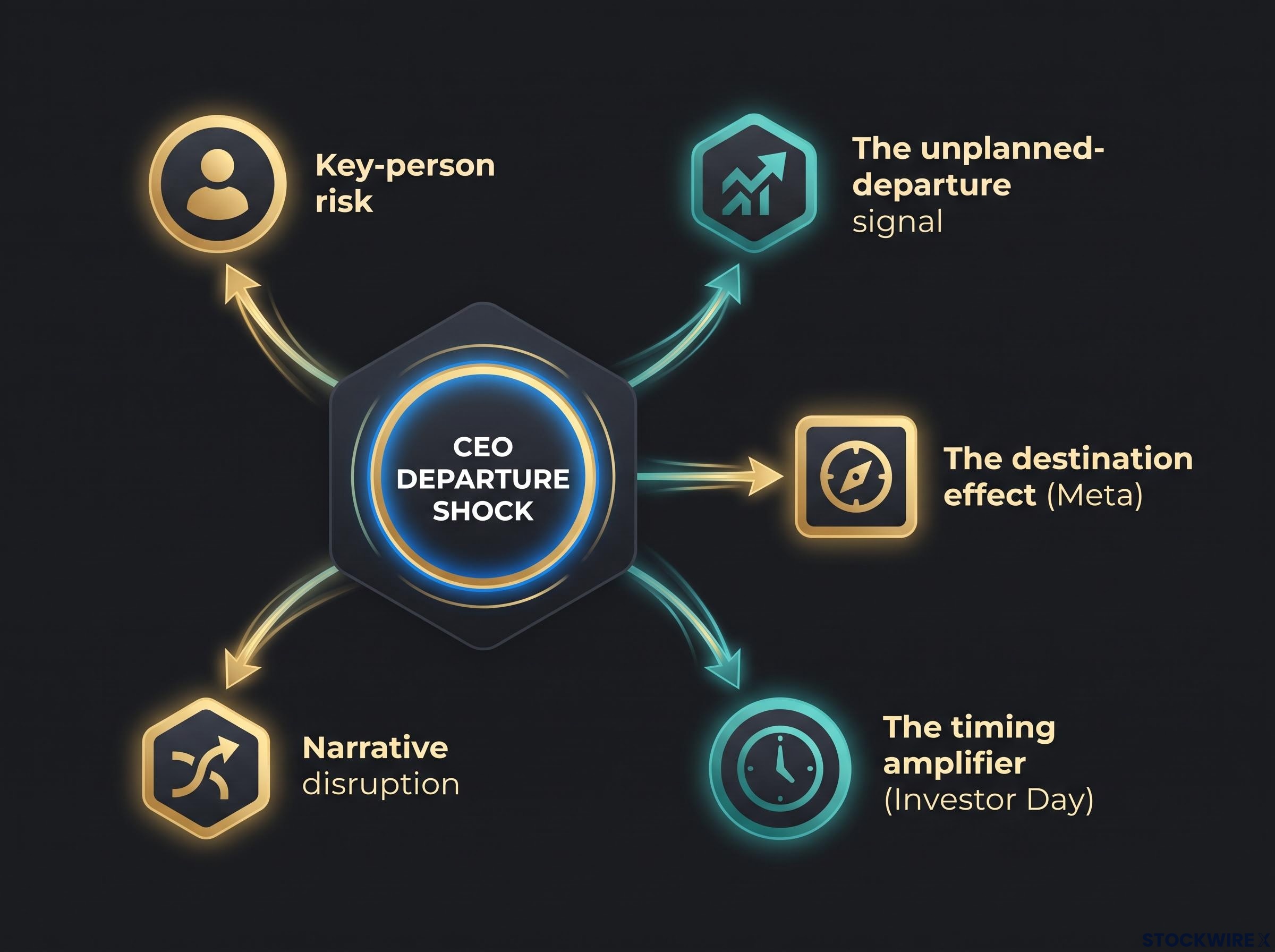
What this tells you is that a CEO-departure selloff has a predictable shape. Once you can name the five factors, you can assess the next event in minutes rather than reacting to the price move alone.
When the destination matters: why going to a rival changes the calculus
There is a categorical difference between a CEO who retires and one who walks straight into a competitor’s leadership team.
Desai’s new role at Meta sits on the exact competitive terrain where MongoDB operates: enterprise AI and infrastructure. His familiarity with MongoDB’s customer strategy, AI positioning, and product roadmap now lives inside a rival with vastly deeper resources.
That is why the destination amplifies the fear. A departure to a non-competing role removes a leader; a departure to a direct rival removes a leader and potentially arms the competition with insider perspective on how you win enterprise deals.
Sentiment shock or genuine red flag? How to read the competing interpretations
So was the market right to panic, or did it overshoot? The honest answer is that both camps have a legitimate evidential basis, and your job is to know which signals would tip you from one to the other.
The overreaction camp points to what did not change. MongoDB reaffirmed its guidance after the announcement, with no new adverse information about demand, margins, or competitive position. Analyst commentary leaned on valuation language rather than fundamental damage. Stifel noted the stock trading at roughly 6.5x CY28 revenue following the selloff, describing the move as valuation compression, not impairment, and still characterising MongoDB as strategically well positioned.
Stifel’s read: MongoDB trading at approximately 6.5x CY28 revenue after the drop, framed as valuation compression rather than fundamental deterioration.
The concern camp is not merely emotional. A CEO leaving in under a year, an improvised succession that reinstates a former CEO on an interim basis, and unresolved Investor Day messaging are real governance signals. They point to possible succession-planning gaps or board-level friction that could carry long-term weight.
Here is the diagnostic that separates the two readings.
| Points to sentiment overreaction | Points to legitimate concern |
|---|---|
| Guidance reaffirmed, no new adverse data | CEO exit after less than one year |
| Analyst language about multiples, not earnings cuts | Improvised interim succession |
| Company still called strategically well positioned | Unresolved near-term strategic messaging |
| Valuation compression, not revenue impairment | Departure to a direct competitor |
The Stifel multiple is the single most useful data point here, because it shows how sophisticated investors are reading the event: as a price dislocation, not a business breakdown. That is the distinction to internalise before you consider acting.
Without this framework, you fall into one of two traps. You either sell into the panic and lock in a loss driven by sentiment, or you shrug off a real governance risk because the numbers still look fine on paper. The framework exists to keep you out of both.
The intraday pattern on 28 September, a 27% plunge followed by a 13.5% recovery before the close, is a compressed illustration of why panic selling is most costly at exactly the moment it feels most justified, with sellers who exited at the $300 intraday low locking in the maximum loss just as buyers were stepping in.
What to actually watch after an event-driven selloff: a practical framework
“It’s down a lot” is not a thesis. Buying early into a leadership-uncertainty event can mean catching a falling knife if fresh governance details keep surfacing, so the useful question is never simply whether the stock is cheap. It is whether the uncertainty is resolving or deepening.
Turn the MongoDB case into a reusable checklist you can run against any future CEO-departure selloff.
- Is guidance reaffirmed with no new adverse disclosures? Reaffirmed numbers are the central signal that a decline reflects sentiment rather than substance.
- Is analyst language about multiples or about earnings cuts? Talk of valuation compression suggests dislocation; talk of revenue impairment suggests real deterioration.
- How clear is the succession plan? An improvised interim appointment, as at MongoDB, carries more governance risk than a prepared handover.
- Are long-term institutional holders standing pat? If major shareholders materially cut positions, that is a stronger signal than any single-day price move.
- Does technical support give a risk-management reference point? Use it to size a position or set a stop, not as a standalone reason to buy.
Position sizing matters more than a binary buy-or-avoid call. Governance uncertainty argues for calibrating size to the unresolved risk and making sure your time horizon can absorb the full length of a permanent CEO search. The search itself is the dominant variable, and it will keep injecting uncertainty until a permanent appointment lands.
Historically, where a respected successor with a clear mandate emerged, stocks tended to recover over weeks to months; where leadership uncertainty lingered, valuations often stayed depressed or drifted lower (a general pattern rather than confirmed precedent data). MongoDB now closes near $334.68, and your forward monitoring begins from there.
Reading the technical picture without over-relying on it
Analysis of MongoDB’s chart after the selloff flagged a technical support level near $290. Support levels reflect where prior buying has clustered and where sellers are likely to meet resistance, not a guaranteed floor.
That distinction is the whole point. The $290 level tells you where the market may find a floor if selling pressure continues. It does not tell you whether you should own the stock at all.
Its relevance is also conditional. If further adverse fundamental or governance information emerges, a support level can break as easily as it holds, which is why it belongs at the end of your checklist, not the start.
What the MongoDB episode tells us about leadership risk as a permanent market variable
Step back from the specifics and MongoDB stops looking like an anomaly. It looks like a clean illustration of a structural feature of modern equity markets: narrative-dependent valuations create outsized sensitivity to leadership change, because part of the price is a premium for a specific person rather than the business alone.
That reframes the whole event. Ittycheria’s earlier tenure produced roughly 90% in stock appreciation, which tells you how much leadership-embedded premium the market had built into MongoDB over the years. The 28 September drop reads less as pure panic and more as the partial unwinding of that confidence premium.
The forward question is no longer what Desai’s exit meant. It is whether the permanent CEO search produces a successor capable of re-anchoring the strategic narrative and restoring that premium. Broader precedent from high-profile transitions at companies such as Apple, Salesforce, and Uber (offered as context rather than confirmed comparison) suggests the medium-term outcome usually turns on successor quality and succession clarity, not on the departure itself.
Broader precedent from high-profile transitions suggests medium-term outcomes turn on successor quality and succession clarity, and the contrast with Berkshire Hathaway’s deliberately staged handover to Greg Abel illustrates just how much a prepared transition can insulate a stock from the confidence-premium collapse MongoDB experienced.
MongoDB’s Investor Day on 29 September 2026 now proceeds under a leadership context nobody expected 48 hours earlier, with Ittycheria’s interim status the unresolved variable most likely to drive price action in the near term.
The takeaway principle: Before investing in any company where one leader dominates the strategic narrative, ask what the stock would look like the day that person announced their departure. If the answer is “dramatically lower,” that is key-person risk embedded in the valuation, and it deserves explicit position-sizing consideration.
This article is for informational purposes only and should not be considered financial advice. Investors should conduct their own research and consult with financial professionals before making investment decisions. Past performance does not guarantee future results, and forward-looking statements are speculative and subject to change based on market developments and company performance.