
United Slashes 2026 Profit Outlook 40% as Iran War Hits Fuel
3 hrs ago

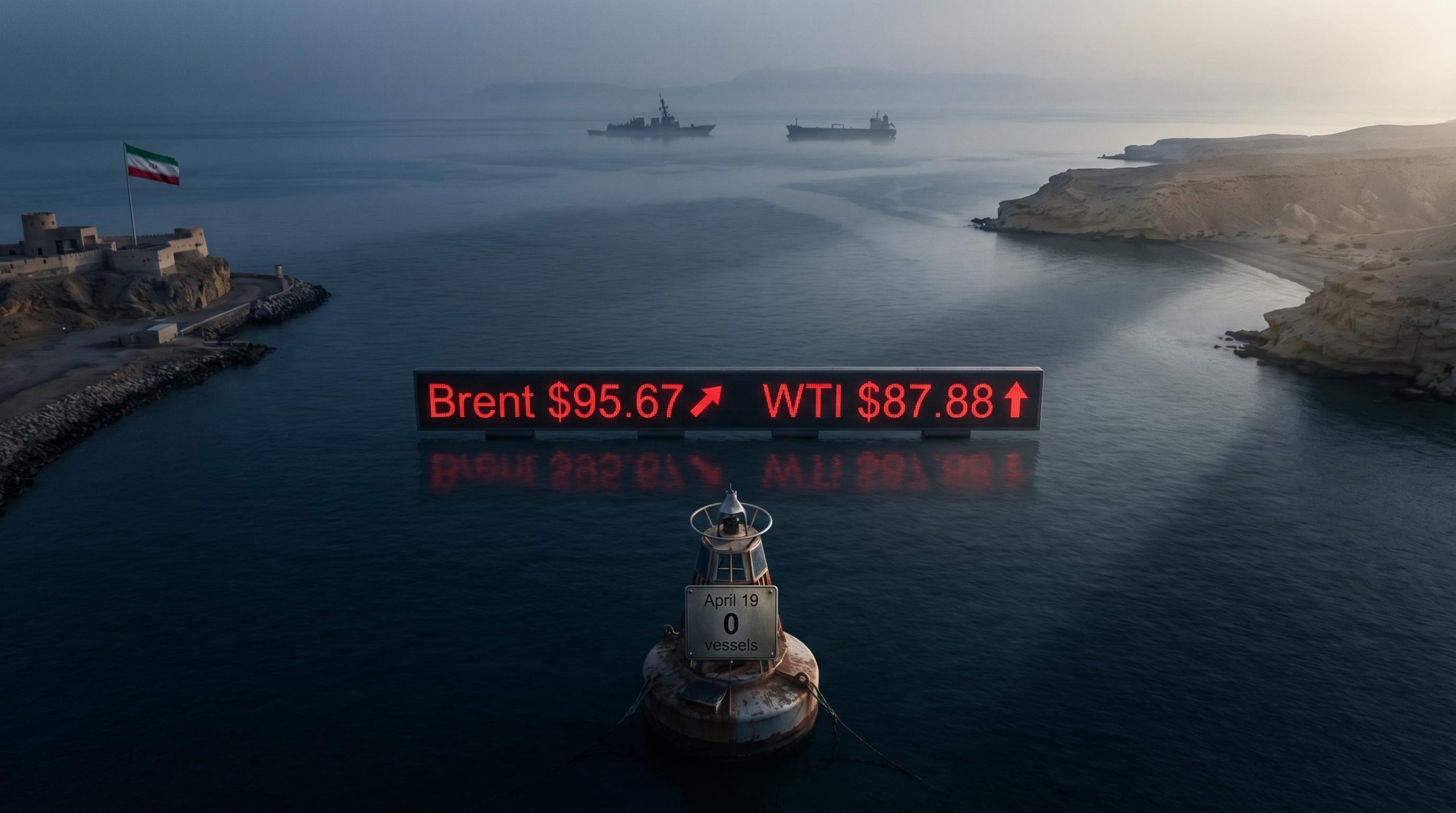
The Strait of Hormuz carried zero commercial tankers on Sunday, a chokepoint that normally handles approximately 20-30% of global seaborne oil, as the U.S.-Iran ceasefire approaches expiration on April 22 with no extension in sight. Peace talks scheduled for April 20-21 in Islamabad remain in doubt after Iran indicated it has “no plans for now to participate,” while U.S. naval forces seized an Iranian cargo vessel on April 19 and President Trump threatened to destroy Iranian power infrastructure if negotiations fail. What follows is a comprehensive account of how last week’s cautious optimism collapsed into Sunday’s confrontation, how oil and financial markets are responding this morning, and what the next 48 hours could mean for energy costs and portfolios globally.
Saturday brought the first real signs of de-escalation in six weeks. Over 20 vessels transited the Strait of Hormuz on April 18, the highest count since March 1, according to Kpler data. Shipping operators quietly began rerouting tankers back through the waterway. Then Sunday arrived.
U.S. Navy forces seized the Iranian-flagged cargo ship Touska in the Gulf of Oman on April 19 after the vessel ignored warnings. U.S. forces fired on the ship, disabled its engine, and boarded. The action followed the U.S. blockade of Iranian ports announced on April 13. Tehran condemned the seizure as “piracy” and threatened retaliation.
The diplomatic consequences were immediate. Iranian state media reported Tehran has “no plans for now to participate” in the Islamabad talks scheduled for today and tomorrow, where U.S. Vice President JD Vance was set to lead the American delegation. President Trump issued an explicit threat: destroy Iranian power plants and bridges if Iran refuses peace terms. He emphasised a red line on nuclear development.
The weekend’s events indicated the diplomatic thaw was brief, according to ING analysts. The ceasefire expires April 22. Three escalation points now define the crisis:
“The weekend’s events indicated the diplomatic thaw was brief.”
ING Energy Analyst
The Strait of Hormuz is a 21-mile-wide channel between Iran and Oman. Approximately 20-30% of global seaborne oil trade transits this waterway under normal conditions. On April 19, that figure was zero.
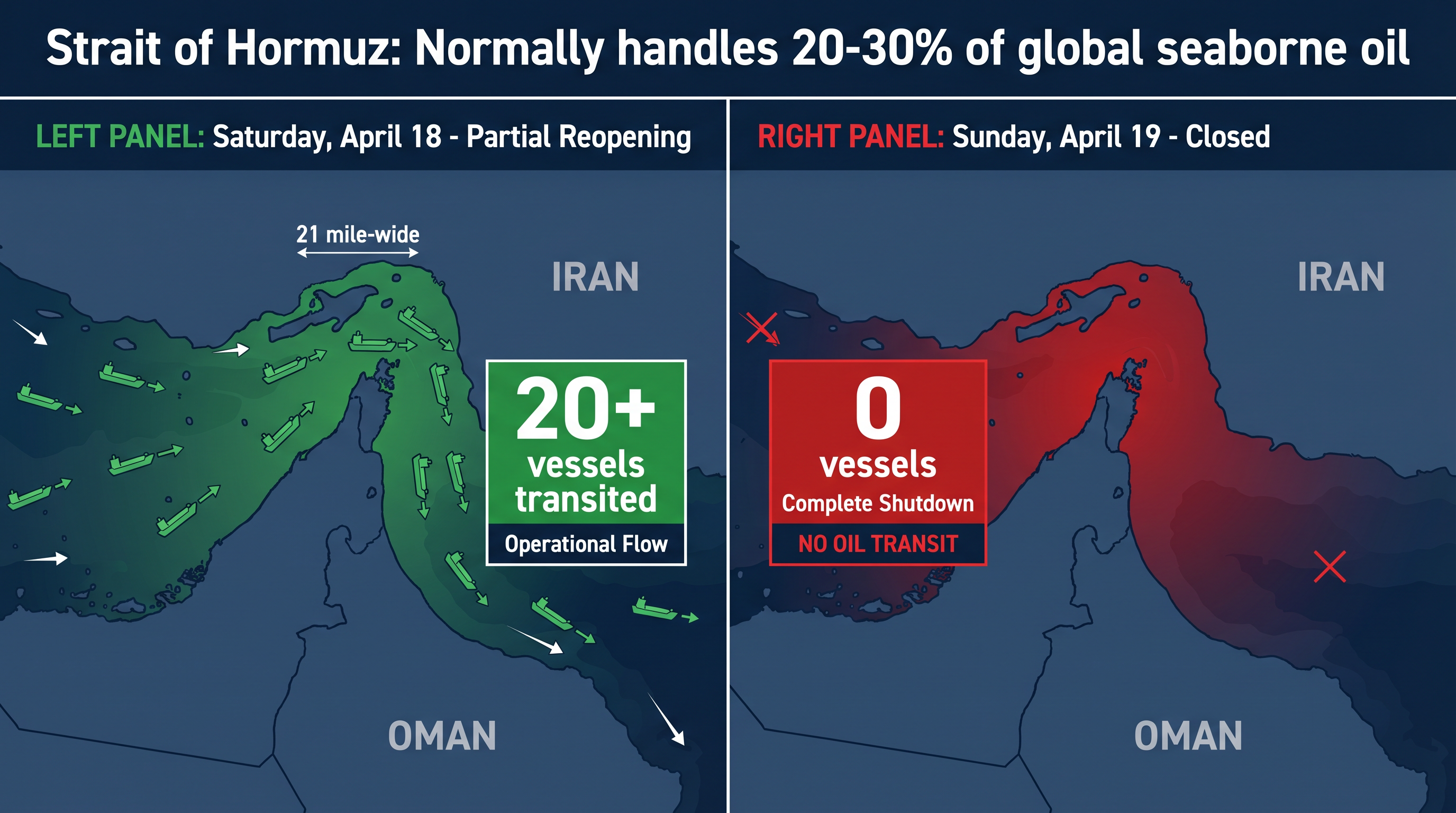
Iran reimposed the blockade following the Touska seizure. The U.S. is enforcing its own blockade of Iranian ports. No commercial tankers transited the strait on Sunday. Iranian officials issued contradictory statements over the weekend about whether the blockade had ended, then declared the strait shut again in response to U.S. actions.
The contrast with Saturday is sharp. Over 20 vessels moved through on April 18, suggesting a brief reopening window. That window closed within 24 hours.
| Date | Status | Transits |
|---|---|---|
| Saturday, April 18 | Partial reopening | 20+ vessels |
| Sunday, April 19 | Closed | 0 vessels |
For global energy consumers and investors, the Hormuz closure is the transmission mechanism turning diplomatic tension into real-world supply constraint. The physical chokepoint explains why oil prices react so sharply to each headline from the Gulf.
Brent crude traded at $95.62-$95.67 per barrel as of 03:59 ET on April 20, up over 5% overnight. U.S. WTI crude reached $87.88 per barrel, up over 5%. Both benchmarks remain below $100 per barrel but elevated compared to pre-conflict levels when the crisis began in late February 2026.
The overnight 5% surge illustrates oil price volatility driven by risk premium changes, where geopolitical events shift market pricing between baseline supply-demand fundamentals and elevated risk scenarios within hours, a dynamic that produced a 9.4% single-day crash just days earlier when similar optimism briefly emerged.
The reversal happened fast. Prices had fallen on Friday amid reopening optimism as Saturday’s 20+ transits suggested the blockade was easing. Then the Touska seizure and blockade continuation triggered the 5% surge.
Elevated energy costs have generated warnings about inflationary pressure and dampened global growth since the conflict began. The overnight price jump signals markets are pricing in prolonged disruption rather than a quick resolution.
“Oil was being driven back and forth by Middle East developments, with apparent de-escalation rapidly shifting to re-escalation.”
ING Energy Analyst
The inflation risk is the second-order economic concern that makes this more than a commodity story. Higher crude prices feed into transportation, manufacturing, and consumer goods costs globally.
Oil prices respond to Hormuz disruption because of physical supply constraint on a route with limited alternatives. When approximately 20-30% of global oil supply can no longer transit its normal path, spot prices rise to reflect scarcity.
The current blockade represents the historical magnitude of the supply disruption measured against previous energy crises, with the International Energy Agency characterising this as the largest oil market shock on record, exceeding the 1973 Arab oil embargo and 1979 Iranian Revolution disruptions in terms of barrels per day removed from global supply.
The ripple effect follows a three-step transmission mechanism:
Alternative routes exist. Tankers can reroute via the Bab el-Mandeb strait or overland pipelines. However, these alternatives cannot absorb full Hormuz capacity quickly. No mitigation measures, such as strategic petroleum reserve releases or large-scale alternative routing programmes, have been announced as of April 20.
For readers who may not follow geopolitics closely, the key principle is straightforward: chokepoint risk translates into price spikes because physical infrastructure cannot adjust overnight. The lack of announced mitigation measures underscores why markets remain on edge as the ceasefire expiration approaches.
U.S. equity futures opened sharply lower on April 20. Dow futures fell 313 points (0.6%) as of 03:29 ET. S&P 500 futures declined 37 points (0.5%). Nasdaq 100 futures dropped 141 points (0.5%), later extending losses to 1.1% by 04:28 ET. Last week’s record highs reversed as investors reassessed geopolitical risk.
The VIX, Wall Street’s fear gauge, surged 11.67% to 19.52, signalling elevated anxiety returning to markets. The index had eased last week during the brief reopening optimism.
| Asset | Level | Change |
|---|---|---|
| Dow futures | -313 pts | -0.6% |
| S&P 500 futures | -37 pts | -0.5% |
| VIX | 19.52 | +11.67% |
| Gold | $4,813 | -1.36% |
| Bitcoin | $74,500 | Risk-off |
Gold futures traded at $4,813.39, down 1.36%, despite geopolitical tension typically driving safe-haven demand. The decline suggests inflation rate concerns are outweighing safe-haven appeal. Higher oil prices raise inflation expectations, which erode the relative value of non-yielding assets like gold.
Bitcoin fell to $74,500, reflecting broader risk-off sentiment as crypto followed equities lower. The 10-year Treasury yield rose 0.49% to 4.264%, indicating bond markets are pricing in persistent inflation pressure from elevated energy costs.
For investors, understanding the cross-asset contagion helps contextualise portfolio moves this week. The VIX spike and gold decline suggest markets are pricing inflation risk alongside supply disruption, creating an unusual dynamic where traditional safe havens underperform.
For investors seeking to understand how portfolio construction principles adapt when geopolitical risk persists beyond short-term shocks, our comprehensive guide to portfolio positioning during sustained market volatility examines asset allocation frameworks, hedging mechanics, and sector rotation strategies with specific applications to energy-driven inflation scenarios.
A ceasefire set to expire in 48 hours, talks in doubt, a critical shipping lane closed, and oil markets pricing in extended disruption. The next two days will determine whether this becomes a prolonged crisis or returns to de-escalation. The Islamabad talks outcome and any announcements regarding ceasefire extension will drive the next move in energy and equity markets. Monitor updates on diplomatic progress as April 22 approaches. What happens in Islamabad, or doesn’t happen, will set the direction for oil prices and portfolio positioning through the second quarter.
This article is for informational purposes only and should not be considered financial advice. Investors should conduct their own research and consult with financial professionals before making investment decisions.
US-Iran tensions are disrupting the Strait of Hormuz, a chokepoint handling approximately 20-30% of global seaborne oil trade. When the strait closes, physical supply is removed from global markets, forcing spot prices higher as buyers compete for available barrels.
The Strait of Hormuz is a 21-mile-wide channel between Iran and Oman that normally carries approximately 20-30% of global seaborne oil. When the strait is closed by conflict or blockade, global oil supply tightens sharply and prices spike in response.
Brent crude rose over 5% overnight to $95.62-$95.67 per barrel and WTI crude reached $87.88 per barrel as of April 20, 2026, following the US Navy seizure of the Iranian cargo ship Touska and the reimposition of the Hormuz blockade.
Investors should monitor whether the Islamabad peace talks proceed, whether the ceasefire is extended, and any announcements regarding strategic petroleum reserve releases or alternative oil routing, as these events will directly drive the next move in energy and equity markets.
US equity futures fell sharply on April 20, with Dow futures down 313 points (0.6%) and Nasdaq 100 futures dropping as much as 1.1%, while the VIX fear gauge surged 11.67% to 19.52, reflecting rising investor anxiety over prolonged supply disruption and inflation risk.


