
United Slashes 2026 Profit Outlook 40% as Iran War Hits Fuel
3 hrs ago

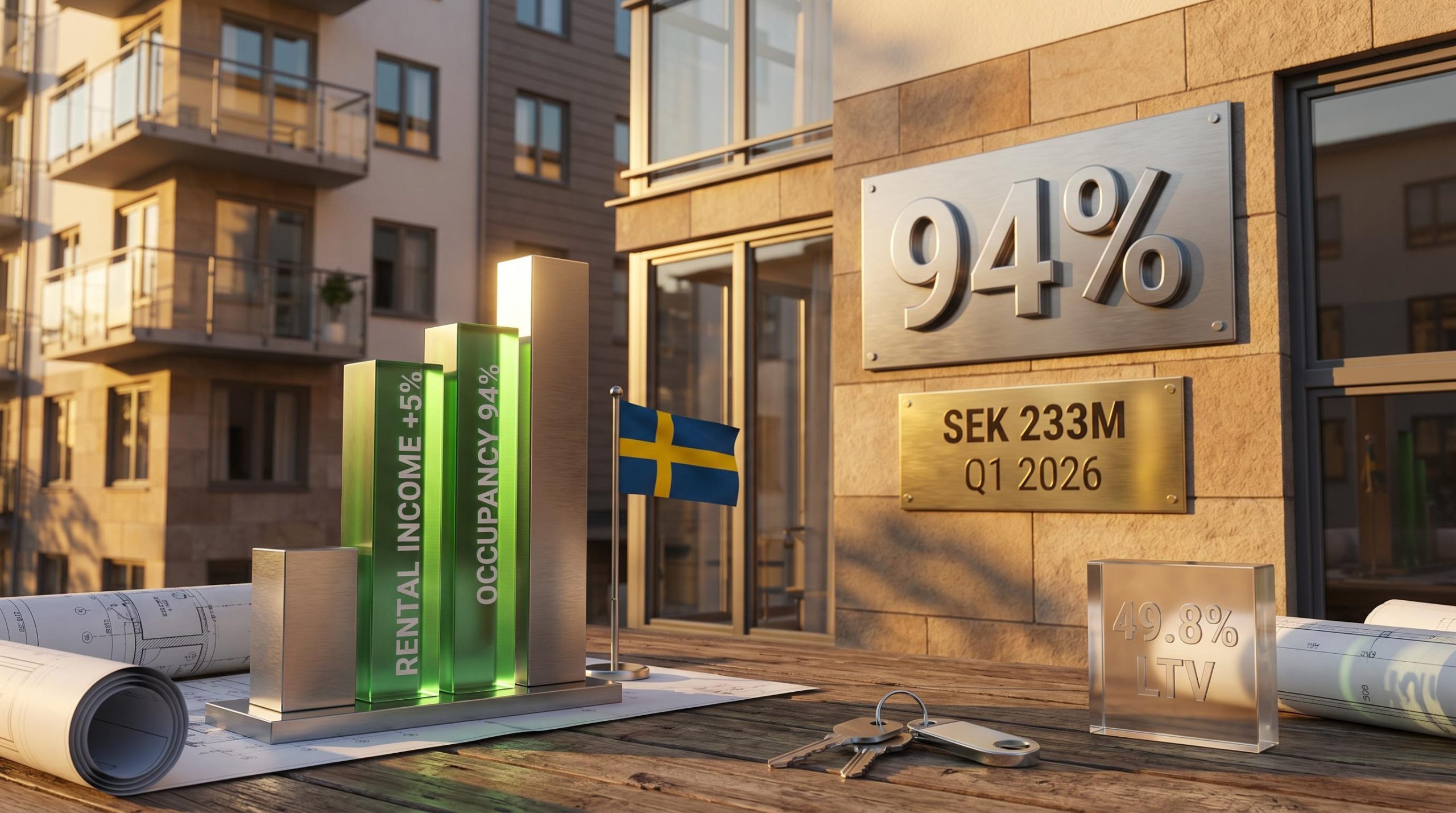
Neobo Fastigheter delivered record occupancy and 5% rental income growth in the first quarter of 2026, pushing through rent increases and vacancy reductions despite elevated interest rates and constrained transaction activity across the Nordic residential property market. The Swedish property company’s Q1 results, released on 22 April 2026, demonstrated operational execution on controllable levers while temporary winter weather costs masked underlying margin strength.
Rental income rose to SEK 233 million in Q1 2026, up from SEK 230 million in the prior year quarter, delivering 5% like-for-like rental income growth. The increase stemmed from three distinct operational levers rather than a single market tailwind.
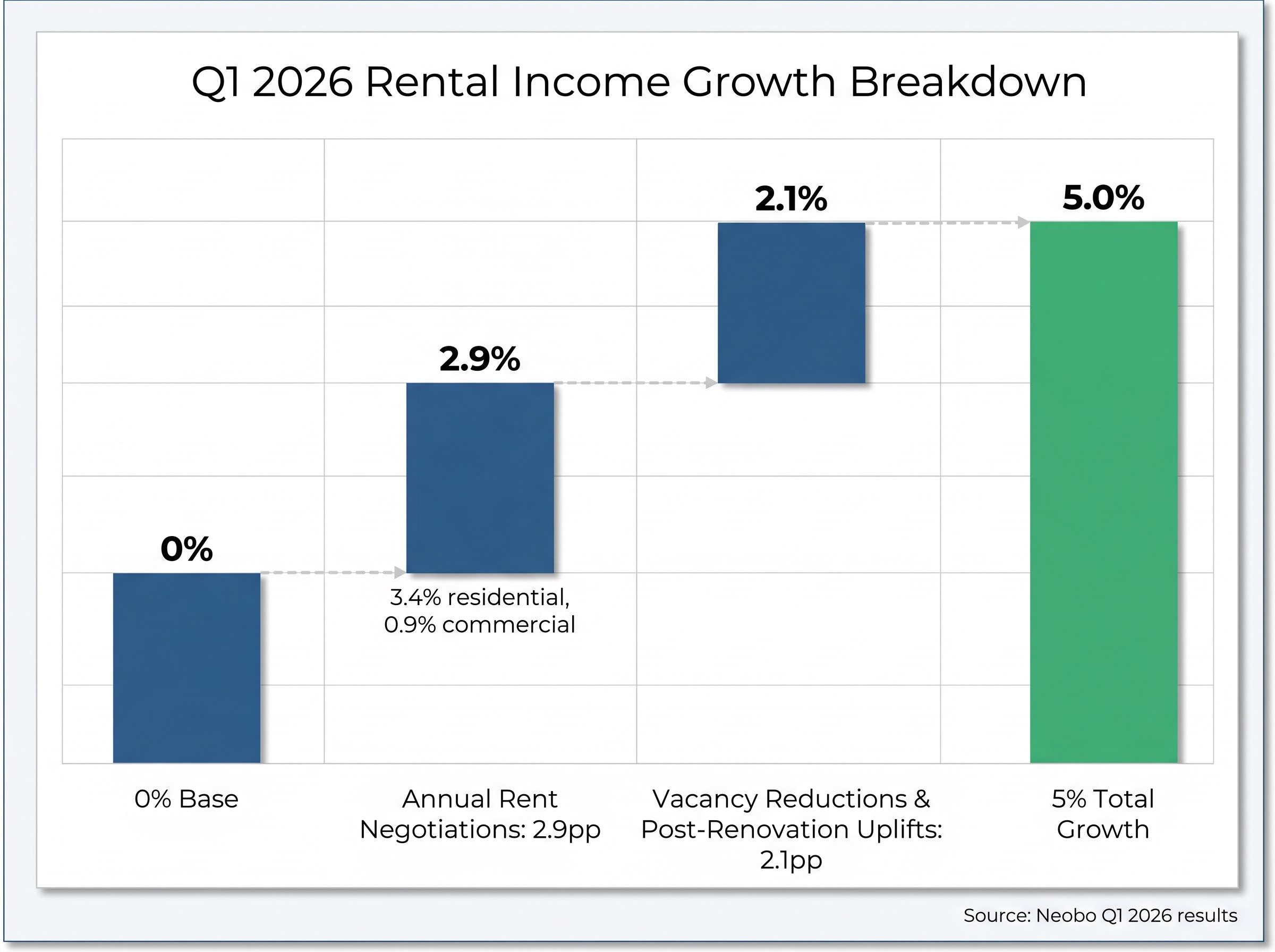
Annual rent negotiations contributed 2.9 percentage points of the growth, with residential rents rising 3.4% and commercial adjustments adding 0.9%. Vacancy reductions and post-renovation rent uplifts accounted for the balance.
Most residential rent increases took effect in early Q1, meaning the full-year revenue benefit is largely locked in. The timing suggests visibility for the remainder of 2026, a relevant consideration for investors tracking Nordic residential REITs in a rate-sensitive environment.
While rental income and occupancy reached record levels, net income contracted 23% as financing costs offset operational gains, a dynamic that separates surface-level revenue performance from bottom-line profitability in rate-sensitive property portfolios.
Deutsche Hypo’s March 2026 analysis of Nordic real estate market stability noted the sector was emerging from a challenging correction phase toward stable growth, with residential assets remaining the most stable class during the interest rate adjustment period, a characterization consistent with Neobo’s operational delivery despite elevated borrowing costs.
Key rental growth drivers:
Neobo achieved 94% total occupancy in Q1 2026, the highest rate in company history. Residential vacancy dropped from 6.6% to 4.6%, a sharp improvement attributable to focused internal efforts rather than broader market conditions.
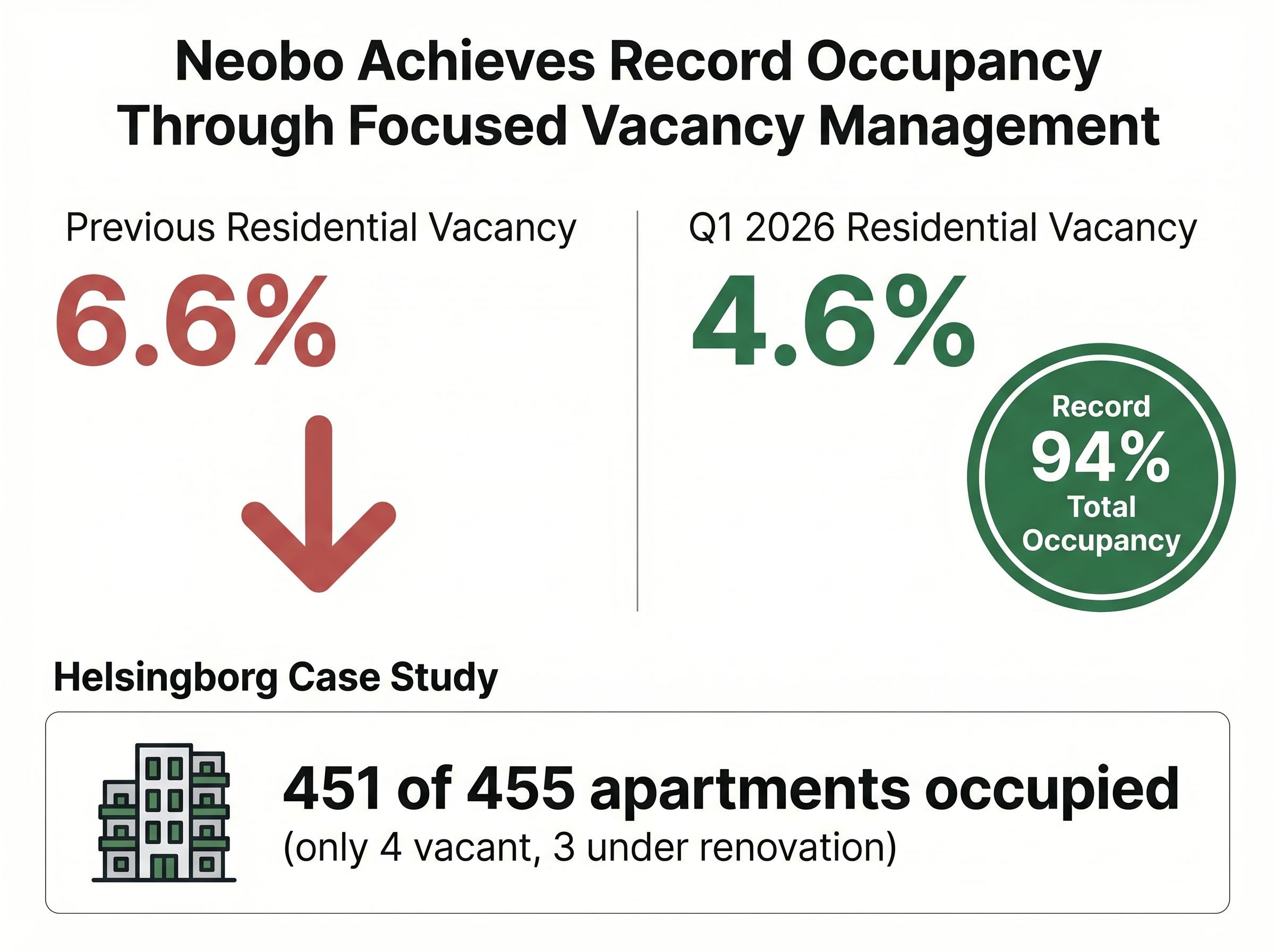
Helsingborg provides the clearest example of the operational discipline at work. Only 4 units remained vacant out of 455 apartments, with 3 of those under active renovation. The near-elimination of unproductive vacancy in a single market signals execution capacity that could protect margins even if macroeconomic conditions tighten further.
Helsingborg Vacancy: Only 4 of 455 apartments vacant, with 3 under renovation
Vacancy is a controllable cost lever. The improvement suggests management has tightened processes around tenant placement and renovation turnaround times, converting previously idle units into income-generating assets.
Net operating income stood at SEK 103 million, with property management profit reaching SEK 26 million. Per-share property management profit held flat at SEK 0.19 year-on-year, despite property disposals, as ongoing share buybacks offset the denominator effect.
The weaker profitability headline reflected a temporary headwind rather than structural margin pressure. Management attributed SEK 6-7 million in additional costs to harsh winter weather conditions, a one-quarter anomaly. The company stated that surplus margins should recover over the balance of 2026 as seasonal cost pressures normalise.
Q1 2026 profitability metrics:
Separating transient weather costs from underlying margin performance clarifies whether the profitability dip warrants concern or represents noise in an otherwise stable operating environment.
For readers wanting to understand how property management profit translates to shareholder value in real estate portfolios, our full explainer on funds-from-operations metrics for property portfolios walks through the cash flow adjustments, depreciation treatments, and distribution capacity calculations that separate accounting profit from distributable earnings.
Neobo invested SEK 55 million in property improvements during Q1 2026, renovating 39 apartments across the portfolio. The capital allocation represents disciplined deployment rather than maintenance capex, with yield-on-cost figures demonstrating return-generating investments.
Energy efficiency projects in Helsingborg delivered approximately 12% yield on cost, while Stockholm renovations generated around 60% rent uplifts post-completion. The double-digit returns on energy investments and high rent increases suggest capital is being deployed where value creation per krona is measurable.
| Location | Apartments Renovated | Return Metric |
|---|---|---|
| Helsingborg (energy efficiency) | 10 | ~12% yield on cost |
| Stockholm | Portfolio-wide | ~60% rent uplift |
These returns connect to the broader portfolio strategy of organic value creation through targeted capital deployment, positioning the company to extract incremental rental income from existing assets rather than relying on acquisition volume in an illiquid transaction market.
Neobo reported a 49.8% loan-to-value ratio at the end of Q1 2026, down from the prior period, with an average borrowing cost of 3.4%. The 1.8x interest coverage ratio over the trailing twelve months provides defensive cushion, while SEK 5.9 billion in active interest rate swaps delivers cash flow stability.
Finansinspektionen’s November 2023 analysis on commercial property debt reduction outlined scenarios where Nordic property firms would need to maintain interest coverage ratios above 1.0x and loan-to-value ratios below 70% to avoid debt reduction pressures, benchmarks that contextualize Neobo’s current 1.8x coverage and 49.8% LTV positioning.
Net financial costs rose SEK 5 million following a beneficial swap expiry and higher base rates. The increase flags one item to monitor as hedges roll off into a higher-rate environment. Management also referenced pending AGM approval for continued share buyback authority, suggesting confidence in balance sheet capacity.
Balance sheet metrics:
A sub-50% LTV provides acquisition optionality and resilience if property valuations compress further. The swap dynamics warrant attention as the company navigates the timing and pricing of hedge renewals against forward rate expectations.
The swap dynamics merit close attention as property companies navigate hedge roll-off in rising rate environments. Readers exploring how interest rate hedging strategies for property portfolios work in practice can examine swap structures, margin-over-benchmark pricing, and maturity extension techniques that determine funding cost trajectories.
Neobo’s Q1 2026 results demonstrate operational resilience through rental growth and record occupancy, with temporary weather costs masking underlying margin strength. The balance sheet positioning supports continued portfolio optimisation. Readers seeking deeper analysis should monitor the company’s Q2 results to assess whether margin recovery materialises and whether management finds attractive acquisition targets in the illiquid residential transaction market.
Neobo Fastigheter reported Q1 2026 rental income of SEK 233 million, up 5% like-for-like, with record total occupancy of 94% and property management profit of SEK 26 million, though net income contracted 23% as financing costs rose.
Net income contracted 23% in Q1 2026 primarily because higher financing costs offset strong operational gains from rental income growth and record occupancy, a common dynamic in rate-sensitive property portfolios.
Rental income growth of 5% was driven by three levers: annual rent negotiations contributing 2.9 percentage points, vacancy reductions across the portfolio, and post-renovation rent uplifts on improved units.
Neobo reported a 49.8% loan-to-value ratio at the end of Q1 2026, which provides acquisition optionality and balance sheet resilience if property valuations compress further in the Nordic market.
Neobo invested SEK 55 million renovating 39 apartments in Q1 2026, achieving approximately 12% yield on cost for energy efficiency projects in Helsingborg and around 60% rent uplifts on completed Stockholm units.


