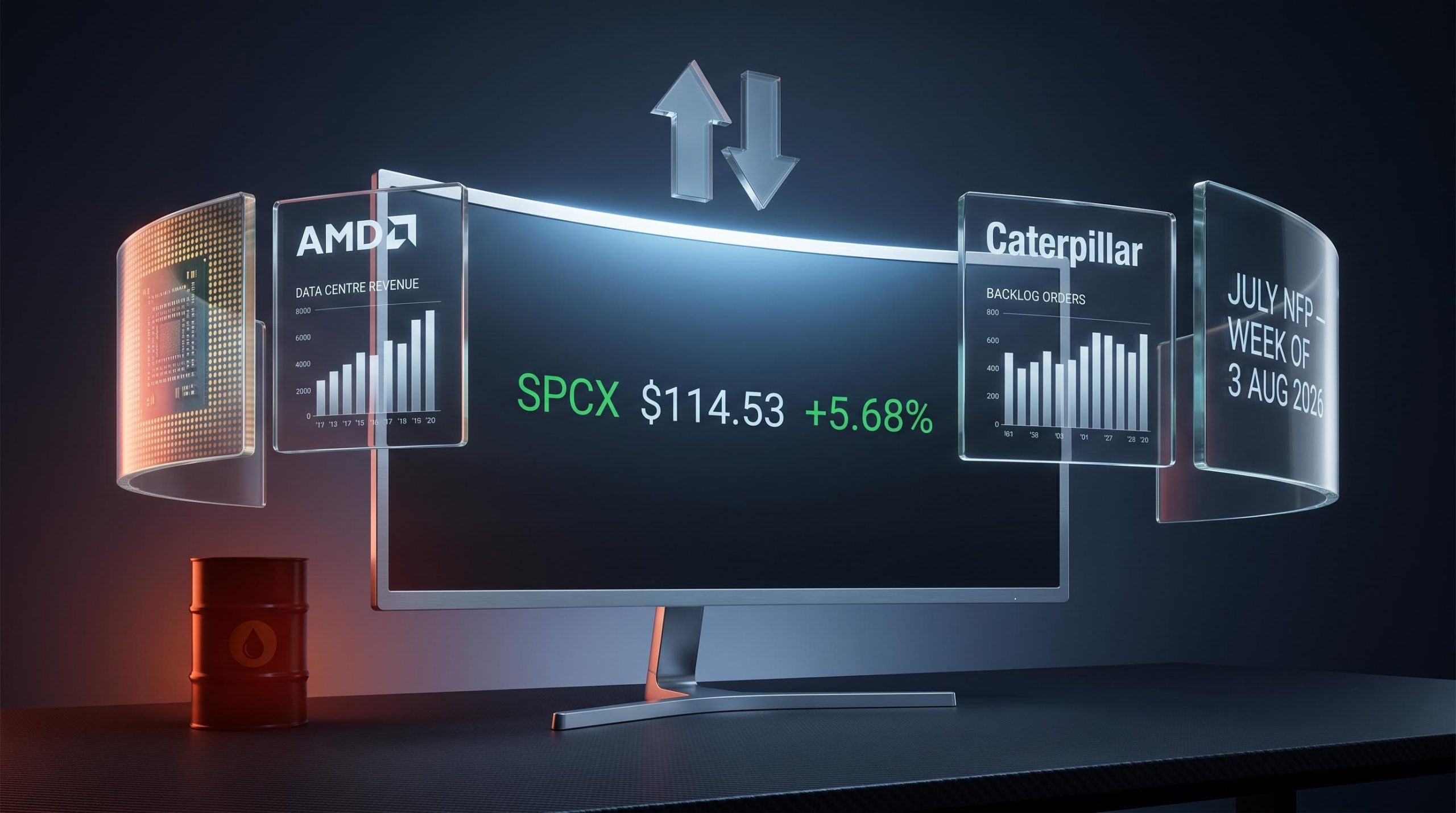
Four market catalysts converge in a single week, and at least two of them are capable of repricing risk assets in opposite directions simultaneously. That is the setup entering the week of 3 August 2026.
SpaceX reports its first-ever public earnings on Tuesday alongside AMD, Caterpillar, and Merck, while July nonfarm payrolls data arrives later in the week carrying direct implications for Federal Reserve rate policy. Layered over all of it: U.S.-Iran tensions that went from an imminent military strike to a cancelled action over a single weekend, leaving oil markets and geopolitical risk premiums in an unstable equilibrium.
Here is how each catalyst maps to the specific market question it will answer, and the direction it could push positioning. The edge going into a week with this much scheduled volatility comes from understanding how these events interact, not from treating each one in isolation.
SpaceX’s debut quarter: what the numbers actually need to show
This is not just another earnings release. SpaceX went public on Nasdaq under ticker SPCX in June 2026, and Tuesday’s report is the first audited quarterly filing public shareholders have ever seen. The quality of the disclosure, the segment-level detail, and the structure of the financials matter as much as the headline numbers, because they set the template for how the market will model this company for quarters to come.
Three separate investment theses sit inside one ticker. Space (launch services), Connectivity (Starlink), and AI infrastructure each carry distinct growth profiles, margin structures, and capital requirements. Investors are not buying a single business at $114.53 a share (up 5.68% on volume of 70.52 million shares ahead of the report). They are buying a bundle of three, and Tuesday’s filing is the first chance to evaluate each one on audited numbers.
The session’s most-watched benchmark: Analyst consensus places Q2 2026 revenue in the $6.8-$6.9 billion range. Missing or beating that figure will anchor how the market models SpaceX for the rest of the year.
The loss trajectory on its own is less important than whether management can demonstrate that capital expenditure is compressing relative to revenue growth over time. That ratio is what tells you whether this is a business that will eventually generate free cash flow or one that perpetually consumes it. Pre-IPO disclosures and early filings provide the baseline context:
Rigorous earnings report analysis of SpaceX’s filing will need to go beyond the headline revenue figure, since the capex-to-revenue ratio, free cash flow trajectory, and the gap between GAAP and any adjusted metrics the company chooses to report will carry more long-term signal than whether the quarter beats or misses consensus by a narrow margin.
| Period | Revenue | Net Income / Loss | Capex |
|---|---|---|---|
| Full Year 2025 | ~$18B* | ~-$4.9B* | ~$20.7B* |
| Q1 2026 | $4.69B* | EPS of -$1.27* | Not separately disclosed |
| Q2 2026 (Estimate) | $6.8-$6.9B* | TBD | TBD |
Figures marked with an asterisk are based on pre-IPO disclosures and analyst estimates that have not been independently verified.
If Q2 revenue lands within or above consensus and the capex-to-revenue ratio shows compression from 2025 levels, the market will have its first concrete evidence that SpaceX’s spending programme is translating into durable growth rather than extending losses.
When big ASX news breaks, our subscribers know first
The lock-up clock: why insider selling is a separate risk variable
Tuesday’s earnings release does not operate alone as a price catalyst for SPCX. It also triggers a lock-up expiration, and the two events need to be read as distinct forces acting on the share price simultaneously.
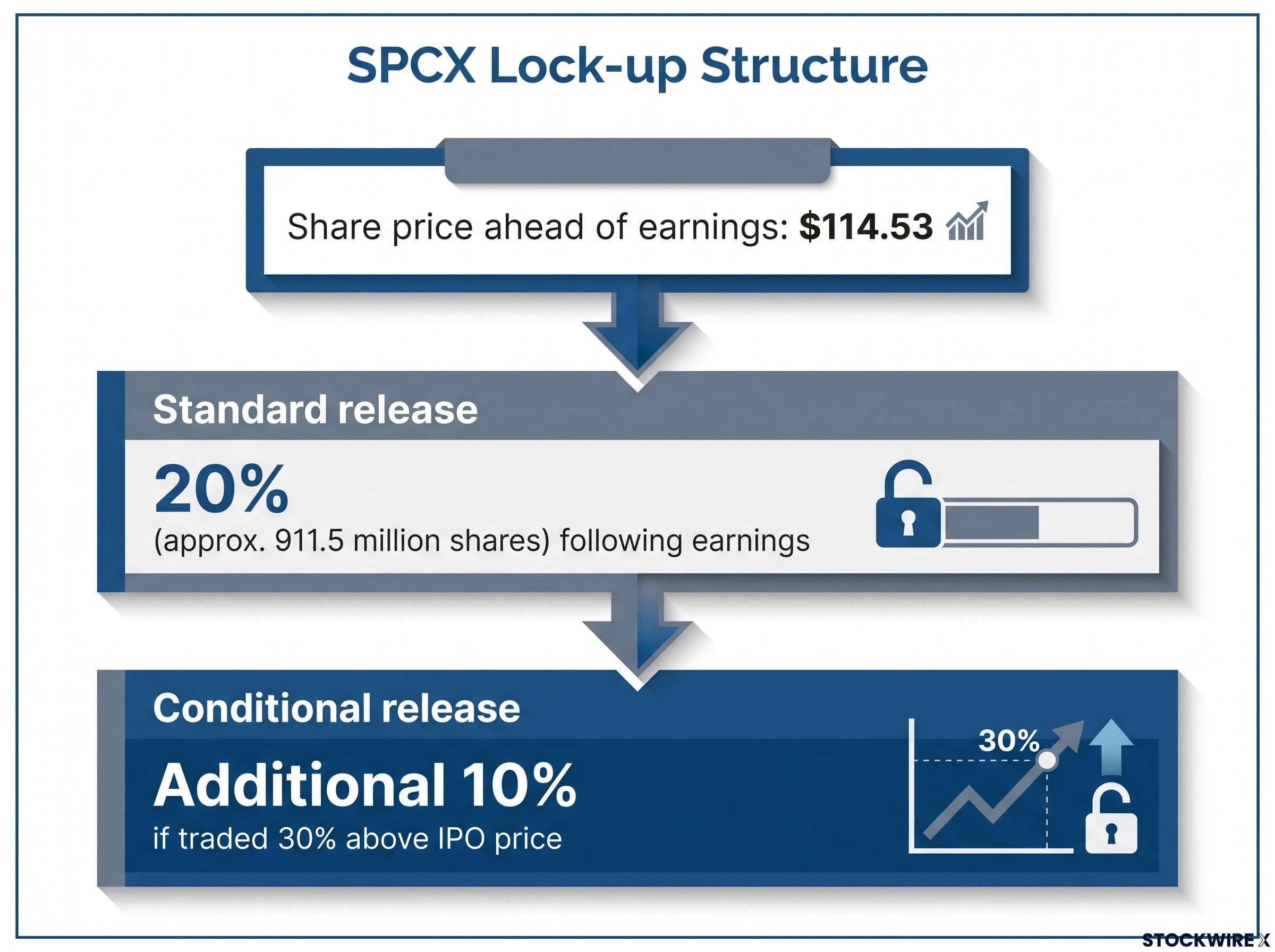
The lock-up structure works in stages:
- Standard release: Insiders may sell up to 20% of their locked shares, approximately 911.5 million shares, following the earnings report.*
- Conditional release: An additional 10% becomes available if SPCX has traded 30% above its IPO price for a qualifying period.*
- Triggering threshold: With shares at $114.53 ahead of earnings, the proximity to that threshold determines whether the conditional tranche activates.
These lock-up figures are based on pre-IPO filings and have not been independently confirmed.
The staggered design is intended to limit extreme volatility, but it does not eliminate the technical supply pressure that a potential wave of newly tradeable shares creates. This is a market-mechanics variable, not a fundamentals variable.
The SpaceX IPO lockup schedule is structured across roughly a dozen distinct unlock events rather than a single 180-day cliff, meaning the August supply wave is one chapter in a longer sequence of potential insider selling pressure that extends through December 2026.
Even a company that beats earnings can see its share price decline in the days following a lock-up release if the supply of newly tradeable shares exceeds near-term demand. If you are considering entering or adding to an SPCX position around the earnings date, the lock-up dynamic is a separate risk layer that exists regardless of whether the quarterly results are good or bad. Misreading a post-earnings price drop as a fundamental signal when it is actually a supply-and-demand artifact is one of the most common errors around IPO lock-up expirations.
Three more earnings that tell a story about the broader economy
SpaceX commands the headlines, but the three other companies reporting on Tuesday 4 August function as a more diagnostic instrument. Each one reads a different layer of the economy. Together, they answer whether the macro backdrop justifying current equity multiples is intact.
AMD
The semiconductor maker is the AI investment cycle barometer this earnings season. The numbers that matter most:
- Data centre segment revenue and quarter-over-quarter growth trajectory
- Forward guidance language on AI infrastructure spending cycles and enterprise GPU order visibility
Strong data centre results reinforce the broader thesis that corporate AI spending remains durable. Any softening in cloud or enterprise GPU orders creates a read-across to the entire semiconductor complex, not just AMD’s own valuation.
Caterpillar
Order backlog is the most forward-looking indicator Caterpillar reports. It tells you whether real-economy capital expenditure, construction activity, and commodity-related investment are holding up, not just financial-market capex. The specific metrics to watch:
- Backlog levels and regional order flow commentary
- Any cautious language on demand from specific geographies, which carries a direct read-across to global growth assumptions
Merck
Large-cap pharma provides the defensive anchor in a week where cyclical and growth names face simultaneous event risk. Key drug franchise performance, pipeline updates, and pricing dynamics will show whether Merck’s predictable cash flows remain intact, context that matters most if AMD and Caterpillar disappoint simultaneously.
If AMD guides cautiously on AI spending while Caterpillar signals softer industrial demand, the combined read is a growth deceleration signal that goes beyond any single sector. That combination would put significantly more weight on the payrolls report later in the week to confirm or counter the trend.
What July payrolls will actually tell the Fed
The July nonfarm payrolls report, expected later in the week of 3 August 2026, is the single highest-weight macro data input of the week. But it does not produce a simple binary outcome. The same number generates different market consequences depending on which other variables it interacts with.
A strong print, meaning robust headline job gains, keeps the Fed in a higher-for-longer posture. That pressures rate-sensitive sectors such as real estate and utilities, weighs on long-duration bonds, while supporting financials and the dollar. A soft print revives rate-cut expectations, broadly supporting equities and growth stocks but potentially weakening the dollar and flagging genuine demand softening beneath the surface.
The four-month deceleration in payrolls leading into this week’s print, with June 2026 coming in at just 57,000 and back-revisions taking May down to 129,000, means the July number arrives into an already-deteriorating trend rather than as a standalone data point, which changes the threshold for a genuinely surprising result in either direction.
The complication is wage growth. Elevated average hourly earnings can keep inflation concerns alive even if job creation slows, preventing a straightforward dovish interpretation. Average hourly earnings (both month-over-month and year-over-year) and the labour force participation rate are the sub-metrics that determine whether the headline number tells the full story or masks a more complex picture.
| Asset Class | Strong Print Scenario | Soft Print Scenario |
|---|---|---|
| Equities (broad) | Mixed; higher-for-longer rates cap multiples | Broadly supportive; rate-cut expectations lift valuations |
| Rate-sensitive sectors | Pressure (real estate, utilities) | Relief rally |
| Bonds (long duration) | Yields rise, prices fall | Yields fall, prices rally |
| U.S. dollar | Strengthens | Weakens |
The payrolls report does not move markets in isolation this week. It arrives after four major earnings calls have already shaped the narrative. Its most powerful effect will be to either confirm or contradict what corporate management teams said on Tuesday about hiring plans, wage pressures, and demand conditions. That interaction is where the real signal sits, and preparing for it before the release is more valuable than reacting to the headline number after it drops.
Iran, oil, and the tail risk that has not gone away
Over the weekend prior to 3 August, President Trump announced that a planned military strike against Iran had been called off. Oil prices declined. Risk sentiment improved. The instinct was to treat the episode as resolved.
It is not.
The diplomatic picture remains contested across three separate threads:
- U.S.-Iran direct: President Trump continued to assert that negotiations with Iran were proceeding, even as Tehran rejected that characterisation. Later on Monday 3 August, he pressed Iran publicly to reach an agreement.
- Iranian denial: Both Iranian officials and state media pushed back firmly against any suggestion that talks were underway, making clear that Tehran had no intention of engaging with Washington.
- Oman-brokered channel: Iran confirmed it was in contact with Oman regarding conditions in the Strait of Hormuz, yet vessel movements through the waterway remained sparse as military tensions between the U.S. and Iran stayed elevated.
The structural risk: The Strait of Hormuz is a chokepoint for global oil flows. Constrained traffic combined with elevated military tension keeps an oil price spike plausible without requiring an actual armed incident. The trigger does not need to be a strike; a shipping disruption, an insurance repricing, or a credible threat alone can move crude sharply.
The cancellation of the strike removed an acute price shock from the table. But the diplomatic impasse between Washington and Tehran means the risk premium in oil markets has compressed without being extinguished. If you are treating this as fully resolved, you are likely mispricing energy sector tail risk. Oil price spikes feed into headline inflation expectations and can complicate the Fed’s balancing act, creating a transmission mechanism from geopolitics directly into the rate policy question that payrolls data will also address later in the week.
Infrastructure-specific oil pricing explains why markets can absorb active U.S.-Iran military exchanges without a sustained crude spike: risk premiums rise materially only when the Strait of Hormuz, production facilities, or export terminals face direct physical threat, not when general regional instability escalates without a clear operational target.
Reading the week as a system, not a list of events
Each catalyst this week produces a different read depending on how the others resolve. That makes sequential interpretation, taking each headline as it arrives, less useful than mapping the interaction effects in advance.
Three interaction-effect watch points structure the week:
- Tuesday earnings direction plus payrolls tone. If AMD and Caterpillar both signal softening demand on Tuesday, and payrolls confirm that with a weak headline number later in the week, the combined read is a growth deceleration signal that goes beyond any individual report. If earnings are firm and payrolls are strong, the higher-for-longer rate narrative hardens.
- SpaceX fundamentals versus lock-up supply. SPCX’s price action after Tuesday needs to be decomposed into two components: the market’s reaction to the earnings quality and the mechanical effect of lock-up shares entering the float. Conflating the two produces a false signal.
- Geopolitical latent multiplier. Iran functions as a background variable that amplifies whichever direction markets are already moving. A risk-off move from weak earnings becomes sharper if oil prices spike on a Strait of Hormuz headline. A risk-on move from strong data becomes more fragile if the geopolitical backdrop deteriorates.
For longer-term investors, the practical question is whether data and commentary this week are consistent with or divergent from the consensus growth-and-inflation outlook that has supported 2026 equity markets. Isolating each event risks being moved by noise rather than signal. The week’s real information content will come from whether the earnings, the labour data, and the geopolitical backdrop are telling a consistent story or a contradictory one.
This article is for informational purposes only and should not be considered financial advice. Investors should conduct their own research and consult with financial professionals before making investment decisions. Forward-looking statements, including analyst estimates and scenario projections, are speculative and subject to change based on market developments and company performance.