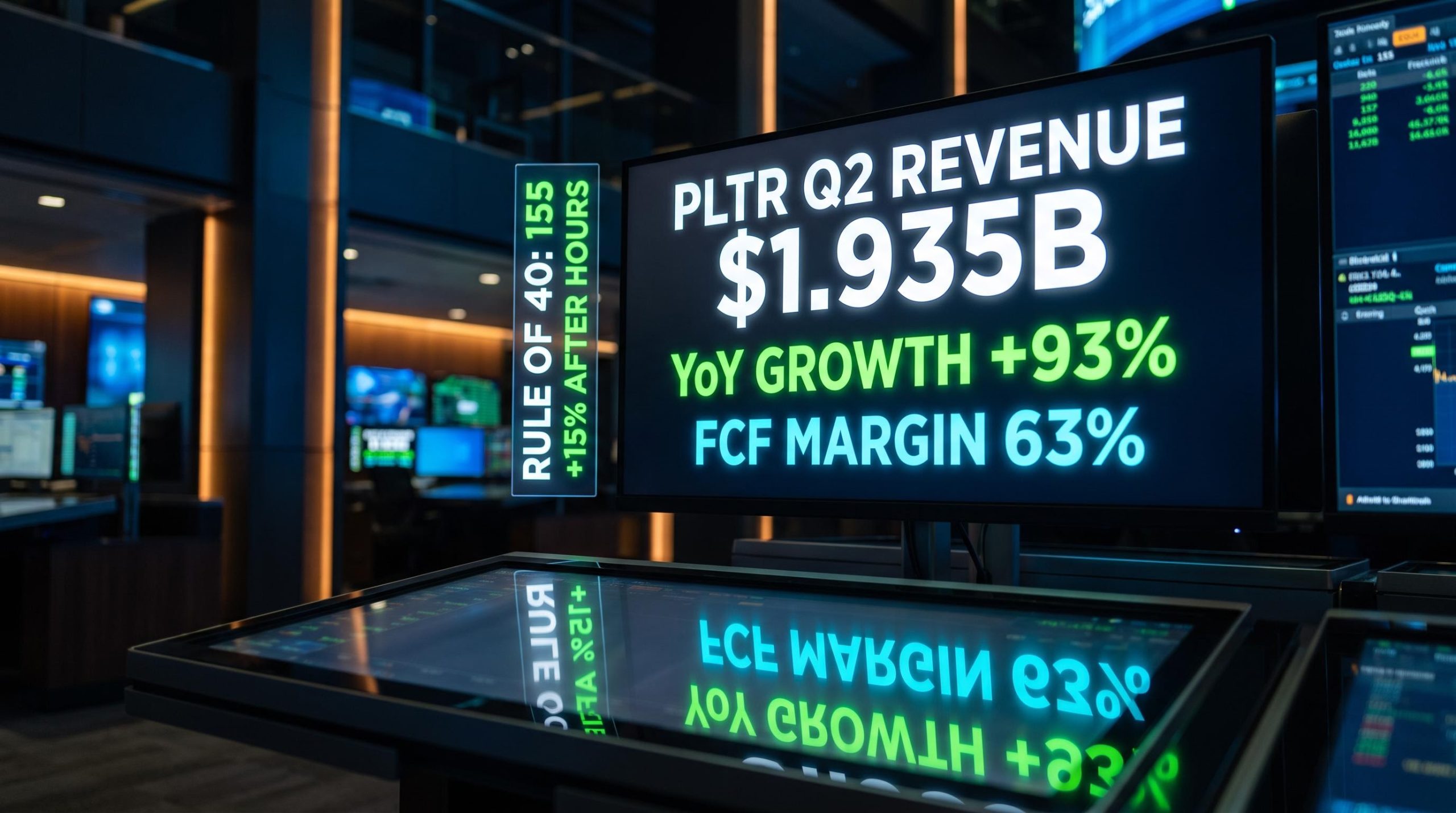
Palantir reported Q2 2026 revenue of $1.935 billion on 3 August, representing 93% year-over-year growth and a meaningful beat against analyst expectations near $1.81 billion. The stock climbed over 15% in extended after-hours trading.
The result is not a one-quarter anomaly. Management called it the 12th consecutive quarter of accelerating revenue growth, and the company simultaneously raised its full-year 2026 revenue guidance by roughly $490-500 million at the midpoint to approximately $8.154 billion. For investors tracking AI infrastructure names, this is the kind of earnings print that demands close attention.
Here is what actually drove the number, which segments are carrying the growth, and what the bear case looks like, so you can form a considered view rather than react to the headline alone.
The numbers that moved the stock
Palantir’s Q2 revenue of $1.935 billion came in well above the pre-earnings analyst consensus of approximately $1.81 billion. That gap, more than $120 million of upside against expectations, is the clearest explanation for why the stock surged 15% after hours rather than drifting on a modest beat.
Year-over-year growth hit 93%. Quarter-over-quarter growth was 19%. Both figures landed on a base that is already multibillion-dollar scale, which makes the acceleration harder to dismiss as early-stage noise.
The Q2 result extends a pattern that was already visible in Palantir’s Q1 2026 earnings, when the company posted 85% revenue growth and raised full-year guidance to $7.65 billion, marking the quarter management described as a potential inflection point in enterprise AI platform adoption.
| Metric | Value | YoY Change |
|---|---|---|
| Q2 Revenue | $1.935 billion | +93% |
| Adjusted Free Cash Flow | $1.22 billion | — |
| FCF Margin | 63% | — |
| Rule of 40 Score | 155 | — |
| Post-Earnings Stock Move | +15%+ | — |
Rule of 40 score: 155. The Rule of 40 measures a software company’s health by adding its revenue growth rate to its profit margin. A score above 40 is considered strong. Palantir’s score of 155 is nearly four times that threshold.
A 63% free cash flow margin alongside 93% revenue growth tells you this is not a growth-at-any-cost story. That distinction is what separates this print from typical high-growth software beats and explains why the market rewarded it with a double-digit move.
When big ASX news breaks, our subscribers know first
Government and commercial: two engines, one trajectory
The headline revenue figure is impressive on its own. The segment breakdown underneath it is where the narrative shifts.
The defence anchor
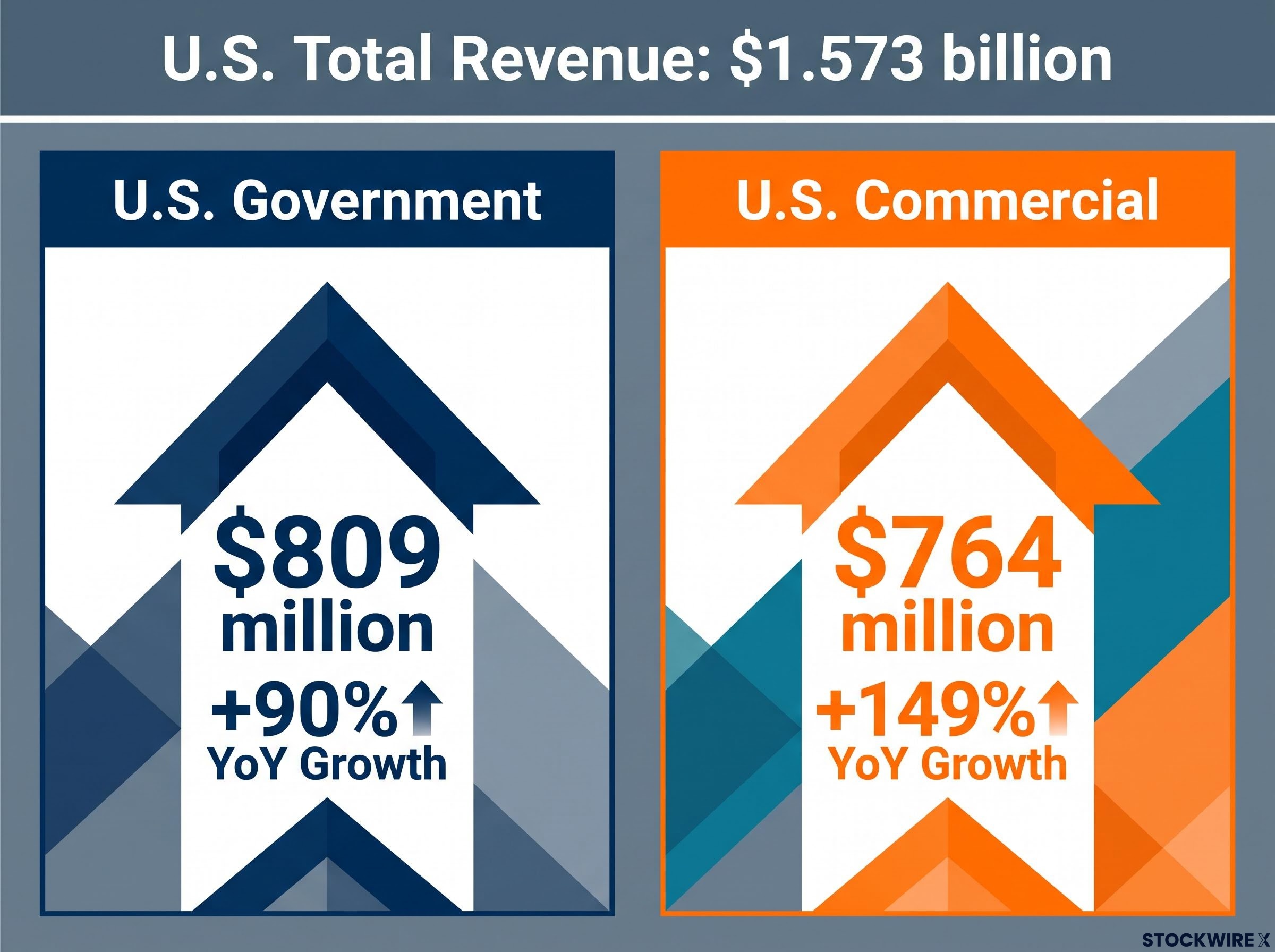
- U.S. government revenue: $809 million, +90% year-over-year
- U.S. total revenue: $1.573 billion
U.S. government demand remains the structural anchor. Defence spending from the Department of Homeland Security and various military services drove the bulk of this figure, and the 90% growth rate on a segment of this size confirms the defence base is still accelerating, not plateauing.
The commercial surprise
- U.S. commercial revenue: $764 million, +149% year-over-year
- Full-year U.S. commercial guidance: raised to more than $3.424 billion, implying more than 134% growth for the segment
Commercial revenue growing at 149% year-over-year signals that enterprise AI adoption is pulling customers toward Palantir’s platform at a rate the market had not priced in. That represents a structural expansion of the investment thesis beyond defence. The full-year commercial guidance raise is the more forward-looking signal worth tracking, because it tells you management sees this pace continuing, not fading.
The 149% growth in U.S. commercial revenue reflects a broader structural shift in enterprise AI adoption, where only an estimated 12-20% of enterprises achieve meaningful operational AI embedding; Palantir’s commercial surge suggests it is capturing a disproportionate share of that narrow cohort.
What Palantir’s Maven platform actually does, and why it matters
Palantir’s government moat is often cited in analyst notes but rarely explained in terms a non-specialist can evaluate. The Maven AI platform is the clearest way to understand it.
The Maven system ingests and analyses battlefield data to support targeting and operational decision-making. It operates inside classified, air-gapped environments, meaning networks physically separated from the public internet. This is not a product you trial on a cloud dashboard. It deploys into operational settings where the data is secret and the stakes are immediate.
That operational context creates three structural barriers that insulate the government segment from the kind of competition Palantir faces commercially:
- Classified deployment requirements: Competitors must meet stringent security clearances and air-gapped infrastructure standards before they can even bid for contracts.
- Procurement process insulation: Government procurement cycles are long, relationship-dependent, and favour incumbents with established track records. Palantir has more than two decades of U.S. government relationships.
- Switching cost depth: Palantir’s Ontology, its data-integration layer that sits between raw AI models and operational decision-making, becomes deeply embedded in agency workflows over time. The shift from AI “experiments” to AI “operations” within government agencies describes how those workflows deepen rather than commoditise. Moving away from the platform is structurally expensive.
The distinction between AI “experiments” and AI “operations” is not marketing language. It describes how deeply Palantir is embedded in mission-critical workflows, and that depth is what makes a switch away from the platform costly for government customers.
The guidance raise and what the second half needs to deliver
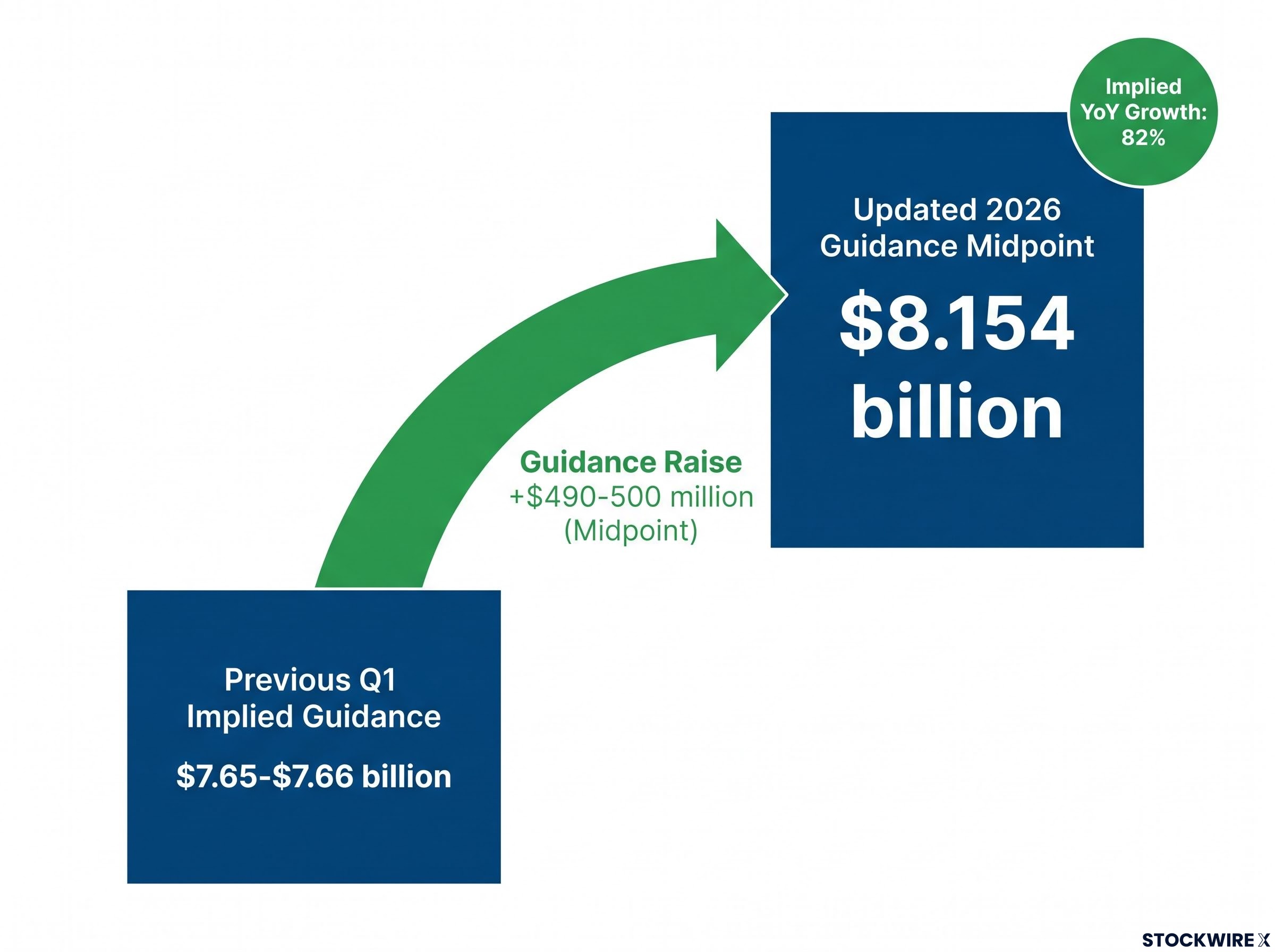
Palantir raised its full-year 2026 revenue guidance to a midpoint of approximately $8.154 billion, representing approximately 82% year-over-year growth. The company’s Q1 guidance range had implied full-year revenue of approximately $7.65-$7.66 billion.
The magnitude of that raise: approximately $490-500 million at the midpoint. That is not a rounding adjustment. It is a signal of materially stronger pipeline visibility.
The arithmetic of the guidance tells you what management is committing to in the second half:
- Q2 annualised run-rate: With Q2 revenue at $1.935 billion, the annualised run-rate is approximately $7.7 billion.
- Updated full-year guidance midpoint: Approximately $8.154 billion.
- Implied H2 requirement: Full-year guidance sits above the annualised Q2 run-rate, which means management expects the second half to be stronger than the first, not weaker.
Management attributed the raise to pipeline visibility from U.S. customers and accelerating sovereign AI demand.
Full-year guidance that sits above the annualised Q2 run-rate tells you management expects continued sequential acceleration. That is the bet the market is now pricing into a 15% after-hours move, and it is the assumption most vulnerable to disappointment if execution slows.
Where the competitive risk actually lives
The bull case: what keeps competitors out
Palantir’s moat sources are well documented and structurally distinct from typical software advantages:
- The Ontology and data-integration platform differentiate Palantir from generic model providers by sitting between raw AI models and operational decisions.
- Deeply embedded workflows across enterprise and government customers create high switching costs.
- More than two decades of U.S. government relationships provide an incumbent advantage that new entrants cannot replicate quickly.
- Government contracts are substantially insulated from commercial competitive dynamics due to procurement structures, clearance requirements, and classified deployment needs.
The bear case: where pressure could emerge
The competitive risk is real, but it is concentrated in specific areas:
- The commercial segment is where lower-cost AI tooling and potential internal enterprise builds represent the most immediate pressure.
- Some analysts have pointed to AI startups, including Anthropic, as developers of lower-cost tooling that could undercut Palantir’s commercial pricing power over time.
- If Palantir must discount commercially to remain competitive as AI model costs decline, margin compression could follow.
CEO Alex Karp has pushed back against the characterisation that frontier AI lab outputs are adequate substitutes for Palantir’s integrated operational platform. The current 63% adjusted free cash flow margin is the baseline investors would watch for signs of compression.
The competitive threat from AI startups applies most directly to commercial pricing power, not to government contracts. Investors should track margin trends in the commercial segment rather than top-line revenue as the leading indicator of whether that pressure is materialising.
For investors tracking Palantir’s commercial segment, AI spending ROI has become the sector’s most consequential demand-side variable: as enterprises impose usage caps and project-level justification requirements, per-customer consumption may flatten even as customer numbers grow, a dynamic that commercial revenue multiples may not yet reflect.
What a sustained growth rate at this scale actually means for the investment case
Twelve consecutive quarters of accelerating revenue growth is a structural data point, not a marketing claim. On a base approaching $8 billion annualised, that streak narrows the field of comparable companies to a handful. It also raises the bar: each subsequent quarter of acceleration becomes harder to deliver.
Three specific metrics will determine whether the current valuation is justified heading into Q3 2026:
- Adjusted operating income margin trajectory: Whether profitability expands, holds, or compresses as the revenue base scales.
- Free cash flow margin stability: The current 63% FCF margin is the benchmark. Any sustained decline signals that growth is becoming more expensive to sustain.
- Commercial segment pricing trends: As AI tooling costs decline industry-wide, any discounting pressure in the commercial segment will show up here first.
Palantir fits the picks-and-shovels framing that analysts use for AI infrastructure plays: the non-discretionary defence base provides downside protection, and the commercial acceleration provides upside optionality. The combination is unusual and warrants a premium. The question is whether the current price already reflects that rarity, or whether any quarter of deceleration would reprice the stock sharply.
A strong earnings print is not a buy signal by itself. These three metrics are what turn yesterday’s news event into an ongoing analytical framework for the quarters ahead.
For investors who want to test whether the current valuation is justified by the guidance trajectory, our dedicated guide to implied growth rate calculations walks through how to convert any stock price into a forward revenue requirement, giving you the one figure standard brokerage platforms never show.
This article is for informational purposes only and should not be considered financial advice. Investors should conduct their own research and consult with financial professionals before making investment decisions. Past performance does not guarantee future results. Financial projections are subject to market conditions and various risk factors.