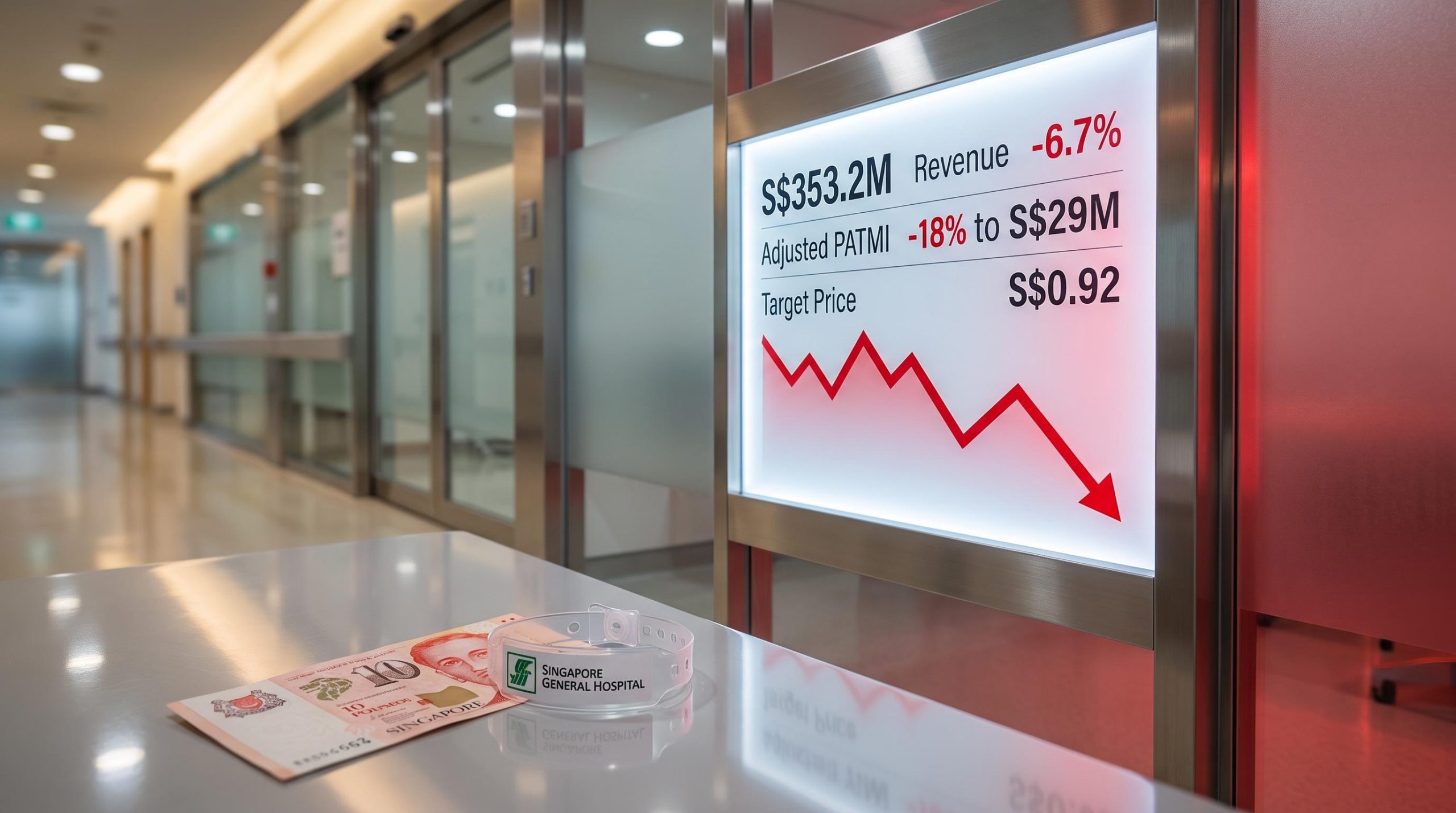
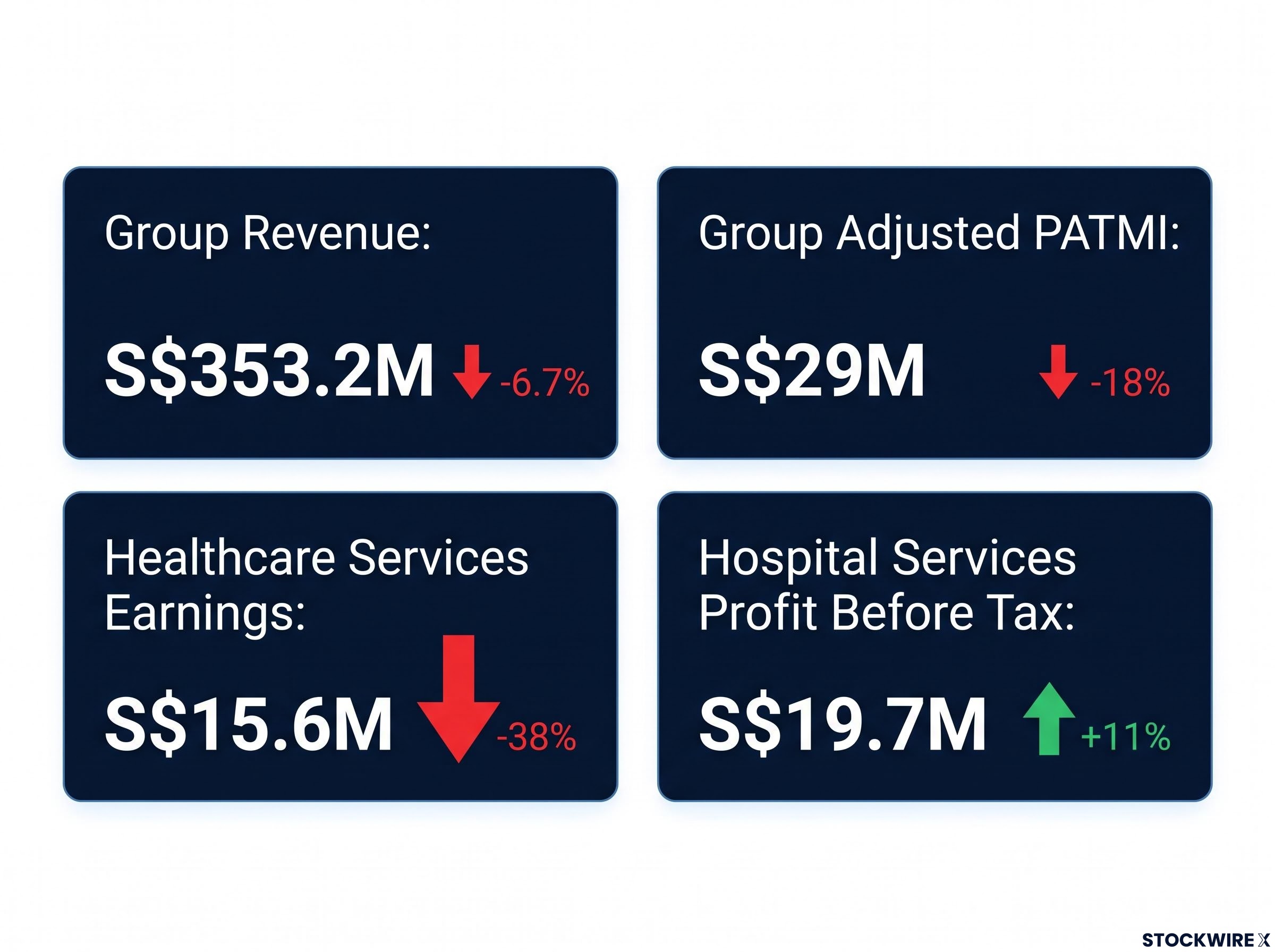
Raffles Medical Group posted first-half 2026 results that came in well below market expectations, with revenue slipping 6.7% year-on-year to S$353.2 million and adjusted profit after tax and minority interests (PATMI) dropping 18% to S$29 million. In response, Phillip Securities Research reduced its target price by 10% to S$0.92, scaled back its full-year earnings estimates, and held its Neutral rating in place.
The headline miss conceals a two-speed business. Hospital services produced gains of 11% in profit terms, showing that the company’s premium positioning holds firm where it can direct case mix and set pricing. The transitional care facility (TCF) segment, facing the effects of additional public hospital capacity in Singapore, pulled group earnings down, and the structural character of that pressure extends well beyond this single reporting period.
Here is what the result tells you about where the stock sits today and what needs to happen in 2H26 for the investment case to shift.
A first half that fell well short on every major measure
The gap between what the market expected and what Raffles Medical Group delivered in 1H26 is visible across every major line item. At S$353.2 million, first-half revenue accounted for only 44% of Phillip’s full-year forecast, and the adjusted PATMI of S$29 million came to roughly 40% of the S$65.4 million annual estimate. That tracking rate is the number that matters most.
Sub-sector divergence within Singapore equities has been a defining feature of 2026, with the same macro environment producing sharply different outcomes for assets differentiated by business model, cost structure, and exposure to public sector policy shifts rather than by headline geography or asset class alone.
| Metric | 1H26 Actual | Year-on-Year Change | FY26 Phillip Forecast | 1H26 as % of FY26 |
|---|---|---|---|---|
| Revenue | S$353.2M | -6.7% | S$803M (approx.) | 44% |
| Reported PATMI | S$29.0M | -9.6% | — | — |
| Adjusted PATMI | S$29M | -18% | S$65.4M | ~40% |
Key signal: Adjusted PATMI at roughly 44% of the full-year forecast at the halfway mark means 2H26 must deliver approximately S$36.4 million, a material step-up from the first half, just to meet already-downgraded expectations.
The difference between the reported PATMI decline (9.6%) and Phillip’s adjusted measure (18%) reflects the broker’s proprietary adjustments to the reported figure, not a discrepancy in RMG’s own numbers. If you are benchmarking the result against your own model, knowing which figure Phillip is working from prevents misreading the severity of the analyst’s stance.
When big ASX news breaks, our subscribers know first
Why transitional care is the fault line in RMG’s business model
Transitional care facilities provide step-down medical care for patients moving from acute hospital treatment back to independent living. They sit between full hospital stays and home care, and for RMG they were previously a reliable revenue contributor within the healthcare services segment.
The structural problem is straightforward, but its earnings impact is not:
- What TCFs do: They house patients who no longer need acute care but are not yet ready for discharge. RMG operates these facilities as part of its broader healthcare services segment.
- What changed: Greater public hospital bed availability across Singapore has cut the flow of patients being directed into private step-down care, reducing referral volumes at private TCFs directly.
- Why the earnings hit is disproportionate: TCF operations are built on a base of substantial fixed costs, principally workforce expenses and property lease commitments, which remain constant regardless of how many beds are occupied. A fall in patient volumes therefore squeezes earnings far more sharply than it reduces revenue.
The MOH hospital capacity expansion plans, covering acute and community hospital bed additions through 2025-2030, set the policy backdrop that is directly suppressing referral volumes into private transitional care facilities such as those operated by RMG.
That amplification is visible in the numbers. Healthcare services segment earnings retreated by around 38% year-on-year to S$15.6 million in 1H26, down from S$24.9 million previously, against a top-line contraction of 16-17%. (Note: sources differ on the exact healthcare services revenue figure, with one reporting S$112 million and another S$119.5 million; both cite a decline in the 16-17% range. RMG does not separately disclose TCF contribution, and the segment figure should be confirmed against the company’s primary disclosure.)
A 38% earnings decline on a 16-17% revenue fall is a fixed-cost leverage problem. Without a structural shift in public hospital policy or a recovery in occupancy, the drag on group earnings is unlikely to self-correct quickly.
The pressures on private healthcare operators are not confined to Singapore: across developed markets, the same combination of public sector capacity expansion, labour cost inflation, and insurer constraints has been compressing margins at hospital and care facility groups throughout 2025 and into 2026.
Hospital services as the one segment delivering for shareholders
The hospital services segment recorded profit before tax of S$19.7 million in 1H26, an 11% year-on-year increase, and the result deserves recognition as a genuine operational achievement.
What drove the improvement
Two levers lifted the segment. RMG oriented its procedure mix towards more complex, higher-value surgical cases that carry greater revenue per patient, while also implementing measured price increases that supported margin expansion without a meaningful loss of volume. Phillip Securities Research takes this as a sign that RMG continues to demonstrate pricing discipline and operational control within its core hospital business.
That said, an 11% profit rise in the hospital segment needs to be weighed against the roughly 38% segment earnings decline in healthcare services. The hospital result is a partial cushion, not a group-level recovery signal. It tells you where RMG’s competitive position is holding, in services where it can control case mix and pricing, and where it is eroding. For anyone assessing the franchise’s long-term value, that distinction matters.
Structural headwinds beyond the half-year result
The 1H26 miss is a symptom of pressures that were building before the result and will persist after it. Phillip’s revised assumptions embed four structural headwinds, each with a distinct mechanism:
- Singapore public hospital expansion: Ongoing capacity additions continue to divert patients away from private TCFs, directly suppressing referral volumes. This is the most immediate earnings drag and the one most visible in the 1H26 result.
- Lower-cost Malaysian competition: Cross-border patient outflows to Malaysia, where procedures are available at considerably lower cost, are weighing on volumes at RMG’s Singapore facilities in a sustained way.
- Insurer pressure on revenue intensity: Private health insurers are limiting the ability of providers such as RMG to expand per-case revenue through ancillary services or billing optimisation, narrowing a margin lever the group has relied on historically.
- China regulatory uncertainty: RMG’s China footprint carries genuine longer-term growth potential, but the uncertain regulatory backdrop means analysts cannot confidently model that contribution in the near term, restricting how much upside can be factored into forecasts.
DBS has also trimmed its Raffles Medical Group forecasts, primarily on slower-than-expected China momentum. The direction of revision is not unique to Phillip; it reflects a broader Street-wide recalibration.
The convergence of four distinct structural pressures tells you the earnings trajectory is not a one-quarter correction but a recalibration of what RMG can realistically earn in its current competitive environment. That distinction matters when assessing whether the stock is cheap or fairly valued at current levels.
What the revised Phillip forecast implies for investors sizing the opportunity
Phillip Securities Research published its revised estimates on 4 August 2026, cutting across all major metrics:
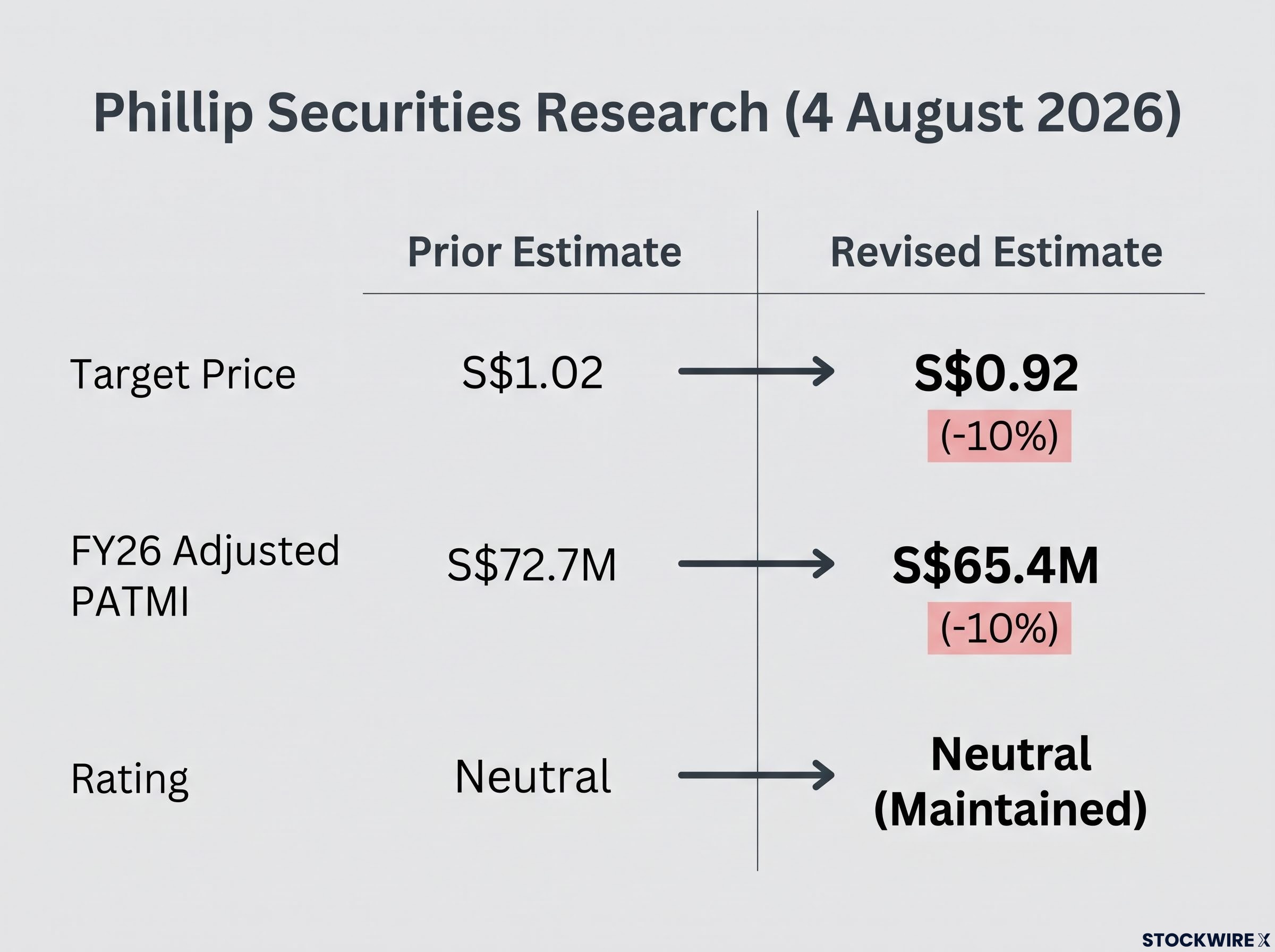
| Metric | Prior Estimate | Revised Estimate | Change |
|---|---|---|---|
| FY26 Adjusted PATMI | S$72.7M (approx.) | S$65.4M | -10% |
| FY26 Revenue | Prior estimate | Cut ~5% | ~-5% |
| Target Price | S$1.02 | S$0.92 | ~-10% |
The Neutral rating, maintained, means Phillip sees the shares as fairly valued at the revised target, with limited near-term catalysts but acknowledged longer-term strategic value. A Neutral call with a 10% target price cut is the broker’s clearest signal that downside risk has been partly priced in, but a re-rating to a Buy is unlikely without new evidence.
Two watchpoints will determine whether the investment thesis shifts in either direction during 2H26:
- TCF utilisation recovery: Any stabilisation in occupancy rates would signal that the public hospital displacement effect is peaking rather than deepening. This is the single largest variable in whether the group meets even the downgraded full-year forecast.
- China operations delivery: Concrete progress on revenue contribution from the China footprint would provide an offsetting growth narrative, but regulatory clarity is the prerequisite, and that remains outside management’s control.
The implied 2H26 earnings requirement, approximately S$36.4 million in adjusted PATMI to meet the revised S$65.4 million full-year figure, gives you a concrete benchmark. That is the number to measure against when the next update arrives.
Fairly valued at revised levels, but the path to a re-rating depends on two variables
Phillip’s Neutral rating reflects a fair-value assessment, not a distressed or deeply undervalued position. The broker acknowledges the franchise quality of the hospital segment and the strategic value of RMG’s regional footprint while recognising that near-term earnings visibility is constrained by structural pressures that management cannot quickly reverse.
The two variables that would change the picture materially are the same ones that explain the miss: TCF volume recovery and China regulatory clarity. Until one or both show tangible improvement, the consensus view is unlikely to shift. DBS trimming in the same direction reinforces that this is a Street-wide recalibration, not an idiosyncratic Phillip call.
A Neutral rating from multiple brokers on a stock that has missed its half-year targets by a meaningful margin typically signals that the risk is understood but not yet sufficiently priced for a contrarian long position. For investors monitoring Raffles Medical Group, those two variables, TCF utilisation data and China regulatory developments, are the indicators most likely to move the consensus.
For investors wanting to understand how analysts distinguish between cyclical earnings weakness and permanent structural impairment in healthcare stocks, our full explainer on healthcare sector valuation under structural pressure examines how fixed-cost operating models interact with volume headwinds across listed healthcare groups.
This article is for informational purposes only and should not be considered financial advice. Investors should conduct their own research and consult with financial professionals before making investment decisions. Past performance does not guarantee future results, and financial projections are subject to market conditions and various risk factors.