SpaceX filed its S-1 with the SEC on 20 May 2026, and buried inside the registration statement is a number that reframes the Nvidia demand story: $7.7 billion in AI-related expenditure in the first quarter of 2026 alone. Annualised, that figure exceeds $30 billion, with Nvidia named as the primary accelerator supplier across both of SpaceX’s operational AI compute clusters. The filing marks the first time SpaceX has disclosed the architectural detail of its AI infrastructure in a public document, and Wolfe Research analyst Liz Pate moved quickly to surface the semiconductor implications in coverage carried by Barron’s and Bloomberg Technology on 21 May. For NVDA investors, this is not a channel check or a supply-chain rumour; it is a company-disclosed, regulator-filed confirmation of GPU commitment at hyperscaler scale. What follows breaks down exactly what the S-1 reveals about Nvidia’s hardware footprint at SpaceX, what the capex trajectory signals for NVDA demand, and how to weigh the longer-term Terafab risk against the near-term hardware story.
Inside SpaceX’s two AI clusters, and where Nvidia sits in each
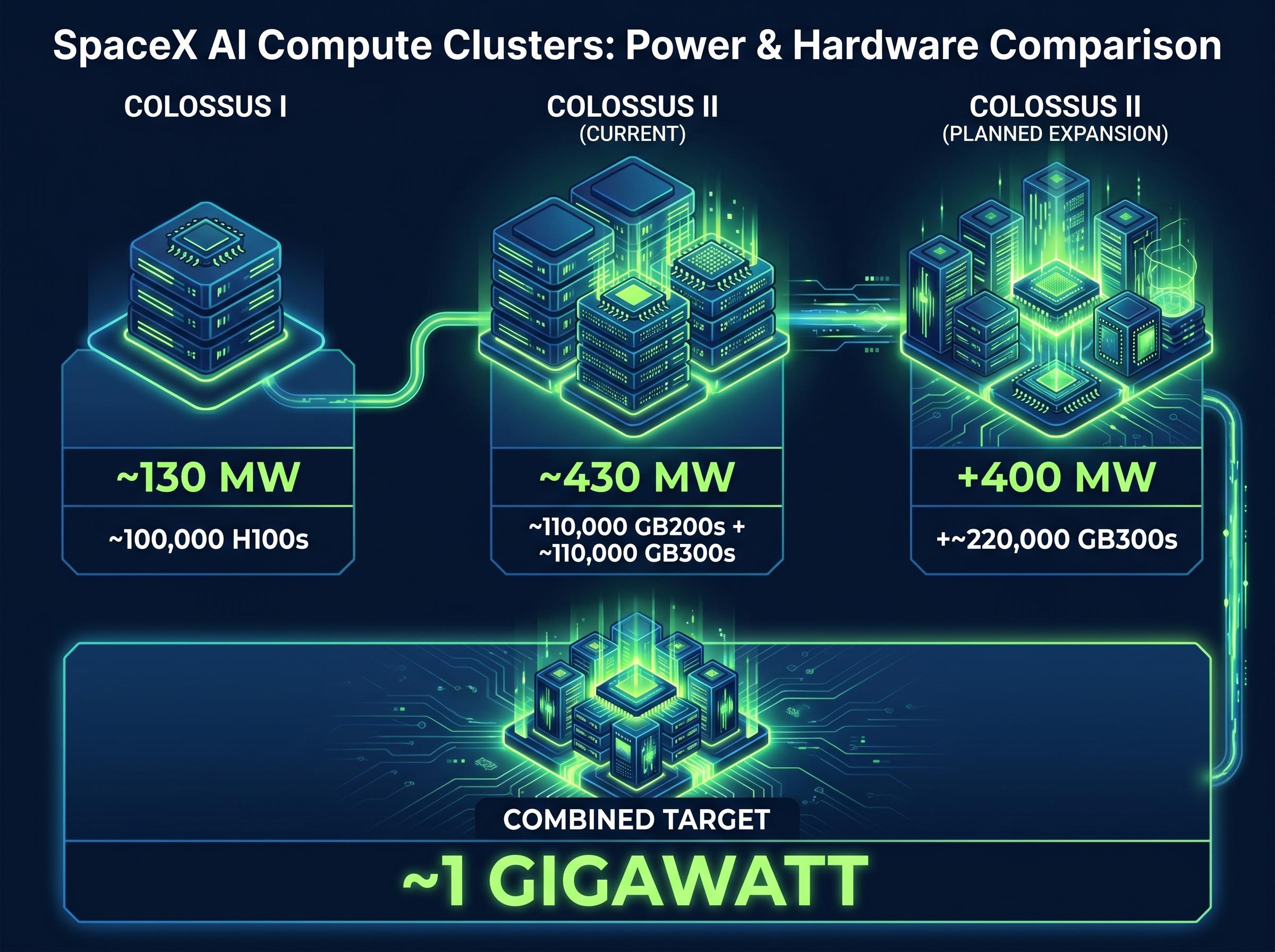
Colossus I is the baseline. Currently operational at roughly 130 megawatts, the cluster runs approximately 100,000 H100 GPUs, establishing SpaceX’s first-generation AI compute foundation.
Colossus II represents the generational step-up. At approximately 430 megawatts, it houses around 110,000 GB200 and 110,000 GB300 processors, both Blackwell-series parts that mark a significant architectural advance over the H100s in the first cluster.
The expansion planned for Colossus II adds another 400 megawatts and approximately 220,000 more GB300 processors, bringing the combined planned capacity across both sites to 1 gigawatt.
| Cluster | Current capacity (MW) | Current GPU count | Planned expansion |
|---|---|---|---|
| Colossus I | ~130 MW | ~100,000 H100s | None disclosed |
| Colossus II | ~430 MW | ~110,000 GB200s + ~110,000 GB300s | +400 MW, +~220,000 GB300s |
| Combined target | ~1 gigawatt across both sites | ||
The unit counts give investors a direct read on which Nvidia product generations are being deployed at scale, and in what quantity, rather than relying on dollar-figure abstractions.
When big ASX news breaks, our subscribers know first
The $30 billion capex signal and what it tells NVDA investors
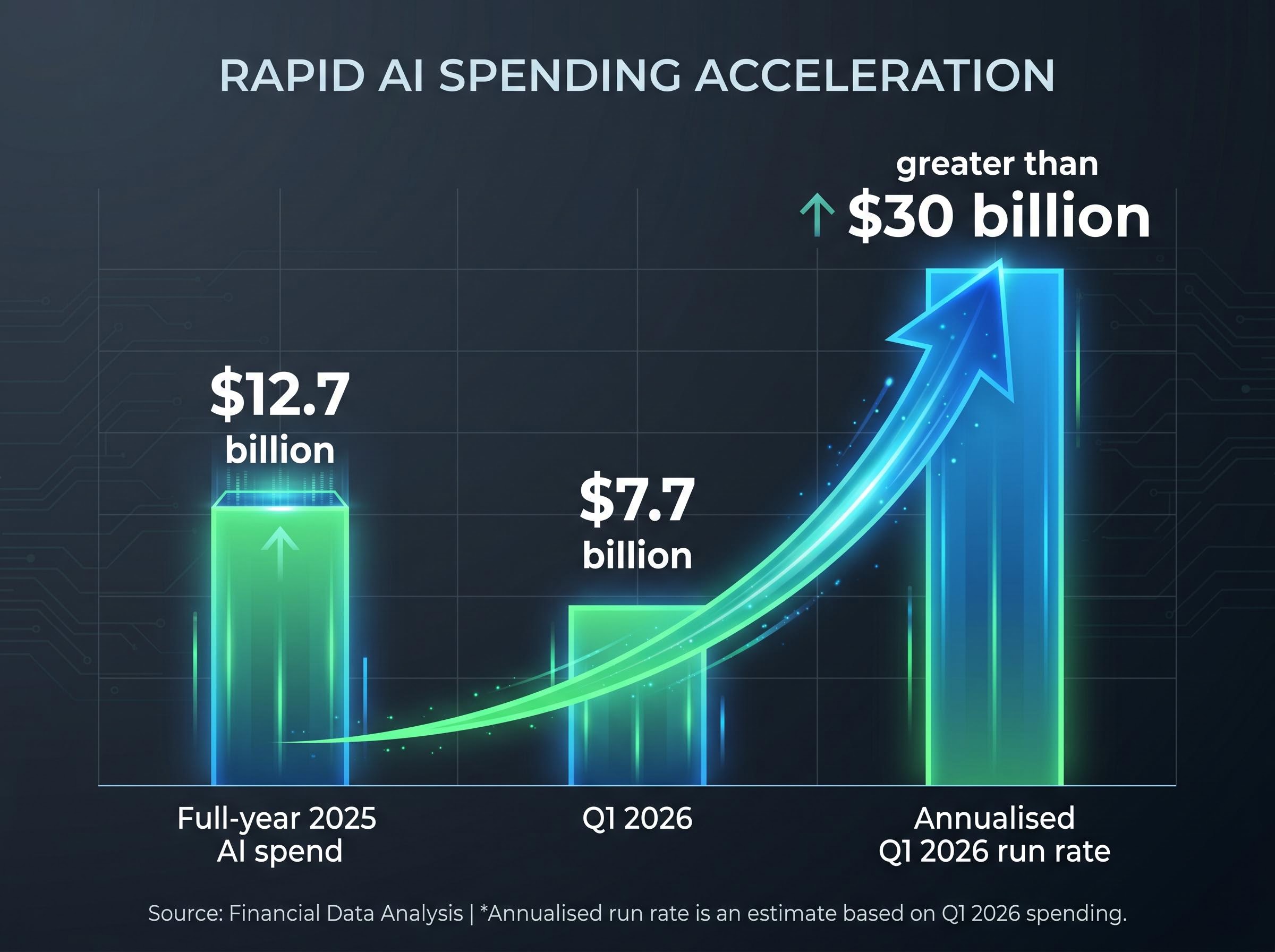
SpaceX reported $7.7 billion in AI-related spending in Q1 2026. That single quarter implies an annualised run rate exceeding $30 billion.
Placed against the $12.7 billion SpaceX spent on AI for all of 2025, the acceleration is stark:
- Full-year 2025 AI spend: $12.7 billion
- Annualised Q1 2026 run rate: greater than $30 billion
This is not a plateau. Spending is already running at more than twice the full-year 2025 rate, and the Colossus II expansion has not yet been completed.
Wolfe Research characterised SpaceX as a “top-tier strategic customer” for Nvidia, with a current roadmap heavily dependent on H100 and GB-series accelerators.
Bloomberg Technology framed SpaceX’s AI build-out as “a material driver of AI accelerator demand.” Per Wolfe Research’s analysis, a substantial share of this capex flows directly to Nvidia hardware procurement, establishing SpaceX as a hyperscaler-scale demand anchor for Nvidia accelerators over at least the next several years.
Nvidia’s Q1 2026 datacenter revenue reached $75.2 billion, a 92% year-over-year increase, with hyperscaler customers accounting for roughly half of that figure, providing the broader demand context against which SpaceX’s disclosed GPU commitments should be measured.
What is Terafab, and should Nvidia investors be worried
What Terafab is
The S-1 discloses Terafab as a chip fabrication facility in Texas, co-located with SpaceX’s operations, designed to produce AI acceleration and communications silicon for internal use. Initial construction was underway as of early 2026.
Intel is named as the process-technology and design-services partner, providing IP, EDA tools, and manufacturing know-how. The S-1 also references a collaboration framework with Tesla (announced March 2026), with Intel formally joining in April 2026.
- Intel’s role: process-technology IP, design-enablement services, EDA tools
- Tesla: collaboration framework; scope beyond the announcement is not publicly detailed
The filing’s own language frames the investment as “several tens of billions of dollars in Terafab-related capex over the next decade,” without committing to a per-year breakdown or specific process node. The stated output goal is approximately 1 terawatt of compute hardware per year.
How Terafab compares to hyperscaler custom silicon programmes
Google TPU, Amazon Trainium/Inferentia, and Meta’s internal chips are the direct analogues. In each case, the hyperscaler runs custom silicon alongside, not instead of, Nvidia hardware.
Custom silicon programmes at Alphabet, Amazon, and Meta follow the same structural logic as Terafab: hyperscalers run internally developed chips alongside Nvidia hardware rather than replacing it outright, and in each case the transition to meaningful internal silicon volume has taken longer and proved more workload-specific than initial announcements suggested.
Wolfe Research’s Pate characterised Terafab’s ramp as a “second-half-of-the-decade story,” noting that even post-ramp, SpaceX would likely continue purchasing some Nvidia hardware for ecosystem compatibility and certain workload types. Reporting from IEEE Spectrum and Wired reached a similar conclusion: initial Terafab chips are expected to target SpaceX-specific workloads (communications, on-orbit inference) rather than general-purpose training, limiting direct competition with Nvidia’s core datacenter GPU business.
The pilot line is targeted for 2027-2028. Meaningful volume production falls later in the decade. For NVDA investors, Terafab is a legitimate long-term variable, but its timeline leaves near-term demand fully intact.
Understanding SpaceX’s AI infrastructure build-out (and why it rivals hyperscalers)
SpaceX is better understood as an AI infrastructure operator that also launches rockets, rather than the reverse. Colossus I and II are ground-based AI compute clusters used for model training and inference, purpose-built for large-scale AI workloads and physically co-located with the company’s Texas operations.
Analyst and media commentary consistently characterises SpaceX’s clusters as “hyperscaler-scale,” comparable in ambition to the largest cloud providers, according to Bloomberg Technology and Wolfe Research.
The S-1 lays out three components of SpaceX’s AI compute strategy, progressing from near-term to long-term:
- Ground clusters (now): Colossus I and II, with a combined planned capacity of 1 gigawatt
- Terafab (mid-to-late decade): custom silicon fabrication to reduce external hardware dependence over time
- Satellite AI constellation (late decade): a 100-gigawatt annual compute capacity target, with programme launch targeted as early as 2028
Wolfe Research estimated that achieving the satellite compute targets would require thousands of rocket launches per year. The constellation remains a forward indicator of sustained hardware demand rather than confirmed near-term capex, but it underscores why SpaceX’s GPU commitments carry weight for Nvidia’s demand runway.
NVDA stock on 21 May: the market’s mixed read on the news
The headline coverage and the actual price data told different stories on 21 May 2026:
- What was reported: Bloomberg Television described Nvidia shares as “modestly higher” in the context of a broader tech rally
- What the data shows: NVDA closed at $219.51, down approximately 1.77% from the prior close of $223.47
The discrepancy has a straightforward explanation. 21 May was also an Nvidia earnings-reaction day. The stock’s movement reflected mixed sentiment on forward guidance as the primary driver, with the SpaceX S-1 as secondary context.
Nvidia Q1 FY2027 earnings delivered $81.61 billion in revenue and a $91 billion Q2 guide that explicitly excludes any Chinese data centre contribution, meaning the SpaceX confirmation arrives at a moment when Nvidia’s forward guidance already assumes US and allied demand must carry the full demand story.
No named analyst has publicly issued a numerically specific NVDA price-target revision or EPS estimate change directly and solely attributed to the SpaceX filing. Wolfe Research framed SpaceX as “incremental upside” relative to existing NVDA AI-demand assumptions, not a standalone catalyst. Retail investors who encountered contradictory day-one coverage should treat the actual closing data, not the narrative summaries, as the definitive record of market sentiment.
SpaceX’s S-1 adds a durable new anchor to Nvidia’s AI demand story
The S-1 confirms SpaceX as a hyperscaler-scale Nvidia customer with a multi-year, publicly disclosed hardware roadmap. That confirmation adds demand durability to an AI infrastructure spending narrative that some investors have questioned for longevity.
Two time horizons apply. Near-term, through mid-decade, the disclosed cluster scale and capex run rate represent a clear NVDA positive. Longer-term, late in the decade, Terafab introduces optionality that could reduce Nvidia’s wallet share at SpaceX, though the complexity and timeline of fab construction suggest monitoring rather than over-weighting.
Three forward-looking indicators for NVDA investors to track:
The SpaceX Nasdaq listing, targeted for 12 June 2026 under ticker SPCX, would convert the company’s publicly disclosed hardware roadmap into a set of quarterly reporting obligations, giving NVDA investors a recurring data source to track GPU procurement commitments directly from SpaceX’s own filings rather than relying on third-party channel checks.
- Terafab construction milestones and any disclosed process-node commitments
- SpaceX’s subsequent quarterly capex disclosures following its expected Nasdaq listing
- NVDA earnings commentary that names SpaceX or space-sector customers as a demand category
This article is for informational purposes only and should not be considered financial advice. Investors should conduct their own research and consult with financial professionals before making investment decisions. Forward-looking statements regarding Terafab timelines and SpaceX capex trajectories are speculative and subject to change based on market developments and company performance.