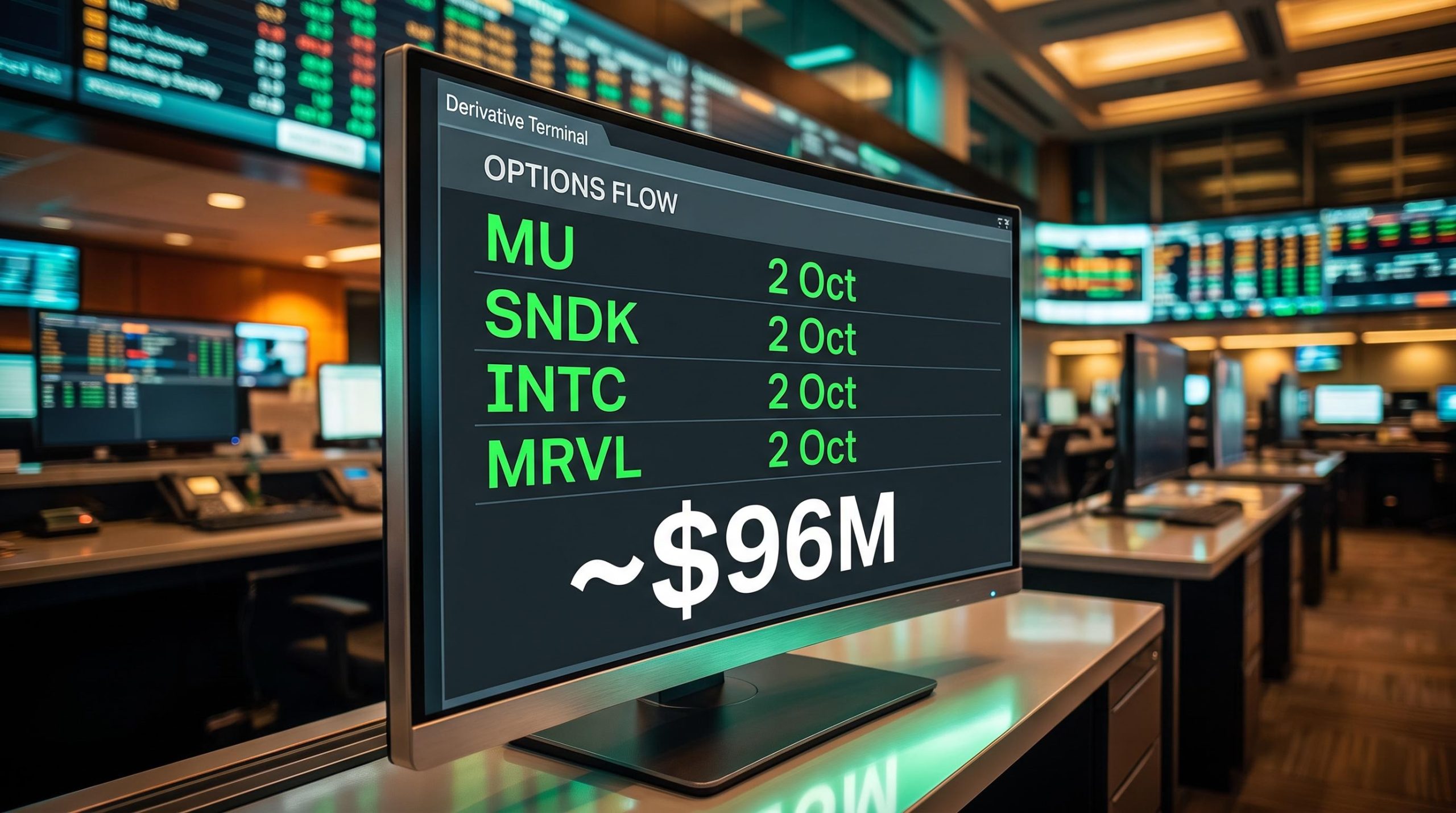
On a single trading session, a buyer committed roughly $96 million in options premium across four semiconductor names, every one of them expiring on 2 October, in what reads on the tape as a coordinated two-week wager on the AI memory trade.
The basket spans Micron, Sandisk, Intel, and Marvell. It drew immediate attention from derivatives desks and market-monitoring services because of its scale, its synchronisation, and the compressed window before expiration.
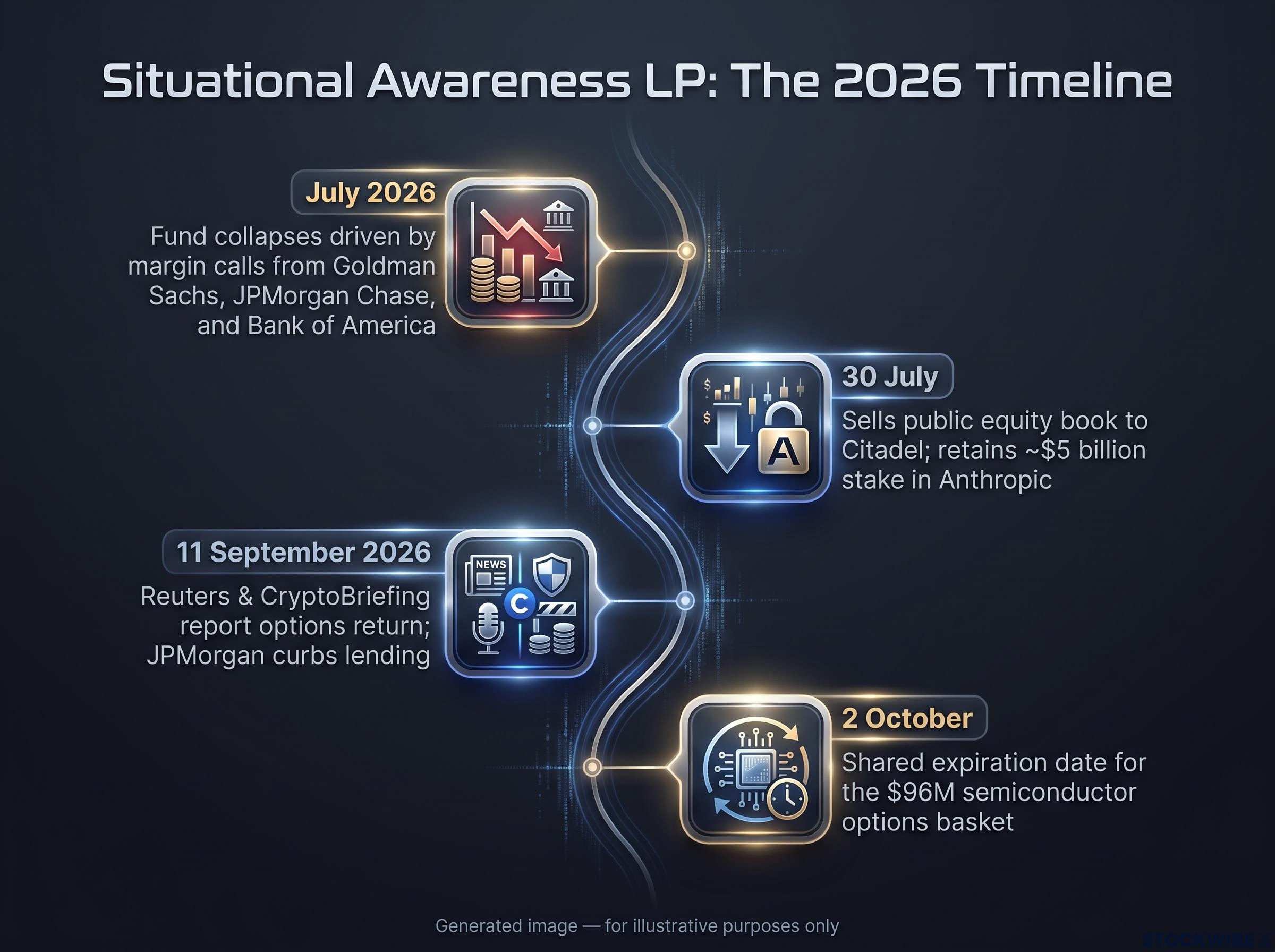
Within hours, an unverified but widely circulated attribution connected the trade to Leopold Aschenbrenner’s Situational Awareness LP, a fund that collapsed in July 2026 after margin calls, sold its public equity book to Citadel, and then reportedly returned to AI-related options markets weeks later.
This breaks down exactly what was bought and at what cost, what the memory market thesis behind the positioning implies, what alternative explanations the structure supports, and why the attribution question matters more than the rumour itself. If you track AI sector momentum and options flow, the structural details here will serve you better than the headlines.
A $96 million call basket, four names, one expiration date
Start with the numbers, because the numbers are the story. A buyer purchased short-dated call options across four semiconductor companies on the same day, and the sums involved are not the kind of flow that passes unnoticed.
The basket lands against a backdrop of an extraordinary semiconductor equity rally: the PHLX Semiconductor Index added roughly $3.8 trillion in six weeks, Sandisk surged approximately 492% year to date through May 2026, and Micron posted record quarterly net income of $13.79 billion, giving the call strikes in this basket a specific earnings context to trade against.
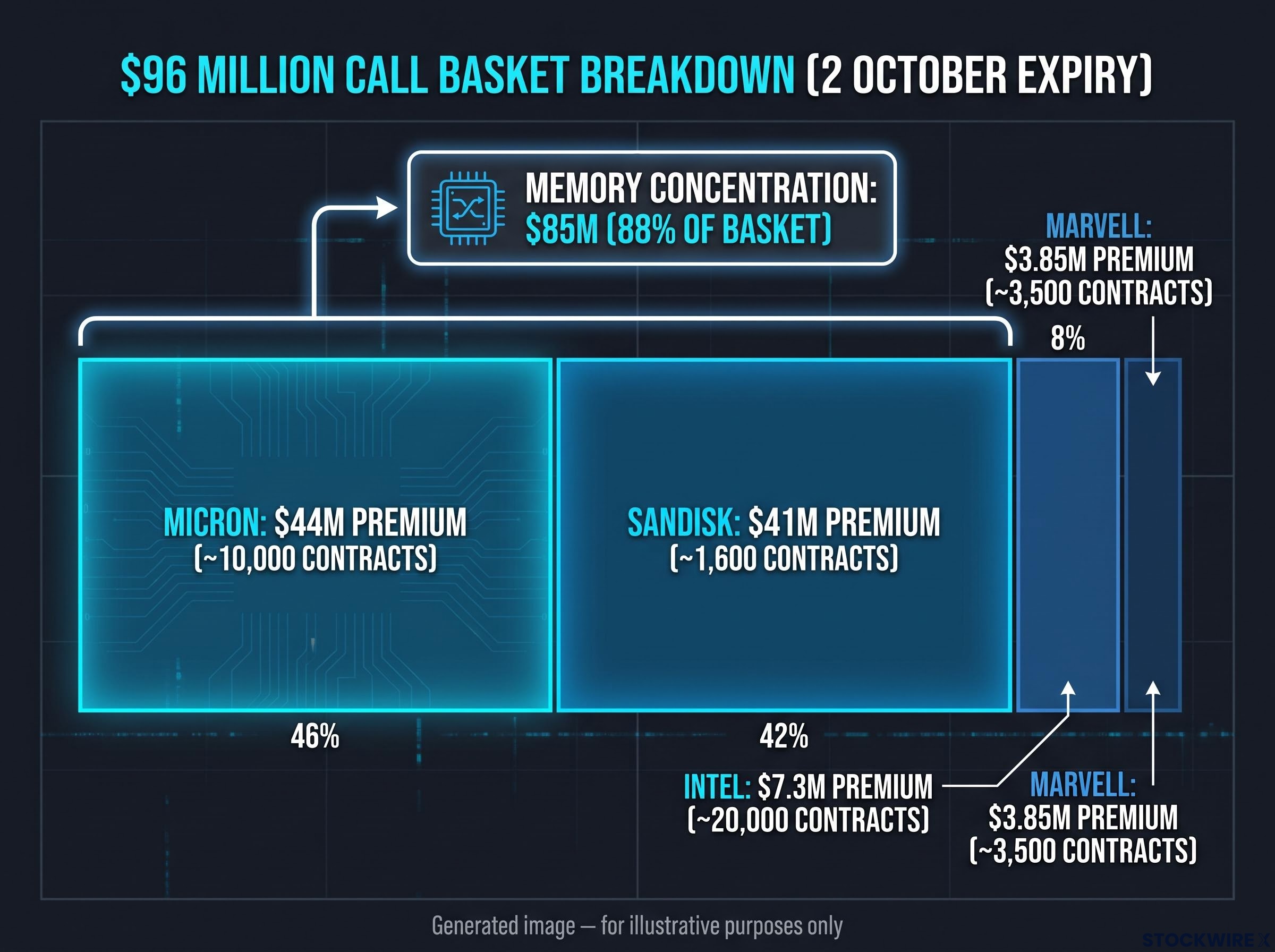
The largest single position sat in Micron (MU): roughly 10,000 contracts of 1,000-strike calls at around $44 per contract, for approximately $44 million in premium. Close behind came Sandisk (SNDK), where a buyer took around 1,600 contracts of 1,600-strike calls at up to $97.60 each, roughly $41 million in premium and a breakeven near $1,697.60.
The remaining two positions were smaller but built on the same template. Intel (INTC) drew about 20,000 contracts of 115-strike calls at up to $3.65, near $7.3 million in premium with a breakeven around $118.65. Marvell (MRVL) rounded out the basket with roughly 3,500 contracts of 250-strike calls at $11, about $3.85 million in premium and a breakeven near $261.
| Ticker | Strike | Contracts | Premium Paid | Breakeven |
|---|---|---|---|---|
| MU | $1,000 | ~10,000 | ~$44M | – |
| SNDK | $1,600 | ~1,600 | ~$41M | ~$1,697.60 |
| INTC | $115 | ~20,000 | ~$7.3M | ~$118.65 |
| MRVL | $250 | ~3,500 | ~$3.85M | ~$261 |
| Total | – | – | ~$96M | – |
The shared expiration is the tell
Note that Micron and Sandisk alone account for roughly $85 million of the total, weighting the basket heavily toward memory rather than spreading it evenly across the four names. That is a deliberate structural choice, not an incidental allocation.
The detail professional options readers will fix on, though, is the identical 2 October expiry across all four. Four unrelated companies, one date, executed together at this size: coincidence does not produce that pattern. That structural feature is precisely what turned the basket from notable into newsworthy, and it lets you measure any emerging catalyst against specific breakeven levels rather than vague directional talk.
When big ASX news breaks, our subscribers know first
Why memory is carrying $85 million of this bet
The concentration in Micron and Sandisk, roughly 88% of the $96 million basket, is not arbitrary. It reflects a specific view on how memory markets behave when demand tightens, and it helps to walk the logic as the buyer would understand it.
Memory segments function as high-beta catalysts for semiconductor equities because of how the cycle moves. Three levers do the work:
The concentration in Micron and Sandisk reflects a broader structural argument: the memory chip supercycle now unfolding is unlike previous DRAM upcycles, with hyperscaler capex projected at $725 billion in 2026 and new manufacturing capacity unable to reach mass production before 2027.
- Cyclicality and pricing power: DRAM and NAND markets swing between oversupply and shortage. When utilisation rises and contract prices stabilise or turn higher, memory producers’ earnings can inflect sharply, driving sector-wide re-ratings.
- AI demand intensity: Advanced data-centre workloads lean on memory bandwidth and capacity as hard constraints, not just cost lines. When AI demand outpaces the supply of advanced memory, the setup favours tight supply and rising prices.
- Supply-constraint mechanisms: Limited high-bandwidth memory (HBM) production capacity, lagging investment in specific nodes, and long lead times for expansion can sustain multi-quarter pricing strength.
The demand-side urgency is what sets this apart from a general AI trade.
Memory bandwidth and capacity, not just raw compute, constrain how AI systems actually perform. That reframes supply tightness as a performance bottleneck for AI infrastructure operators, which gives pricing pressure a demand-driven edge.
Here is the constraint the two-week window imposes. A 2 October expiry means the buyer is not positioned for a multi-quarter memory thesis. This is a near-term catalyst play: a pricing data release, an earnings-adjacent update, or supply commentary that could move memory equities quickly.
What that means for you is straightforward. If memory pricing data or supply commentary emerges before 2 October and confirms tightening, the Micron and Sandisk positions are built to capture a sharp re-rating. If the window passes without a catalyst, that $85 million faces near-total decay regardless of whether the longer-term thesis is right.
What else this structure could be, beyond a directional bet
It is tempting to read the basket as a pure bet that these stocks go up. Institutional options desks rarely deploy structures this cleanly, and there are at least three interpretations worth genuine weight.
- Directional speculation. The straightforward read: an aggressive near-term bet on a catalyst. A modest premium controls significant notional exposure for a brief window, and a sharp upside move generates outsized percentage gains.
- Stock replacement. A fund forced to reduce gross equity exposure can hold calls instead of shares, keeping upside participation with defined downside (the premium) and far less balance-sheet commitment. This is directly relevant to a fund recently compelled to shrink its equity book.
- Hedging overlay. A portfolio already long AI infrastructure or cloud platforms might buy memory and chip calls as a disaster hedge, protection against an industry upturn that would otherwise leave it under-exposed to key beneficiaries.
Each of these carries a different meaning for what the flow tells you about professional positioning.
The risk profile every interpretation shares
Whichever reading is correct, the same three risks apply. With roughly two weeks to expiration, theta decay is brutal, and gradual appreciation is not enough; the underlying stocks must move fast and far. The payoff depends on a narrowly timed catalyst, so a delayed or muted event can gut the position even if the broader thesis holds. And if implied volatility was elevated at entry, the buyer may have overpaid for the expected move, with wide bid-ask spreads and slippage across multiple names adding execution risk on top.
Understanding this menu of explanations lets you resist the binary framing of “someone knows something” versus “it is just noise”. The flow tells you something about professional positioning regardless of who initiated it, and acting on incomplete inference is how traders get caught out.
The attribution question, and why the tape cannot answer it
The rumour is the reason this trade travelled. Tommy Thornton of Hedge Fund Telemetry attributed the basket to Leopold Aschenbrenner of Situational Awareness LP, consistent with an initial flag from ZeroHedge. Separate reporting from Reuters and CryptoBriefing on 11 September 2026 noted the fund had returned to AI-related options markets with “hundreds of millions” in fresh bets weeks after the Citadel sale.
The context makes the attribution plausible on its face. The fund suffered a collapse in late July 2026, driven by margin calls from Goldman Sachs, JPMorgan Chase, and Bank of America. Around 30 July it sold its public equity book to Citadel in a negotiated block transaction, yet the entity continued operating, anchored by an approximately $5 billion stake in Anthropic. As of the 11 September Reuters report, JPMorgan had curbed its lending to the fund.
Plausible is not the same as confirmed, and here is why the tape cannot close the gap:
- SEC and CFTC reporting systems do not identify the beneficial owner of each trade. Public prints show size, strike, and expiry, not who placed the order.
- A large print can travel several routes: dealer hedging, client facilitation, internalisation, or aggregation across multiple funds. Any of these can produce a headline-sized block with no single directional owner.
- Experienced journalists covering block trades know the limits. They rely on multiple sources and still frame most attributions cautiously, because getting it wrong has consequences.
SEC beneficial ownership reporting thresholds require disclosure only when a holder crosses 5% of a class of equity securities, which is why options positions of the scale described here can print on the tape without any public filing identifying the buyer by name.
The original source was explicit about this.
The claim was characterised as unverified rumour, from a source described as relatively credible within the context of market rumours. Trade tape alone cannot confirm the identity of the order originator.
So weigh the context against the impossibility of confirmation. The attribution to Situational Awareness may be accurate, wrong, or partially correct, for instance a prime broker or intermediary executing on behalf of a client. Before you treat any of this as a trading signal, understand that misattributing large trades to specific actors distorts how everyone else reads the flow. The mechanics of options attribution are as important to grasp as the trade structure itself.
What to watch before 2 October, and what this flow signals regardless of who placed it
Set the initiator aside. The basket exists, and its existence has already changed the information landscape for anyone tracking AI semiconductor momentum. The question now is what could move these names inside the window.
Watch these catalyst categories before 2 October:
- Memory pricing data or supply commentary on DRAM, NAND, and HBM
- AI infrastructure capex signals from hyperscalers
- Any earnings-adjacent guidance updates from Micron, Sandisk, Intel, or Marvell
- Broader chip-sector sentiment shifts
The basket itself is also a signal, and this is the part many readers tracking unusual activity miss.
Large short-dated call buying at this scale forces market makers to hedge their exposure by trading the underlying shares. That delta-hedging creates mechanical buying and selling pressure in the stocks themselves, which can influence near-term price behaviour independent of whether the original thesis ever proves correct.
The delta-hedging pressure the article describes operates through a precise mechanism: as the underlying stock price approaches or exceeds the call strike, market makers must buy more shares to remain hedged, with the sensitivity of that hedge expanding sharply in the final days before expiration as delta polarises toward its extreme values.
The numbers to watch are the breakevens, not the headline premium: SNDK near $1,697.60, INTC near $118.65, and MRVL near $261. Those strikes mark where the trade crosses from loss into gain, and where hedging pressure becomes most acute.
The 2 October deadline is hard. Any thesis that plays out after that date produces zero value from these specific contracts. If you watch memory pricing releases, hyperscaler capex commentary, or chip-sector windows over the next two weeks, you now have specific dollar thresholds and a specific set of names to judge whether the thesis is being confirmed or abandoned. Whoever placed it, the flow is the signal worth following.
This article is for informational purposes only and should not be considered financial advice. Investors should conduct their own research and consult with financial professionals before making investment decisions. These statements are speculative and subject to change based on market developments and company performance. Past performance does not guarantee future results.