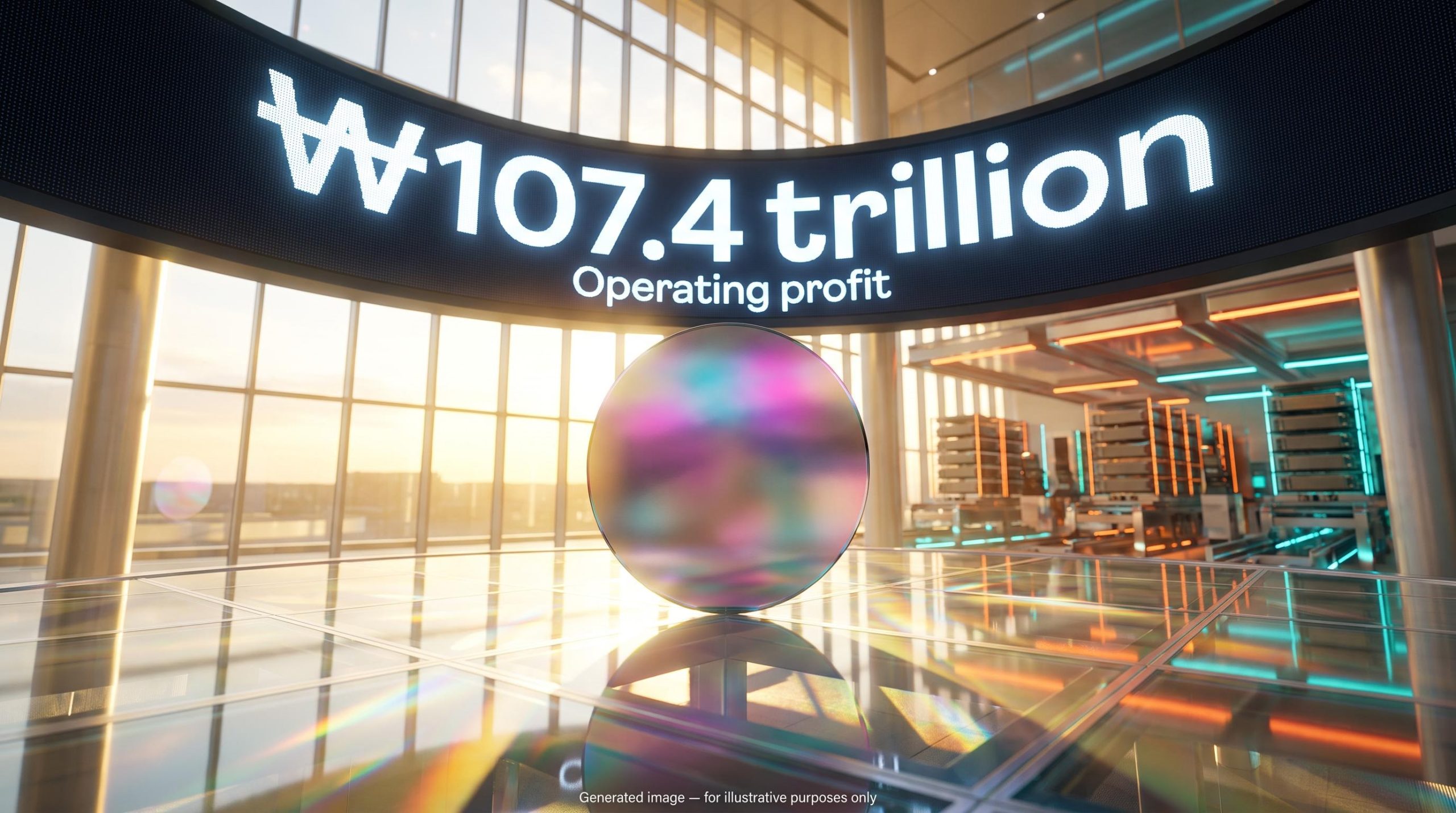
Samsung Electronics has guided to an operating profit of ₩107.4 trillion (about US$80 billion) for the September quarter. That makes it the first South Korean company to earn more than ₩100 trillion in a single quarter. The Samsung Q3 2026 profit puts a memory chip maker in an earnings bracket once held only by the largest companies in the world.
The figure edged past consensus of about ₩106 trillion. Revenue of about ₩195 trillion landed slightly below some forecasts.
These numbers are preliminary. Full results with divisional detail are due later in October.
This piece covers what is driving the record, how durable it looks, and which disclosures to check when the full figures arrive.
Why a memory chip maker just out-earned almost everyone
Start with the margin. On roughly ₩195 trillion of revenue, Samsung kept about 55% as operating profit. That is an exceptional rate for a company that also builds phones and televisions.
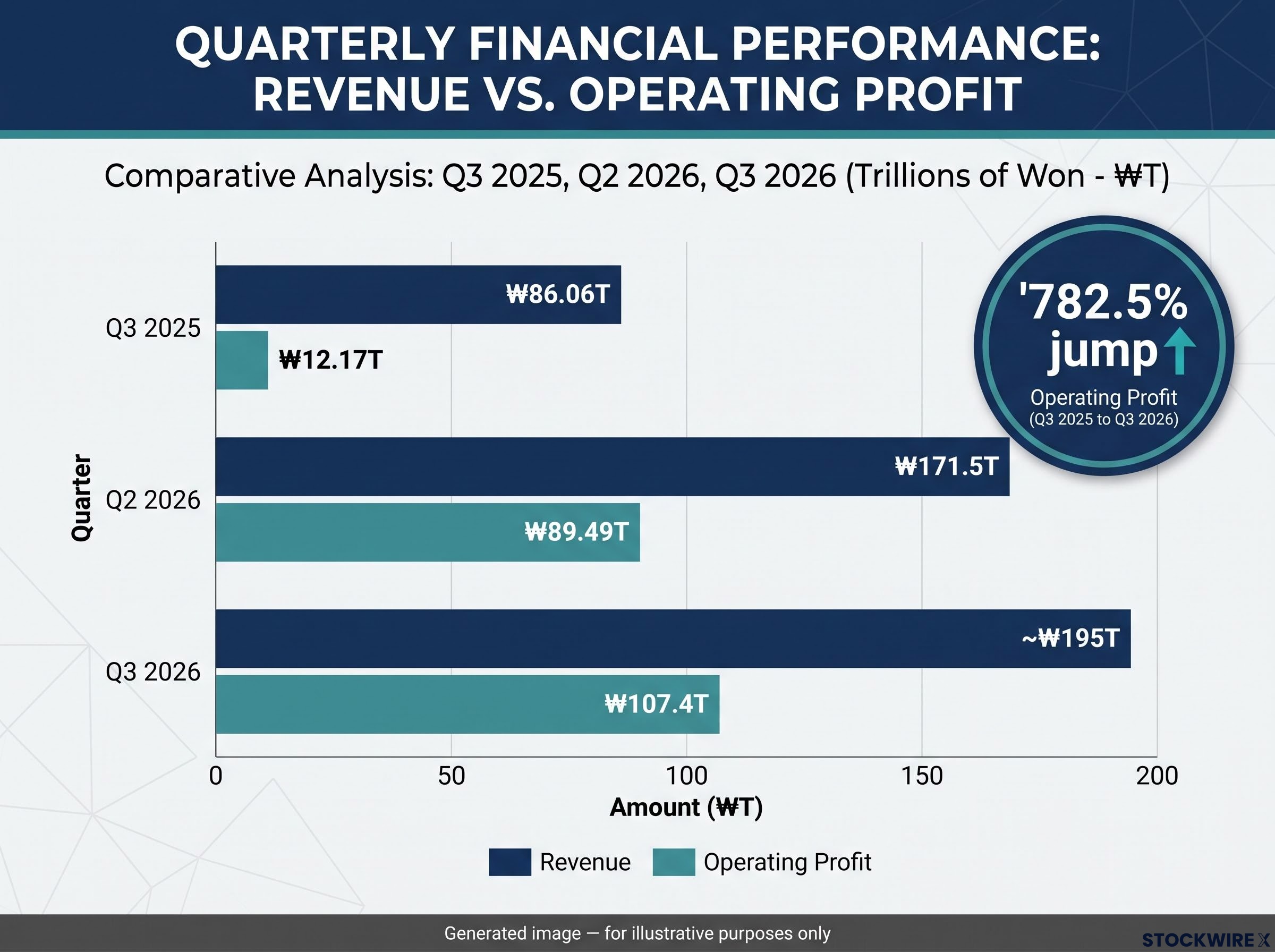
The comparisons show how far the business has moved.
| Metric | Q3 2026 | Q2 2026 | Q3 2025 |
|---|---|---|---|
| Revenue | ~₩195T | ₩171.5T | ₩86.06T |
| Operating profit | ₩107.4T | ₩89.49T | ₩12.17T |
Operating profit climbed about 20% from the June quarter, which is already a strong sequential gain. Against the same quarter last year it jumped 782.5%, close to ninefold, while revenue rose 126.6%.
That gap is the story. When profit grows several times faster than sales, the change comes from pricing and product mix in memory, not from a normal cyclical bounce. You should treat Q3 2025 as a poor baseline for judging what normal looks like now.
Samsung is not alone in this: Samsung, SK hynix and Micron all posted earnings growth above 900% in the first quarter of 2026, which points to industry-wide pricing power rather than individual outperformance.
A national first No South Korean company had previously reported quarterly operating profit above ₩100 trillion.
This is Samsung’s fourth consecutive record quarter and its highest third-quarter operating profit on record. Across the first nine months of 2026, the company booked ₩500.37 trillion in revenue and ₩254.13 trillion in operating profit.
One caveat applies. The figures are preliminary estimates under K-IFRS, Korea’s version of international accounting standards, and Samsung gave no divisional breakdown.
When big ASX news breaks, our subscribers know first
How AI demand turned memory into a seller’s market
The profit follows from supply arithmetic, not from a vague “AI boom.”
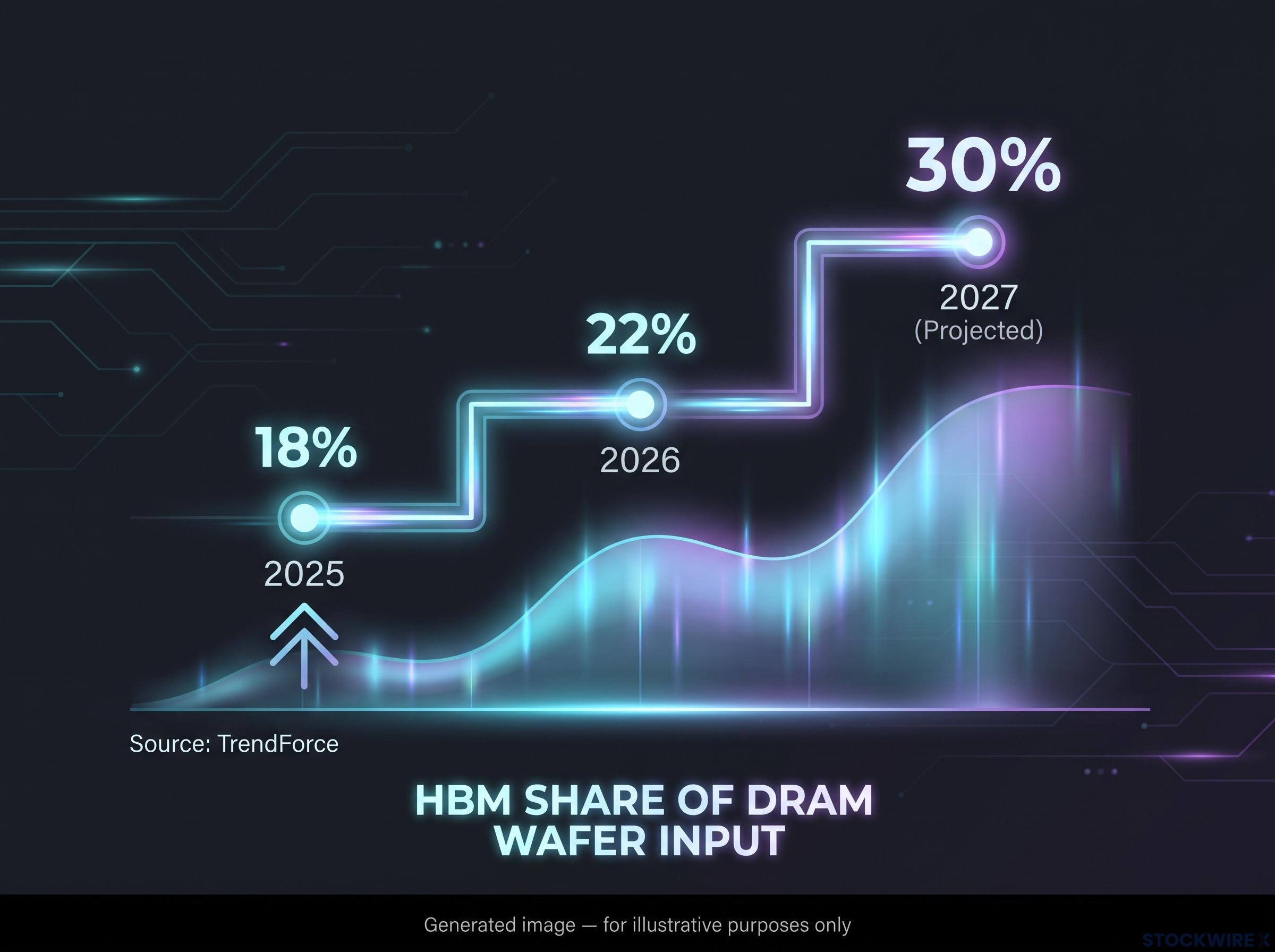
It starts with high bandwidth memory (HBM), a type of stacked DRAM chip that feeds data to AI processors at very high speed. DRAM is the short-term working memory used in computers and servers. Making HBM uses up wafers, the silicon discs chips are cut from, that would otherwise become ordinary DRAM.
TrendForce estimated in June 2026 that HBM takes about 18% of DRAM wafer input in 2025 and 22% in 2026, and it projects 30% by 2027. Three forces then tighten the market:
- Wafer reallocation: wafers diverted to HBM shrink the supply of commodity DRAM as well as HBM.
- Sold-out capacity: the three major suppliers are effectively sold out through 2026.
- HBM price increases: HBM3E contract prices are rising, and suppliers see room for further increases into 2027 as HBM4 ramps.
TrendForce expects HBM plus RDIMM (registered memory modules used in servers) to account for 51% of DRAM bit supply in 2026. MarketsandMarkets puts the HBM market at about US$35 billion in 2025 and US$58 billion in 2026.
For you, the takeaway is that AI buyers are now outbidding everyone else for memory, and they are setting the price. That explains how profit can surge even when revenue only roughly meets forecasts. Long-term allocation agreements with hyperscalers, the largest cloud operators, also give suppliers revenue visibility the industry has rarely had.
Where Samsung sits against SK hynix and Micron
TrendForce’s early-2026 assessment ranks SK hynix as the HBM leader and Samsung as a fast-improving second source through HBM3E and HBM4. Micron sits third. HBM3E remains the volume product, at roughly two-thirds of 2026 HBM shipments.
All three supply Nvidia. Precise 2026 market shares by vendor were not available, and the research did not identify a dated Samsung HBM4 qualification milestone. Wafer mix, the HBM4 ramp and allocation deals are the levers to track across all three.
The beat, the miss and the won: what the headline hides
The record is real, but the details behind it are less tidy.
| Metric | Result | Consensus or reference | Gap |
|---|---|---|---|
| Operating profit | ₩107.4T | ₩106-106.64T (LSEG SmartEstimate ₩106.1T) | Beat of about ₩0.76-1.4T |
| Revenue | ~₩195T | Some forecasts ₩200-201T | Slightly below |
The consensus figures from Yonhap Infomax, FnGuide and LSEG had already moved lower. Forecasts were cut about 7.7% from an August peak near ₩114 trillion.
The main cause was the stronger won, not weaker memory demand. A stronger won shrinks the value of dollar-denominated overseas sales once they are converted back into Korean currency.
The consumer businesses absorbed the rest of the pressure:
- Stronger won: translated dollar sales are worth less.
- Component inflation: the same memory price surge raises Samsung’s own costs.
- Consumer-unit margins: the Galaxy smartphone division reportedly posted an operating loss of about ₩700 billion, its first quarterly deficit since 2011.
Samsung has not confirmed that loss, and it will not do so until the full results. The semiconductor division is estimated to have earned more than ₩100 trillion, which would mean chips carried almost the entire quarter.
A narrow beat after a downward revision tells you expectations had already been reset. Judge the quarter on the quality of the semiconductor margin, not the size of the surprise. Currency and cost pressure is a different problem from fading demand, and so far the evidence points to the former.
The previous record quarter showed how little a beat can matter once positioning is crowded: Samsung’s stock fell more than 6% in July after its June-quarter profit landed only modestly above expectations.
Supercycle or peak? What to watch when full results arrive
Whether this quarter marks a new normal or a high point depends on which reading of the memory market you accept.
Structural or cyclical: the two readings
MarketsandMarkets describes a structural, multi-year “AI memory supercycle” backed by hyperscaler commitments. In November 2025, Amati Insights pointed to demand beyond data centres, including on-device AI in phones and PCs, and compared memory makers to the “steel and cement” of digital infrastructure. TrendForce’s rising HBM wafer share through 2027 and supplier capacity discipline lend weight to this view.
The cyclical camp is less convinced. Dataintelo argued in September 2026 that the AI build-out is fully priced in, and it expects revenue per HBM stack to fall as normal chip price declines take hold.
Intuitionlabs flags large fab programmes, including Samsung’s Texas fab, SK hynix’s expansion and Chinese state-backed capacity. It suggests these could tip DRAM into oversupply by the early 2030s if AI spending plateaus.
The cyclical camp points to the classic supply response that has ended past upcycles, with SK hynix’s $29 billion Nasdaq IPO funding a 60% capacity expansion by 2030.
Other risks are already visible: currency, consumer margins, and heavy reliance on a small group of hyperscalers and GPU vendors. Samsung’s weight in the KOSPI and Korea’s exports magnifies all of them. MoneyToday called the result “new history.”
When the detailed release lands later in October, check:
- Divisional operating profit, especially the semiconductor figure.
- Management commentary on HBM mix and HBM4 progress.
- The outlook for memory pricing into 2027.
- The confirmed Mobile division result.
Those disclosures will tell you more about durability than the headline already published.
What the ₩107.4 trillion quarter does and does not settle
The quarter confirms that AI memory demand is now producing record earnings at national scale. It also shows the limits of that strength: a narrow beat, slightly light revenue, and real currency and consumer-unit pressure.
The next decision point is the full release later in October. The semiconductor division’s profit and Samsung’s HBM commentary will test the supercycle case most directly.
Until then, read Samsung, SK hynix and Micron through supply discipline and hyperscaler spending, not through headline records. The profit is real. How long it lasts is still an open question.
This article is for informational purposes only and should not be considered financial advice. Investors should conduct their own research and consult with financial professionals before making investment decisions. Past performance does not guarantee future results. Financial projections are subject to market conditions and various risk factors.