Salesforce beat second-quarter expectations, raised its full-year guidance, and launched a co-branded AI product with Anthropic on the same night. Shares surged more than 13% in after-hours trading on 26 August 2026, the largest single-session move for the stock in over a year.
The timing matters. Enterprise AI monetisation has been a promise across front-office software for the better part of two years, but most SaaS companies are still reporting prolonged sales cycles and buyer hesitation heading into late 2026. Salesforce is now presenting something different: raised financial targets paired with a named product, Claudeforce, that embeds Anthropic’s Claude reasoning engine directly into live sales workflows. That is evidence, not a roadmap slide.
Here is what the numbers and the partnership structure actually tell you about where Salesforce stands in the AI monetisation race, what the Claudeforce architecture means in practice, and which specific metrics will confirm whether this momentum holds into the second half of FY’27.
Salesforce’s Q2 beat: what drove the numbers and why the market reacted this sharply
A 13% after-hours move on an enterprise software stock is not a sentiment trade. It requires fundamental surprise, and Salesforce delivered it across multiple dimensions simultaneously.
Q2 FY’27 results exceeded Wall Street consensus on both revenue and earnings. The company then raised its full-year guidance above prior targets, a decision that carries more weight than the quarterly beat itself. A single quarter can outperform on timing or deal pull-forward. A guidance raise tells you management has enough confidence in AI-driven momentum to commit publicly to higher numbers for the rest of the fiscal year.
The 13% after-hours move compresses the stock’s forward multiple rapidly, and a detailed Salesforce valuation analysis published in May 2026 laid out the specific metrics, including Agentforce pilot-to-production conversion rates and Data Cloud ARR trajectory, that analysts identified as the clearest forward indicators separating the bull from the bear case.
CEO Marc Benioff framed the results in terms that left little room for ambiguity. AI, according to Benioff, is a current contributor to financial performance across three specific channels:
- Higher pricing: AI features are commanding premium tiers in customer contracts
- Better retention: AI-enabled workflows are reducing churn by deepening platform dependency
- Operational efficiency: Internal AI deployment is compressing costs alongside driving revenue
Benioff positioned AI as a present-tense driver of results, not a future narrative. The raised guidance on the same night as a named product launch is management’s way of backing that claim with a financial commitment.
For investors evaluating enterprise AI software, the pairing of a guidance raise with a product announcement is unusual. It separates this event from the pattern of AI announcements that accompany soft results as a distraction. Salesforce chose to raise the bar on the same night it launched Claudeforce, which tells you management believes the two are connected, not coincidental.
When big ASX news breaks, our subscribers know first
What Claudeforce actually is and how the Anthropic architecture works
Strip away the branding and Claudeforce is an integration architecture that embeds Anthropic’s Claude reasoning directly into Salesforce workflows, data, and governance layers. This is not a chatbot bolted onto the side of a CRM. It sits inside the platform, operating on the same data, rules, and permissions that sales teams already use.
The first product is “Salesforce in Claude,” a plugin that gives sellers access to prebuilt sales skills within Claude’s interface. Those skills include reasoning over live revenue context, automating pipeline updates, and executing governed actions without switching between platforms. At launch, a cohort of pilot customers had been granted early access, with an open beta scheduled to go live in September 2026 and a broader set of skills and integrations to follow later in the year.
| Component | What it does | Availability |
|---|---|---|
| Claudeforce platform | Embeds Claude reasoning into Salesforce data, workflows, and governance | Announced 26 August 2026 |
| Salesforce in Claude plugin | Prebuilt sales skills with live revenue context, pipeline automation, governed actions | Pilot active; open beta September 2026 |
| Slack integration | Claude positioned as default model for Slackbot and related AI features | Rolling out with Claudeforce timeline |
The embedded architecture is the detail that matters for investment analysis. A standalone AI tool competes for attention. An embedded one becomes part of the workflow itself, which is what drives the retention and pricing dynamics Benioff cited in the earnings call.
The reciprocal customer structure and what it signals about partnership durability
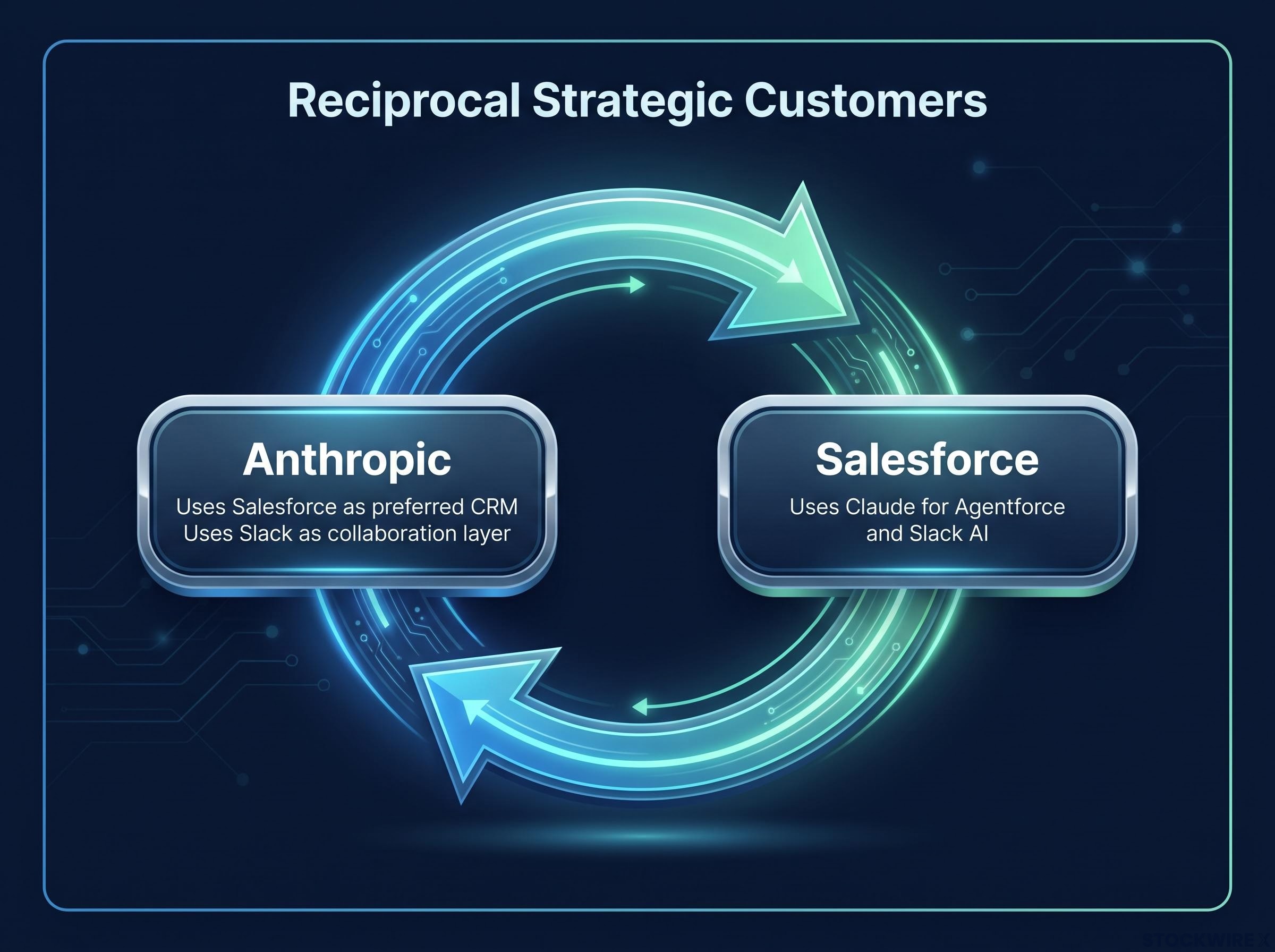
Both companies describe themselves as “strategic customers” of one another. Anthropic uses Salesforce as its preferred CRM and Slack as its collaboration layer. Salesforce relies on Claude for AI experiences across Agentforce and Slack AI.
This is not a branding choice. It means both companies have operational skin in each other’s performance. If Anthropic’s internal sales team runs on Salesforce data and Salesforce’s AI features run on Claude, unwinding the relationship would disrupt both companies’ own operations. That mutual dependency gives the partnership a structural durability that a standard licensing deal, where one side can switch providers at renewal, simply does not have.
Where Salesforce now stands versus front-office software peers
The competitive picture sharpens when you place the Salesforce results alongside what the rest of the front-office software sector has been reporting.
Raymond James analysts drew attention to a clear divergence in the data. According to their read of the results, Salesforce confirmed that its growth metrics are on course to pick up pace in the back half of FY’27, a trajectory that stands in stark contrast to rival front-office software vendors, which had pointed to stretched sales cycles persisting through 2026. The scale of that contrast is difficult to ignore.
Raymond James observed that Salesforce’s outlook for renewed growth acceleration set it apart from competitors still caught in prolonged sales-cycle headwinds, pointing to a competitive position strengthened by the depth of its AI product offering.
The connection between sales-cycle compression and AI product depth is straightforward. Buyers evaluating CRM and sales platforms are increasingly asking what AI capabilities come built in. Salesforce can now point to Agentforce and Claudeforce as named, operational products with pilot customers and a published beta timeline. Peers without equivalent AI integration face a harder sell, and the sales-cycle data reflects it.
The switching-cost dimension reinforces this. Once Claudeforce is embedded, three layers of dependency lock in:
- CRM data dependency: Claude reasons over live Salesforce data; replacing the CRM means rebuilding the AI’s context layer
- Workflow automation: Pipeline updates and governed actions run through Salesforce rules; migrating means re-engineering automation
- Slack collaboration: Claude as the default Slackbot model means the collaboration and AI layers are fused; switching either platform disrupts both
The sales-cycle divergence Raymond James flagged is the leading indicator to watch. If it persists into the next two quarters, it will confirm that AI integration is a genuine competitive separator rather than a one-cycle anomaly.
The enterprise AI adoption divide the Raymond James data reflects has measurable financial consequences: BCG research cited in the NVIDIA 2026 State of AI Report found early AI adopters building on shared data foundations delivered 3.6x higher three-year total shareholder return than laggards, a finding that frames the sales-cycle compression Salesforce is reporting as a leading indicator of a compounding structural advantage rather than a one-quarter anomaly.
The metrics that will confirm whether this AI momentum is real
The after-hours surge prices in optimism. What follows over the next two to three quarters will determine whether the optimism was warranted.
The metrics that matter for AI-enabled SaaS are different from the ones investors may be tracking for semiconductor and infrastructure plays. GPU shipments and capex cycles measure AI buildout. Net revenue retention (NRR, the percentage of revenue retained and expanded from existing customers), remaining performance obligations (RPO, contracted future revenue not yet recognised), and free-cash-flow margin measure AI monetisation. Salesforce now sits squarely in the second category, and investors who adjust their monitoring framework accordingly will be positioned earlier in the monetisation cycle.
NRR trend lines are the forward indicator that will determine whether the current optimism holds: sector-level analysis from July 2026 found that NRR holding or expanding across SaaS incumbents is the primary empirical test separating sentiment-driven multiple compression from genuine structural repricing, a framework that applies directly to reading Salesforce’s next two to three quarterly prints.
| What to watch | Why it matters | When to expect clarity |
|---|---|---|
| Claudeforce beta adoption | Validates whether embedded AI drives real workflow change or stalls at pilot stage | September 2026 open beta onwards |
| NRR and RPO trends | Confirms whether AI-inclusive contracts are lengthening commitments and expanding spend | Next 2-3 quarterly earnings reports |
| Competitive sales-cycle gap | Shows whether AI integration is compressing Salesforce’s cycles while peers remain extended | Front-office peer earnings through late 2026 |
| Second-half growth acceleration | Tests management’s reaffirmed expectation that growth metrics improve in H2 FY’27 | Q3 and Q4 FY’27 results |
The forward catalysts arrive in a specific sequence:
- September 2026: Claudeforce open beta launches, providing the first measurable adoption signal
- Later in 2026: Additional skills and integrations roll out, testing whether the product deepens or plateaus
- Second half of FY’27: Quarterly results either validate the growth acceleration Raymond James flagged or reveal that Claudeforce is adoption-constrained
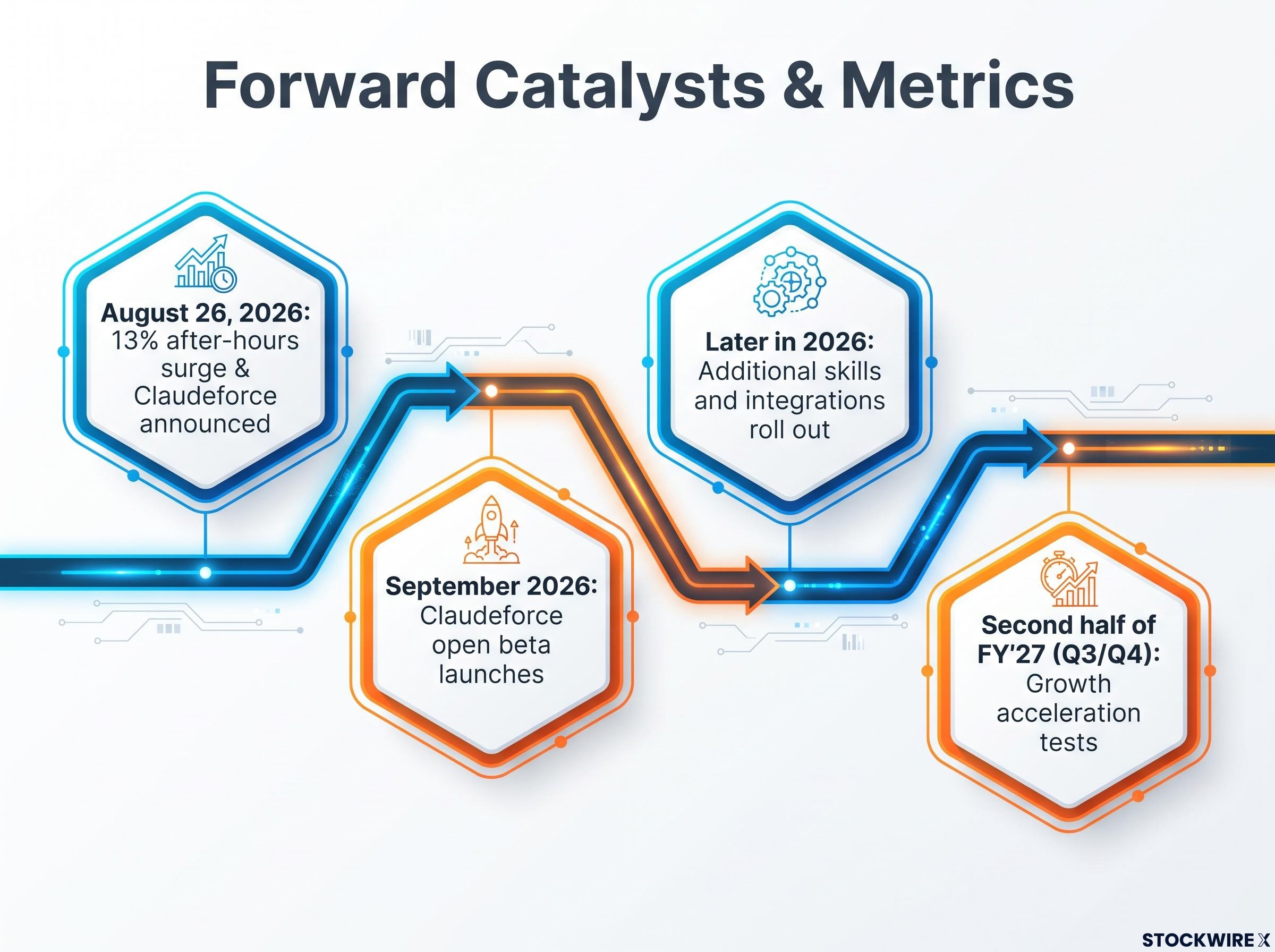
That sequence gives you a built-in timeline for re-evaluating the thesis at each stage rather than relying on a single earnings print.
What the Salesforce-Anthropic combination actually changes for software investors
The distinction this event establishes is worth carrying into every AI-enabled SaaS evaluation from here. AI-enabled software companies monetise via seat expansion, pricing power, and retention. They do not monetise via capex cycles. Salesforce has now provided a concrete, named example of how that plays out: a raised guidance, a product with pilot customers and a published beta date, and a partnership structure where both companies have operational dependency on each other’s platforms.
Claudeforce is not vaporware. The pilot-to-beta timeline, the reciprocal customer architecture, and the guidance raise on the same night form a pattern that points to product readiness, not marketing choreography.
The near-term test is specific. Raymond James pointed to the second half of FY’27 as the period when Salesforce’s own growth-metric targets should begin materialising. NRR and RPO trends over the next two to three quarters will either confirm that AI monetisation is scaling at Salesforce or reveal that the market priced in more than the product can deliver. Those are the numbers to watch, and they are the numbers that will separate the AI-enabled SaaS winners from the announcements.
For investors wanting direct exposure to Anthropic’s side of the partnership, our dedicated guide to Anthropic investment vehicles covers the six regulated fund structures and five large-cap tech positions that offer verified Anthropic equity exposure before a public listing.
This article is for informational purposes only and should not be considered financial advice. Investors should conduct their own research and consult with financial professionals before making investment decisions. Past performance does not guarantee future results. Financial projections are subject to market conditions and various risk factors.