
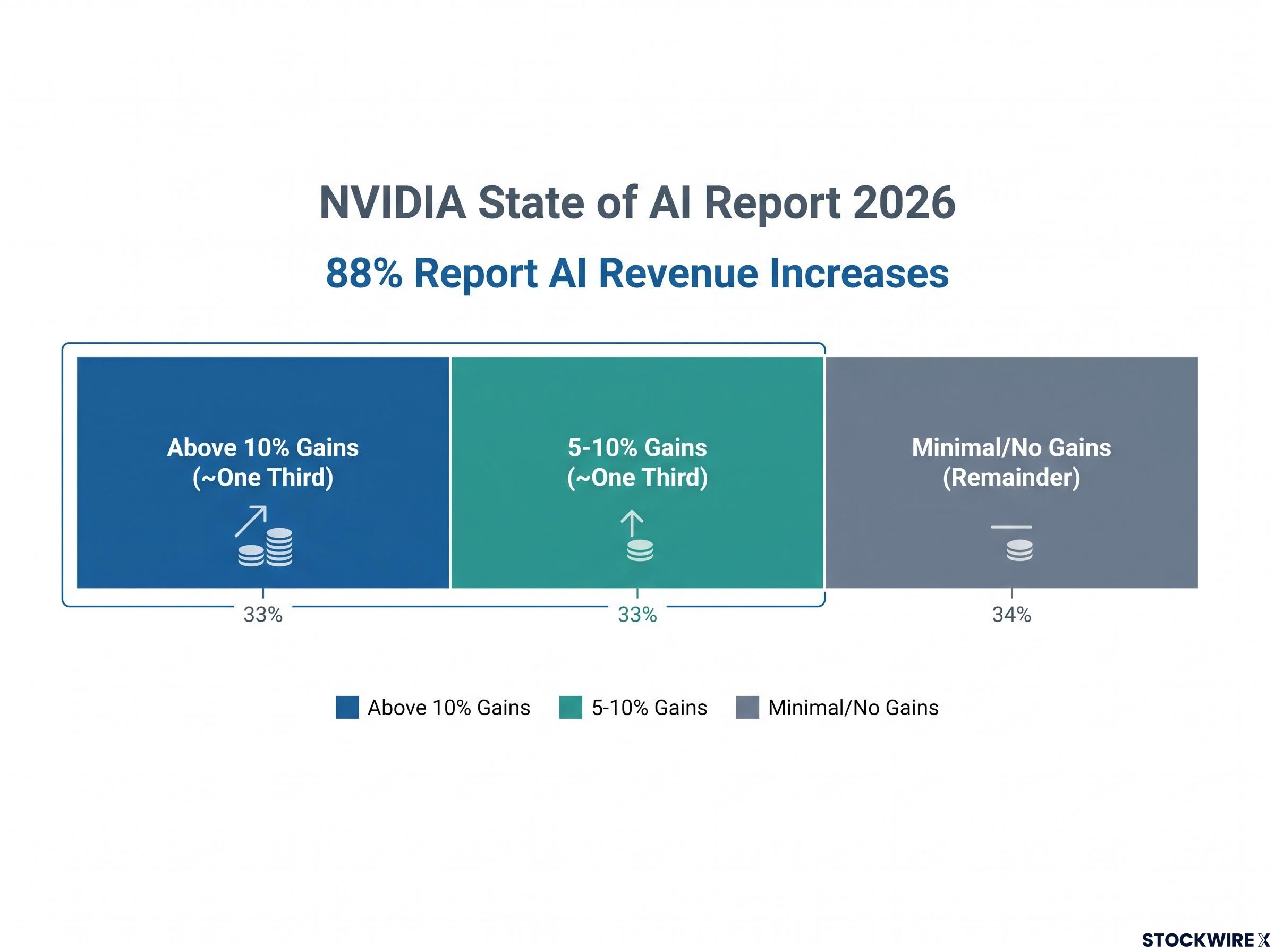
Eighty-eight per cent of organisations say AI has increased their annual revenue, according to the NVIDIA State of AI Report 2026. That sounds like a consensus. It is not. Roughly a third of those organisations report gains above 10%. Another third sit in the 5-10% range. And the tail, the cohort quietly buried inside that headline figure, is capturing little to no meaningful return despite significant spending.
The question enterprise leaders were asking two years ago, whether to invest in AI, has been replaced by a harder one: whether those investments are compounding into structural advantage or merely funding experiments that competitors can replicate at the same cost. Research published in 2026 reveals a measurable and widening divide between organisations building AI into their business and technology foundations and those still cycling through disconnected pilots.
Here is what the data actually tells you about where the value is concentrating, and why. This piece examines the four dimensions that separate compounding enterprise AI programmes from expensive activity: architecture, data maturity, scaling capability, and use-case type. Whether you are evaluating your own organisation’s AI programme or assessing a company’s competitive positioning, these are the diagnostic questions that matter now.
The revenue signal hiding inside the averages
Start with the good news. 88% of respondents in the NVIDIA State of AI Report 2026 say AI has lifted their organisation’s annual revenue. That is a genuinely significant finding, not a rounding error or a cherry-picked sample. Separately, the NTT DATA Business Solutions Transformation Study 2026, drawing on responses from 1,115 senior leaders across 15 countries, found that 60% of organisations now regard AI as the principal force driving their transformation programmes.
Revenue gain distribution (NVIDIA 2026): 88% of organisations report AI-driven revenue increases. Roughly one third report gains above 10%. Another third report gains in the 5-10% range. The remainder sit at the lower end, with minimal measurable return.
The distribution is where the story sharpens. The three tiers look like this:
- Above 10% revenue gains: approximately one third of respondents
- 5-10% revenue gains: approximately one third
- Minimal or no measurable gains: the remaining tail, despite active AI spending
That tail is the critical detail. “Most companies are winning with AI” is a less useful frame than “a specific type of company is winning substantially.” The divide is not about who started first. It is about how organisations have architected their AI programmes, and the sections that follow lay out exactly where the structural differences sit.
Separate AI automation ROI benchmark findings synthesising research from McKinsey, BCG, MIT, and Gartner place the share of organisations reporting measurable EBIT impact from generative AI at 39% in 2026, a figure that sits well below headline adoption rates and corroborates the distribution pattern the NVIDIA data reveals.
When big ASX news breaks, our subscribers know first
What enterprise leaders are actually optimising for in 2026
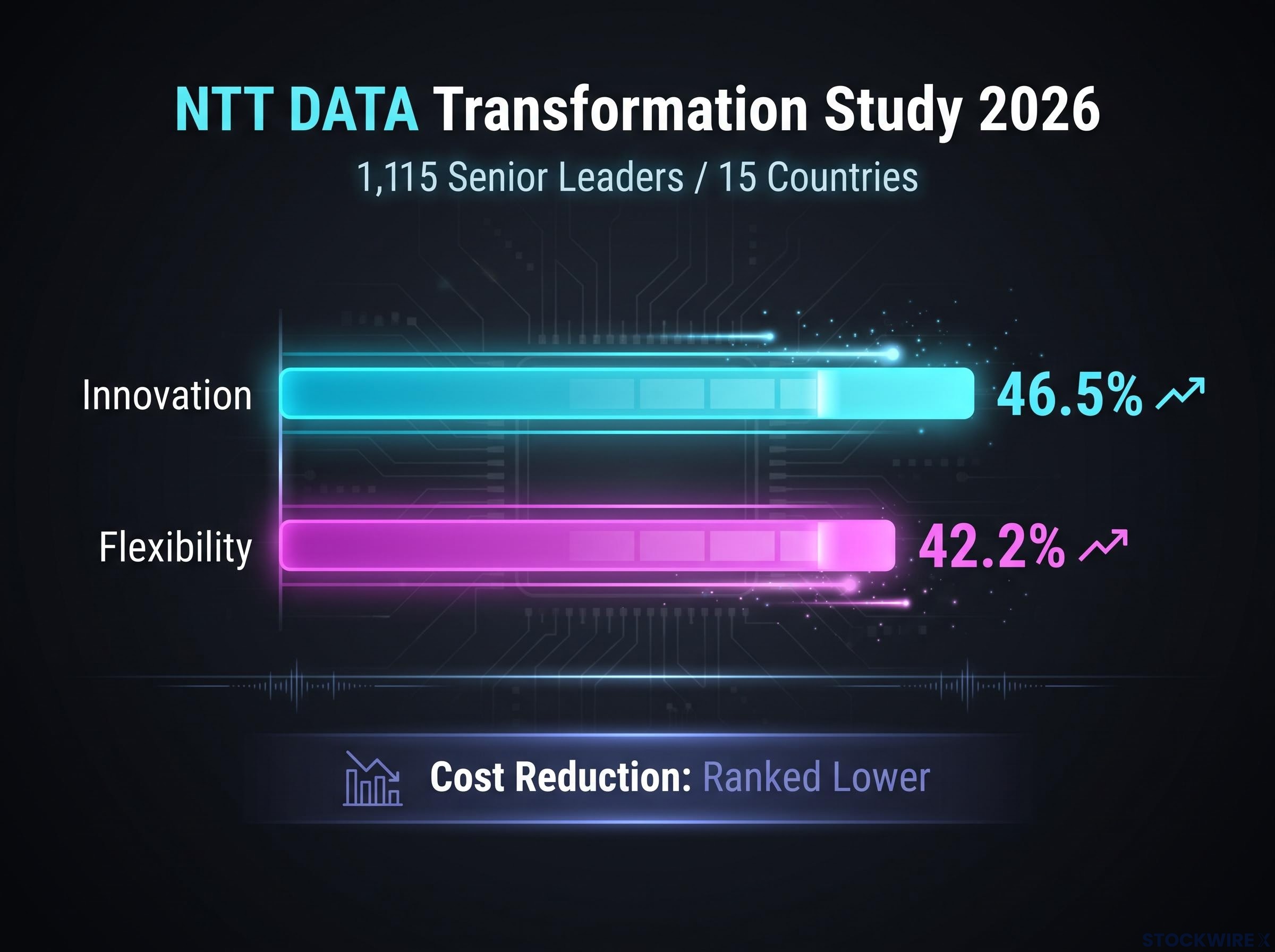
The NTT DATA 2026 study surfaces a pattern that is easy to miss in the headline figures: the strategic objectives enterprises are assigning to AI have shifted.
- Innovation: 46.5% of organisations now rank this as a strategic AI priority
- Flexibility: 42.2%
- Cost reduction: ranked below both
Two years ago, the dominant frame for enterprise AI was efficiency and automation: do what you already do, but cheaper. The current phase looks different. Growth, new business models, and value creation are now shaping where organisations direct their AI investment. The data does not describe a gradual evolution. It describes a strategic reorientation.
That reorientation connects to something the SYBIT Expert Talk panel made explicit: customers do not pay for the AI technology itself but for the tangible outcomes it delivers. The panel pointed to higher availability, faster decision-making, and improved service quality as the forms of value that actually drive willingness to pay. The underlying technology is simply the vehicle; revenue follows the result, not the capability.
What this tells you is direct. The enterprises most likely to build defensible AI positions are those reorienting their programmes around outcomes customers will pay a premium for, not around what IT departments can automate. If you are evaluating an enterprise AI programme, the first diagnostic question is straightforward: is this organisation using AI to defend margins, or to create offerings worth paying more for? The data suggests the premium accrues to the latter.
Governance and data quality as the real constraints on AI value
A common assumption runs through most boardroom AI conversations: the gap between leaders and laggards will close as models improve and better tools arrive. The research points in a different direction.
The data quality paradox (NTT DATA 2026): According to the Transformation Study 2026, data quality ranks among the most significant enablers of successful transformation programmes and, simultaneously, among the most persistent obstacles organisations report encountering, making it the variable that both unlocks and limits AI value.
That dual finding is worth sitting with. It means the organisations that have solved data quality and governance are pulling ahead precisely because most others have not, despite years of investment. The constraint is organisational, not technical. Better models do not fix poor data governance. Better tooling does not compensate for unclear programme objectives.
The SYBIT Expert Talk panel reinforced the sequence that separates programmes that scale from those that stall:
- Establish the business problem the programme is intended to address
- Clarify the value to be created in terms the customer or business unit can actually measure
- Choose the use case and technology only once steps one and two are settled
Organisations that invert this sequence, buying AI capability first and then hunting for use cases, consistently struggle to generate sustainable returns. The error is organisational in origin, not technical. For anyone evaluating an AI programme’s trajectory, the persistence of data quality and governance challenges despite years of spending is a warning sign that the conditions for scaling have not yet been established.
Data and architecture as the compounding moat
Data quality is a point-in-time problem. Data architecture is a compounding structural advantage. The distinction matters enormously for how you assess enterprise AI positioning.
In earlier cycles, enterprises devoted considerable resources to constructing large, monolithic data stores where every asset was pre-classified and formally structured before any AI system could touch it. That model assumed AI required near-perfect organisation upfront. More capable AI systems have changed the calculus: they can draw on heterogeneous sources and interpret data in context, shifting the priority from exhaustive pre-classification to ensuring that data is accurate, reachable, and subject to clear governance.
The NTT DATA 2026 study ranks transparency regarding data and transformation expertise among the top success factors for AI-driven change. The SYBIT Expert Talk panel identified data, processes, and architecture as the decisive foundation for turning first use cases into scalable solutions.
From shared data layers to standardised interfaces
In practical terms, leading organisations are building centralised data platforms, commonly called shared data layers, so that the same information assets can serve analytics tools, customer portals, AI assistants, and automation systems from a single governed source rather than through separate, brittle connections maintained for each application individually.
Shared data layers depend on the continued authority of systems of record, the incumbent SaaS platforms that hold the authoritative versions of customer, financial, and operational data; BCG research found that early AI adopters building on these foundations delivered 3.6x higher three-year total shareholder return than laggards, a figure that aligns closely with the revenue distribution pattern described in the NVIDIA 2026 data.
Model Context Protocol (MCP) sits on top of this foundation. MCP is an open standard introduced in 2024 for connecting AI applications to external data sources, tools, and workflows. Rather than building bespoke connectors for every new AI use case, organisations using MCP can expose their business data and processes to AI systems through a common interface, so that integration work done once can be reused across multiple applications.
| Dimension | Legacy approach | Modern AI architecture |
|---|---|---|
| Data organisation | Monolithic, pre-classified repositories | Accessible, high-quality data assets designed for reuse |
| Integration model | Point-to-point integrations per application | Shared data layers serving multiple applications simultaneously |
| AI interface design | Custom connectors rebuilt for each use case | Standardised interfaces (e.g. MCP) enabling rapid reuse |
| Deployment speed trajectory | Each new application costs the same as the last | Each new application is faster and cheaper than the last |
The compounding logic is the critical point. An enterprise that has invested in shared data layers and standardised AI interfaces is not just more efficient today. It is accumulating a structural cost and speed advantage over every competitor that must rebuild integration infrastructure for each new use case. The strategic value sits in the reusability pattern, not in any specific tool or protocol. Over time, that compounding deployment speed becomes a moat that slower movers find increasingly difficult to close.
The scaling test that separates leaders from laggards
The defining strategic question is not how large an organisation’s portfolio of AI initiatives has grown. It is whether those initiatives are converging on shared platforms that can support dozens of applications, or whether each one remains a standalone experiment requiring its own infrastructure. That distinction is where the leader-laggard divide becomes most visible.
Transformation complexity (NTT DATA 2026): Most transformation programmes are complex, overrun budgets, and miss timelines. AI and IT transformation are multi-year programmes, not linear projects.
The complexity is real. But the leaders navigating it share a recognisable pattern, and so do the laggards.
The revenue distribution data from the NVIDIA 2026 report gains additional context when set against enterprise AI pilot failure rates, with converging research from Gartner, McKinsey, and Forrester estimating that 70-80% of pilots stall before reaching scale, and poor data integration identified as the primary cause rather than talent or tooling shortfalls.
Leader characteristics:
- Initiatives are connected to shared platforms and reusable architectural components
- Data infrastructure and governance support scaling across multiple business functions
- Success is measured in revenue, customer outcomes, or new product delivery
- Successful pilots are treated as foundations for broader innovation
Laggard characteristics:
- Many disconnected experiments running simultaneously
- No shared infrastructure, governance, or standardised interfaces
- High AI spending with no measurable scaling of individual pilots
- Success is measured in initiative count rather than business outcomes
The revenue gain distribution from the NVIDIA 2026 report is the external evidence of this divide. The third of organisations capturing gains above 10% are not simply spending more. They are deploying AI on foundations that let each application build on the last. Perpetual pilot mode is not a temporary phase on the way to scale. For most organisations stuck there, it is the destination, and the external financial data is beginning to make that distinction visible to investors and boards.
What the leader-laggard divide actually means for enterprise AI investment
The analytical arc of this piece points to five dimensions that distinguish compounding advantage from table-stakes experimentation. For anyone evaluating an enterprise AI programme, whether from a leadership seat or an investment perspective, these are the diagnostic questions worth asking with specificity.
| Dimension | What to look for | Red flag |
|---|---|---|
| Outcome clarity | Programme targets are tied to revenue, retention, or new products with defined measurement | Success measured by initiative count or technology deployed |
| Data maturity | Accessible, high-quality data with governance that enables experimentation | Data quality cited as a persistent challenge with no visible remediation |
| Architecture design | Shared data layers and standardised interfaces reducing marginal cost per application | Custom integration work required for every new AI use case |
| Use-case type | AI creating new offerings, business models, or proprietary data advantages | AI programme focused exclusively on cost savings and margin defence |
| Scaling capability | Pilots evolving into platform-level deployments across multiple functions | High spending, many pilots, no evidence of scaling beyond initial use cases |
The 88% revenue figure from the NVIDIA 2026 report returns here as the closing anchor. Most organisations are seeing some return from AI. That is no longer in question. The harder question, and the one this data answers, is whether those returns are compounding into structural competitive advantage or simply keeping pace with a baseline that every competitor is also reaching. The five dimensions above function as the diagnostic: any enterprise AI programme that cannot answer these questions with specificity is most likely generating activity rather than building a moat.
The distinction between activity and compounding advantage maps onto a broader capital allocation question: the relationship between AI capex and monetisation has become one of the defining fault lines in how investors assess technology businesses, with Goldman Sachs projecting hyperscaler AI capital expenditure at $755-$800 billion in 2026 while monetisation timelines remain highly variable.
This article is for informational purposes only and should not be considered financial advice. Investors should conduct their own research and consult with financial professionals before making investment decisions.
Building for compounding advantage, not the next pilot cycle
The enterprise AI question in 2026 has moved past adoption. The harder question is about compounding, and the organisations answering it well are building structural advantages that will be difficult to close.
That does not mean the path is clean. Transformation programmes routinely overrun budgets and miss timelines. The gap between pilot success and platform-level value is where most programmes stall, and the data from the NTT DATA 2026 study confirms that this friction is real rather than rhetorical.
The forward-looking implication sits here. As AI models continue to improve, the organisations with proprietary data, shared infrastructure, and outcome-oriented programme design will extract disproportionate value from every model advancement. They will not need to restart with each new capability cycle. Organisations without those foundations will. The divide between the two is already measurable. It is widening. And it is increasingly visible in the financial data that investors and boards use to allocate capital.
The forward dynamic described here, where proprietary data, shared infrastructure, and outcome orientation extract disproportionate value from every model improvement, has a concrete recent illustration in proprietary data compounding at REA Group, which trained 90% of its Australian workforce on AI and tripled its searchable property index in six months by building on a 30-year dataset that no new entrant can reconstruct.
These statements are speculative and subject to change based on market developments and company performance.