
Nvidia just reported $96.22 billion in quarterly revenue, beat Wall Street’s earnings estimates by a wide margin, and guided the next quarter to $108 billion. Its stock still fell.
That tension is where this story begins. Reported on 26 August 2026 for the quarter ended 26 July 2026, Nvidia’s fiscal Q2 2027 results continued a pattern that has become its own financial phenomenon: numbers that would be extraordinary for almost any other company are, for Nvidia, merely expected. The question now is what the forward guidance signals, what the margin story confirms, and why the market responded the way it did.
Here is the beat-versus-consensus maths, the segment breakdown that explains where the growth actually lives, and a clear-eyed read on what the post-earnings dip tells you about how institutional investors are positioning around one of the defining infrastructure plays of this era.
Nvidia’s Q3 guidance lands well above the Street, again
The number that matters most in this report is not what Nvidia delivered last quarter. It is what the company says comes next.
For Q3 FY27, Nvidia set a revenue target of $108.0 billion (plus or minus 2%), alongside an adjusted gross margin outlook of roughly 74.0% (plus or minus 50 basis points). Pre-earnings, the Street’s consensus for Q3 clustered between approximately $103.8 billion and $105.2 billion depending on the data provider. Even measured against the high end of that range, Nvidia’s outlook landed several billion dollars above what analysts had modelled.
$108.0 billion (plus or minus 2%), with zero China Data Center compute revenue assumed.
That last detail deserves its own beat. Nvidia’s Q3 guidance explicitly assumes no Data Center compute revenue from China. Every dollar in that $108 billion target comes from the rest of the world. If regulatory conditions shift and Chinese demand re-enters the picture, the $108 billion floor has upside baked in that is not yet reflected in the number. If restrictions tighten further, the baseline is already built without it.
China gray-market pricing for Nvidia’s DGX B300 server surpassed $1.1 million by mid-2026, more than double the U.S. list price, quantifying the scale of suppressed demand that sits behind the zero-China revenue assumption embedded in the Q3 guidance.
The BIS export controls on advanced computing, first imposed in October 2022 and expanded in October 2023, are the regulatory framework that removed Chinese Data Center compute revenue from Nvidia’s addressable market, making the zero-China baseline in Q3 guidance a direct consequence of those restrictions.
| Metric | Q3 FY27 Guidance | Prior Street Consensus | Guidance Beat |
|---|---|---|---|
| Revenue | $108.0B (±2%) | ~$103.8B-$105.2B | ~$2.8B-$4.2B |
| Non-GAAP Gross Margin | ~74.0% (±50 bps) | — | — |
For investors, forward guidance is where positioning decisions get made. A guidance beat of this magnitude, constructed on a zero-China baseline, tells you the demand floor is higher than many analysts had modelled before any potential regulatory easing would add to it.
When big ASX news breaks, our subscribers know first
The Q2 headline numbers: $96.22 billion in revenue, 106% year-over-year growth
Start with the top line. Nvidia reported Q2 FY27 revenue of $96.22 billion, representing growth of 18% quarter over quarter and 106% year over year. The consensus heading into the print sat between approximately $91.9 billion and $92.2 billion across major data providers.
That puts the revenue beat at approximately $4.0 billion to $4.3 billion above the collective estimate of Wall Street’s best-resourced analysts.
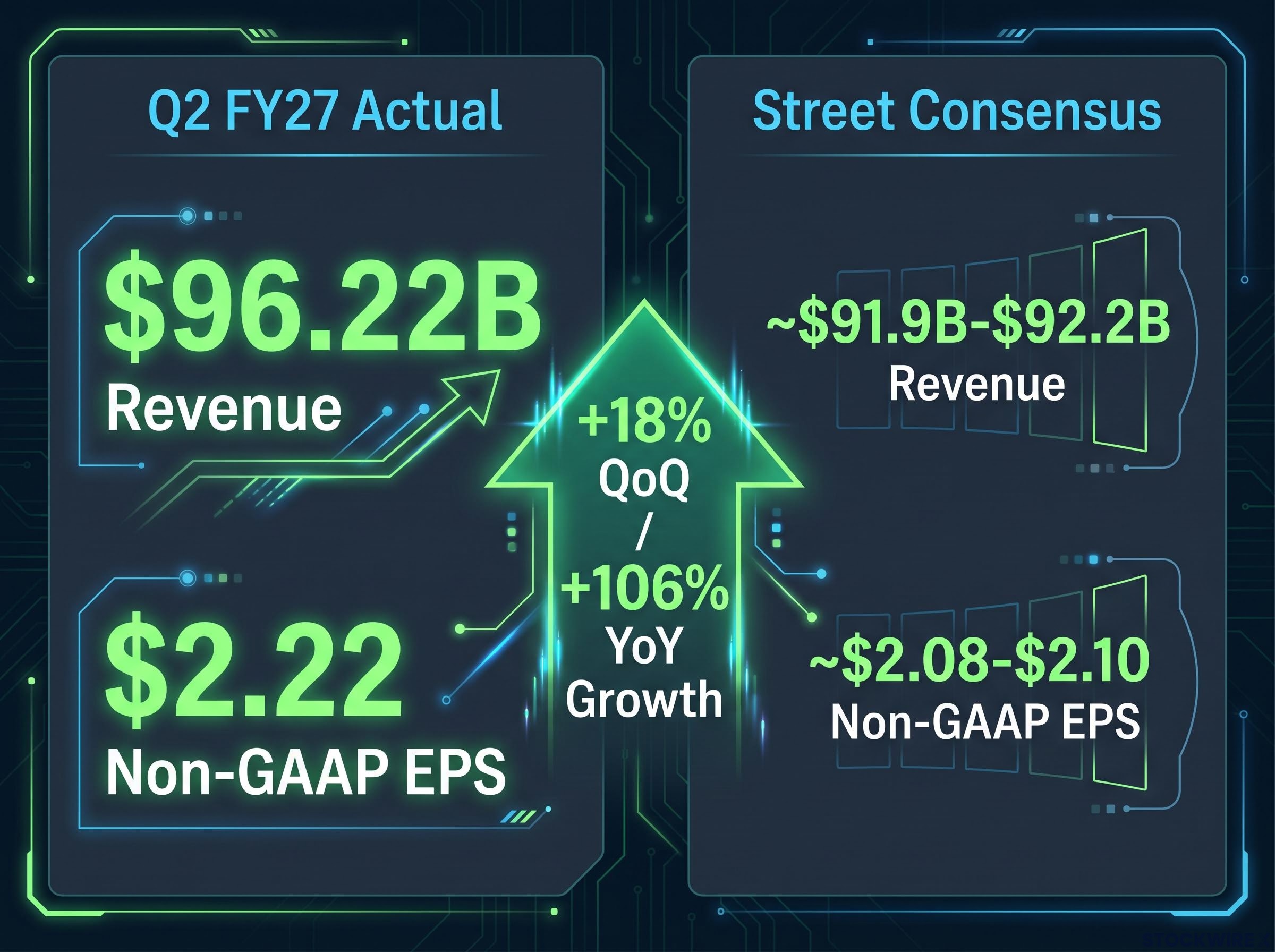
On earnings, the non-GAAP adjusted figure, which is the appropriate basis for consensus comparisons, printed at $2.22 per share against analyst forecasts of approximately $2.08 to $2.10. That is a beat of roughly $0.12 to $0.14. The GAAP earnings per share figure was $2.46, which includes items excluded from the adjusted calculation.
- Quarter-over-quarter revenue growth: +18%
- Year-over-year revenue growth: +106%
- Non-GAAP EPS beat: approximately $0.12-$0.14 above consensus
| Metric | Q2 FY27 Actual | Analyst Consensus | Beat |
|---|---|---|---|
| Revenue | $96.22B | ~$91.9B-$92.2B | ~$4.0B-$4.3B |
| Non-GAAP EPS | $2.22 | ~$2.08-$2.10 | ~$0.12-$0.14 |
| GAAP EPS | $2.46 | — | — |
| Non-GAAP Gross Margin | 75.0% | — | — |
A $4 billion-plus revenue beat on a $92 billion consensus base is not a rounding-error outcome. It means Nvidia’s demand environment during the quarter was measurably stronger than the collective estimate of the analysts covering it, and that gap matters for how you read management’s credibility when they guide to $108 billion next quarter.
Data Center at $89 billion and 75% gross margins: the structural story behind the beat
The headline revenue figure is impressive. Where it comes from is what makes the financial profile unusual.
Nvidia’s Data Center segment generated $89 billion in Q2 FY27, up 117% year over year. That single segment accounted for approximately 92% of total company revenue. This is not a revenue story spread evenly across the business. It is a single-segment concentration that explains both the growth rate and the margin structure, reflecting sustained and accelerating demand from hyperscalers and large enterprises ramping GPU infrastructure spending.
Hyperscaler capital expenditure reached $130 billion in Q1 2026 alone across the four largest U.S. cloud operators, providing the demand backstory behind Nvidia’s Data Center segment growth and making continued AI infrastructure spending the most consequential external variable in the company’s forward model.

That concentration, at this stage, is a feature rather than a risk. The AI compute market is expanding fast enough that the segment’s dominance reflects where the demand actually sits rather than a failure to diversify.
Gross margin expansion and what it signals for Q3
The margin story reinforces the quality of the revenue growth. The non-GAAP gross margin for Q2 FY27 reached 75.0%, with the GAAP figure landing at the same level. Measured against the roughly 72.5% recorded in Q2 FY26, that marks a year-over-year expansion of approximately 250 basis points.
- Q2 FY26 non-GAAP gross margin (baseline): ~72.5%
- Q2 FY27 non-GAAP gross margin (actual): 75.0%
- Q3 FY27 non-GAAP gross margin (guidance): ~74.0% (±50 bps)
The 250 basis point expansion tells you Nvidia is not sacrificing profitability to chase volume. It is growing revenue at 106% annually while simultaneously becoming more profitable per dollar of sales. That combination, pricing power plus operating leverage during a rapid build-out cycle, is what separates Nvidia’s financial profile from a conventional semiconductor company and is a core part of the valuation premium most analysts attach to the stock.
The Q3 guided margin of approximately 74.0% represents a modest sequential dip. That is worth watching as a signal of whether the product transition to next-generation hardware carries any near-term cost pressure, but at this level, it is a question to monitor rather than an alarm.
Why shares traded lower after a clearly strong report
Nvidia shares traded modestly lower in after-hours trading following the results release on 26 August 2026. A beat on revenue, a beat on earnings, a guidance raise, and the stock still fell.
The mechanism is straightforward, even if it feels counterintuitive. When elevated expectations are already embedded in a stock’s price heading into an earnings report, even a genuine beat can trigger selling from investors who entered pre-earnings positions and are now taking profits. Multiple institutional previews explicitly flagged this specific risk going into the Q2 FY27 report. It was, in analyst language, a well-telegraphed dynamic.
Expectations gap mechanics explain why 84% of S&P 500 companies beating estimates in Q1 2026 still produced negative post-earnings price reactions in many cases: markets price the anticipated outcome before the report lands, compressing the incremental upside that even strong results can generate.
“When elevated expectations are already embedded in a stock’s price, a beat on the reported quarter can still disappoint relative to what was already priced in.”
Nvidia has a documented history of trading flat or lower after strong earnings beats across multiple recent quarters. A rich valuation means the market prices in expectations ahead of the report, leaving less room for a positive price reaction to the absolute results.
The post-earnings dip is not a verdict on the quality of the report. It is a reminder that for Nvidia at this valuation, the stock price already contained a large portion of the good news before the numbers were released. That dynamic is worth holding onto when interpreting any future Nvidia earnings reaction: the question the market is asking has shifted from “did they beat?” to “did they beat by enough to justify what was already priced in?”
What the $108 billion guide and the beat-then-raise pattern mean for what comes next
Step back from the individual figures and a repeating pattern comes into focus. Q2 FY27 delivered what analysts characterise as a beat-then-raise across all three layers:
- Beat on revenue: $96.22 billion versus consensus of approximately $91.9-$92.2 billion
- Beat on EPS: $2.22 non-GAAP versus consensus of approximately $2.08-$2.10
- Raised guidance above consensus: $108.0 billion Q3 target versus Street expectations of approximately $103.8-$105.2 billion
This is not a single-quarter event. It is a pattern consistent with how institutional previews and financial commentary have characterised Nvidia’s earnings behaviour across multiple recent cycles. The beat-then-raise has become the baseline expectation rather than the surprise outcome.
Two variables will determine whether the $108 billion guidance proves conservative or faces pressure. The first is the demand trajectory from hyperscalers and large enterprises, which showed no visible softening in Q2 results. The second is any regulatory shift affecting China Data Center revenue access, which could convert what is currently a zero-contribution assumption into a material tailwind.
For investors tracking Nvidia across earnings cycles, the market’s reaction function has shifted. It is no longer “did they beat?” It is “by how much, and does the guidance suggest the ceiling is still rising?” On both counts, Q2 FY27 delivered. The $108 billion target, built on a zero-China baseline, sets a new floor that will define how analysts and investors frame the next cycle.
For investors wanting to stress-test the demand assumptions behind Nvidia’s $108 billion guidance, our deep-dive into AI capex sustainability examines whether hyperscaler spending at 93-94% of operating cash flow can continue, and what a capex plateau would mean for the AI infrastructure supply chain.
This article is for informational purposes only and should not be considered financial advice. Investors should conduct their own research and consult with financial professionals before making investment decisions. Past performance does not guarantee future results. Financial projections are subject to market conditions and various risk factors.