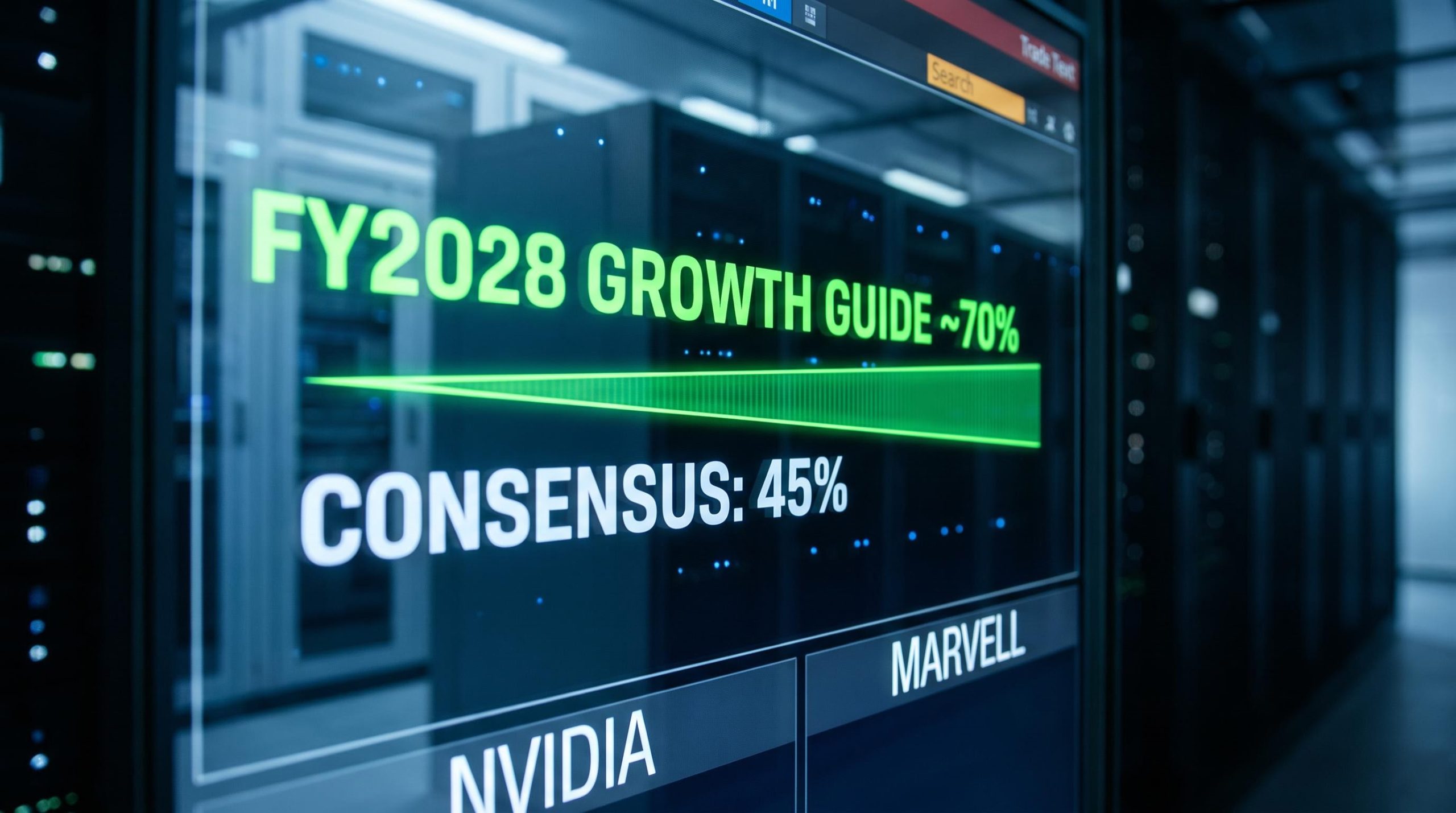
“Nvidia just guided fiscal year 2028 revenue growth at roughly 70%. Wall Street’s consensus sat at 45%. That is not a routine beat. That is the market thinking it knew how long this boom had left, and Nvidia extending the runway by a margin wide enough to rewrite the models.\n\nThe timing makes this more than a single-company story. Nvidia’s Q2 FY2027 results are already in. Marvell Technology reports after the close today, 27 August 2026. These two companies represent the two dominant tracks of AI chip infrastructure: standardised GPU scale and bespoke custom silicon. Both reporting in the same window creates a rare dual read on whether hyperscaler AI spending is durable or beginning to sequence down.\n\nHere is what these two AI chip earnings cycles, read together, actually tell you about where infrastructure spending is headed, which signals are worth tracking across coming quarters, and which headline figures are noise. The goal is an analytical lens you can reapply every earnings season, not just a data summary that expires tomorrow.\n\n## What Nvidia’s Q2 results actually reveal about the pace of AI infrastructure spending\n\nThe headline figures landed well above expectations across every metric that matters:\n\n- Revenue: approximately $96.2 billion versus $92.3 billion consensus (a beat of roughly $3.9 billion)\n- Adjusted EPS: approximately $2.22 versus $2.09 consensus (a beat of roughly $0.13)\n- Data centre revenue: approximately $89 billion versus $85.8 billion expected (a beat of roughly $3.2 billion)\n\nThose numbers are strong. But the beat itself is less revealing than what management said next.\n\nNvidia guided Q3 FY2027 revenue to approximately $108 billion, against a consensus of $104.2 billion. For fiscal year 2028, CFO Colette Kress indicated that the company now anticipates revenue growth of approximately 70%, a figure reported by the Wall Street Journal that stands well ahead of the 45% FactSet consensus forecast.\n\n> The anchor statistic: Nvidia’s FY2028 revenue growth projection of approximately 70% versus the 45% FactSet consensus represents the widest guidance-to-consensus gap of this entire AI infrastructure cycle.\n\n
| Metric | Nvidia reported / guided | Analyst consensus | Beat |
|---|---|---|---|
| Q2 FY2027 revenue | ~$96.2B | ~$92.3B | ~$3.9B |
| Q2 FY2027 adjusted EPS | ~$2.22 | ~$2.09 | ~$0.13 |
| Data centre revenue | ~$89B | ~$85.8B | ~$3.2B |
| Q3 FY2027 revenue guidance | ~$108B | ~$104.2B | ~$3.8B |
\n
\n\nA 70% forward growth projection against a 45% consensus is not a routine guidance raise. It signals that Nvidia has line-of-sight into multi-year hyperscaler commitments that the analyst community has not yet fully modelled. Approximately 92% of Nvidia’s revenue now comes from the data centre segment, meaning this forward view is almost entirely an AI infrastructure story.\n\nKress cast current AI infrastructure spending as an investment that would yield substantial future returns, contending that the top frontier AI laboratories are on a path to becoming the most valuable technology businesses ever created. That is not earnings commentary. That is a deliberate reframe of the hyperscaler free cash flow anxiety narrative, positioning current capex as \”targeted\” strategic investment rather than speculative overbuilding. The reader should treat the guidance-to-consensus gap as the most important data point in this entire earnings cycle: if even approximately correct, AI infrastructure spending is not plateauing. It is extending its runway in ways most models are still underweighting.\n\nThe post-earnings share price dip reflected a valuation dynamic where institutional investors had already priced in strong performance, shifting the market question from whether Nvidia beat to whether it beat by enough, a pattern that has defined every major Nvidia earnings release in this cycle.\n\n## Why margin compression is not the contradiction it appears to be\n\nMargins are falling. Growth projections are rising. On the surface, those two signals contradict each other. They do not.\n\nThe guided trajectory is plain:\n\n- Q3 FY2027 gross margin: approximately 74%, down from 75%\n- Q4 FY2027 gross margin: guided to 71%-72%, per CFO Colette Kress\n- Context: low-70% gross margins remain well above typical semiconductor peers\n\nBank of America analyst Vivek Arya flagged rising high-bandwidth memory costs as a key pressure point. Input costs are climbing faster than Nvidia can fully offset through pricing or product mix. The supply chain is tightening in ways that benefit upstream component suppliers while squeezing system-level economics.\n\n### What falling margins in a booming market actually signal\n\nThe margin-compression-alongside-growth pattern is characteristic of a cycle transitioning from scarcity to scaled competition. In the early phase, a single dominant supplier captures extraordinary rents. As the market matures, costs rise, competitors emerge, and customers gain bargaining power. That is not a bust. It is a market becoming real.\n\nValue is shifting up the stack. Memory vendors, custom ASIC designers (where Marvell participates), and interconnect specialists are gaining pricing power as GPU volumes scale and standardise. Nvidia’s margins are compressing precisely because the market it created is now large and competitive enough to redistribute economic rents along the supply chain.\n\nWhat this tells you is that the compression is evidence the cycle has moved from early-mover monopoly to scaled, contested infrastructure market. Historically, that transition extends duration but compresses peak returns. If you are evaluating Nvidia’s earnings, the margin trajectory confirms the boom is maturing, not weakening, and that is a structurally different read from the one a simple margin-decline headline would suggest.\n\nValuation discipline in semiconductor markets has replaced momentum-driven price discovery across the sector, with TSMC’s most profitable quarter in history still triggering share price declines because the market had already pre-priced the result, a pattern that directly informs how investors should interpret Nvidia’s own post-earnings price action.\n\n## Marvell’s custom silicon trajectory as a structural confirmation signal\n\nMarvell Technology builds bespoke AI processors and the high-speed data centre interconnect fabric that ties chip clusters together within AI infrastructure deployments. That makes Marvell a direct play on hyperscalers building denser, more network-intensive infrastructure rather than simply buying more GPUs.\n\nCustom AI chip economics favour ASICs for high-volume, stable inference workloads while leaving GPUs essential for frontier model training, a complementary architecture that explains why hyperscaler demand for both Nvidia silicon and Marvell custom programmes can accelerate simultaneously rather than cannibalising each other.\n\nThe company reports Q2 FY2027 results after the close today. But the guidance trajectory already in hand is the analytical signal. Management guided Q2 FY2027 revenue to approximately $2.7 billion (plus or minus 5%), with non-GAAP EPS of approximately $0.93 (plus or minus $0.05), implying a range of $0.88-$0.98. More importantly, Marvell pulled forward its $3 billion quarterly revenue target to Q3 FY2027, one quarter earlier than previously guided, and in May 2026 set a custom chip revenue ambition of more than $10 billion by fiscal 2029.\n\n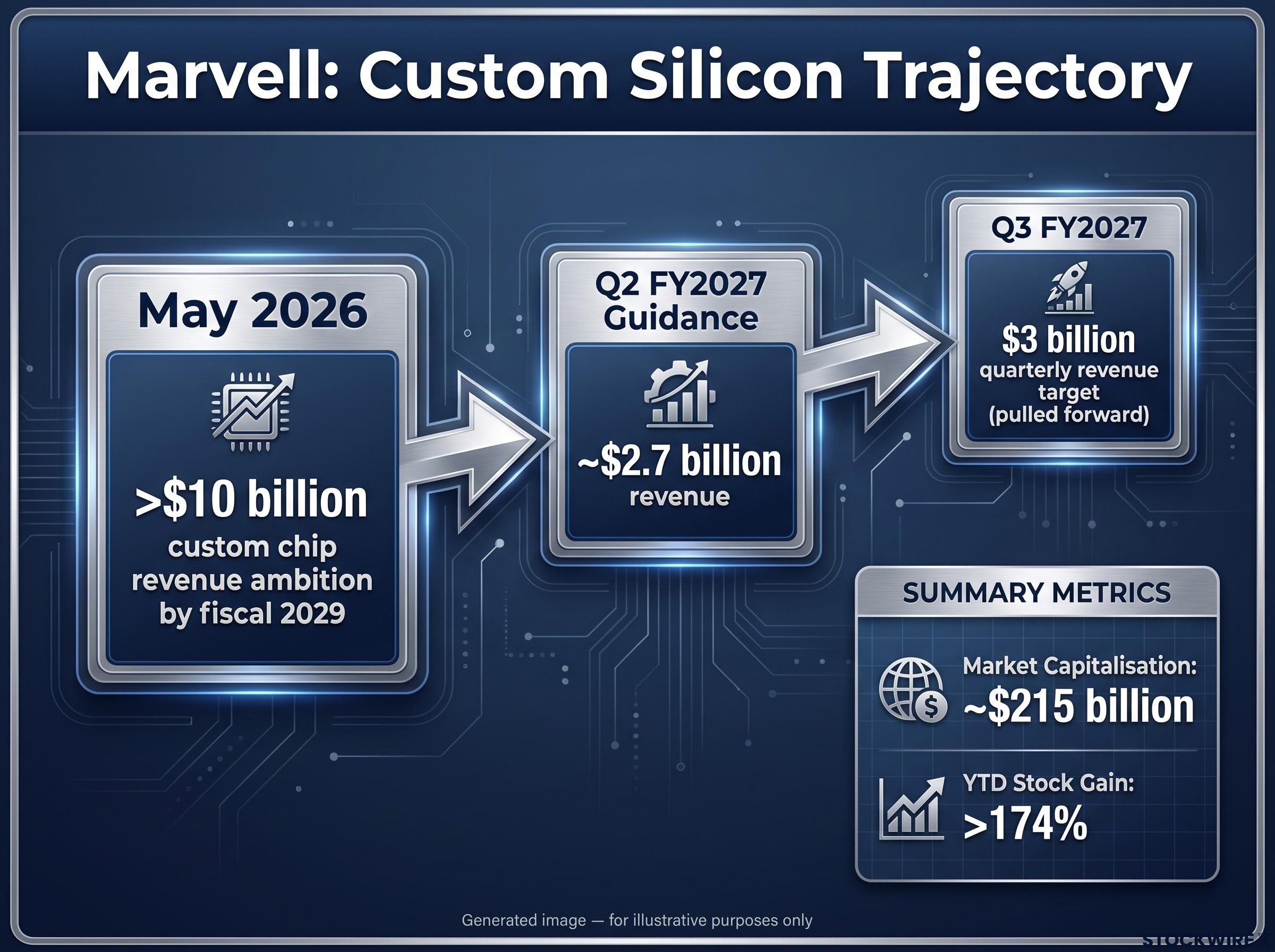 \n\n> Management commentary: Marvell’s CEO highlighted \”exceptional AI-related bookings\” on the prior earnings call, explicitly attributing the raised revenue outlook for both fiscal 2027 and fiscal 2028 to AI demand.\n\n
| Quarter | Revenue | Non-GAAP EPS | Operating cash flow |
|---|---|---|---|
| Q2 FY2026 | $2.006B (+58% YoY) | $0.67 (+123% YoY) | Not separately reported |
| Q3 FY2026 | ~$2.075B (+37% YoY) | $0.76 (+77% YoY) | ~$582M (record) |
| Q4 FY2026 | Not separately disclosed | $0.46 (GAAP) | Not separately reported |
\n
\n\nThe quarterly trajectory shows AI is pulling the entire company’s revenue, margins, and cash generation higher over multiple sequential periods. This is not a one-off spike.\n\nCustom chip programmes lock in multi-year production commitments once a design is validated by the hyperscaler customer. That means Marvell’s raised revenue outlook reflects long-dated bets by hyperscalers, not short-cycle opportunistic orders. The pull-forward of the $3 billion quarterly milestone by one quarter is the single clearest signal that hyperscalers are accelerating their custom silicon commitments rather than deferring them. Shares in Marvell have gained more than 174% year-to-date, lifting its market capitalisation to approximately $215 billion, a valuation that directly reflects the market’s confidence in that accelerating commitment schedule.\n\nWhen both the standardised GPU track and the bespoke custom silicon track are accelerating simultaneously, the cycle thesis is corroborated from independent directions. That is the analytical payoff of reading these two companies together.\n\n## Four signals that tell you whether the AI infrastructure cycle is extending or topping\n\nThe evidence from Nvidia and Marvell points in the same direction as of today. But this is a framework piece, not a victory lap. Here are the four variables that will confirm or contradict the extension thesis over the next two to four quarters, ranked by monitoring priority:\n\n1. Revenue guidance versus consensus trajectories for both GPU and custom silicon suppliers. Nvidia’s 70% FY2028 growth guide against a 45% consensus is the current benchmark. Watch whether that gap narrows because consensus catches up (bullish) or because guidance comes down (bearish). Apply the same test to Marvell’s fiscal 2029 custom chip ambitions.\n\n2. Gross margin direction relative to input cost trends. Bank of America’s flagging of high-bandwidth memory cost pressure is the risk to monitor. If revenue keeps rising but margins erode faster than guided, the cycle may be entering a phase where growth persists but per-unit profitability compresses, which changes the investment calculus.\n\n3. Hyperscaler ordering language on earnings calls. Listen for pull-in versus push-out commentary. CFO Kress’s \”targeted\” capex framing is the current hyperscaler free cash flow counterargument. If that language shifts toward \”optimisation\” or \”re-sequencing,\” it is the earliest signal of a capex slowdown.\n\n4. Changes to multi-year AI revenue frameworks. Any revision to milestones like Marvell’s more than $10 billion custom chip target by fiscal 2029, upward or downward, is a direct read on whether hyperscaler commitment is strengthening or softening.\n\n### The nuanced base case: extending, not peaking\n\nCurrent bookings and guidance from both Nvidia and Marvell do not show a material pullback. Custom silicon design win economics reduce the probability of a sudden broad capex collapse because they represent signed, multi-year engineering and supply commitments.\n\nThe debate has shifted. It is no longer about whether AI infrastructure investment persists. It is about which parts of the stack capture the most value as GPU competition intensifies and margin pools migrate toward memory vendors, custom ASIC providers, and interconnect specialists. If Marvell’s interconnect and custom silicon growth continues to outpace aggregate cloud capex, it tells you AI cluster deployments are becoming more complex and longer-lived, not shorter, and that is the single most durable confirmation that this is a structural cycle rather than a cyclical one.\n\n## Reading AI semiconductor earnings as a cycle indicator, not just company events\n\nThese two earnings reports function as leading indicators because of what they measure. Nvidia has visibility into hyperscaler GPU deployment roadmaps that precede actual data centre buildout by quarters. Marvell’s locked-in custom silicon design wins reflect hyperscaler commitments that are even longer-dated, since custom chip programmes entail multi-year design cycles and production agreements signed well before volume shipments begin.\n\nReading them together creates a two-variable diagnostic. Three conditions distinguish a structural demand signal from a vendor-specific one:\n\n- Both tracks accelerating simultaneously: Signals broad-based, durable infrastructure demand (the current reading as of 27 August 2026)\n- One accelerating while the other stalls: Signals architecture rotation, meaning hyperscalers may be shifting spend between standardised and custom silicon, which warrants re-evaluation of individual exposures\n- Both stalling: Signals a genuine capex re-sequencing or demand ceiling, the scenario that would challenge the extension thesis\n\n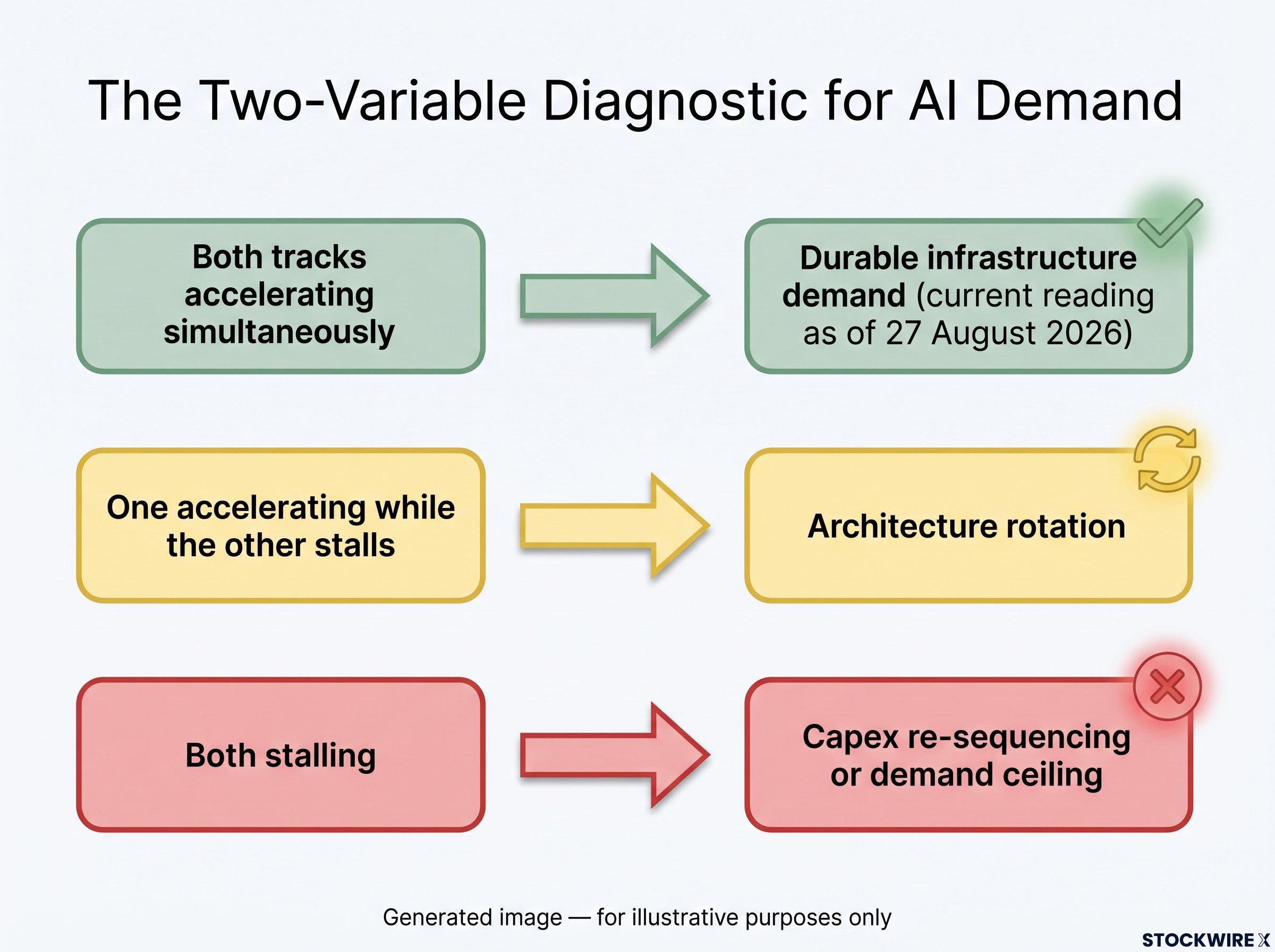 \n\nThe demand broadening dynamic from Nvidia’s results reinforces the structural read. CFO commentary indicated hyperscale revenue more than doubled year over year, while enterprise and sovereign AI deployments also grew strongly. When the customer base extends beyond a narrow set of U.S. megacaps into sovereign and enterprise buyers, cycles tend to lengthen rather than compress.\n\nNvidia CEO Jensen Huang has publicly labelled Marvell a prospective trillion-dollar company, a piece of qualitative context that underscores how closely the two firms’ trajectories are tied to the same underlying demand drivers. When GPU and custom silicon earnings move in the same direction simultaneously, you are observing a structural demand signal, not vendor-specific momentum, and should adjust your interpretation of future semiconductor earnings accordingly. That frame converts two quarterly events into a repeatable diagnostic tool you can apply every reporting cycle.\n\n## What today’s dual earnings window changes for the investment thesis\n\nThe analytical burden has shifted. After Nvidia’s results and ahead of Marvell’s report tonight, the question is no longer whether the AI infrastructure cycle is real. It is which parts of the semiconductor stack will capture the most value as competition intensifies, margins compress from peak levels, and profit pools redistribute toward memory, custom silicon, and interconnect.\n\nThe four monitoring signals outlined above give you an early-warning system for any genuine capex re-sequencing across the next two to four quarters. Track the guidance-to-consensus gap, the margin trajectory, the ordering language, and the multi-year framework revisions. Those variables, not individual quarterly beats, are what will distinguish a cycle that is extending from one that is topping.\n\nSemiconductor cycle turning signals, including memory oversupply timing, equipment order backlogs, and the double-hit mechanism where earnings disappointment and multiple compression arrive simultaneously, provide the structural framework for interpreting whether the guidance-to-consensus gap narrowing is bullish catch-up or the first sign of a cycle peak.\n\nToday’s dual earnings window is not the confirmation of a simple bull case. It is the starting point of a more nuanced phase where the boom persists but the economics within it are shifting, and the investors who track the right signals will see the turns before the headlines catch up.\n\nThis article is for informational purposes only and should not be considered financial advice. Investors should conduct their own research and consult with financial professionals before making investment decisions. Past performance does not guarantee future results. Financial projections are subject to market conditions and various risk factors.“
Navigating this shift requires a precise approach to AI supply chain investing that maps exactly where profit is concentrating across foundries, advanced packaging, and network fabrics.
The same massive capital expenditure wave funding standard GPU orders is simultaneously bankrolling custom silicon programmes at major tech conglomerates, representing a credible long-term threat to single-vendor dominance.
This specific revenue mix aligns with broader industry data showing that major tech conglomerates are aggressively accelerating their AI capital expenditure to secure infrastructure capacity.
Nvidia’s FY2028 revenue guidance of approximately 70% growth, against a 45% analyst consensus, represents the widest guidance-to-consensus spread reported this cycle, a gap that forced immediate upward revisions across the sell side following the earnings call.