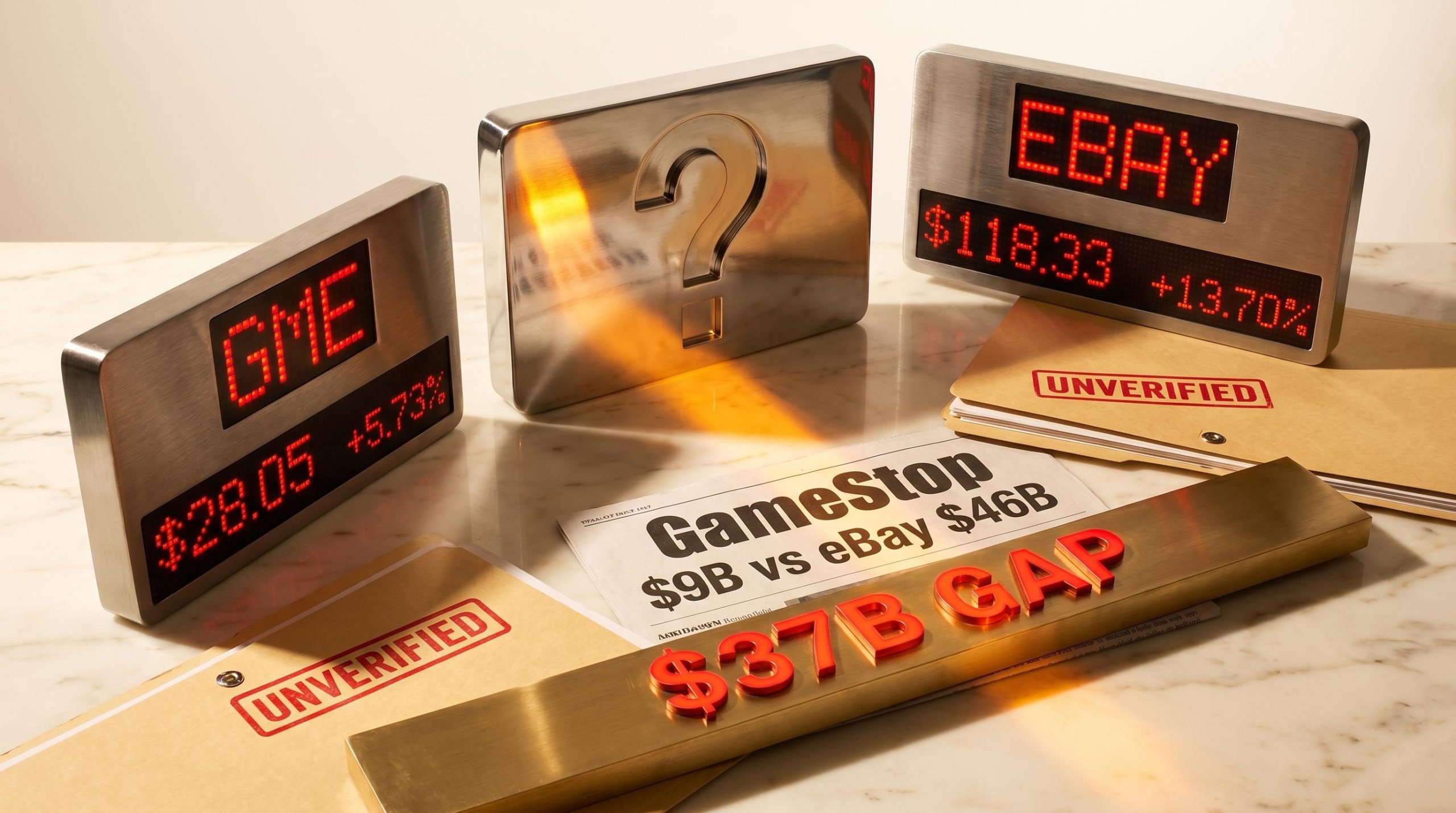
eBay shares surged more than 13% in after-hours trading on 1 May 2026, but the acquisition bid reportedly driving that move may not exist yet, and may not be financially possible even if it does. Reports circulated on 1 May that GameStop, a $12 billion company sitting on roughly $9 billion in cash, is preparing an offer for eBay, a $46 billion platform with 136 million active buyers. No SEC filings, press releases, or confirmations from either company have verified a formal offer. Despite that, both stocks moved sharply in after-hours trading.
What follows breaks down what the market is actually reacting to, whether the financial arithmetic supports a real bid, what Ryan Cohen’s public record reveals about his dealmaking intentions, and what investors in both GME and EBAY should monitor for next.
Markets moved hard on an unconfirmed rumour, here is what we know
The numbers arrived before the evidence did. EBAY closed at $104.07 on 1 May 2026, then jumped to $118.33 in after-hours trading, a gain of 13.70%. GME rose from a close of $26.53 to $28.05 after hours, up 5.73%.
EBAY after-hours surge: +13.70%, the largest single-session move in the stock since Q4 2024, driven entirely by unverified acquisition reports.
Reports citing unnamed sources alleged GameStop is preparing a formal bid for eBay, potentially to be submitted during May 2026. The sourcing, however, is thin. No SEC 8-K, Schedule TO, or 13-D filings from either company confirm any offer or acquisition approach as of 1 May 2026. No major wire service, including the Wall Street Journal breaking news desk, Bloomberg, Reuters, or the Financial Times, has independently confirmed a formal bid exists.
Options markets suggest speculative positioning was already building. GME‘s $26 strike call volume hit 36,730, representing approximately +900% change. EBAY showed elevated out-of-the-money call open interest at the $108 strike, with 5,293 contracts outstanding.
| Ticker | Closing Price | After-Hours Price | Change (%) | Volume |
|---|---|---|---|---|
| GME | $26.53 | $28.05 | +5.73% | 15,309,966 |
| EBAY | $104.07 | $118.33 | +13.70% | 10,311,335 |
Both sets of shareholders are now carrying rumour-driven risk. Understanding how little verified sourcing underpins the move is the first step to evaluating that exposure.
When big ASX news breaks, our subscribers know first
The financial gap that makes this deal harder than it looks
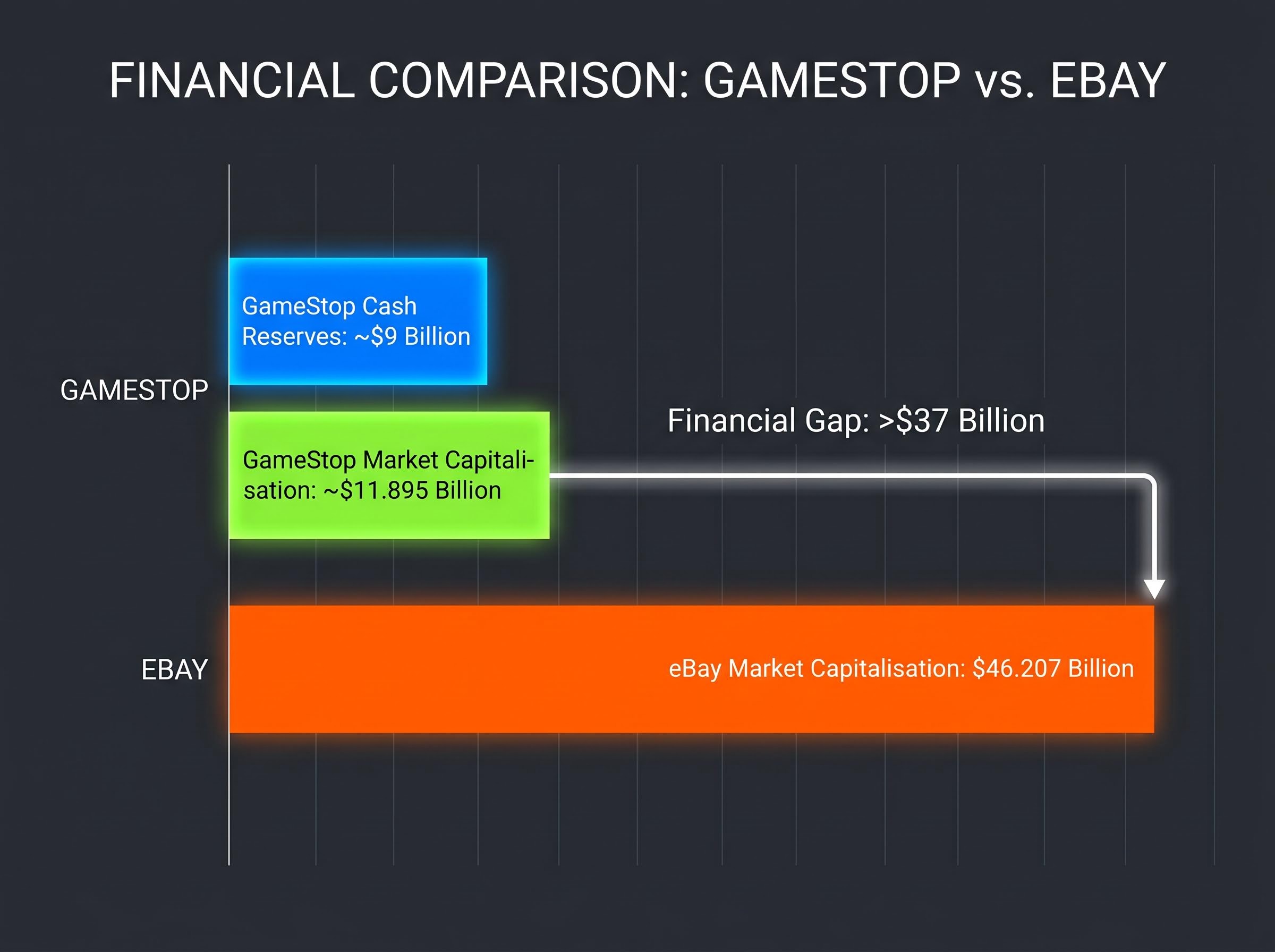
GameStop holds approximately $9 billion in cash. That figure has drawn attention because it dwarfs the reserves of most mid-cap retailers. Set it against eBay‘s market capitalisation of $46.207 billion, however, and the scale of what an acquisition would require comes into focus.
The gap is more than $37 billion. GameStop‘s entire market capitalisation sits at roughly $11.895 billion, meaning the acquirer is less than one-quarter the size of the target. Closing a shortfall of that magnitude would require one of three mechanisms, each facing significant obstacles:
- All-cash acquisition: Impossible with $9 billion in reserves against a $46 billion target. The shortfall exceeds GameStop‘s total market value.
- Leveraged buyout with debt financing: Would require GameStop to secure more than $37 billion in debt, a structure no lender has been reported to be evaluating. Cohen has shown no public appetite for leverage of this scale.
- Stock-plus-cash hybrid: Would require massive equity issuance, diluting existing GME shareholders substantially. No such structure has been signalled.
No financing arrangements, bridge loans, or debt commitments have been reported or rumoured in connection with this deal.
More realistic targets on GameStop’s balance sheet
For context, GameStop‘s $9 billion cash position would more comfortably support acquisitions in the $2-5 billion range. Peloton, with a market capitalisation of approximately $2.24 billion, and Marathon Digital, at approximately $4.36 billion, represent the scale of targets that GameStop could theoretically pursue without requiring transformational leverage. Neither has been named as a target; both are included here solely as financial reference points.
Why eBay is not a random target: the secondhand market logic
The arithmetic is daunting. The strategic reasoning, however, is not irrational, and understanding why this rumour gained traction matters as much as understanding why it may not materialise.
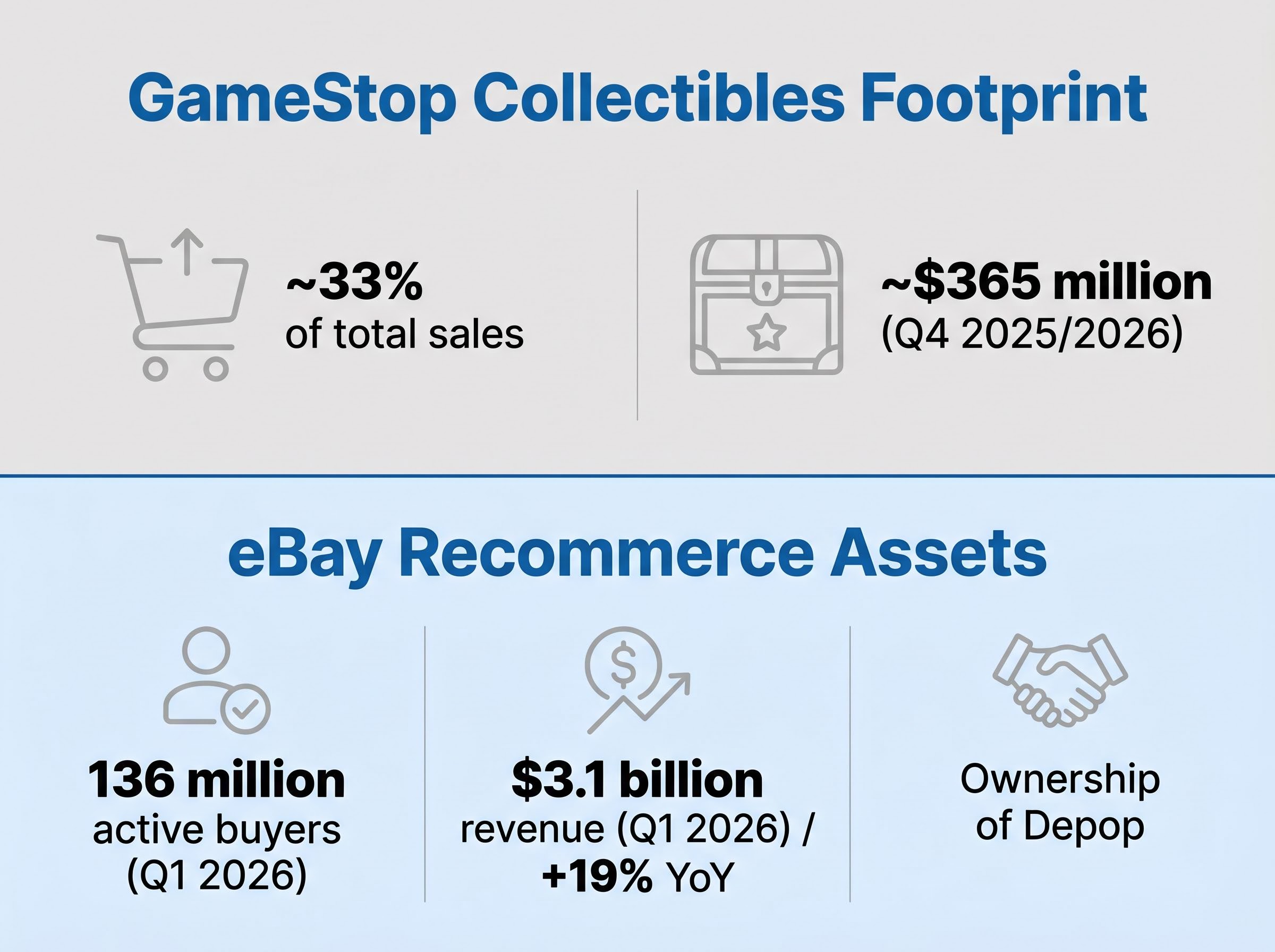
GameStop‘s collectibles segment now represents approximately 33% of total sales, generating roughly $365 million in Q4 2025/2026. The company has been repositioning away from new-game retail toward the broader recommerce and collectibles market. eBay is the largest established platform in that space.
eBay‘s assets relevant to that strategic direction include:
- 136 million active buyers as of Q1 2026, a user base GameStop cannot build organically on any reasonable timeline
- Q1 2026 revenue of $3.1 billion, up 19% year-over-year, indicating accelerating growth in secondhand commerce
- Ownership of Depop, adding secondhand fashion to its recommerce footprint
- Established marketplace infrastructure for authentication, seller tools, and global logistics in collectibles categories
Ryan Cohen’s compensation structure includes up to $35 billion in GME stock, contingent on the company reaching a $100 billion market valuation. An acquisition of eBay‘s scale would represent the most direct path to that threshold, if it were financially achievable.
That compensation incentive does not confirm Cohen is pursuing eBay specifically. It does, however, explain why a deal of this magnitude fits the strategic logic Cohen has publicly described.
What Ryan Cohen has and has not actually said
The gap between what Cohen has confirmed and what the current rumour cycle assumes is wider than the market reaction suggests.
The documented record versus the rumour
What Cohen has confirmed:
- In a Wall Street Journal interview in late January 2026, Cohen stated he was evaluating potential acquisition candidates in the consumer and retail space and wanted to pursue a “very big” deal.
- His compensation structure, up to $35 billion in GME stock tied to reaching a $100 billion market capitalisation, creates a documented financial incentive for transformational dealmaking.
- He has overseen the accumulation of approximately $9 billion in cash reserves and approximately $368-$370 million in Bitcoin (based on 4,710 BTC held as of January 2026).
What has not been confirmed:
- Cohen has made no public statement naming eBay as an acquisition target.
- His X account contains no posts matching acquisition-related criteria as of at least 17 April 2026.
- No evidence of a formal approach to eBay‘s board has surfaced in SEC filings or company disclosures.
- Reports suggesting Cohen would take a bid directly to eBay‘s shareholder base via a proxy battle if the board refused to engage remain unverified by any named source.
The proxy battle narrative in particular requires scrutiny. While Cohen’s retail investor following could theoretically support such an effort, no organised shareholder campaign targeting eBay has been identified.
What both sets of shareholders should watch for now
The distance between rumour and reality will be closed, or widened, by specific observable events. Investors holding either stock can reduce their exposure to information asymmetry by monitoring the following:
- SEC EDGAR filings from GameStop (CIK: 0001326380) or eBay (CIK: 0001065088): a Schedule TO (tender offer), 13-D (activist position disclosure), or 8-K (material event disclosure) would be the first verifiable signal
- eBay board statement: any confirmed approach would likely trigger a public response within days under standard merger and acquisition disclosure norms. The current silence is consistent with no formal offer having been received
- Cohen’s social media activity: any direct reference to eBay or acquisition plans would represent a material shift from his current silence
- Financing announcements: any reported bridge loan, debt facility, or equity issuance from GameStop would indicate a deal structure is being assembled
Key risks if the deal does move forward
Should a formal bid materialise, three structural risks would immediately face investors. First, eBay‘s 136 million active buyer base and $3.1 billion quarterly revenue make Federal Trade Commission (FTC) antitrust review a near-certainty, though no such discussions are on the public record. Second, GME shareholders face dilution risk if any stock component is included in an offer structure. Third, if debt financing is required to bridge the more than $37 billion gap, the leverage burden on the combined entity would be substantial.
A $46 billion question that only an SEC filing can answer
The rumour describes a deal that is strategically coherent but financially daunting, driven by a chief executive with a documented appetite for transformational moves and a compensation structure that rewards them. None of it has been verified as of the close of 1 May 2026.
Market reactions are real even when the underlying deal is unconfirmed. Both GME and EBAY shareholders are carrying event-driven risk that requires active monitoring. The next verifiable development will come from SEC EDGAR, not from social media or unnamed sources.
This article is for informational purposes only and should not be considered financial advice. Investors should conduct their own research and consult with financial professionals before making investment decisions. These statements regarding any potential acquisition are speculative and subject to change based on market developments and company actions.