
Oracle reports Q1 FY2027 earnings after today’s market close, and the stock arrives at the release having shed more than half its value from its September 2025 peak, with options markets bracing for an 11-point swing in either direction tonight.
Wall Street is not just watching a routine beat-or-miss. It is watching whether a company that cut roughly 21,000 jobs, guided to as much as $95 billion in capital expenditures this fiscal year, and tied its forward revenue thesis to a single artificial intelligence customer can prove to investors that the math is starting to work.
Here is what each of the major numbers means tonight, and the specific signal investors are using to decide whether Oracle’s AI bet is on track or still fragile. Three variables carry the weight: Oracle Cloud Infrastructure (OCI) growth, backlog conversion, and the free cash flow trajectory. Know which one to watch when the numbers drop, and you will read the report faster than the analyst notes that follow it.
What Wall Street is expecting from Oracle tonight
The scorecard is straightforward. Wall Street consensus, per FactSet, calls for adjusted earnings per share of $1.74 on total revenue of roughly $19.13 billion, which works out to about 28% year-over-year revenue growth and roughly 18% EPS growth against the $1.47 posted in the same quarter last year.
Oracle’s Q1 FY2027 earnings announcement is scheduled for release after today’s market close, with a webcast to follow, as confirmed through the company’s official investor relations communications published on September 2, 2026.
Here are the three figures that will frame the headline:
- Adjusted EPS consensus: $1.74
- Total revenue consensus: $19.13 billion
- Implied year-over-year growth: approximately 28% on revenue, 18% on EPS
| Metric | Consensus Estimate | Prior-Year Actual | Implied Growth |
|---|---|---|---|
| Adjusted EPS | $1.74 | $1.47 | ~18% |
| Total Revenue | $19.13B | ~$14.9B | ~28% |
| OCI Growth Rate | 115-116% | 93% (prior quarter) | Acceleration |
The EPS line will grab the headlines, but it is not the number that moves the stock. That honour belongs to OCI growth, and the bar is high.
The distinction between free cash flow vs EPS is not merely technical in Oracle’s case: Morgan Stanley’s analysis of S&P 500 earnings found that stocks with EPS beats but falling free cash flow estimates underperformed peers by 0.2%, a dynamic directly relevant to a company guiding for negative $42 billion in free cash flow while reporting non-GAAP earnings growth.
The single most-watched call ahead of the print Jefferies analyst Brent Thill projects OCI growth could accelerate to 115% in Q1 FY2027, up from the 93% recorded last quarter. Some analyst models push the figure to 116%.
Why does the OCI number carry more weight than earnings? Because it is the clearest read on whether Oracle’s multi-year infrastructure spending is pulling forward genuine demand, or simply producing capacity that has not yet turned into recognised revenue. That distinction is the whole story tonight, and you should hold it in mind before the number arrives.
Oracle set its own markers back in June 2026. Company guidance projected non-GAAP EPS of $1.72-$1.76 and total cloud revenue growth of 58-64%. Tonight is a test of whether Oracle meets the floor of that range or clears its ceiling.
Mizuho Securities carries an Outperform rating and a $320 price target, and its analysts expect Oracle to beat consensus, driven largely by the scale of new capacity coming online. Their focus, as with much of the Street, sits on one question: is that capacity converting into revenue on schedule?
When big ASX news breaks, our subscribers know first
The stock’s brutal year and what options markets are saying about tonight
The price tells the first part of the story on its own. Oracle closed at $161.63 on 9 September 2026, trading in a tight $158-$162 band in the days heading into the release. From its September 2025 peak, the stock is down by more than half.
Here is the scale of the damage:
- Down more than 50% from its September 2025 peak
- Down approximately 20% over the preceding three months
- Down more than 16% year-to-date
- Roughly one-third of peak market capitalisation erased
Investors have spent most of fiscal 2026 discounting Oracle’s AI infrastructure commitments ahead of proof that the revenue would materialise. The sell-off is not a reaction to a bad quarter. It is a running verdict on a spending bet that has yet to show its payoff.
How options traders are sizing up tonight’s release
Now look at what professional traders are pricing in, because it reframes the decline entirely.
A large move, but a bounded one Options markets imply a post-earnings swing of approximately 11-11.7%, notably below the stock’s average post-earnings move of 16% across the prior four quarters.
At the $161 share price, an 11% move is roughly $18 in either direction. That is a meaningful outcome, not a coin-flip disaster. The gap between the 11% implied move and the 16% historical average tells you something specific: traders see tonight as large but contained, not chaotic.
There are two ways to read that lower implied move. Either uncertainty has genuinely fallen heading into the print, or the market has already absorbed much of the downside during the drawdown. For an investor watching from the sidelines, that is the central question: does the sell-off already reflect the bad news, or could tonight’s report unlock further downside?
The capex machine: $55 billion spent, $95 billion more coming, and free cash flow still negative
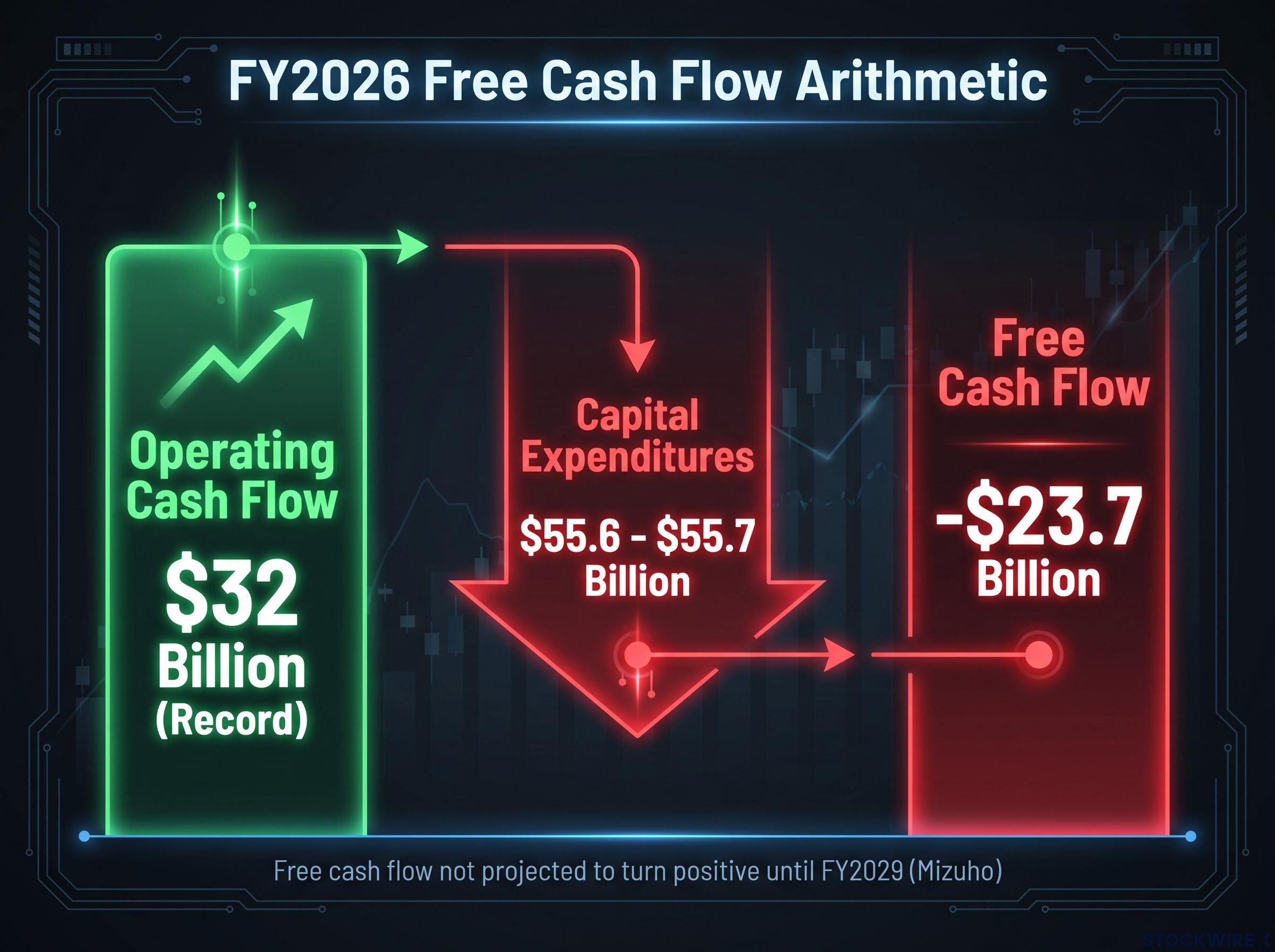
To understand the free cash flow deficit, follow the money in sequence. Oracle recorded record operating cash flow of $32 billion in fiscal 2026. That is a healthy business generating cash.
Then came the spending. Capital expenditures more than doubled to $55.6-$55.7 billion across the year, as Oracle built out data centres for its AI infrastructure push.
The result of that collision was negative free cash flow of $23.7 billion for fiscal 2026, the fifth consecutive quarter of negative free cash flow through the current reporting period. The deficit is not a surprise. It is the direct arithmetic of spending more on infrastructure than the business currently generates.
Oracle’s credit downgrade to BBB- by S&P in July 2026, the lowest investment-grade notch in the company’s history, added a financing dimension to the capex story that equity-only analysis misses: leverage was already heading toward the mid-4x range before FY2027 spending guidance was issued.
And the spending is not slowing. Oracle has guided net capital expenditures for fiscal 2027 to a range of $70-$95 billion, net of customer reimbursements. That guide tells you Oracle is not in the middle of its infrastructure cycle. It is still accelerating into it.
Three sources are funding that build-out:
- The $8-$10 billion in annual cash flow freed by the workforce reduction, redirected toward capex
- Additional debt and equity raises
- Internally generated operating cash flow
| Fiscal Year | Capital Expenditures | Operating Cash Flow | Free Cash Flow |
|---|---|---|---|
| FY2026 (actual) | $55.6-$55.7B | $32B (record) | -$23.7B |
| FY2027 (guided) | $70-$95B | Not guided | Expected negative |
| FY2029 (projected) | Not guided | Not guided | Turns positive (Mizuho) |
So when does Oracle start generating the cash back?
The recovery is years out Mizuho Securities does not project Oracle’s free cash flow to turn positive until fiscal 2029. That asks investors to look through at least two more years of negative free cash flow before the cash-generation story begins.
The entire timeline hinges on whether revenue materialises on the schedule Oracle and its analysts are projecting. Paul Meeks of Freedom Capital Markets has framed the read plainly: a stronger-than-expected OCI result would signal the capex cycle may be approaching its peak, while a miss deepens the concerns. That is the lens for tonight’s capex commentary.
OCI’s 1-gigawatt quarter and the OpenAI backlog that defines the bull case
Start with something physical. Roughly 1 gigawatt of new OCI data-centre capacity is projected to come online during Q1 FY2027. To grasp the scale, that is about as much capacity as Oracle added across all of fiscal 2026, compressed into a single quarter.
But capacity is not revenue, and understanding the difference is where the real signal lives. Oracle’s AI business runs on multi-year, usage-based compute contracts, and revenue is recognised as customers consume, not when contracts are signed.
Before that new capacity generates a dollar of recognised revenue, three things have to happen:
- The data-centre campuses have to be energised
- The GPUs have to be installed and commissioned
- Utilisation has to ramp to meaningful levels
That conversion timing is the pivotal variable. It is exactly the metric Mizuho is watching as a leading indicator, and it is why capacity coming online is only half the story.
The OpenAI concentration question investors cannot ignore
The other half is the backlog, and it is enormous.
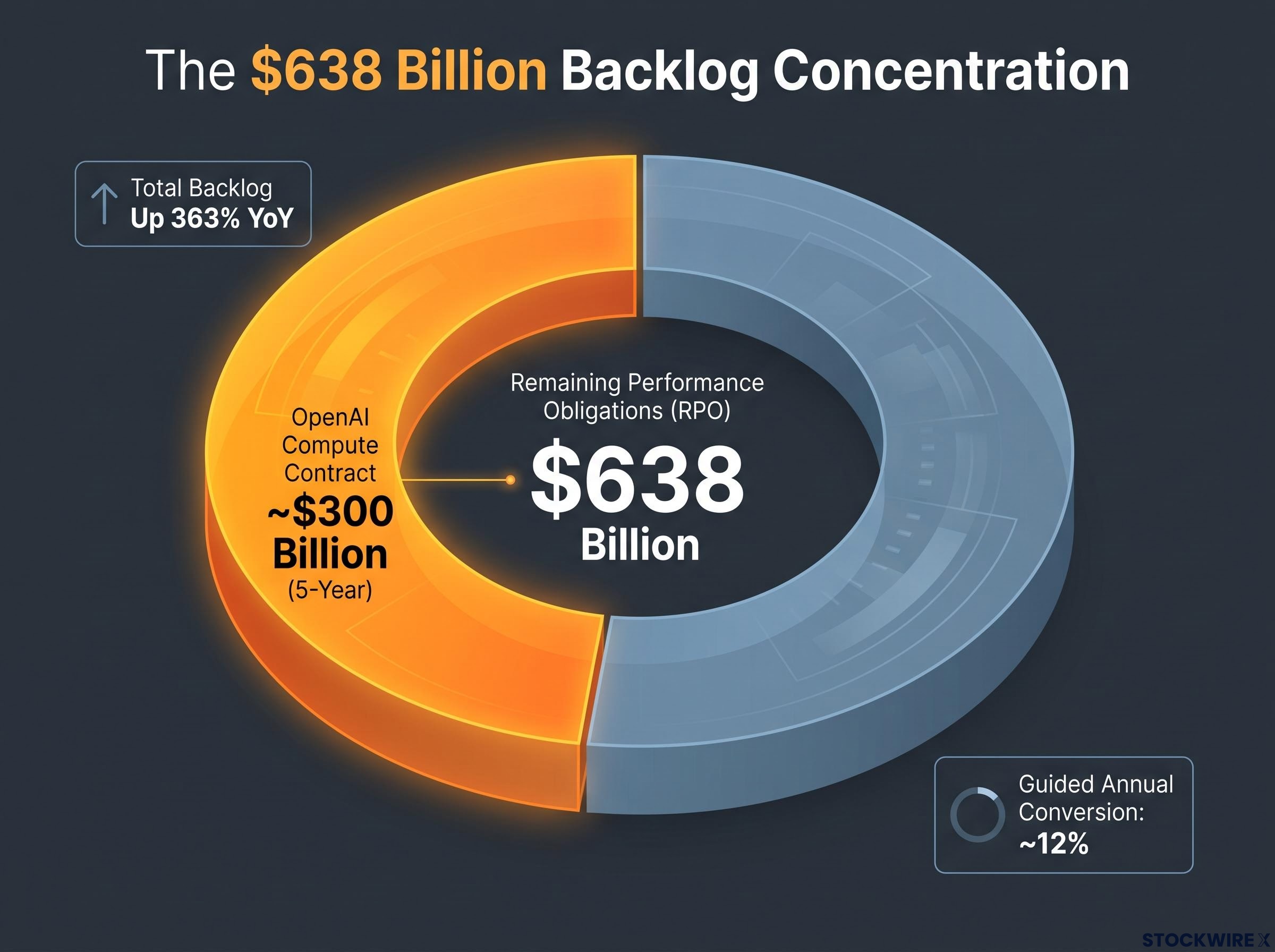
The bull case, expressed as a number Oracle’s remaining performance obligations (RPO) backlog stands at $638 billion, up from $553 billion the prior quarter, a rise of roughly 363% year-over-year.
RPO refers to contracted revenue that has not yet been recognised. It is the clearest forward indicator Oracle offers, and Oracle guides to converting roughly 12% of that backlog into recognised revenue per year.
Here is the catch. Approximately half of that $638 billion is reported to be tied to a single customer, OpenAI. The widely reported figure is a $300 billion, five-year compute contract, part of the broader $500 billion Stargate Project. If realised, that contract alone could represent nearly one-third of Oracle’s revenue by 2028.
A note on that figure: the $300 billion contract is widely reported but has not been independently confirmed through Oracle’s primary disclosures. Read tonight’s RPO update with that caveat attached.
The concentration is the whole risk-reward. When roughly half the backlog sits with one customer, the bull case and the bear case become almost the same trade. Everything depends on whether OpenAI stays solvent, committed, and consuming at the projected rate.
OpenAI backlog durability is the structural question underneath tonight’s RPO update: the customer’s current annual revenue of $25-30 billion would need to more than double to cover the implied $60 billion per year compute obligation, and open-source model commoditisation continues to compress the pricing window that supports those charges.
Oracle’s own SEC filing language adds a further layer. The company has signalled that adoption of AI technologies “resulted, and may continue to result” in workforce reductions, meaning the cost structure itself remains in motion as this plays out.
What a strong or weak print changes heading into fiscal 2027
Tonight does not resolve Oracle’s AI bet. It either strengthens or weakens the confidence around a thesis that will not be settled until free cash flow turns positive, which Mizuho does not project until fiscal 2029.
A strong print would look like this:
- OCI growth at or above 115%, confirming demand is real
- The $638 billion backlog expanding, with conversion guidance holding near 12% annually
- No upward revision to the $70-$95 billion capex guide
That combination would give Oracle credibility that the infrastructure cycle is self-funding on schedule, and would shift the conversation from financing risk to execution milestones.
A weak print would intensify the opposite concerns:
- An OCI miss against the 115% bar
- Capex guided higher, above the $95 billion ceiling the market is already discounting
- Any signal that the free cash flow recovery is slipping past fiscal 2029
From a base already down more than 50% from peak, that outcome risks further stock pressure and revives the question of whether the OpenAI-heavy backlog is durable enough to justify the capital structure.
The institutional bull case anchor Mizuho’s $320 price target sits nearly double the current $161.63 share price, and rests on free cash flow turning positive in fiscal 2029.
For an investor, the takeaway is about horizon. The options-implied swing of 11-11.7% bounds tonight’s move, but the real question is whether roughly 12% of that $638 billion backlog converts to revenue over the coming year as guided. Understanding the multi-year nature of this bet is what stops you from overreading a single quarter in either direction.
Hyperscaler capex commitments across the four major providers total approximately $600 billion for FY2026 alone, nearly double the $309 billion deployed in FY2025, and more than $2.3 trillion in legally contracted backlog sits across those providers, reframing the core investment risk as execution speed rather than demand existence.
This article is for informational purposes only and should not be considered financial advice. Investors should conduct their own research and consult with financial professionals before making investment decisions. Past performance does not guarantee future results. Financial projections are subject to market conditions and various risk factors, and forward-looking statements are speculative and subject to change based on market developments and company performance.