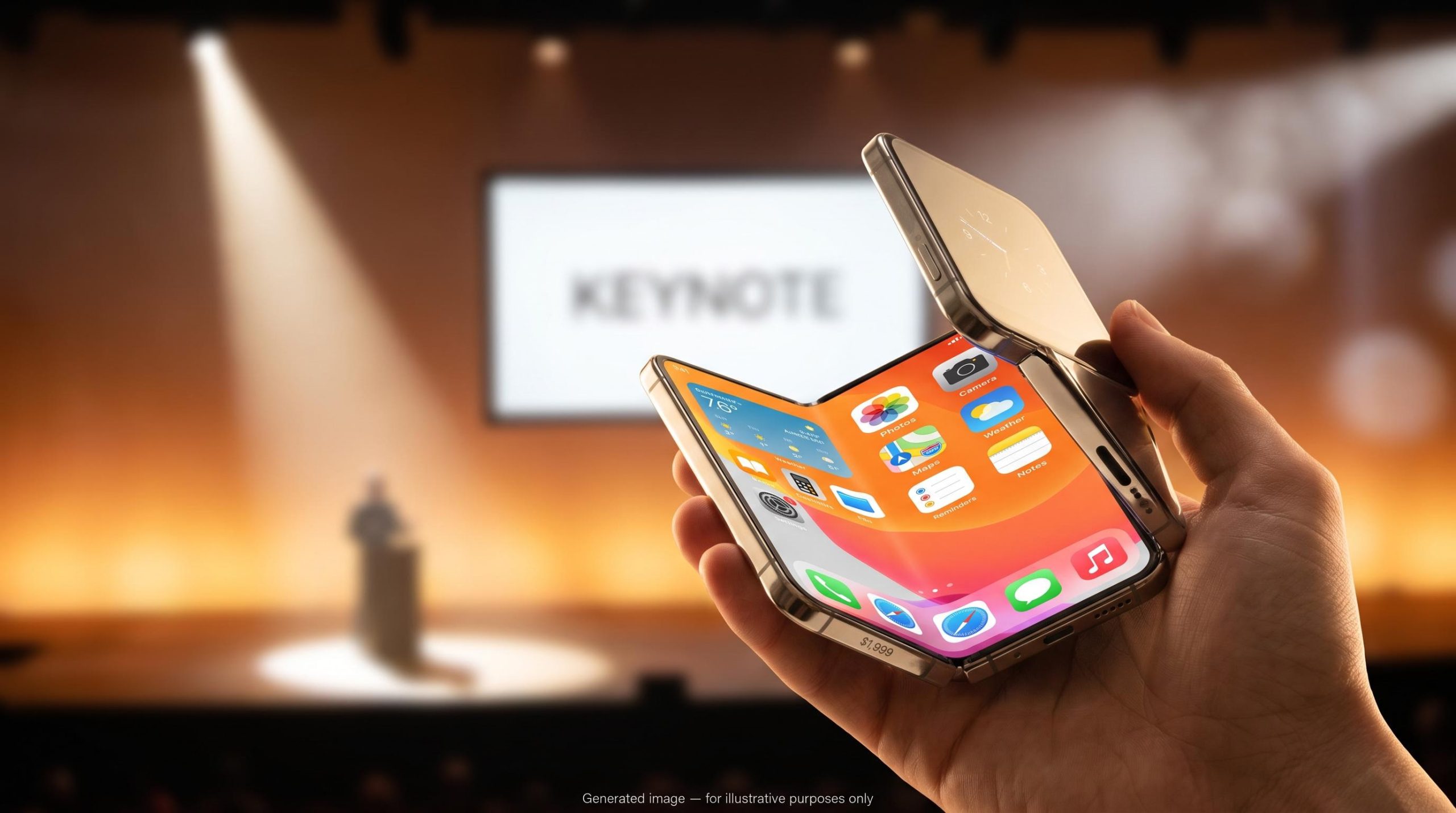
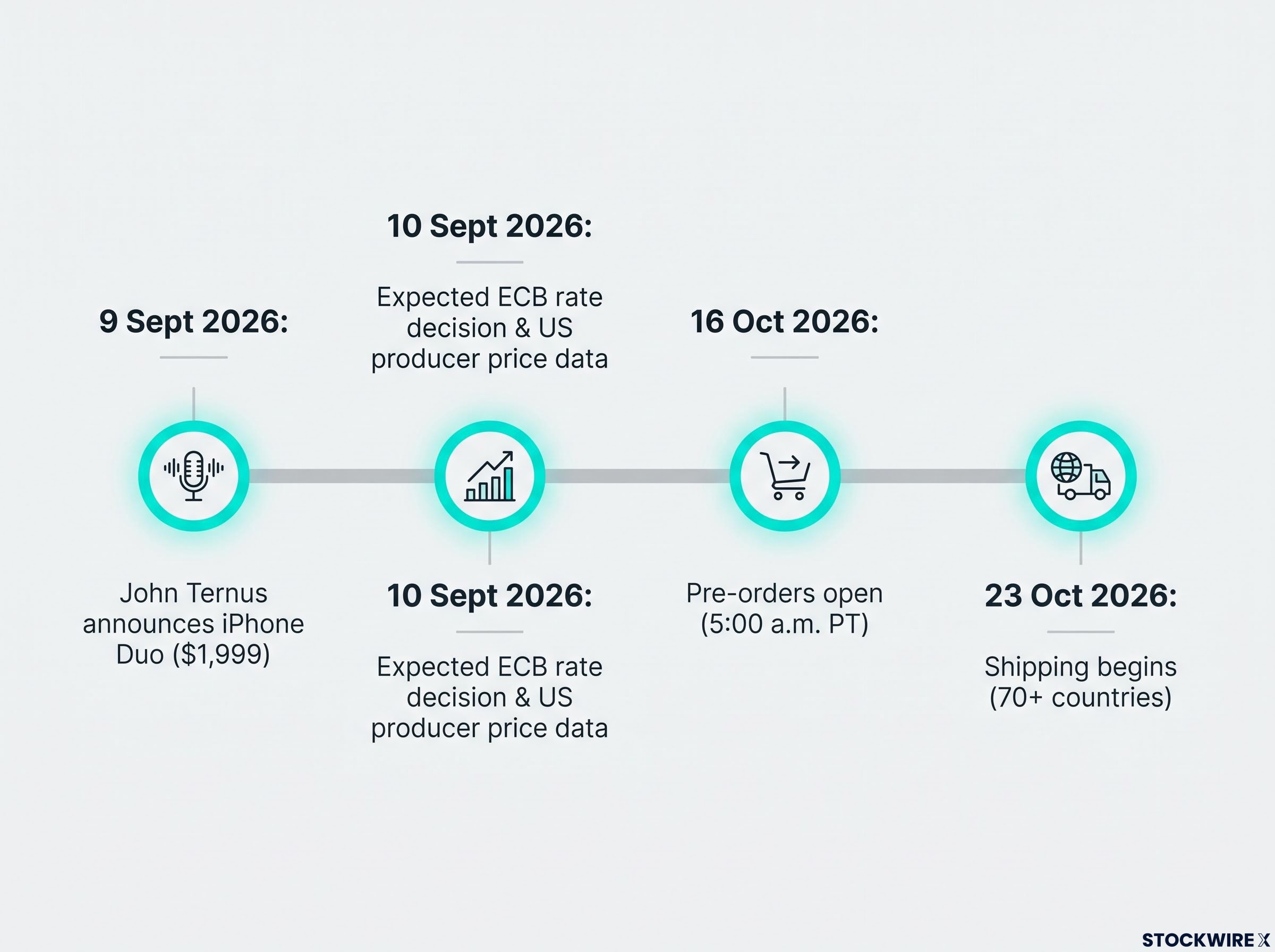
On 9 September 2026, John Ternus walked on stage as Apple’s chief executive for the first time and announced a foldable iPhone priced at $1,999. Both facts carry weight on their own. Together, they open the first chapter of what Apple’s board has decided comes next.
The iPhone Duo is Apple’s answer to years of speculation about whether it would enter the foldable category at all, and at what price. That the announcement came from Ternus, and not from the hardware chief he used to be, is the second half of the story.
These two events are not coincidental. The Duo is the clearest possible statement of what a Ternus-led Apple intends to prioritise.
Here is what the launch actually signals: Apple’s product ambitions, the logic behind its premium pricing, and the leadership bet the company has made. By the time you finish this, you will have a clear-eyed view of what changed today and what remains genuinely uncertain.
John Ternus takes the stage: what his first act as CEO reveals
Apple confirmed the leadership change on 20 April 2026, when its newsroom published a release titled “Tim Cook to become Apple Executive Chairman; John Ternus to become Apple CEO.” The handover took effect on 1 September 2026. Cook stepped into the role of Executive Chairman after nearly 15 years running the company. Ternus, previously Senior Vice President of Hardware Engineering, took the top job.
The 9 September event was his public debut in the role, as reported by Market Index.
The background of the man matters here. Cook built his reputation on operations and supply-chain management: manufacturing, logistics, and cost control were the disciplines that defined his tenure. Ternus spent decades leading hardware teams across iPhone, Mac, and iPad. One optimised how Apple builds and ships; the other has spent his career deciding what gets built.
That distinction is the lens for everything else today.
Choosing a foldable iPhone as the first major product under a hardware-first CEO is not an accident of the pipeline. It reads as a deliberate opening statement about product-category ambition.
What this tells you is that Apple’s board has decided the company’s next competitive edge will be built in the lab, not the supply chain. For years, observers debated whether Cook’s successor would come from operations, services, or hardware. Ternus’s elevation settles that question in favour of engineering, and the Duo is the first evidence of what that judgment produces.
For readers wanting the financial baseline behind today’s launch, our deep-dive into Apple’s Q2 2026 earnings covers the $111.2 billion revenue record, the Cook-to-Ternus succession context, and the open AI monetisation questions that shaped the leadership environment Ternus inherits.
When big ASX news breaks, our subscribers know first
What the iPhone Duo actually is, and what it costs
The Duo is a book-style foldable: a 7.6-inch inner display that opens out from a 5.4-inch outer screen, both Super Retina XDR panels with ProMotion high-refresh-rate technology and Always-On functionality. It is wrapped in a polished Grade 5 titanium frame and carries an IP68 dust and water resistance rating, making it Apple’s first foldable to arrive with full flagship durability credentials.
The engineering choices inside signal intent. The Duo runs on the A20 Pro chip and, more notably, Apple’s own C2 modem, the company’s first departure from Qualcomm for cellular connectivity. Together they mark the device as a technology-generation statement rather than a tentative first attempt.
Apple’s chip diversification push, which included early-stage talks with Samsung Foundry and Intel Foundry Services over US-based manufacturing as of May 2026, provides the supply-chain backdrop against which the C2 modem’s debut as a Qualcomm replacement carries additional strategic weight.
Here are the specifications that matter most:
- Displays: 7.6-inch inner and 5.4-inch outer, both Super Retina XDR with ProMotion and Always-On
- Frame and durability: Grade 5 titanium, IP68 rating
- Chip and modem: A20 Pro processor, Apple C2 modem
- Cameras: Dual 48-megapixel rear sensors, plus an under-display FaceTime camera on the inner screen
- Battery: Dual-battery design totalling roughly 5,800 mAh, rated for up to 31 hours of video on the inner display and 44 hours on the outer
The pricing tells its own story:
| Storage Tier | US Price | Monthly Financing (24 months) |
|---|---|---|
| 256 GB | $1,999 | ~$83.29/month |
| 512 GB | $2,199 | Not disclosed |
| 1 TB | $2,599 | Not disclosed |
| 2 TB | $3,199 | Not disclosed |
Internationally, the base model lands at £1,999 in the United Kingdom and 299,900 rupees in India. Pre-orders open on 16 October 2026, with shipping from 23 October 2026 across more than 70 countries.
What the pricing table really tells you is that Apple has built a product whose ceiling, $3,199, sits above any mainstream smartphone on the market. That is not an accident of components. It is a positioning decision.
Why $1,999? Apple’s premium launch playbook and what history suggests
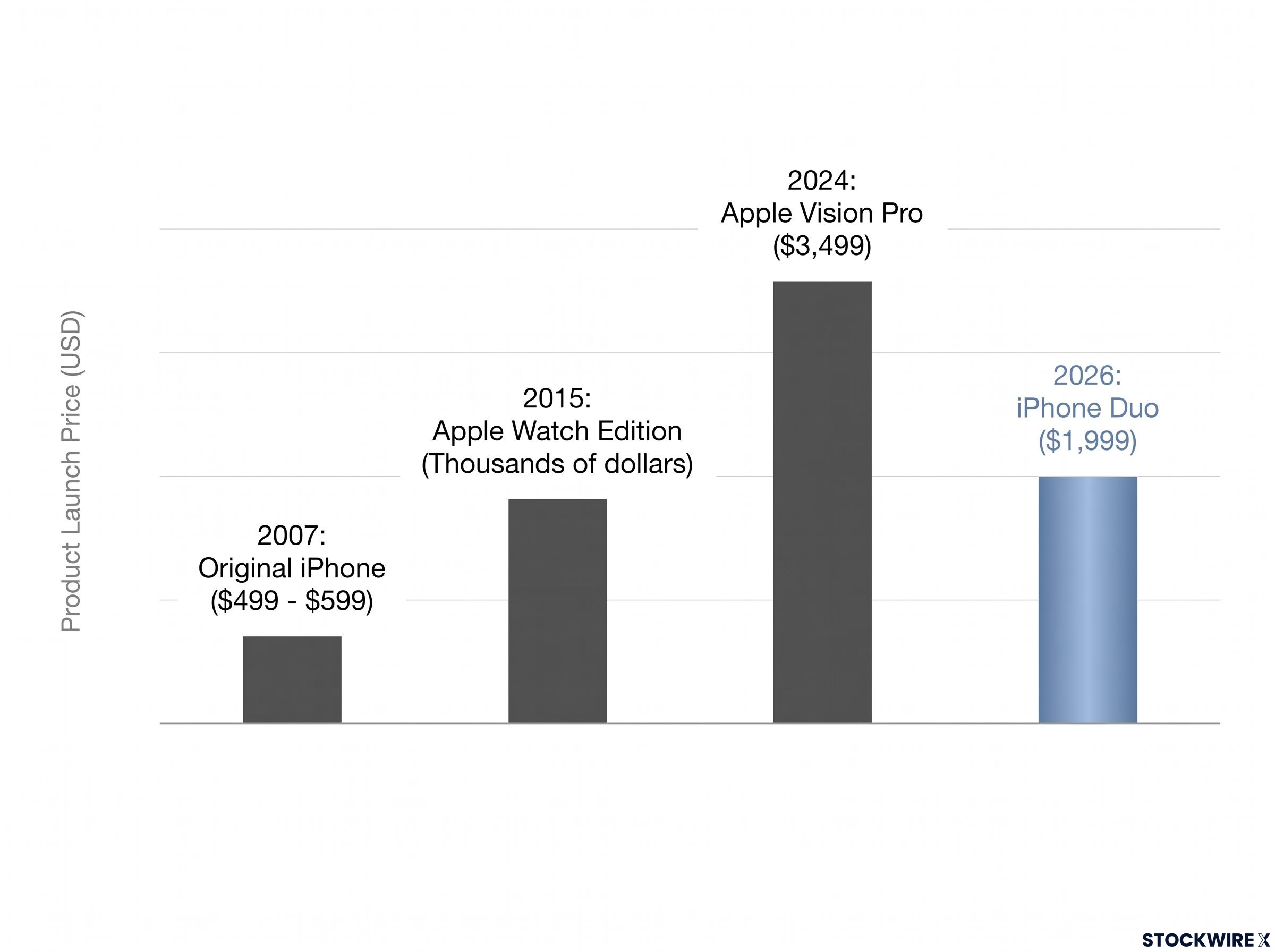
A $1,999 phone sounds outrageous until you look at how Apple has entered every new category. The pattern is consistent: launch high, absorb the scepticism, and let brand strength and early adopters validate the concept before broadening.
The original iPhone arrived in 2007 at $499 to $599, well above most phones of the day, and analysts openly doubted that buyers would pay it. The Apple Watch Edition launched in 2015 in a gold variant priced in the thousands of dollars. Most recently, the Apple Vision Pro debuted at a price that placed it firmly outside the mainstream.
The Vision Pro precedent Apple Vision Pro launched in 2024 at $3,499, positioned for developers and early adopters rather than everyday buyers, with cheaper variants expected to follow later.
The Duo’s price also aligns with who actually buys foldables. Research from Counterpoint Research and IDC across 2022 to 2024 consistently found that foldable buyers skew toward higher-income and tech-enthusiast segments, with devices like Samsung’s Galaxy Z Fold line selling in modest volumes at high average prices.
Apple is not misjudging its audience. It is targeting a premium cohort that already exists.
Framed this way, $1,999 reads as Apple treating the Duo as a halo product investment rather than a volume play, at least in this launch window. The historical pattern suggests the high entry price is a calculated bet on ecosystem pull and early-adopter validation, not a pricing error.
KeyBanc’s bearish Apple outlook, published just three days before the 9 September event, cited the company’s 34x price-to-earnings ratio and estimated the foldable at a slow production ramp of 7-8 million units in the second half of 2026, framing it as a niche catalyst rather than a near-term revenue driver.
But the same history carries a warning. The iPhone succeeded because its everyday utility proved undeniable. The Vision Pro’s mainstream uptake has been slower precisely because that utility is less obvious. The Duo’s trajectory depends on which of those two paths the foldable form factor ends up walking.
The risks Apple’s launch day glossed over
Launch presentations are optimistic by design. What Apple did not linger on tells you where the genuine uncertainty sits.
Four risks stand out:
- Durability: Foldable displays and hinges have drawn scrutiny across the category, with crease visibility, screen failures, and hinge wear dogging early Samsung and Chinese models. Apple’s titanium frame, IP68 rating, and redesigned hinge are its answer, but whether they meaningfully outperform rivals over years of daily folding is unproven.
- Modem execution: The C2 is Apple’s first in-house modem, replacing Qualcomm. Reuters flagged this specifically as a risk, because Apple is deploying an untested component category at the same moment it ramps production of a complex new form factor.
- Pricing environment: The $1,999 to $3,199 range lands into a 2026 consumer environment shaped by inflation and economic uncertainty. Premium discretionary purchases tend to slow when conditions tighten.
- Competitive intensity: Samsung, Huawei, Oppo, and Honor have iterated through multiple foldable generations, narrowing the gap on price, thickness, and reliability. App optimisation for large inner displays remains an industry-wide gap Apple still has to close.
The durability and competitive risks are category-wide. Every foldable maker faces them. The modem risk is specific to Apple’s own execution choices with this device.
That distinction matters for how you read the launch. The Duo is not guaranteed success by brand and specifications alone. It depends on Apple executing in two technically novel areas at once, the foldable form factor and a first-generation in-house modem, in an economy that does not make $1,999 decisions easy for most people.
This article is for informational purposes only and should not be considered financial advice. Investors should conduct their own research and consult with financial professionals before making investment decisions.
What comes next for Ternus’s Apple, and what to watch
The launch is the start of the story, not its ending. Three variables will determine whether the Duo becomes a category statement or an expensive proof of concept.
Watch these in the weeks ahead:
- Pre-order velocity: Pre-orders open at 5:00 a.m. PT on 16 October 2026, with general availability from 23 October 2026 across more than 70 countries. How fast they move is the first real read on whether $1,999 suppresses demand or simply concentrates it among committed buyers.
- Ternus’s operational credibility: His challenge is dual. He has to prove he can manage Apple’s operational complexity while Cook provides continuity as Executive Chairman, and he has to deliver on the product-first vision the Duo embodies.
- The macroeconomic backdrop: An ECB rate decision and US producer price data were both expected around 10 September 2026, per Market Index. They are a reminder that the Duo launches into a global environment that is itself a variable in how premium consumer spending moves through Q4 2026.
Put together, these signals will tell you whether Ternus’s opening act lands as a genuine category statement or a high-profile niche. Pre-order numbers, early durability reporting, and how app developers respond to the large inner display are the leading indicators worth tracking.
For investors wanting to model how the Duo fits into Apple’s broader hardware strategy, our full explainer on Apple’s 2026 market share trajectory covers the installed base expansion logic and how hardware share gains in 2026 function as a leading indicator for services revenue in 2027-2028.
Past performance does not guarantee future results. Financial projections are subject to market conditions and various risk factors. These statements are speculative and subject to change based on market developments and company performance.