Brent crude fell below $100 per barrel on Monday 25 May 2026, marking its sharpest single-session decline in weeks after Iran rejected a negotiation framework that US officials had characterised just days earlier as largely agreed. The selloff centred on a single unresolved demand: Iran’s push for permanent sole authority over the Strait of Hormuz, the waterway through which roughly 20% of global oil supply transits daily.
What appeared to be a deal moving toward closure is now a standoff, and energy markets are repricing that uncertainty in real time. Oil prices dropped sharply on both the Brent and West Texas Intermediate (WTI) benchmarks, even as energy equities held steady, a divergence that carries its own signal about how investors are reading the situation.
This article covers what happened to oil prices on Monday, why the Hormuz clause is the specific sticking point, how the broader three-phase negotiation framework is structured, and what the unresolved impasse means for energy investors, shipping operators, and household fuel costs globally.
Brent crude falls below $100 as deal optimism unravels
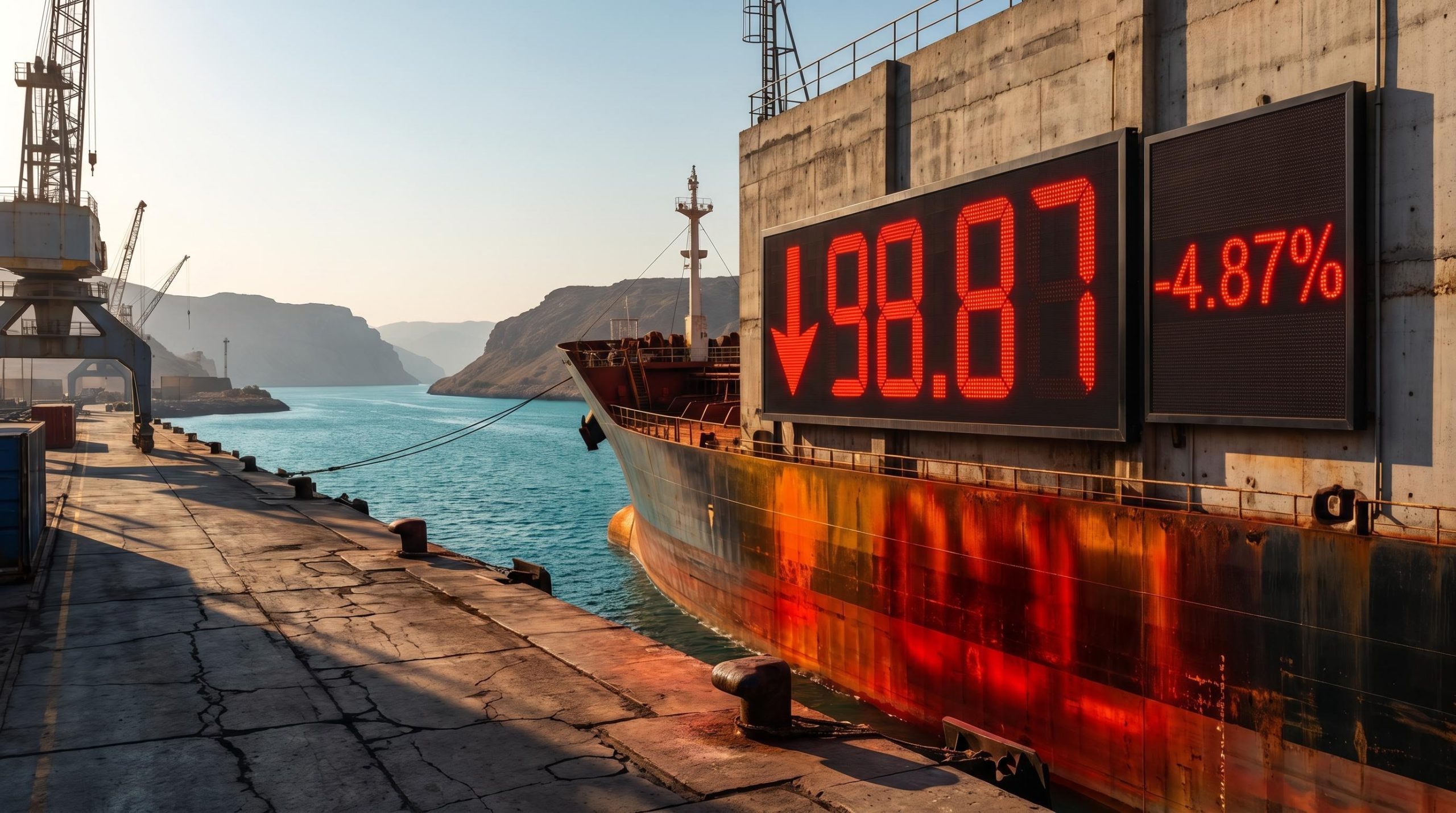
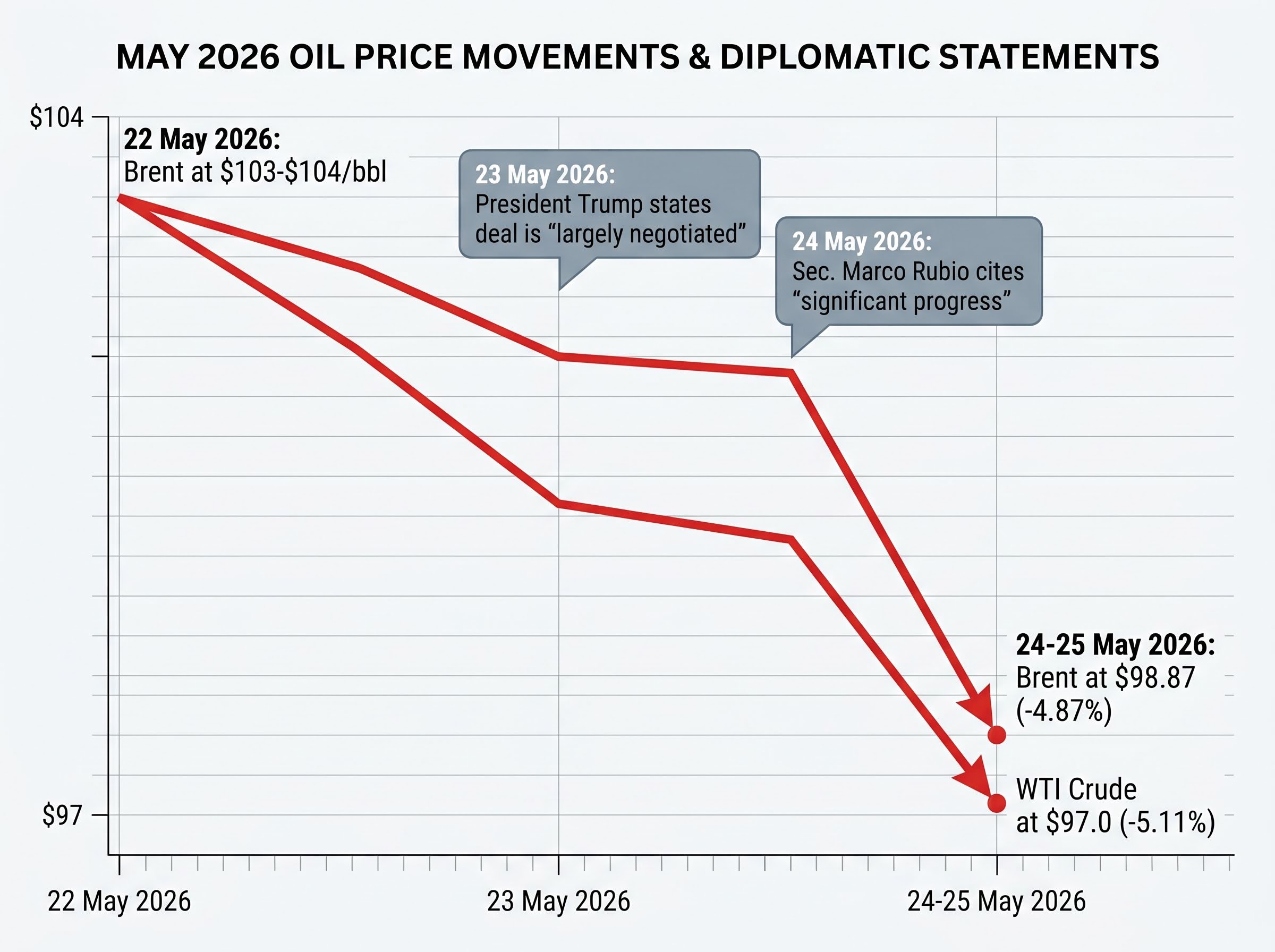
The week had started with Brent trading around $103-$104 per barrel as of 22 May 2026. By Monday, the benchmark had dropped to approximately $98.87, a fall of 4.87% from the prior session. WTI followed with a steeper decline, down 5.11% to approximately $97.0.
The scale of the reversal reflects what the market made of the diplomatic sequence. On 23 May 2026, President Trump described the deal as “largely negotiated.” By Monday, Iran had rejected the framework, and crude was repricing accordingly.
The Hormuz risk premium built into crude prices since February 2026 represents a quantifiable gap between J.P. Morgan’s structural forecast of approximately $60 per barrel and spot prices that have traded above $100 for weeks, a spread that reflects geopolitical uncertainty rather than any shift in underlying supply-demand fundamentals.
- Brent crude: approximately $98.87/bbl on 24-25 May 2026, down 4.87%
- WTI crude: approximately $97.0/bbl, down 5.11%
- Prior week close: Brent at approximately $103-$104/bbl around 22 May 2026
The 4.87%-5.11% single-session decline across both benchmarks represents the sharpest daily move in weeks, directly tied to the diplomatic reversal rather than any shift in supply-demand fundamentals.
One detail stood out. The S&P 500 energy sector closed up 0.44% on the same day oil fell nearly 5%. That gap suggests equity investors are treating the breakdown as a temporary complication in talks that remain broadly on track, not as a structural collapse.
When big ASX news breaks, our subscribers know first
Why the Strait of Hormuz clause is the deal’s breaking point
The Strait of Hormuz is a narrow waterway between Iran and Oman, roughly 20% of global oil supply passes through it on tankers bound for Asian and European markets. Any disruption, or any new cost imposed on that transit, ripples outward through freight rates, refinery input costs, and ultimately consumer fuel pricing.
Iran’s position on the Strait is not a negotiating footnote. It is the structural core of the current impasse.
What Iran’s Persian Gulf Strait Authority proposes
Iran established the Persian Gulf Strait Authority with proposed tolling and fee structures for vessels transiting the waterway. Analysts have noted these steps aim to monetise control and extract revenue, a position that runs contrary to international norms on freedom of navigation.
The institutional steps intensified from March-April 2026, well before the current round of talks, indicating a premeditated strategic objective rather than an improvised bargaining position.
- Iran: Established the Persian Gulf Strait Authority; proposed mandatory vessel transit fees
- Gulf states (Saudi Arabia, UAE, Kuwait, Bahrain): Have historically opposed unilateral Iranian dominance; Gulf states formally advised shipping operators to avoid the route
- United States: Regards permanent Iranian sole authority as incompatible with freedom-of-navigation norms
- Oman: Engaged in bilateral discussions with Iran on Strait management
Any mandatory transit fee regime would add directly to shipping operating costs, flow through to freight rates, and ultimately reach consumer goods pricing, making this a supply-chain dispute with consequences extending well beyond the oil price itself.
The IMO freedom of navigation standards explicitly prohibit any country from imposing transit fees or restricting safe passage through international straits, positioning Iran’s proposed tolling regime as a direct challenge to customary international maritime law.
How the three-phase negotiation framework is structured
The framework under discussion follows a deliberate sequence. Understanding where in that sequence the breakdown is occurring clarifies why markets moved sharply and what remains unresolved.
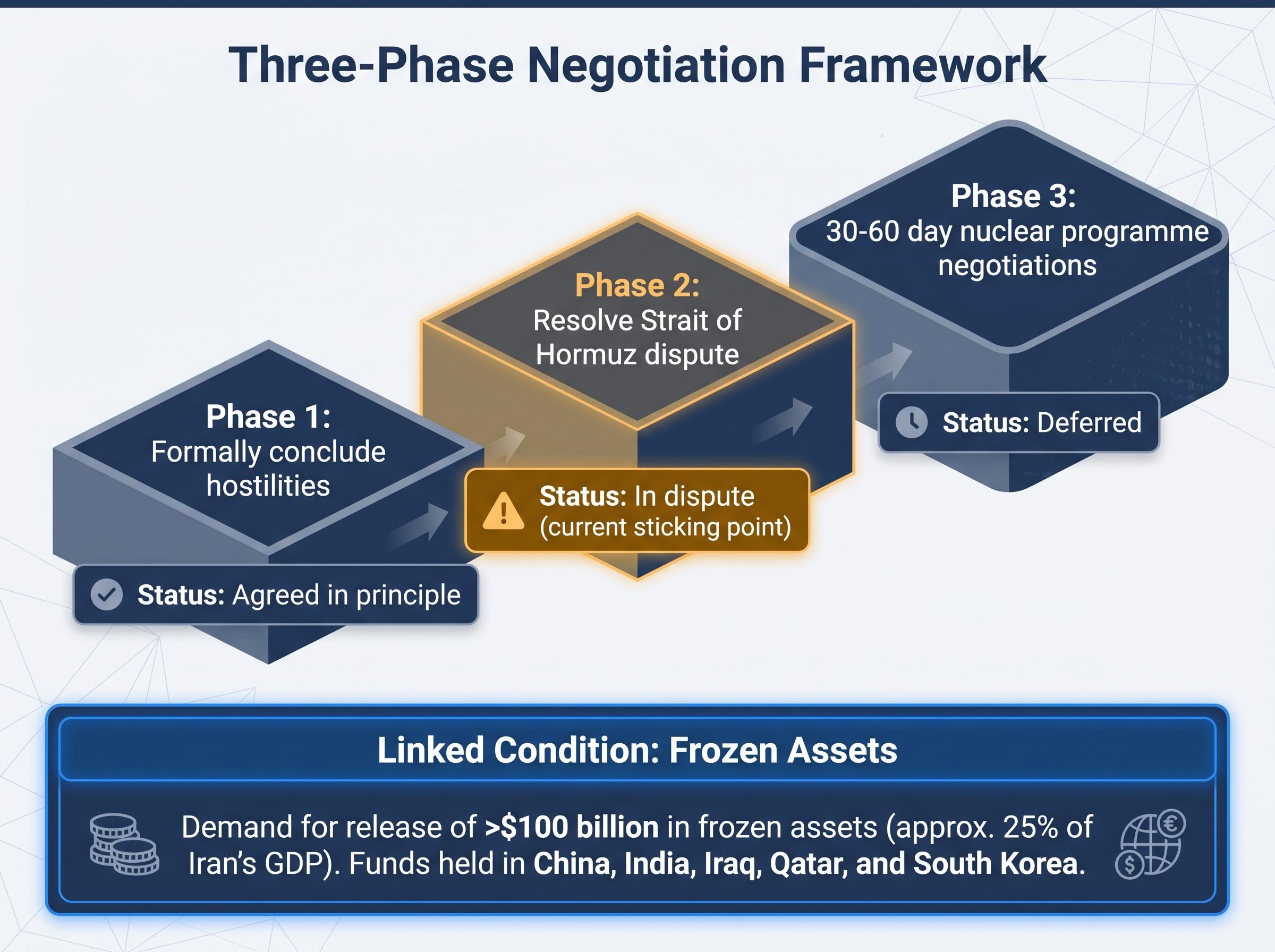
- Phase one: Formally conclude hostilities between the US and Iran
- Phase two: Resolve the Strait of Hormuz dispute, including Iran’s authority claims and proposed fee structures
- Phase three: Open a 30-60 day broader negotiation window covering the nuclear programme, including Iran’s highly enriched uranium stockpiles
The nuclear file, often assumed to be the primary obstacle, is deliberately deferred to phase three. The current sticking point is phase two: the Strait.
On 23 May 2026, President Trump stated the deal had been “largely negotiated.” Secretary of State Marco Rubio followed on 24 May 2026, citing “significant progress” and suggesting “some good news” on the Strait could emerge within hours. Iran’s subsequent rejection of the framework collapsed that timeline.
A linked condition sits alongside the three phases. Iran has demanded the release of an estimated more than $100 billion in frozen assets, representing approximately 25% of Iran’s GDP. These funds are held primarily in China, India, Iraq, Qatar, and South Korea.
| Phase | Description | Current status |
|---|---|---|
| Phase 1 | Formally conclude hostilities | Agreed in principle |
| Phase 2 | Resolve Strait of Hormuz dispute | In dispute (current sticking point) |
| Phase 3 | 30-60 day nuclear programme negotiations | Deferred |
Until phase two is resolved, oil supply uncertainty remains the default condition, and the nuclear file cannot proceed.
What the Hormuz standoff means for household energy costs and corporate spending
The diplomatic impasse is already producing observable effects on consumer behaviour and corporate decision-making, well before any final deal outcome is known.
Walmart, according to reporting by the Wall Street Journal in May 2026, observed signs of consumer fuel rationing among its shoppers. Management stated its intention to hold in-store prices stable despite fuel-pump pressures, a signal that the retailer is absorbing margin compression rather than passing costs through immediately.
The strain extends beyond US borders:
- United States: Consumer inflation expectations for the next 12 months reached 4.8% as of the May 2026 survey, while consumer confidence fell to 44.8, below the forecast of 48.2, according to Bloomberg data
- United Kingdom: Retail sales contracted 1.3% in April 2026, the steepest monthly fall since May 2025, partly attributed to the economic shock from the Iran conflict, Bloomberg reported
- Japan: Core inflation dropped to a four-year low in April 2026, aided by government subsidies, but elevated oil prices present renewed upside inflation risk, according to Reuters
The consumer-side evidence suggests the diplomatic stall is already embedding itself in spending behaviour. A prolonged impasse carries compounding risk for consumer-facing equities and discretionary retail sectors, extending the impact well beyond direct energy exposure.
Triple-digit oil has evolved from a supply shock into a structural inflation risk, transmitting through a three-stage chain of energy costs, logistics costs, and consumer prices, with the IEA characterising Middle East geopolitical tension as a persistent upside pressure on oil prices that is likely to decompress over months rather than weeks regardless of how the current negotiation resolves.
IMF energy price pass-through research demonstrates that wholesale oil price shocks transmit to consumer price indexes through both direct fuel costs and indirect supply-chain channels, with transmission effects intensifying in the post-pandemic period, providing the analytical basis for why an unresolved Hormuz standoff carries compounding inflation risk well beyond pump prices.
What to watch next: the signals that will move oil prices from here
Rather than open-ended uncertainty, the current situation presents a specific set of observable triggers that will determine direction from here.
- Strait resolution signal: Any formal withdrawal of Iran’s proposed fee structure, or agreement on shared management of Hormuz transit, would constitute a phase two resolution and could prompt a rapid oil price recovery
- Iranian leadership approval timeline: The White House indicated it did not anticipate a formal agreement on Sunday 25 May 2026, and Iranian leadership approval may require several additional days
- China export data: Reuters reported that China is projected to modestly increase refined fuel exports in June 2026 while maintaining existing export restrictions to protect domestic supply, a secondary variable that could cushion or complicate the price picture
How adjacent markets are reading the risk
Two signals from adjacent markets suggest the current posture is cautious optimism rather than panic. The VIX sat at 16.7 as of Monday 25 May 2026, well below levels associated with a full breakdown scenario. The Australian 10-year bond yield declined 2 basis points to 4.89%, its lowest since 11 March 2026, a mild risk-off signal rather than a flight to safety.
With the VIX contained and energy equities up on a day oil fell nearly 5%, the market is pricing a deal delay, not a deal collapse. Whether that posture holds depends on the triggers above.
Emergency reserve releases totalling approximately 280 million barrels from IEA members and strategic petroleum reserves have failed to halt inventory drawdowns running at 8.5 million barrels per day in Q2 2026, a scale of depletion that leaves the Hormuz reopening timeline as the single most consequential variable for the oil supply outlook through the rest of the year.
A deal that is almost done has failed before
The two-day arc from “largely negotiated” to sub-$100 Brent illustrates a pattern familiar in Iran-US diplomacy: frameworks progress to near-completion before collapsing on sovereignty-linked demands.
The pattern has a direct precedent: during an earlier deal-framework episode on 7 May 2026, Brent fell 7.6% in a single session as peace reports removed a large portion of the war premium, only for the commodity complex to reprice again within days as implementation uncertainty re-emerged.
The Hormuz authority clause is not a late-stage technical detail that emerged during final drafting. Iran’s Persian Gulf Strait Authority was established as an institutional step, and its proposals intensified from March-April 2026, months before the current talks reached their reported near-conclusion. This is a premeditated negotiating position reflecting a core Iranian strategic objective.
Resolution requires one of two outcomes: either Iran modifies its Hormuz authority position, or the US and Gulf states accept some form of tolling framework. Both carry significant political costs for the parties involved. No final signed agreement had been announced as of 25 May 2026.
On 23 May 2026, President Trump said the deal was “largely negotiated.” Two days later, Brent crude traded below $100. The gap between a described framework and a signed one is precisely the risk premium that energy investors must now carry.
This article is for informational purposes only and should not be considered financial advice. Investors should conduct their own research and consult with financial professionals before making investment decisions.
These forward-looking statements regarding negotiation outcomes and oil price trajectories are speculative and subject to change based on diplomatic developments and market conditions.