
European companies faced 116 new public activist campaigns in 2025, a 43% increase on the prior year. That is not a blip. It is the latest step in a staircase that has only moved in one direction.
The forces behind that number are structural. European equities persistently trade below comparable U.S. peers. M&A activity has recovered from a 2023 trough. And the infrastructure that supports activist campaigns, from proxy advisers to institutional coalitions to evolving regulation, has matured to a point where campaigns are cheaper to execute and harder for boards to dismiss.
All three forces are compressing simultaneously, and that compression is reshaping how European corporate governance operates. Here is the analytical framework for understanding where activist pressure is building, why it is building now, and what it means for anyone tracking governance-driven catalysts or positioning around event-driven opportunities across Europe’s largest equity markets.
Europe’s activism surge is structural, not cyclical
The campaign volume data tells you something important when you read it in sequence rather than as a single headline. Each record year has been a record relative to the one before it, forming an ascending staircase rather than a single spike:
- Lazard reported a record 69 new campaigns against European targets in 2023, a 15% increase on the prior record year.
- A separate Lazard study counted 235 campaigns aimed at European companies, a 36% rise year-on-year, the most active year since 2018.
- Skadden’s Activist Investing in Europe 2026 found 116 new public campaigns launched in 2025, up 43% versus 2024, with total European campaigns reaching 398 by Q4 2025.
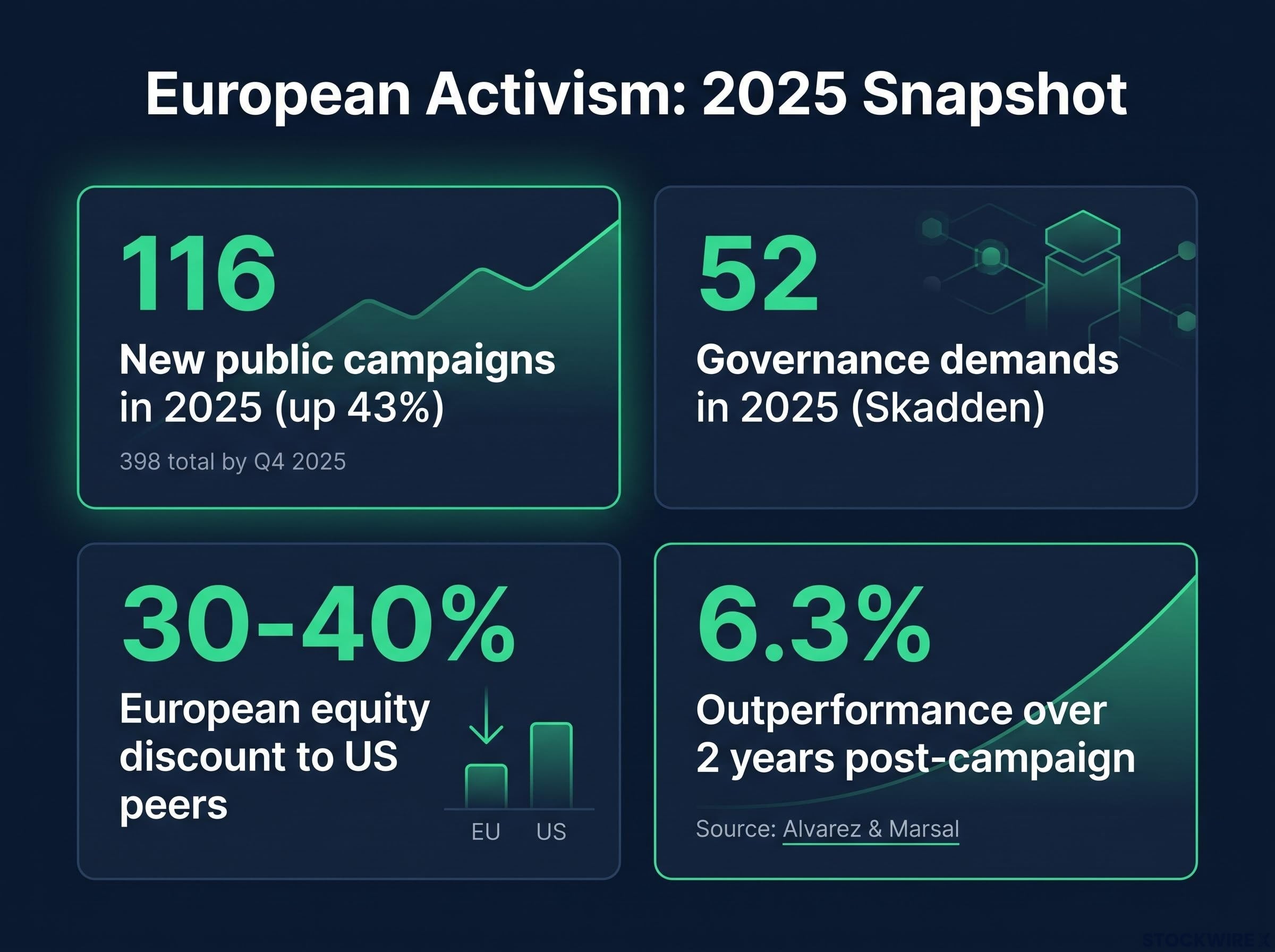
Skadden data: 116 new public campaigns in 2025, up 43% on the prior year, with 398 total European campaigns by Q4.
JPMorgan analysts, writing in February 2026, confirmed the same directional trend, pointing to particularly high campaign activity concentrated in the UK, Germany and France as the three most prominent markets.
This is not a cyclical uptick that European boards can wait out. The pattern is a permanently elevated baseline of external pressure, geographically distributed rather than concentrated in a single market anomaly. Each year’s record is the new floor, not the ceiling.
When big ASX news breaks, our subscribers know first
The valuation gap that activists are being paid to close
The economic case for European activism starts with a specific observation. JPMorgan analysts noted that markets such as the UK, France and Germany contain a disproportionately large share of companies whose stock prices sit below book value relative to the U.S., a condition that makes them compelling candidates for acquisition activity.
JPMorgan: Markets including the UK, France and Germany contain a disproportionately large share of companies trading below book value relative to U.S. peers, creating a concentration of attractive M&A targets.
Market estimates put the broader European equity discount to U.S. peers at roughly 30-40% on various metrics, though this figure circulates widely without independent verification and should be treated as a market estimate rather than a confirmed number. The discount is persistent, not episodic.
The European equity discount to U.S. comparables on forward earnings multiples, estimated at roughly 31% on MSCI data, is the same structural gap that makes European-listed multinationals simultaneously attractive to long-only investors seeking diversification and to activists whose return thesis depends on that gap closing through governance-driven re-rating.
The Corporate Governance Institute notes that UK activists are explicitly targeting this valuation gap, frequently pushing companies to add a U.S. listing or move their primary listing to Wall Street. German companies attract campaigns for a related but distinct set of reasons: lower valuation multiples, decreasing returns, rising capital costs and supply-chain issues converge as a specific activation trigger.
From mispricing to actionable thesis
The distinction that matters here is between broken businesses and fixable situations. Activists targeting European companies are not looking for distressed turnarounds. They are looking for companies with durable cash generation where governance, capital allocation or strategic clarity is the problem, not the underlying business.
That profile is why the below-book-value signal matters doubly. It simultaneously flags companies as activist targets and as potential M&A candidates. The same dynamic that attracts a governance campaign may also attract a bid, and activists understand that overlap as part of the return thesis.
What activists are demanding, and what boards are conceding
The demand categories reveal which specific gaps activists are diagnosing, and governance sits at the top.
Skadden’s 2025 data shows that structural governance changes, meaning board or management changes and governance reforms, totalled 52 demands, more than in 2024. Demands for operational or cost improvements and broader strategic changes also rose. Capital returns remain a lever, particularly for cash-rich, undervalued companies, but campaigns that focus solely on financial engineering without accompanying governance asks are relatively uncommon in the European context.
| Demand category | 2025 trend | Representative outcome |
|---|---|---|
| Governance / board changes | 52 demands (up from 2024) | Board reconstitution, independent director appointments |
| Capital returns | Persistent, often paired with governance | Buyback programmes, special dividends |
| Operational improvements | Rising | Cost reduction, margin discipline |
| Strategic changes | Rising | Divestitures, strategic reviews, re-listings |
Boards are increasingly willing to concede on capital returns, governance tweaks or strategic reviews to avoid protracted public battles. That shift in European boardroom posture is itself a signal: boards now treat pre-emptive concessions as cheaper than contested proxy fights.
The frequency of board reconstitution demands reflects a deeper truth about the corporate governance hierarchy: shareholders hold ultimate structural authority, and activists are simply exercising that authority more systematically than most institutional investors have historically chosen to.
Alvarez & Marsal outcome data gives you a concrete benchmark. Targeted companies outperformed broader markets by approximately 6.3% over the two years following campaign launch, with UK campaigns delivering the highest average returns. That figure tells you activism in the European context does not just generate headlines; it generates measurable value.
The IES meta-analysis on activism value creation, synthesising findings across 49 studies and more than 1,100 estimates, finds consistent positive long-run effects on firm value and stock returns, lending independent academic weight to the 6.3% outperformance figure Alvarez & Marsal report for European campaign targets.
The geography and sectors where activist pressure is densest
The geographic hierarchy is data-driven: the UK first, Germany second, France third, with Switzerland and Scandinavia forming the secondary tier. Alvarez & Marsal frame these as Europe’s “Big 5” activist markets.
Country-level selectivity within Europe is not just an allocation preference; it maps directly onto activist opportunity density, with the UK’s shareholder rights framework and Germany’s lower multiples producing structurally different campaign dynamics than markets where governance traditions or state involvement limit activist access.
| Market | Key sector exposure | Structural activist driver |
|---|---|---|
| United Kingdom | Energy, Industrials, Consumer | Strongest shareholder rights framework, deepest institutional engagement tradition |
| Germany | Industrials, Healthcare, Technology | Lower multiples, rising capital costs, supply-chain pressures |
| France | Consumer, Industrials | Conglomerate complexity, cross-holdings creating simplification targets |
| Switzerland | Consumer, Healthcare | Premium-listed multinationals with capital discipline gaps |
| Scandinavia | Industrials, Technology | Governance-focused institutional base, mid-cap concentration |
The UK numbers are striking. Diligent’s Corporate Governance in Europe 2025 report found 52 UK companies faced activism between September 2024 and August 2025, up 44% from the prior year. A record 31 new activists launched UK campaigns in 2023, double the 2022 figure.
Sectorally, JPMorgan research points to Industrials, Consumer Discretionary and Technology as the three sectors drawing the greatest volume of activist attention. Healthcare was the single most targeted sector in Europe in H1 2025. Named targets in recent campaigns include Bayer, Siemens, BP, Shell, TotalEnergies, Nestlé and Kering.
The top four sectors, with a one-line rationale for each:
- Industrials: Corporate complexity creates scope for simplification, asset disposals and strategic unbundling.
- Technology: Persistent mispricing relative to U.S. tech comparables, with identifiable capital allocation improvements.
- Healthcare: Large, diversified groups where portfolio rationalisation can unlock embedded value.
- Energy: Capital discipline questions and strategic direction debates, particularly around transition spending.
The sectoral concentration tells you that activists are not hunting for turnaround stories. They are targeting large, complex organisations where corporate simplification or capital redeployment can unlock value without requiring a business model change.
How the M&A recovery amplifies activist leverage
Activism and M&A in Europe are increasingly interlinked playbooks, not parallel trends. The mechanics reinforce each other, and understanding that reinforcement changes how you read individual campaigns.
JPMorgan analysts (February 2026): Europe’s regulatory backdrop has grown progressively more supportive, providing a meaningful boost to M&A volumes that have been climbing steadily since bottoming out in 2023.
The activist-to-M&A pressure ladder works through three specific escalation steps:
- Strategic review demand: The activist pushes for a formal review of portfolio structure, forcing the board to publicly evaluate whether divisional breakups or exits would unlock value.
- Divestiture push: If the review reveals non-core assets, the activist pressures for disposals, which both generate capital for returns and simplify the corporate structure for a potential acquirer.
- Re-listing call: In the UK specifically, activists increasingly push for dual or primary U.S. listings to capture higher valuations, a move that also raises the company’s profile for U.S.-based acquirers.
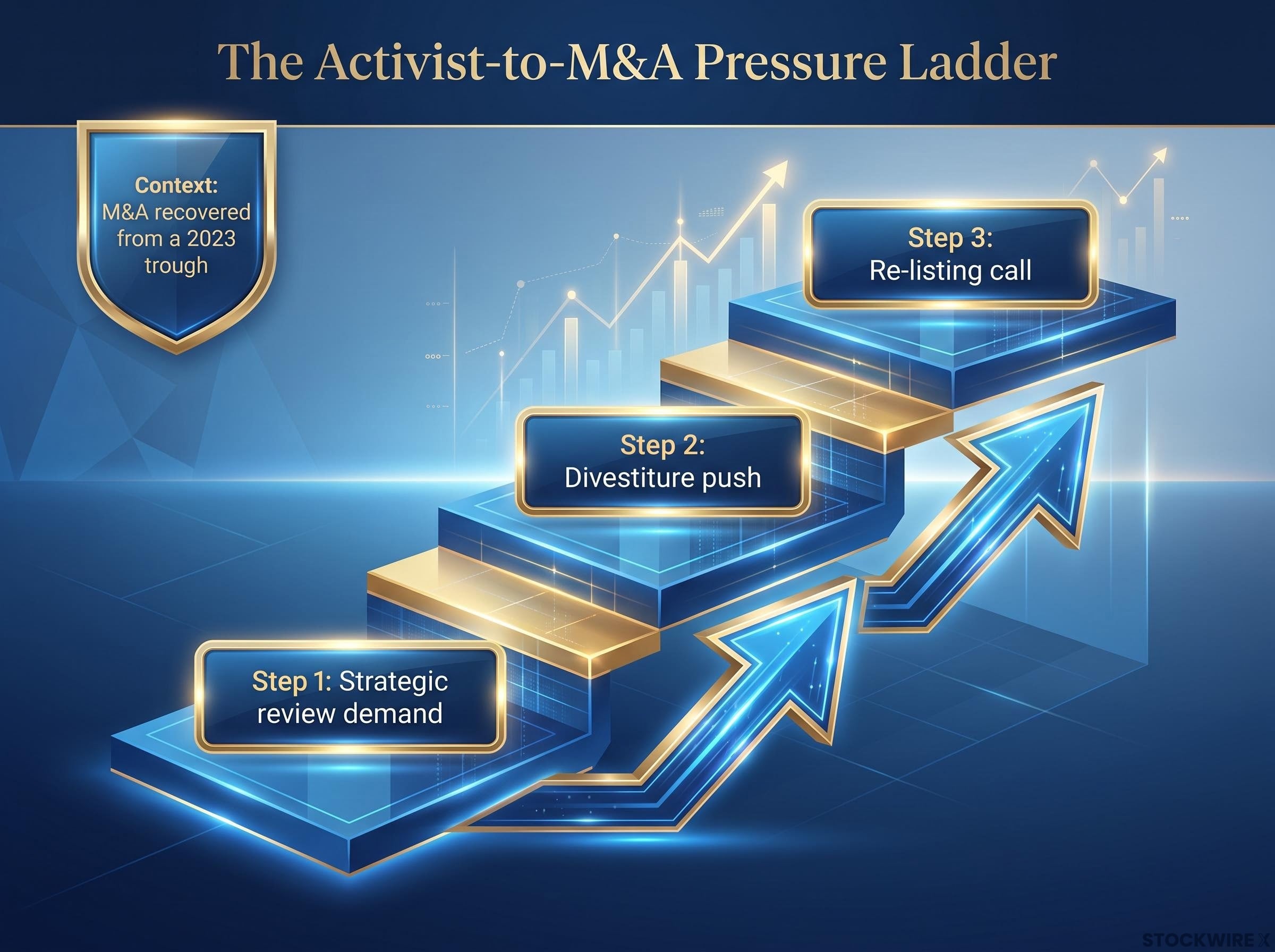
A credible take-private or strategic acquisition option creates a valuation floor and shifts board incentives. When an activist builds a stake in a European company and the M&A market is simultaneously active, the bid premium optionality is part of the activist’s return thesis, not a secondary outcome. Boards know this, which makes them more receptive to pre-emptive concessions.
For anyone tracking event-driven opportunities, monitoring M&A deal flow in the UK, Germany and France alongside activist campaign filings provides a layered signal. Where both are elevated, the probability of a governance-driven re-rating or strategic transaction is highest.
The infrastructure powering campaigns, and the friction still limiting them
Three pillars of activist enablement infrastructure have matured simultaneously. ISS and Glass Lewis have expanded their European coverage, and their recommendations are widely cited as influential in mobilising dispersed institutional shareholders around activist proposals. Large European asset managers are becoming more interventionist under ESG-linked governance mandates and fiduciary pressure to address underperformance. And a proposed revision to EU shareholder rights legislation, referred to as SRD III, could lower the cost of cross-border campaigns if adopted.
SRD III forward look: A more unified EU framework for shareholder rights and engagement would reduce execution costs for multi-jurisdiction campaigns and could accelerate activist deal flow in ways current campaign volume data does not yet reflect. Legislative timing and outcomes had not been finalised as of August 2026.
Where the real friction sits
The structural case is real, but the friction points are equally important.
Co-determination: Germany’s co-determination rules and supervisory board structures require tactics that differ meaningfully from those applicable in the UK, raising campaign execution costs for non-specialist activists. This is a structural constraint, not a cultural one, and it limits the portability of campaign playbooks across jurisdictions.
State holdings: Energy, defence, utilities and financial services contain names where government involvement creates a ceiling on activist ambition. These are not fringe cases; they include some of Europe’s largest listed companies.
Cultural resistance: French and German boardrooms retain corporate cultures that are less reflexively receptive to external shareholder pressure than UK or U.S. equivalents. Stakeholder-oriented governance traditions mean that adversarial campaign dynamics face a higher bar of social and institutional acceptance.
These constraints do not undermine the structural case, but they do affect which companies and geographies are genuinely activist-accessible versus nominally so. The opportunity is real but geographically and structurally uneven, and ignoring the friction points leads to a misread of any individual campaign’s probability of success.
Reading the European activist map in 2026 and beyond
The convergence of valuation gaps, M&A recovery, and maturing activist infrastructure converts into a monitoring framework with four specific variables to track, presented in priority order:
- Valuation discount persistence: If European equities continue to trade meaningfully below U.S. comparables on book value and earnings multiples, the economic case for activism remains intact and the target pool stays large.
- M&A deal flow in core geographies: Rising deal volumes in the UK, Germany and France increase the credibility of the activist’s bid-premium thesis and make boards more receptive to pre-emptive concessions.
- SRD III legislative progress: Adoption of a more unified EU shareholder rights framework would lower the cost of cross-border campaigns and potentially accelerate activist activity in continental markets beyond the current Big 5.
- Proxy adviser coverage expansion: Further expansion by ISS and Glass Lewis into mid-cap European names reduces the mobilisation barrier that has historically protected smaller companies from coordinated institutional pressure.
Specific index focus: The FTSE 250 and MDAX represent where activist-amenable mid-cap concentration is highest, according to Alvarez & Marsal. These are the indices to watch for governance-driven re-ratings.
Macro constraints, specifically rising financing costs and geopolitical uncertainty, affect campaign timing and the credibility of capital return demands in any given cycle. They do not alter the structural thesis.
Holding this monitoring framework positions you to identify activist-linked inflection points before they are widely reported. That is where the informational edge in event-driven analysis sits: not in reacting to campaign announcements, but in recognising the conditions that make them probable.
For investors wanting to extend the valuation gap analysis into a specific portfolio thesis, our full explainer on the contrarian case for European equities examines how the expectations-versus-reality framework translates into position sizing when institutional consensus remains deeply underweight.
This article is for informational purposes only and should not be considered financial advice. Investors should conduct their own research and consult with financial professionals before making investment decisions.
Forward-looking statements regarding regulatory developments, including SRD III, are speculative and subject to change based on legislative outcomes and market developments.