U.S. stocks did not just rise on Tuesday, 4 August 2026. They settled a months-long argument about whether the artificial intelligence trade was backed by real commercial revenue, and the answer arrived through earnings reports at every level of the AI supply chain. Both the S&P 500 and Dow Jones Industrial Average reached new all-time closing records, while the Nasdaq Composite turned in its best performance in approximately six weeks.
The records came at the end of a tense summer. July had driven AI-linked chip valuations sharply lower, with investors growing increasingly doubtful that the scale of infrastructure spending would ever translate into proportionate revenue. That backdrop is what makes Tuesday’s session more than a green day on the screen: it was the market’s verdict on whether the AI sceptics were right.
Here is what actually moved markets on Tuesday, and what it tells you about where the AI trade stands heading into the back half of 2026.
S&P 500 and Dow close at all-time highs as Nasdaq posts its best session in six weeks
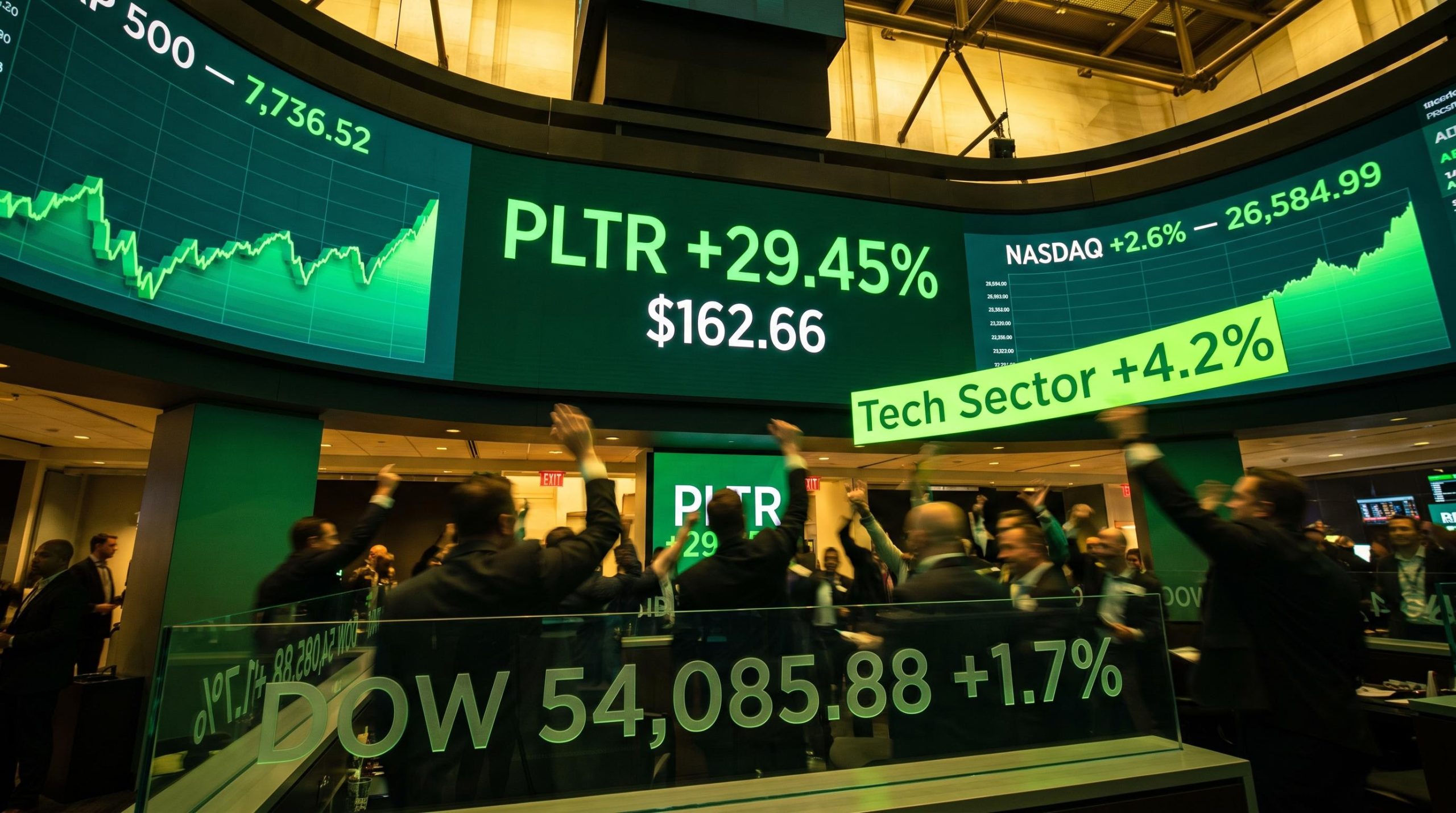
The numbers landed with force. Every major U.S. index closed sharply higher, with the S&P 500 and Dow both securing fresh all-time closing records and the Nasdaq recording its strongest finish since the final week of June.
| Index | Closing level | Point gain | Percentage gain |
|---|---|---|---|
| S&P 500 | 7,736.52 | +136.02 | +1.8% |
| Dow Jones Industrial Average | 54,085.88 | +907.47 | +1.7% |
| Nasdaq Composite | 26,584.99 | +671.10 | +2.6% |
The Nasdaq’s 2.6% advance was the session’s tell. A routine broad-market drift higher does not produce a nearly one-percentage-point gap between the Nasdaq and the Dow. The technology sector gained approximately 4.2%, more than double the broader market’s advance. Industrials followed at roughly 3.4%, while energy and utilities were clear underperformers.
Sector standout: Technology’s 4.2% single-session gain was the day’s defining number, revealing that the rally was driven by concentrated conviction in AI-linked equities rather than a uniform risk-on bid.
That concentration matters. The index records were earned by a specific leadership group, not by everything going up together.
When big ASX news breaks, our subscribers know first
What drove the rally: earnings results, easing oil prices, and a shift in AI sentiment
Three catalysts converged on a single session, and their combined weight, not any one of them alone, is what pushed markets to records rather than a modest recovery.
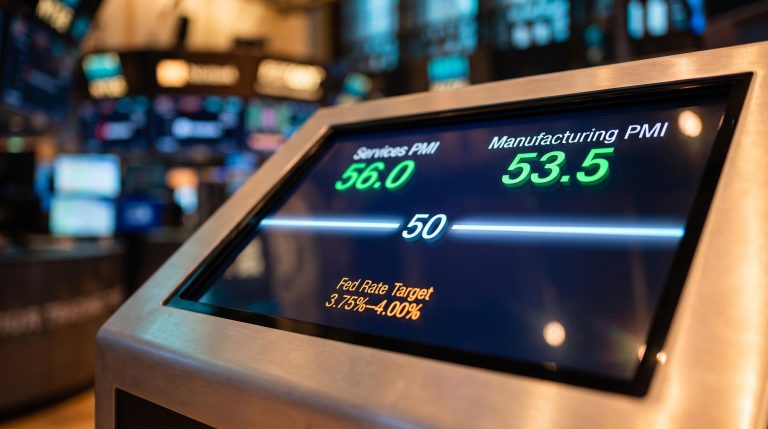
The broadest tailwind came from falling crude oil prices. Hopes for a deal easing tensions around the Strait of Hormuz removed one of the summer’s persistent macro overhangs, giving risk assets room to run. On top of that, strong ISM manufacturing PMI data reinforced the view that the U.S. economy remained resilient.
The earnings-specific catalysts
Then the earnings picture stacked on top. Reuters specifically pointed to upbeat AI-driven forecasts from Palantir and Caterpillar, alongside Middle East optimism, as central to the S&P 500’s move to record territory. Recent results from Microsoft and Amazon had already laid a foundation by confirming that hyperscaler AI investment was continuing at pace.
The three primary drivers, in summary:
- Easing oil prices and geopolitical risk, reducing a key macro overhang that had weighed on sentiment throughout the summer
- Broad corporate earnings strength, with Q2 results accelerating toward multi-year growth highs
- Renewed AI confidence, as company-level revenue figures replaced the speculative optimism that had faltered in July
The simultaneous arrival of all three created a rare moment where multiple overhangs lifted at once. That combination is why the market moved to records rather than simply bouncing. If any single catalyst fades in coming weeks, the other two provide a floor; if all three hold, the rally has structural support.
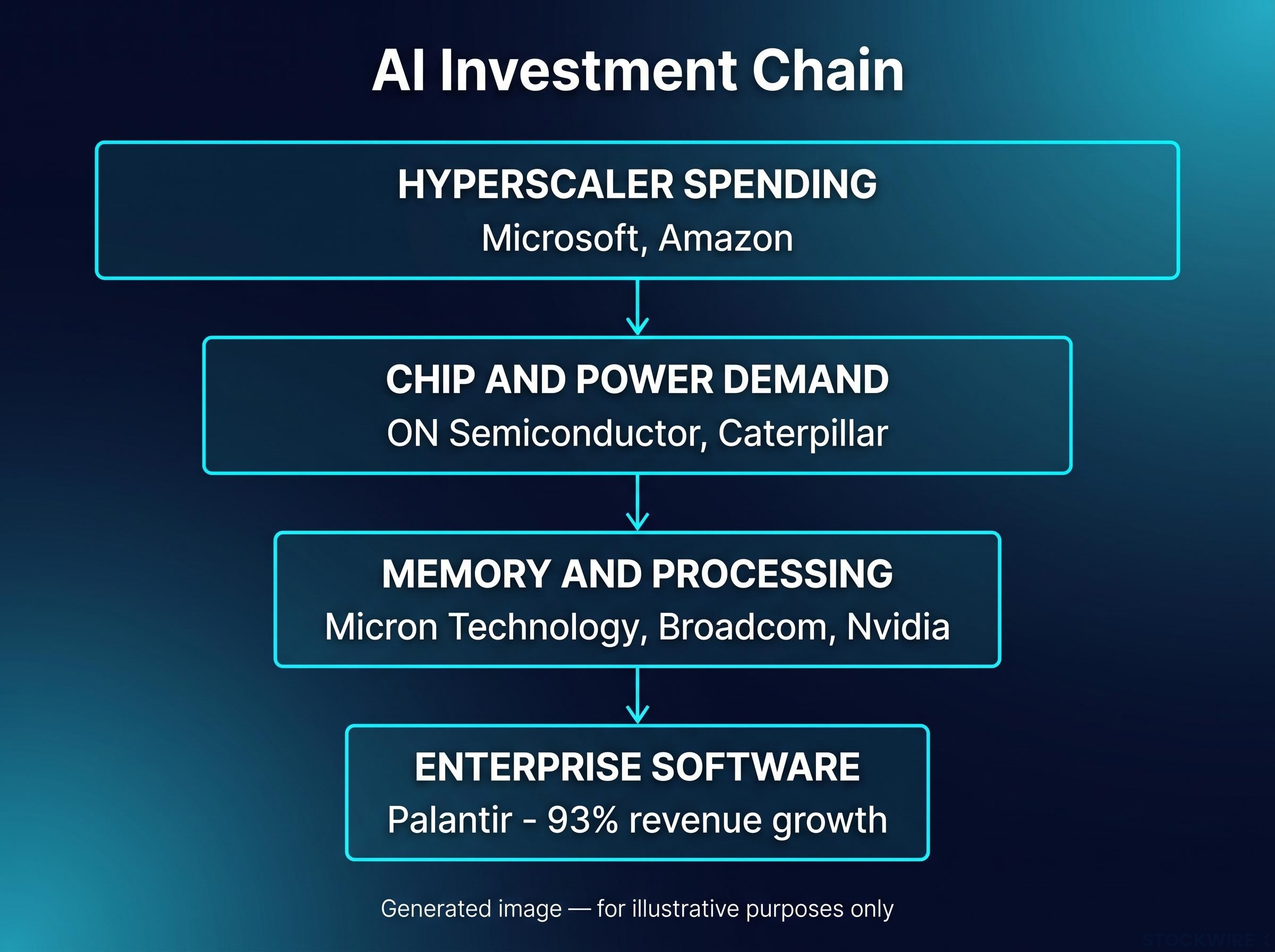
How earnings results translate into market-wide momentum: the AI investment chain explained
A single company beats revenue expectations. Its stock surges. But how does one earnings report push an entire index to an all-time high? The answer is the AI investment chain, a sequence where each positive data point validates the next link.
The AI supply chain spans seven structurally distinct layers, from raw materials and chip fabrication through to enterprise software platforms, and Tuesday’s simultaneous gains across semiconductors, memory, and application software confirmed that positive earnings data was propagating upward through multiple layers at once rather than being confined to a single segment.
On Tuesday, that chain fired at every level simultaneously:
- Hyperscaler spending: Microsoft and Amazon recently confirmed they are continuing to pour capital into AI infrastructure, validating the demand signal for the hardware companies that supply them.
- Chip and power demand: ON Semiconductor guided revenue above expectations, explicitly tied to surging demand for power management chips used in AI data centres (the specialised facilities that house the processors running AI workloads). Caterpillar’s upbeat forecast validated the industrial side of AI infrastructure buildout.
- Memory and processing: Micron Technology, Broadcom, and Nvidia all advanced, reflecting investor confidence that memory and processing hardware demand is being sustained by real orders.
- Enterprise software: Palantir’s 93% revenue growth, which CEO Alex Karp described as an “otherworldly” quarter, validated that companies are not just building AI infrastructure but paying for the software platforms that run on it.
CNN summarised the arc: fears about AI earlier in the summer gave way to a strong earnings season that “helped push the S&P 500 back toward record highs.”
Each link in this chain reinforced the next on Tuesday. Hyperscaler spending validated chip demand, which validated memory demand, which validated software demand. That is qualitatively different from a sentiment-driven bounce. It was earnings-verified at multiple points along the AI investment stack. For you, this chain also works in reverse: when one link disappoints, the selling can cascade just as fast as Tuesday’s buying did.
Palantir leads a historic chip surge: the standout stock moves of the session
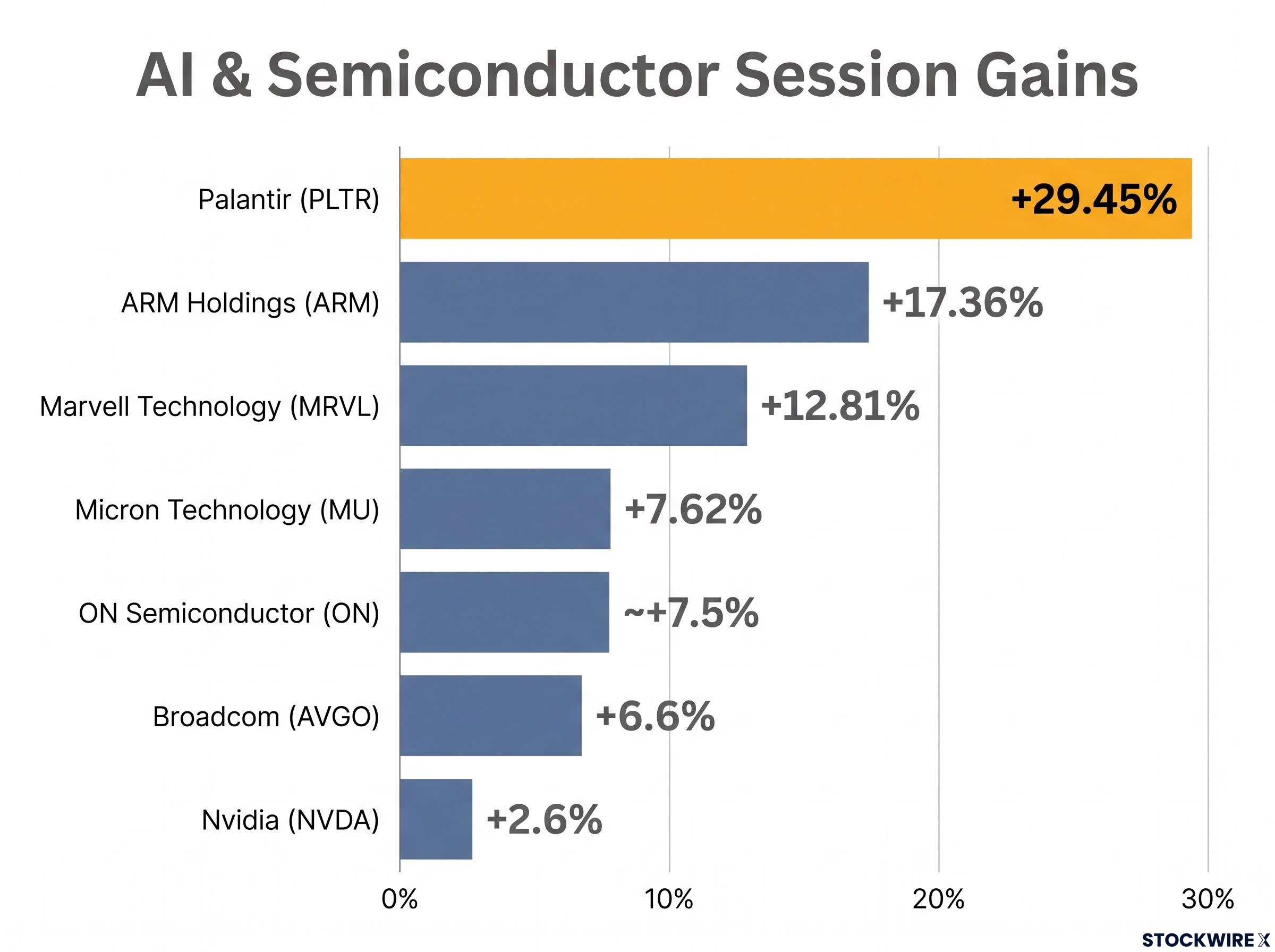
Palantir Technologies set the high-water mark. The stock surged 29.45% in a single session, closing at $162.66 on volume of approximately 175.03 million shares, making it the most actively traded name on U.S. exchanges.
Alex Karp, CEO of Palantir, described overall revenue growth of 93% as an “otherworldly” quarter, a characterisation that captured why the stock moved as violently as it did: enterprise AI software demand was not just growing, it was accelerating.
The rest of the semiconductor and AI leaderboard confirmed that Tuesday’s move was not a one-stock event.
| Stock | Ticker | Session gain | Closing price |
|---|---|---|---|
| Palantir Technologies | PLTR | +29.45% | $162.66 |
| ARM Holdings | ARM | +17.36% | $280.56 |
| Marvell Technology | MRVL | +12.81% | $218.59 |
| Micron Technology | MU | +7.62% | $892.67 |
| Broadcom | AVGO | +6.6% | — |
| ON Semiconductor | ON | ~+7.5% | — |
| Nvidia | NVDA | +2.6% | — |
The Philadelphia Semiconductor Index climbed well above 6% on the day, extending its recovery from the prior month’s heavy losses. The breadth of the leaderboard, from Palantir’s 29% to Nvidia’s 2.6%, tells you this was not concentrated in one name. Software platforms, chip designers, memory manufacturers, and power management specialists were all repriced upward simultaneously. That pattern is the signature of a narrative shift, not routine earnings-season volatility.
The Philadelphia Semiconductor Index had posted its strongest first-half performance on record before the July pullback removed more than 20% from its peak, leaving Tuesday’s recovery sitting inside a sector that has simultaneously produced the year’s biggest gains and its most significant drawdown.
Why AI stocks sold off in July, and what changed in August
To understand why Tuesday’s records mattered, you need the context of what came before them. AI-linked equities and chip stocks broadly retreated through July, with investors growing concerned that lofty valuations built on AI expectations had outpaced the actual commercial evidence supporting them. The fear was specific: that AI might not deliver the revenue growth required to justify the infrastructure spending and the stock price multiples that had accumulated.
CNN reported that “nerves about AI roiled markets earlier this summer,” with doubts about whether AI could live up to the hype contributing to meaningful volatility. Yahoo described 4 August explicitly as “the AI trade rebounding from a volatile July.” The scepticism was real, and it was reflected in prices.
The specific earnings that flipped investor sentiment
What changed was not optimism. It was evidence. A wave of Q2 earnings reports provided concrete, revenue-level confirmation at multiple points along the AI investment chain:
- Palantir reported 93% revenue growth, the most dramatic single-company validation of enterprise AI software monetisation
- ON Semiconductor guided revenue above expectations, explicitly tied to AI data centre demand, the kind of supply-chain-level confirmation that had been absent during July’s sell-off
- Microsoft and Amazon confirmed continued hyperscaler AI infrastructure investment in recently disclosed results
- Caterpillar delivered an upbeat AI-driven forecast, validating the industrial side of the buildout
The July-to-August pivot illustrates a distinction that matters for your decision-making: sentiment-driven selling, where investors flee on fear rather than deteriorating fundamentals, can reverse quickly once evidence arrives. Fundamental deterioration does not reverse on a single earnings cycle. Tuesday’s evidence puts the summer correction firmly in the first category.
What the record close signals, and where the AI trade stands now
Tuesday’s S&P 500 close of 7,736.52 confirmed that the AI trade, after a volatile summer, has received enough earnings-level validation to push broad market indexes to new highs. That is what the session demonstrated.
What it did not demonstrate is that the current pace is sustainable. The concentration of leadership remains a vulnerability: technology at +4.2% versus the broader market at roughly +1.7-1.8% means the index records were built on a relatively narrow foundation. Energy and utilities underperformance reinforced that this was AI-specific confidence, not universal economic optimism.
The forward-looking question for you is whether Q3 earnings continue to validate the AI investment chain at the same rate as Q2 did. Three variables will determine that:
Hyperscaler capital expenditure is projected to consume approximately 94% of operating cash flow in 2026, compared with a historical average of around 40%, which means the spending confirmations from Microsoft and Amazon that anchored Tuesday’s rally are also underwriting a long-duration monetisation thesis that Q3 and Q4 earnings will need to continue validating.
- Q3 hyperscaler earnings from Microsoft, Amazon, and peers, to confirm whether AI infrastructure spending is accelerating, plateauing, or decelerating
- Geopolitical developments affecting oil prices, particularly Strait of Hormuz negotiations, which provided a macro tailwind that could reverse
- Further AI revenue guidance from semiconductor companies, especially whether demand from AI data centres sustains the margins that drove Tuesday’s chip stock surge
The earnings evidence that powered Tuesday’s records is structurally different from a speculative bid. But the concentration that delivered those records also means the next disappointment in any single link of the AI chain will test them.
For investors wanting to understand the systemic dimension of concentrated AI positioning, our full explainer on AI model convergence examines how shared architectures and overlapping training data create the correlated exit risk that can turn a single-link disappointment in the AI investment chain into a broader market stress event.
This article is for informational purposes only and should not be considered financial advice. Investors should conduct their own research and consult with financial professionals before making investment decisions. Forward-looking statements regarding earnings trends and market conditions are subject to change based on market developments and company performance.