The first Phase 3 trial of an individualised mRNA cancer vaccine has been stopped early, not because something went wrong, but because the treatment was working too well to justify keeping the control arm on standard therapy alone.
Moderna and Merck announced on 19 August 2026 that INTerpath-001, their 1,137-patient Phase 3 study of personalised mRNA vaccine mRNA-4157/V940 combined with Keytruda, met both its primary endpoint and a key secondary endpoint. The combination showed approximately 50% reductions in cancer recurrence and metastatic spread in high-risk melanoma patients. Moderna shares responded by surging to roughly $141, more than double the most bullish analyst price target on Wall Street.
Here is what the data actually tells you about whether this is a durable platform transformation or a single-catalyst trade, and what separates the science that just got validated from the commercial execution story that has not.
What the Phase 3 trial actually showed
Before the detail, the headline facts:
- Trial: INTerpath-001; vaccine designation mRNA-4157/V940, also known as intismeran autogene
- Patients: 1,137 enrolled, stage IIB-IV resected melanoma, randomised 2:1 against Keytruda alone
- Endpoints met: Both primary (recurrence-free survival) and key secondary (distant metastasis-free survival), each showing approximately 50% reductions
- Early stopping: Halted at the first interim analysis after an independent data monitoring committee determined results were strong enough that withholding treatment from the control arm was no longer ethical
That dual-endpoint success matters more than either result alone. In oncology trials, it is common for a drug to clear one threshold while missing another, which complicates the regulatory filing and gives payers grounds to negotiate down reimbursement. INTerpath-001 cleared both.
The Phase 2 predecessor, KEYNOTE-942, backs the durability of the signal. At 60.3 months of median follow-up, that earlier study showed a 49% reduction in recurrence-or-death risk (hazard ratio 0.51) and a 59% reduction in distant metastasis-or-death risk (hazard ratio 0.41).
Nearly 70% of vaccine-plus-Keytruda patients were cancer-free at five years, versus roughly 49% on standard therapy alone.
Overall survival data from the Phase 3 study are still maturing and were not part of this readout. That question remains open. But the combination of early stopping and simultaneous success on two clinically distinct measures tells you this is not a borderline result; it is a strong, consistent signal that materially strengthens the regulatory and reimbursement path ahead.
When big ASX news breaks, our subscribers know first
How a vaccine built from a patient’s own tumour works
The production sequence for each patient’s vaccine is a manufacturing process with no direct precedent in approved oncology therapies:
- Tumour removal and tissue collection during surgical resection
- Genomic sequencing of the tumour and normal tissue to identify up to 34 mutations unique to that patient’s cancer
- Neoantigen selection using bioinformatics algorithms to predict which mutations will provoke the strongest immune response
- mRNA synthesis encoding the selected neoantigens into a single custom mRNA molecule
- Lipid nanoparticle formulation (the same delivery class used in COVID mRNA vaccines) for injection
- Quality control and release before shipping the finished product back to the patient’s treatment centre
The entire process currently takes approximately 6-9 weeks from tumour sampling to first dose. Every batch is unique to one patient. There is no off-the-shelf version.
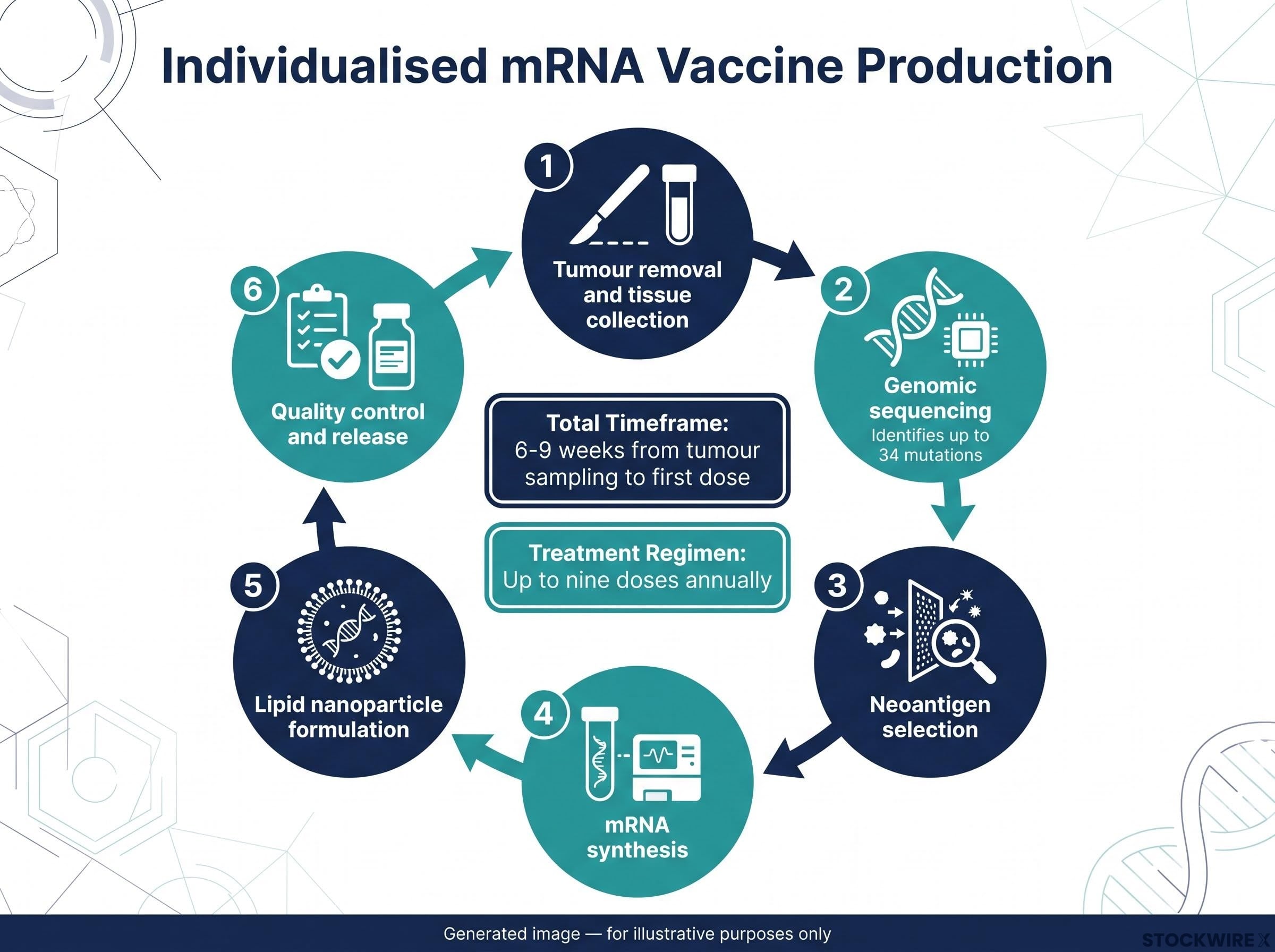
Once injected, the patient’s own cells produce small neoantigen protein fragments, which are neoantigens (abnormal proteins created by the tumour’s mutations). The immune system recognises these fragments as foreign and primes T cells to hunt and destroy any residual cancer cells carrying the same mutations. Patients receive up to nine doses annually, making this an ongoing individualised regimen rather than a one-time shot.
Why Keytruda is part of the regimen
Keytruda (pembrolizumab) is a PD-1 checkpoint inhibitor, a drug that removes molecular brakes tumours exploit to hide from T cells. It has been in clinical use since 2014, but this is its first application within a personalised mRNA vaccine framework.
The scientific rationale is straightforward: the personalised vaccine creates highly specific immune targets, and Keytruda amplifies the T-cell response against those targets. The combination outperformed Keytruda alone precisely because checkpoint blockade without a specific target is less efficient than checkpoint blockade with one.
T-cell response dynamics sit at the heart of why the vaccine-plus-checkpoint combination outperformed checkpoint blockade alone: without a specific neoantigen target to focus the immune attack, PD-1 inhibition amplifies a broad and diffuse response, whereas the personalised vaccine concentrates cytotoxic activity on mutation-specific fragments the tumour actually expresses.
Why “stopped early” is good news, not a red flag
Two conditions stop oncology trials early: safety failures and overwhelming efficacy. This trial hit the second threshold.
The distinction matters because the instinctive reaction to “trial halted” is caution. In this case, the opposite applies.
- Early stop for safety: An independent data monitoring committee detects unacceptable adverse events and halts the study to protect patients. This is bad news.
- Early stop for efficacy: The observed benefit is so large and consistent that continuing to withhold treatment from the control arm would be unethical. The effect must clear a pre-specified statistical threshold that is deliberately set high to prevent premature calls on noisy data.
INTerpath-001 hit that efficacy threshold at the first interim analysis, across both primary and secondary endpoints, with no safety concerns identified. For an investor evaluating platform risk, that combination of facts moves the regulatory approval probability materially upward for the melanoma indication and raises the prior for related programmes in non-small cell lung cancer, bladder, and colorectal cancers. Standard regulatory review for novel biologics typically runs 10-12 months, potentially shorter under priority or breakthrough designations.
Priority regulatory designations such as Orphan Drug, Breakthrough Therapy, and Fast Track status have become central to oncology timelines, with Immutep’s April 2026 designation for eftilagimod alfa in soft tissue sarcoma illustrating how favourable labels can collapse standard 10-12 month review windows and alter reimbursement positioning before a product reaches market.
What Wall Street missed and why the repricing was so dramatic
The analyst positioning before 19 August tells the story of a consensus that had categorised Moderna as a post-COVID respiratory vaccine company with longer-dated, probability-discounted oncology optionality.
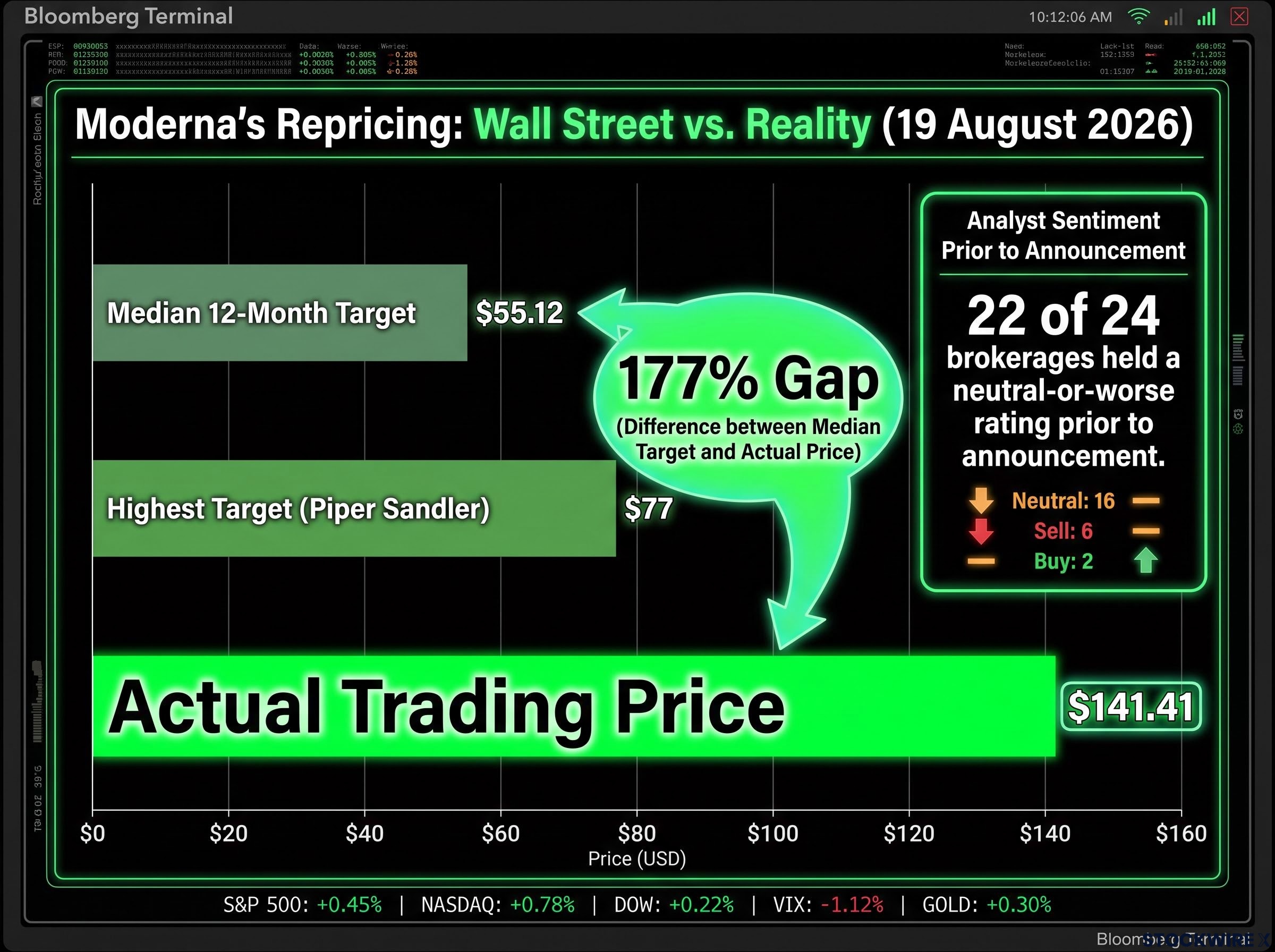
| Analyst Metric | Pre-Announcement Value | Post-Announcement Context |
|---|---|---|
| Analysts rated neutral or worse | 22 out of 24 | Model revision underway |
| Median 12-month price target | $55.12 | Stock trading at $141.41 |
| Highest individual price target | $77 (Piper Sandler) | Stock already more than double this |
Of the 24 brokerages covering Moderna, all but two carried a neutral-or-worse rating. By the morning after the announcement, the stock had reached $141.41, well above every published target on the street.
The Moderna stock repricing on 19 August 2026 added roughly $44 billion in market capitalisation overnight, a move that occurred almost entirely before regular-hours retail participation and that has materially reset the valuation baseline from which any forward-looking analysis must now start.
The 177% gap between trading price and analyst consensus is not evidence of irrational exuberance. It reflects the scale of the model revision required when a company’s core business category changes. Most analyst frameworks had assigned low probabilities to a Phase 3 oncology success and correspondingly minimal value to the pipeline. When that probability jumped overnight, the entire valuation architecture needed rebuilding, from probability-adjusted peak sales estimates for melanoma through to the implied value of downstream programmes. That recalibration process is likely still incomplete.
The commercial realities that will determine whether this milestone translates into durable revenue
The inverted supply chain is where the tension sits. Unlike conventional drugs where manufacturing scales with volume, personalised mRNA vaccines require a unique batch for each patient. Fixed costs cannot be spread across large production runs.
Independent manufacturing assessments suggest production costs can exceed $100,000 per patient on the manufacturing side alone, with some contract development and manufacturing organisation models estimating $300,000-$500,000 per course before commercial markup. These figures have not been publicly confirmed by Moderna or Merck and should be treated as indicative rather than definitive.
The four execution risks investors should watch:
- Manufacturing scalability: Revenue will track operational throughput (personalised batches per year), not conventional unit volume, requiring automated bioinformatics pipelines and geographically distributed manufacturing under lot-by-lot regulatory oversight
- Regulatory label scope: The initial indication will likely be limited to high-risk resected melanoma; broader labels require additional trial data
- Payer pricing acceptance: High per-patient costs will face reimbursement scrutiny, particularly outside the United States
- Competitive dynamics: BioNTech and others are advancing their own personalised mRNA and neoantigen cancer vaccines targeting similar indications
What the Merck partnership changes
Merck brings established oncology sales infrastructure and Keytruda’s existing guideline penetration, which lowers the market-access and physician-education execution risk considerably. The trade-off is that the partnership splits economics, meaning Moderna’s revenue share will be a fraction of total commercial revenues rather than the full top line. It is a risk-sharing arrangement that accelerates commercialisation at the cost of margin concentration for Moderna specifically.
The manufacturing cost and throughput constraint is the variable that will determine whether the 50% efficacy advantage translates into durable earnings power or gets absorbed by costs and payer pushback. This is what investors should track most closely in Moderna’s quarterly disclosures going forward.
What changes now and what the remaining proof points are
The Phase 3 result fundamentally repositions Moderna’s risk profile, moving it away from a company defined by its COVID franchise with speculative, probability-discounted oncology assets towards one with a validated lead programme and meaningful pipeline leverage. But that repositioning is in process, not complete.
mRNA platform approvals have been arriving in quick succession for Moderna in August 2026, with the FDA clearing mFlusiva as the first mRNA flu vaccine in US history just two weeks before the INTerpath-001 readout, a sequencing that materially changes how analysts must model the company’s revenue diversification beyond COVID.
Three pending milestones will determine whether the current stock price anticipates a narrow melanoma product or a broad oncology platform:
- Regulatory submission and label scope: The initial filing will target high-risk resected melanoma (stage IIB-IV). Review timelines for novel biologics typically run 10-12 months under standard review, potentially shorter under priority or breakthrough designations. The exact regulatory pathway has not yet been disclosed.
- Overall survival data from INTerpath-001: Still maturing and not part of the August 2026 readout. Long-term survival benefit is the gold standard for oncology reimbursement and guideline integration.
- Expansion trial results in additional tumour types: Non-small cell lung cancer, bladder cancer, and colorectal cancer programmes are in development. Tumour biology matters here; personalised neoantigen vaccines appear most effective in highly mutated “hot” tumours like melanoma, and less mutated tumour types may respond differently.
BioNTech and several other large pharmaceutical companies are advancing their own personalised mRNA or neoantigen-based cancer vaccines. The pace of competitor manufacturing and delivery solutions will influence Moderna’s future pricing power.
The distance between a narrow melanoma approval and a broad oncology platform is measured in tens of billions of dollars of implied market value. Investors who track these three specific milestones will be better placed to make informed decisions than those who respond to each headline as it arrives.
The science has been validated. The commercial execution story is still being written. Investors who can name the specific remaining proof points can make more disciplined hold-versus-trim decisions as Moderna discloses regulatory, manufacturing, and clinical updates over the next 12-24 months, rather than reacting to each headline in isolation.
This article is for informational purposes only and should not be considered financial advice. Investors should conduct their own research and consult with financial professionals before making investment decisions. Past performance does not guarantee future results. Financial projections are subject to market conditions and various risk factors.
—