Every time the semiconductor sector grabs headlines, the same question lands: which chip stock do you buy? NVIDIA is priced for perfection. TSMC carries geopolitical risk that no earnings beat can fully offset. AMD has delivered violent drawdowns even in years when revenue grew. The obvious move, buy the best chip stock, is also one of the hardest calls in global markets.
What makes semiconductor stock selection structurally harder than it looks is the number of things you need to get right simultaneously. You need the sector call (are chips in a growth phase or an inventory correction?), the sub-segment call (memory, logic, equipment, or foundry?), and the company-specific call (which firm within that segment will execute?). Miss any one of those and your returns can disappoint even when the broader industry grows.
This piece lays out the specific investment logic behind the Global X Semiconductor ETF (ASX: SEMI) as a chip-sector vehicle, what the fund actually owns, and the honest conditions under which it makes sense for your portfolio. The goal is a framework for making an informed call rather than defaulting to whichever name is loudest on a given day.
The three calls you have to get right when picking individual chip stocks
Buying an individual semiconductor company is not one decision. It is three decisions stacked on top of each other, and each one compounds the difficulty of the one before it.
- The sector call: Is now the right time to have money in semiconductors at all? Chip earnings are cyclical, and valuations can swing sharply during inventory corrections or technology spending slowdowns.
- The segment call: Within the chip industry, which sub-segment will lead next? Memory, logic, foundry, or equipment? Demand rotates across these segments in patterns that are only obvious in hindsight.
- The company call: Within the segment you have chosen, which firm will execute? Product delays, management missteps, and competitive shifts can separate winners from losers within the same sub-industry.
Assessing whether current multiples are justified or stretched requires engaging directly with semiconductor valuation fundamentals: Bank of America’s May 2026 analysis found active long-only overweights at approximately 20%, half the 2017 cycle peak, while earnings revisions of more than 20% in 2026 gave elevated price-to-earnings ratios a genuine earnings foundation to rest on.
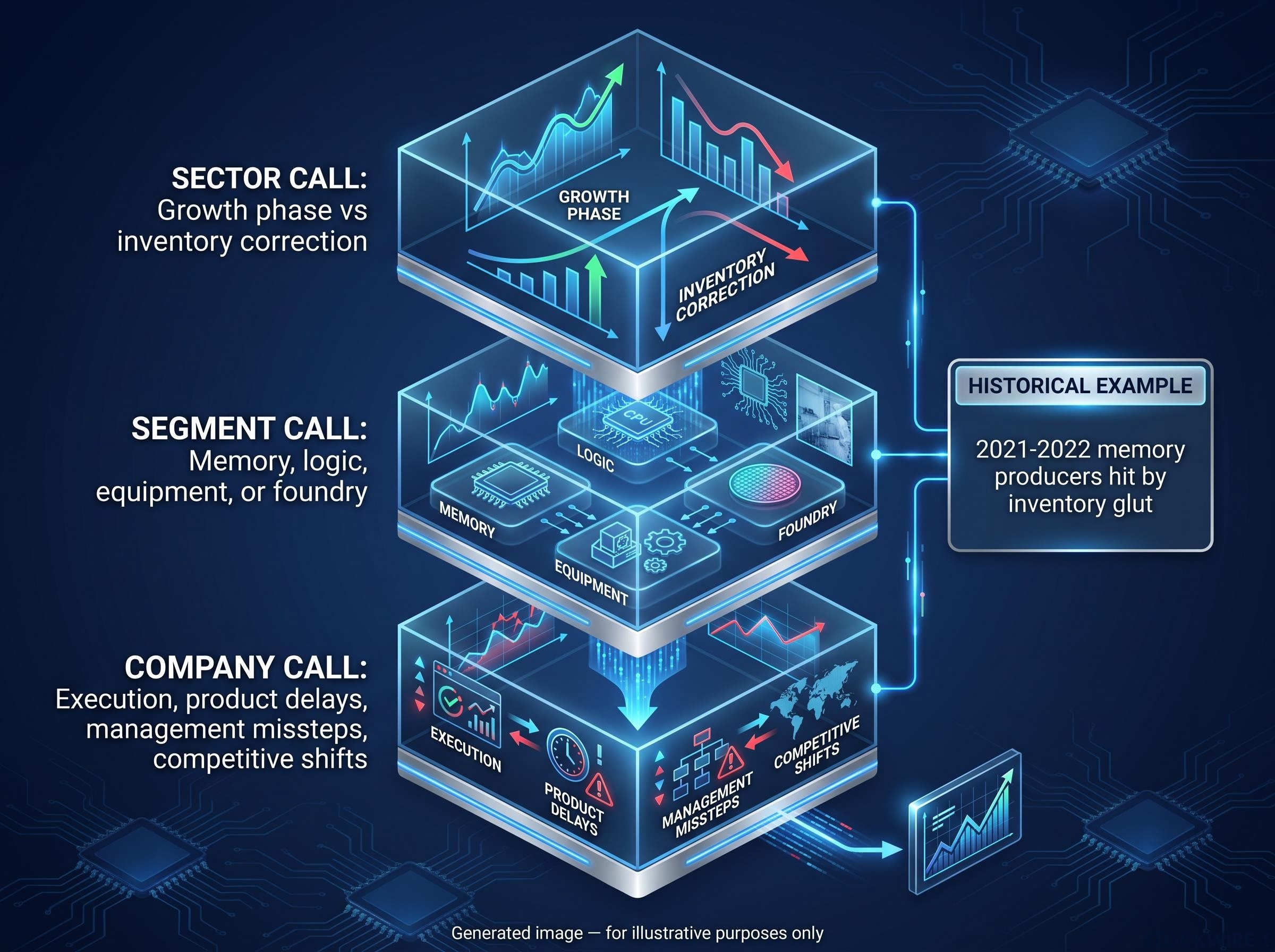
Getting all three right simultaneously is the real challenge. Consider an investor who correctly identified chips as the right sector in 2021-2022 but allocated to memory producers just as an inventory glut hit. The sector call was right. The segment call was wrong. The result was significant losses in a period when the broader chip industry was still growing.
When the rules change mid-cycle
Geopolitical risk adds another layer entirely. US-China export controls can affect individual names asymmetrically: some companies absorb restrictions and adapt, others are structurally disadvantaged. In prior down cycles, major semiconductor holdings have recorded peak-to-trough declines in the 40-60% range, a pattern that speaks to the industry’s structural volatility rather than the failings of any individual business.
None of this means individual chip stocks are bad investments. It means the analytical burden they impose is genuinely high, and most investors are not positioned to carry it consistently across a multi-year horizon.
When big ASX news breaks, our subscribers know first
What SEMI actually owns and how the portfolio is built
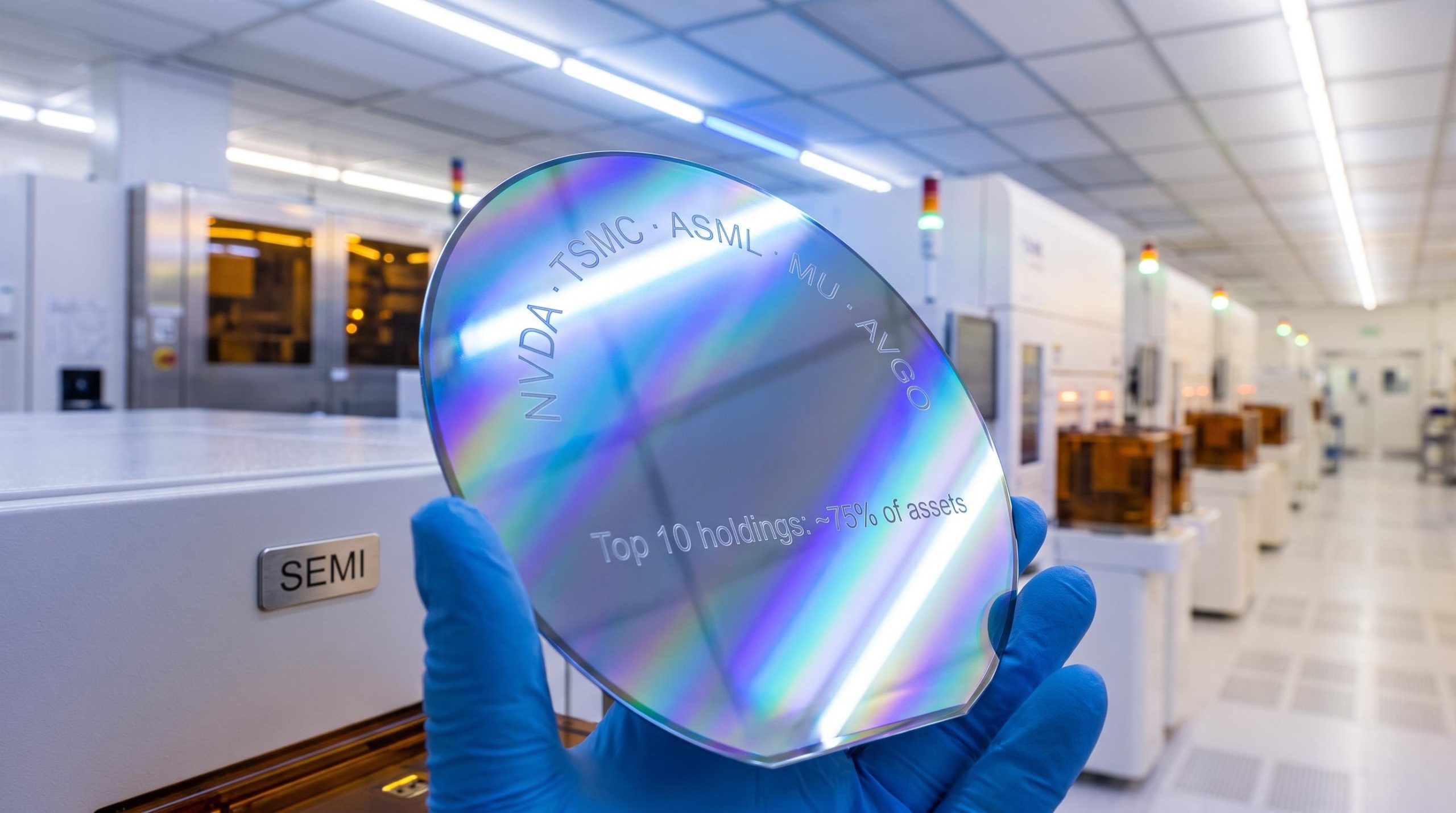
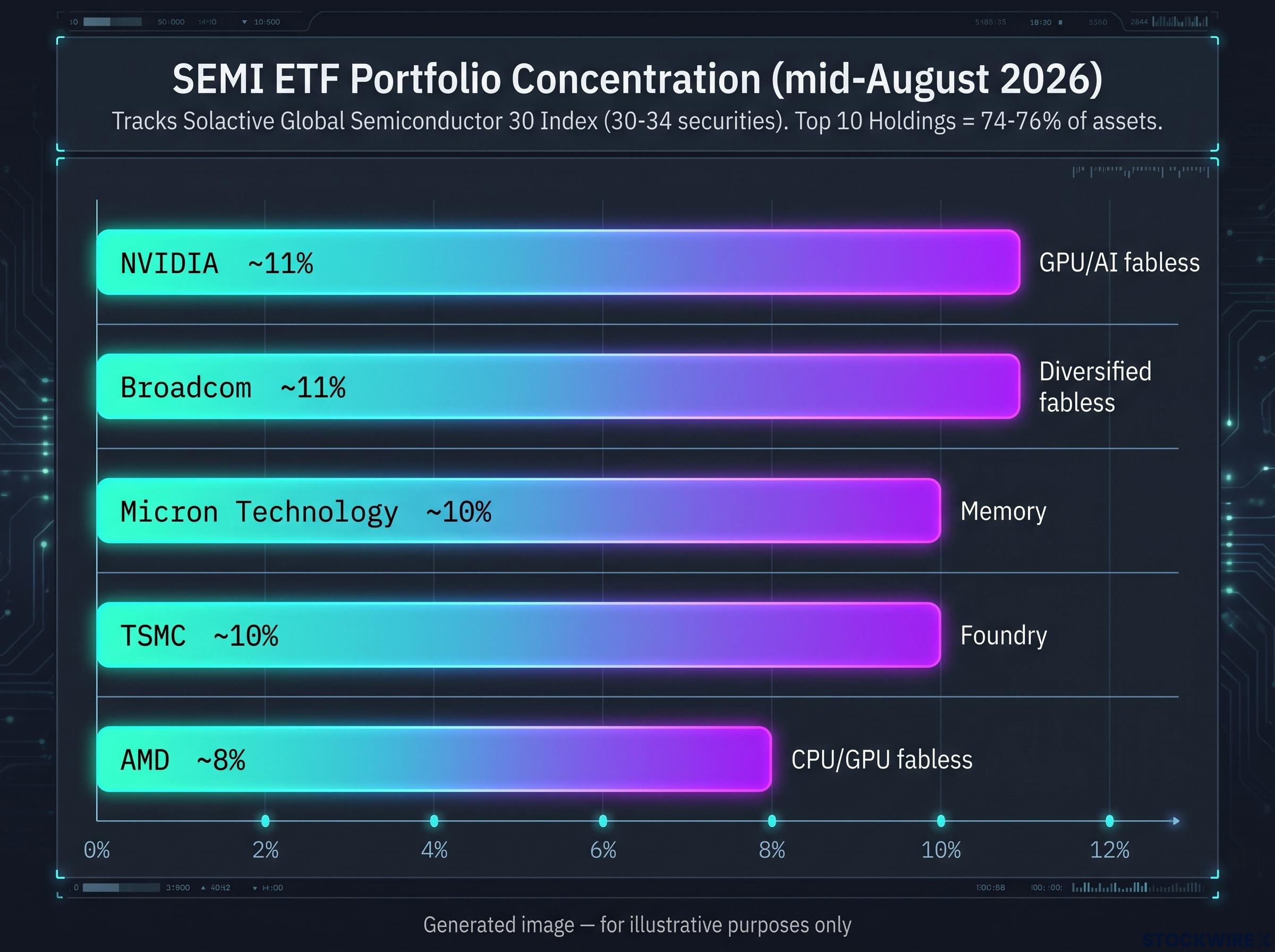
SEMI tracks the Solactive Global Semiconductor 30 Index and holds approximately 30-34 securities across the global semiconductor supply chain. The top 10 holdings represent approximately 74-76% of total assets, which tells you immediately that this is not a diversified index fund in the traditional sense. It is a focused bet on the leading global semiconductor companies.
| Company | Approximate Weight | Supply Chain Role |
|---|---|---|
| NVIDIA | ~11% | GPU and AI accelerator design (fabless) |
| Broadcom | ~11% | Diversified chip design (fabless) |
| Micron Technology | ~10% | Memory production |
| TSMC | ~10% | Contract chip manufacturing (foundry) |
| AMD | ~8% | CPU and GPU design (fabless) |
Holdings data current as of mid-August 2026.
What matters more than the individual names is the supply chain architecture they collectively represent. The fund spans five distinct segments:
- Fabless designers (companies that design chips but outsource manufacturing): NVIDIA, AMD, Broadcom, Qualcomm, Marvell
- Foundries (companies that manufacture chips for others): TSMC
- Memory producers (companies that make storage and memory chips): Micron, SK Hynix
- Equipment makers (companies that build the machines used to fabricate chips): ASML, Lam Research, Applied Materials, KLA, Tokyo Electron
- Analog and mixed-signal specialists (companies making chips for real-world signal processing): Texas Instruments, Analog Devices, Infineon
That concentration in the top 10 is worth sitting with. It means a broad negative event affecting the leading chip companies, whether an escalating export control regime or a major valuation reset, will be felt acutely across the portfolio. Understanding this distinction matters for how you size SEMI in a portfolio.
Why demand rotation across the supply chain is the core argument for the ETF structure
Understanding what SEMI owns is step one. Understanding why that structure is particularly well-suited to the semiconductor industry’s cyclical dynamics is where the investment case sharpens.
Semiconductor demand does not rise uniformly. It rotates across sub-segments across a typical cycle. Memory producers may lead in one phase as data centre buildouts drive storage demand. Equipment makers may lead in another as foundries expand capacity. Fabless designers may outperform when a new product cycle (AI accelerators, for instance) drives design wins. Predicting which segment leads next requires cycle-timing skill that most investors do not reliably possess.
The segment rotation dynamic at the heart of the SEMI investment case is inseparable from where any given year sits in the broader semiconductor cycle; semiconductor cycle investing requires tracking five leading indicators, including book-to-bill ratios and equipment lead times, to distinguish a demand-driven expansion from a capacity-driven overshoot.
Holding all segments simultaneously sidesteps this requirement entirely.
No single company leads across every phase of the semiconductor cycle. An ETF structured around the full supply chain captures the gains wherever they appear, without requiring you to predict the rotation in advance.
The structural demand themes that underpin the long-term case are broad and durable:
- AI infrastructure: Large-scale data centre buildouts requiring specialised accelerators, networking chips, and high-bandwidth memory.
- Cloud computing: Ongoing expansion of hyperscaler capacity driving demand for both logic and memory chips.
- Automotive electrification: Increasing chip content per vehicle as electric drivetrains and autonomous driving systems proliferate.
- Industrial automation: Growing deployment of sensors, controllers, and embedded processors across manufacturing and logistics.
- Connected devices: Continued growth in IoT endpoints across consumer and enterprise applications, each requiring low-power, specialised silicon.
These themes collectively suggest that the coming decade from August 2026 is the relevant investment horizon for structural semiconductor demand to compound. SEMI contrasts favourably here with broad technology indexes that dilute chip exposure with software, internet platforms, and non-chip hardware. The fund maintains thematic purity: every holding is a semiconductor or semiconductor equipment company.
For an Australian investor who cannot easily build and rebalance a 20-30-stock global chip portfolio, the ETF structure is not a compromise. It provides ASX-listed access to TSMC, NVIDIA, ASML, Micron, and Broadcom in a single vehicle, with simplified currency management, trading, and custody. That is a genuinely more practical way to express a long-term structural conviction.
The honest risk picture: what SEMI does not protect you from
The ETF structure solves the stock-selection problem. It does not solve the sector-volatility problem.
SEMI is a concentrated sector ETF. During semiconductor down cycles, inventory corrections, or technology spending slowdowns, the fund will experience sharp drawdowns. The diversification across sub-segments may soften the blow relative to holding a single name, but it will not prevent a broad-based semiconductor selloff from hitting the portfolio hard.
What the ETF structure does not fix
Because the top 10 holdings represent approximately 74-76% of total assets, a negative event affecting the leading chip companies, such as an escalating trade restriction regime or a repricing of technology valuations broadly, will be felt acutely. In prior semiconductor downturns, even the sector’s largest names have seen valuations compress by 40-60% from peak to trough. A concentrated sector ETF will reflect those moves.
Sector volatility of this magnitude is not theoretical: the Philadelphia Semiconductor Index fell approximately 20.6% in July 2026 alone, its worst monthly performance since October 2008, while record ETF inflows during the same period confirmed that concentration risk compounds when investors buy the same crowded narrative through multiple vehicles simultaneously.
An investor who sizes SEMI as they would a diversified index fund is making a category error. The volatility profile is categorically different, and the position sizing should reflect that.
The appropriate investor profile for SEMI looks like this:
- A genuinely long-term investment horizon, with the coming decade as the relevant reference period
- A real belief in structural semiconductor demand growth, not a short-term momentum trade
- Willingness to hold through periods of significant price volatility without panic selling
- Appropriate sizing as a focused growth allocation within a broader portfolio, not as a core defensive position
“This article is for informational purposes only and should not be considered financial advice. Investors should conduct their own research and consult with financial professionals before making investment decisions. Past performance does not guarantee future results.”
Making a considered call on chip sector exposure
The question was never SEMI or nothing. The question is SEMI or picking individual chip names, and that alternative carries a specific set of analytical requirements that most investors are not positioned to meet consistently across a multi-year horizon.
SEMI makes strong sense as a portfolio vehicle under two conditions:
- A genuinely long-term horizon. The structural demand themes, AI infrastructure, cloud computing, automotive electrification, industrial automation, connected devices, need the coming decade from August 2026 to compound fully. Short-term traders will find the volatility uncomfortable and the thesis unsatisfying.
- Appropriate sizing as a focused growth allocation. This is not a broad market replacement. It is a thematic position within a diversified portfolio, sized according to your overall risk tolerance and conviction in long-term semiconductor demand.
SEMI sits alongside other ETFs suited to structural growth themes for long-term Australian investors, covering distinct but complementary areas. The fund’s specific value is thematic purity: it gives you the chip industry and nothing else.
For investors evaluating whether a broader AI exposure vehicle better fits their risk tolerance than a pure semiconductor fund, our dedicated guide to GXAI versus SEMI compares holdings, fee structures, and return histories across both ASX-listed funds in detail.
The structural conviction that underpins the case is straightforward. Chips will matter more in 2030, 2035, and beyond than they do in 2026. A diversified vehicle built around the leading global players is a pragmatic way to express that view without needing to be right about which company leads the next cycle. For the investor who believes that conviction and is willing to hold through the volatility that comes with it, SEMI offers a considered way to put that belief to work.
—