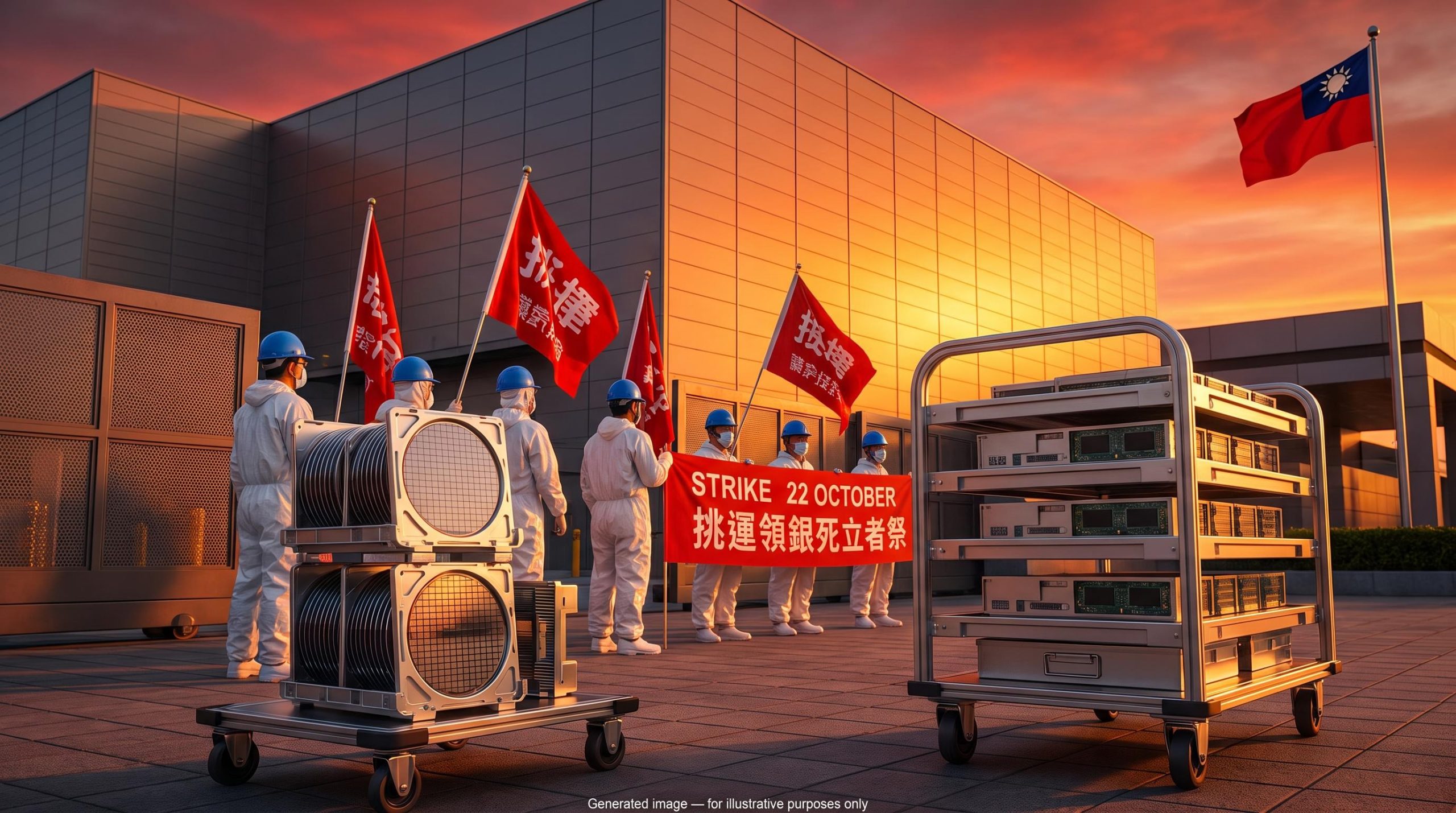
Micron’s Taoyuan union plans to strike on Thursday, 22 October 2026, putting a labour dispute directly in the path of the memory chips that AI servers depend on. The union has not said how long the walkout will last.
The timing is deliberate. The separate Taichung union, which represents workers at Micron’s largest Taiwan site, returns to mediation the same day.
Investors are watching from an awkward starting point. Micron shares sit near $905, well below the late-June record close of about $1,213.56.
The useful question is not whether a strike sounds dramatic but whether it becomes an earnings problem. Here is what is confirmed, what remains only a risk, and the short list of variables that will decide which one this becomes.
Why could a Taoyuan walkout matter for AI memory supply?
Taiwan is where much of Micron’s memory actually gets made. Taoyuan primarily produces DRAM, the working memory inside servers and computers, while the newer Taichung facility handles packaging and testing for high-bandwidth memory (HBM), stacked chips built to feed data to AI processors at high speed.
The company employs roughly 15,000 people in Taiwan, and a majority of its fiscal 2026 DRAM output came from the island. Taiwanese financial reporting puts Taiwan at about 60% of Micron’s overall output, though the DRAM-plus-HBM share is not stated consistently across sources. The share of global HBM output made in Taiwan could not be found.
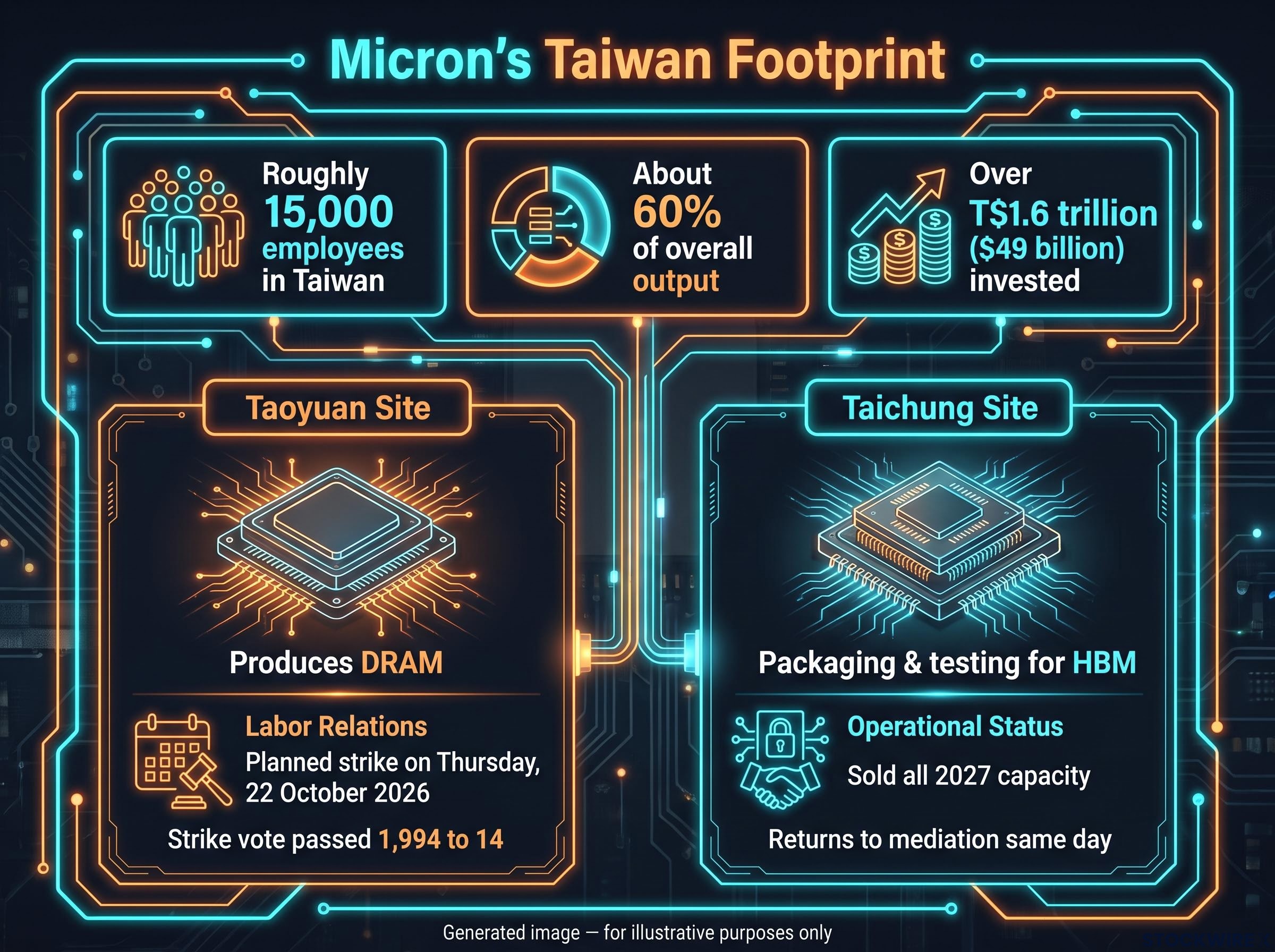
What turns this into a supply question is how little room exists. More than 75% of fiscal-2027 shipments are already covered by supply or capacity agreements, and President and COO Manish Bhatia said Taichung has sold all the capacity it will produce in 2027. HBM demand for 2027-2028 has been reported as substantially exceeding supply.
The tightness traces back to a structural DRAM shortage in which HBM inventory sits at just 3-4 weeks industry-wide, leaving little buffer for any producer facing a labour interruption.
That leaves several pressure points:
- Equipment maintenance that cannot be deferred for long
- Cleanroom continuity and process monitoring
- Thin spare capacity across DRAM and HBM
- Limited inventory at the wafer level
- Contract exposure under strategic customer agreements
TrendForce assessment (8 October) A Taoyuan strike could interfere with equipment maintenance and engineers’ process monitoring, hurting yield and process stability before any full shutdown. The impact depends on duration, participation and Micron’s contingency measures.
Micron’s own annual report warns that labour disruption could impair delivery schedules under strategic agreements, risking contractual liability or demand shifting to competitors. Because capacity is already sold, even modest yield loss would land on customers’ delivery dates rather than on spare stock. The risk to watch is delivery reliability, not a dark factory.
Why automation only buys time
Fabs can keep automated wafer processing running for a while. But engineers and technicians handle maintenance, troubleshooting, yield management and lot transitions, and those tasks do not wait politely.
Module-level inventory is elevated in parts of the market, while wafer-level supply stays constrained. That cushion could soften a brief, symbolic action. It would do far less against a prolonged one.
When big ASX news breaks, our subscribers know first
What the union wants, and what Micron has already put on the table
On money alone, the two sides are not as far apart as the strike vote suggests. The real gap is about how pay gets decided.
| Issue | Union position | Micron position |
|---|---|---|
| Profit-sharing structure | Permanent, transparent, verifiable system allocating 15% of operating profit | Annual discretionary rewards under the Incentive Pay Plan |
| Payment timing | Quarterly | Annual |
| Current-year amount | One-off bonus of about 83 months of salary | Fiscal-2026 rewards worth 35-68 months of pay, including at least NT$1.7 million cash plus NT$1 million for qualifying staff |
Micron calls its offer the largest employee compensation package in its history. The unions point to pay at Samsung Electronics and SK Hynix as their benchmarks, and they want a share of AI-era profits that management cannot adjust year by year.
The Samsung strike threat earlier this year centred on a near-identical demand, a permanent 15% operating profit pool, which suggests the Micron dispute is part of a wider sector-level push over AI-era profit sharing.
Government-mediated talks failed in September. The Taoyuan authorisation vote then passed 1,994 to 14, about 99% of votes cast, as reported on 7 October. Labour authorities said they respected the vote and urged Micron to answer with concrete proposals, while President Lai Ching-te called on both sides to negotiate sincerely. Micron says it has invested over T$1.6 trillion (about $49 billion) in Taiwan.
A fight over a standing formula is harder to settle than a fight over a number. If you are expecting a bigger cheque to end this, the structure of the demand suggests a longer standoff is plausible.
Two unions, one pending decision
Taoyuan is acting now. Taichung, the larger workforce, has not voted on or authorised any strike and remains in mediation on Thursday.
The union says it will announce the strike’s length and scale on Thursday.
How has Micron’s stock reacted so far?
If the market were bracing for a production hit, the trading record does not show it. The day the strike authorisation landed, the stock ended higher.
- 7 October: Shares fell about 2.8% premarket after the vote, then closed up 4.06% at $1,088 following an analyst target revision (Yahoo Finance)
- Late June: Record close of about $1,213.56
- Later sessions: Trading near $879-$905
- Most recent session reported: Closed at $904.90, up 2.97%, with after-hours at $897.20 (down 0.85%), per Investing.com data cited with Reuters
D.A. Davidson price target Raised from $2,100 to $3,000, a 43% increase, despite the labour risk (Seoul Economic Daily, 9 October).
The slide from the June peak has been attributed mainly to broader semiconductor volatility and profit-taking, not the Taiwan dispute alone. No closing move tied specifically to Thursday’s planned strike has been verified.
The stock has responded to analyst targets and sector mood far more than to the labour story. Today’s price should not be read as pricing in a real production loss, in either direction.
What did Samsung’s strikes teach, and which signals should investors watch?
The closest precedent comes from South Korea. In July 2024, Samsung workers launched a three-day strike followed by broader union action. Samsung said there was no disruption in the first three days, though the union later said some chip lines ran more slowly. Its shares rose 0.1% in one session while the benchmark fell 0.7%.
The longer-tail risk shows up in KB Securities’ analysis from 22 April 2026. It warned a lengthy Samsung stoppage could need weeks to normalise production, with a worst case of a 3-4% fall in global DRAM output and 2-3% in NAND. Automation absorbs the first shock; restarts and yield recovery are where prolonged absence bites.
The current memory supercycle differs from past upcycles because new manufacturing lines are not expected to reach mass production until after 2027, so lost output cannot be quickly replaced elsewhere.
| Scenario | Reasoning | Caveat |
|---|---|---|
| Symbolic pressure tactic | Framed as solidarity while Taichung mediation continues | Even brief interruptions complicate maintenance and monitoring |
| Prolonged escalation | Near-unanimous vote; Taichung is the larger workforce | Taichung has not voted to strike |
| Limited earnings hit | Automation, inventory buffers, Samsung precedent | Taiwan output is heavily committed for 2027 |
| Memory price support | Lost supply amid strong demand could lift prices and help rivals | Would not offset delayed revenue, contract exposure or customer diversion |
Five signals to watch
- Duration, due in Thursday’s announcement
- Engineer and maintenance participation, visible in the first days
- Whether Taichung authorises action if mediation fails
- Inventory condition across wafers and modules
- Whether other sites can replace Taiwan output, and any shift in customer allocations
The most likely near-term reading is a pressure tactic aimed at a better offer. The authorisation alone has shown no production disruption, so hold off on assuming earnings damage until technical staff participation, Taichung’s decision and strike length are known.
What this walkout changes, and what it does not yet
The confirmed facts are narrow: a near-unanimous strike vote, a planned walkout in Taoyuan and mediation still open in Taichung. Production loss is not confirmed, and the share price has not treated it as such.
Thursday brings the next two decision points. The union’s details on length and scale will show whether this is a short show of resolve, and the Taichung mediation outcome will show whether a second, larger workforce enters the dispute.
Investors exploring how to position through the cycle will find our dedicated guide to navigating the semiconductor cycle sets out a five-indicator framework for memory exposure.
This article is for informational purposes only and should not be considered financial advice. Investors should conduct their own research and consult with financial professionals before making investment decisions. Past performance does not guarantee future results, and the facts may change materially after Thursday’s announcements.