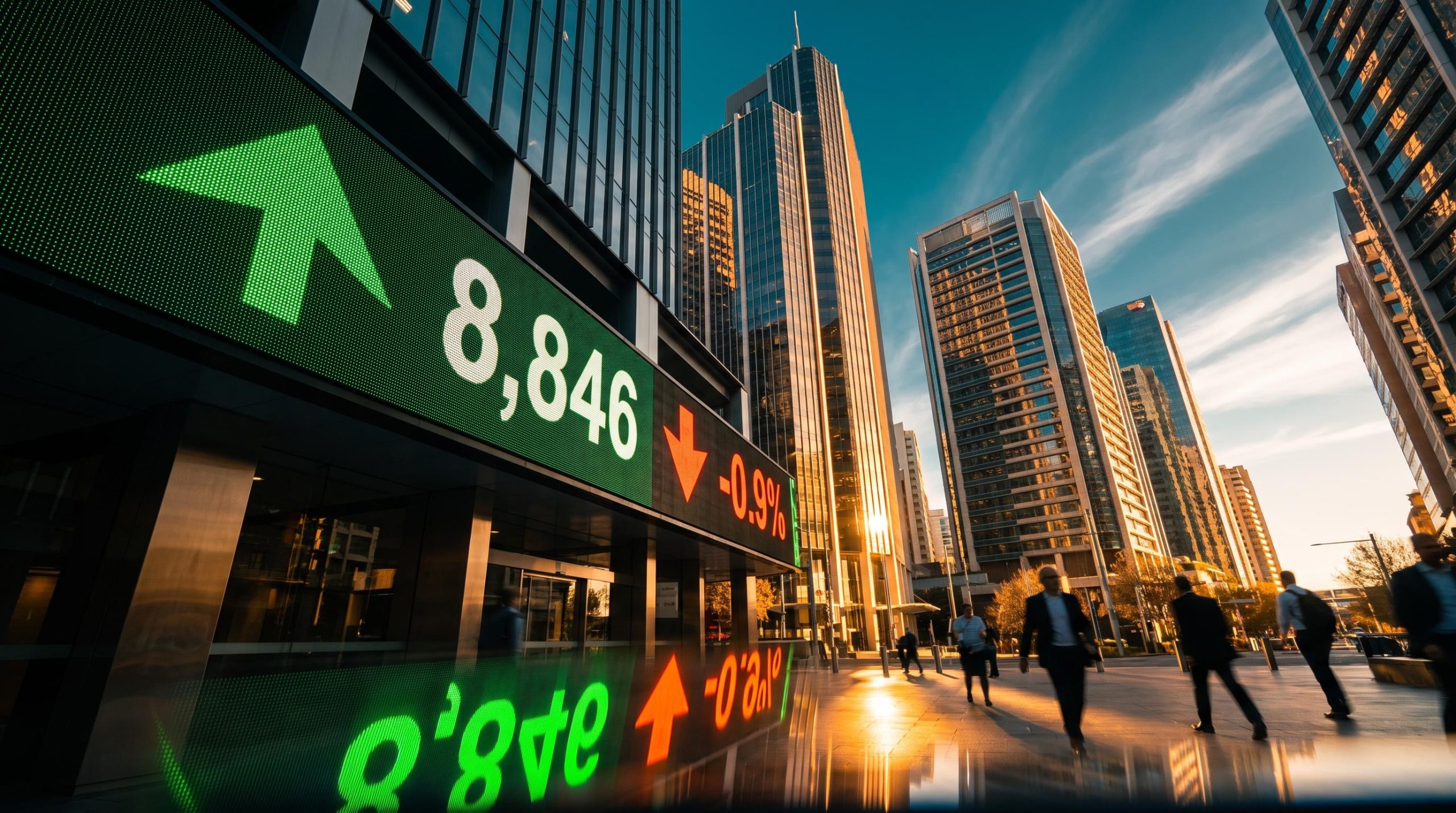
Australian shares closed higher on Monday after briefly reaching a five-week high during the session, carried by the big four banks, even as futures signalled a fall of roughly 0.9% at Tuesday’s open. In this markets wrap, the gap between those two numbers is the story.
Overnight, US investors returned to artificial intelligence (AI) shares after last week’s sell-off. In Europe, weekend unrest in France pushed the region’s banks sharply lower.
At home, the S&P/ASX 200 gain came from banks and energy, while technology shares slipped. The sections below explain why each region moved differently, which of those moves look fragile, and what is on the calendar for Tuesday.
Why did the ASX 200 hit a five-week high while futures point lower?
A rising market followed by a falling futures signal looks like a contradiction. It is less of one once you see what actually lifted the index.
The ASX 200 added 39.0 points, or 0.4%, to close at about 8,846, according to CommSec. Three sectors did most of the work:
- Energy: +2.21%
- Financials: +0.86%
- Information technology: -1.31%
The banks were the main support. CommSec described financials as a safe haven after last week’s AI and semiconductor rout. Australian lenders have little direct exposure to US AI and data-centre financing, and they still had room to recover from their August sell-off.
Monday’s defensive bid sits against stretched ASX bank valuations, with active fund managers holding record underweights while passive flows keep prices elevated.
| Bank | Move | Close |
|---|---|---|
| Commonwealth Bank | +0.65% | $155.39 |
| NAB | +1.48% | $39.90 |
| Westpac | +0.74% | $35.41 |
| ANZ | +1.03% | $39.29 |
Energy stocks rode oil prices that touched five-month highs late last week. BHP rose 0.7% to $60.43, and the Australian dollar firmed to about 69.79 US cents after China’s growth beat expectations.
The standout was Challenger, which jumped 19.29% to $11.75. The company said it is considering a $7.8 billion takeover proposal from Dai-ichi Life, which shows how quickly a single bid can take over a stock’s day.
The futures gap reflects timing. Before Monday’s open, futures pointed only about 0.12%-0.15% lower, and local bank buying outweighed that. Tuesday’s 0.9% indication reflects the overnight global backdrop, especially Europe.
For your portfolio, the takeaway is that Monday’s gains were defensive and concentrated in a few sectors. A lower open would not necessarily mean broad local weakness.
Is the AI rebound on Wall Street a recovery or just a bounce?
On the numbers alone, Wall Street had a good day for tech:
- Dow: -0.1%
- S&P 500: +0.4%
- Nasdaq: +1.1%
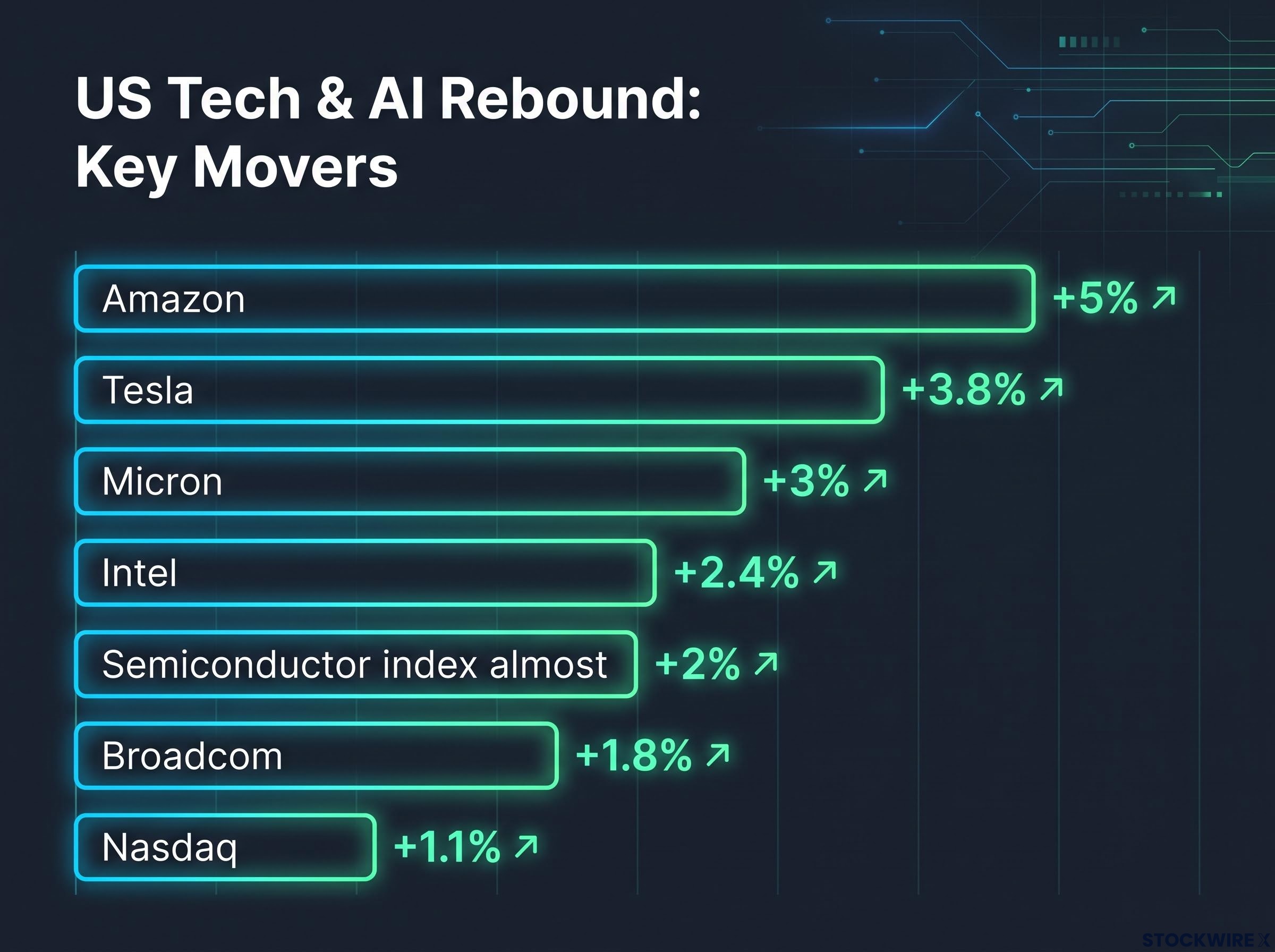
- Philadelphia semiconductor index: up almost 2%, ending an eight-day losing streak, its longest since October 2008
- Intel +2.4%, Broadcom +1.8%, Micron +3%
- Amazon +5% on a broker upgrade; Tesla +3.8%
The rally was narrow. Seven of the 11 S&P 500 sectors fell, with consumer discretionary and tech doing the lifting.
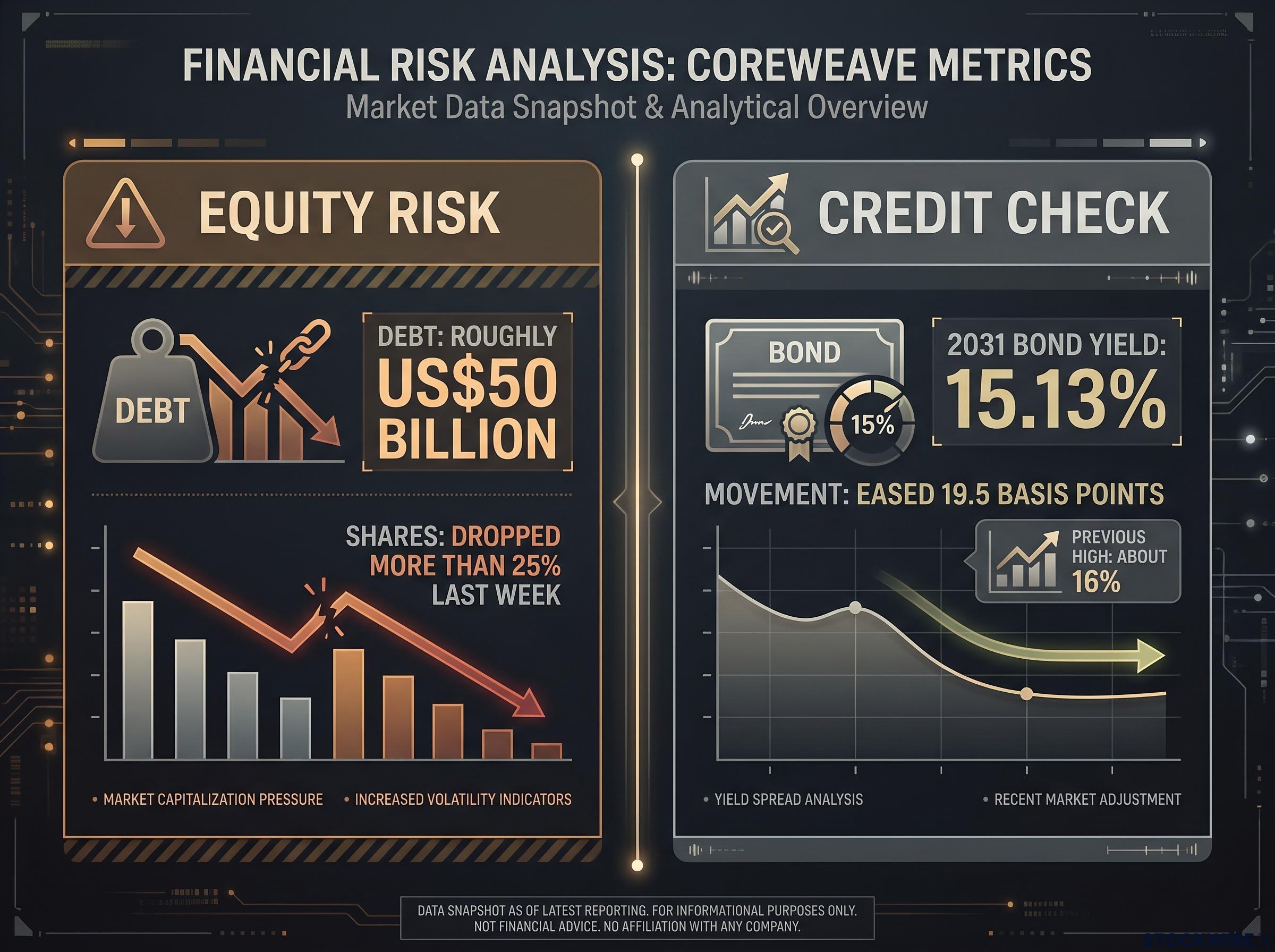
Last week’s sell-off was a financing and valuation shock rather than a collapse in demand for AI computing power. It centred on CoreWeave, a data-centre operator carrying roughly US$50 billion of debt, whose shares dropped more than 25% last week.
What the CoreWeave debt says about the rally
Goldman Sachs upgraded CoreWeave from “neutral” to “buy” on Monday, citing tight computing capacity and a performance advantage. The stock rose early, then closed down 0.4%.
The bond market was even more cautious. A bond yield is the annual return investors demand to lend to a company. The higher it goes, the riskier lenders think the borrower is.
CoreWeave’s credit check The company’s 2031 bond yield eased 19.5 basis points to 15.13%, down from about 16% at the height of the sell-off. Equity buyers returned on Monday, but lenders still price this debt as high risk.
The two kinds of risk behind this need to be separated. Some are cyclical, such as higher Treasury yields and profit-taking, and these can fade. Others are structural, such as heavy leverage and dependence on a small number of customers, and a single upgrade does not fix them.
The same structural leverage problem is not confined to CoreWeave, as AI stock debt risk has also reached hyperscalers such as Oracle, where a credit downgrade has forced external capital raising.
Rates add to the pressure. The US 10-year yield rose four points to 5.14%, and the 2-year rose three to 4.77%, after the 10-year’s largest weekly fall in seven months. Talk of a possible Federal Reserve rate hike later this year could raise the discount rate applied to future AI earnings.
If you hold US tech or semiconductor ETFs, treat Monday’s rebound as conditional. It was driven partly by short covering while credit yields stayed above 15%, so it is not yet an all-clear.
What else moved the market, and what should you watch on Tuesday?
France and European banks
Weekend rioting across French cities hit sentiment. The Euro Stoxx 600 fell about 0.8%, the FTSE 100 dropped more than 1% and the CAC 40 lost about 1.4%-1.5%. European banks fell 2.2%, with BNP Paribas, Société Générale and Crédit Agricole down roughly 2%-3.4%.
For lenders, this is a sovereign-debt problem. Investors worry that political paralysis could stall deficit cuts and push French yields higher, which weighs on banks holding government bonds. The pattern has played out before: during the 27 August budget sell-off, BNP fell about 4%.
The French bond spread has already widened to its highest level since 2011, pushing yields higher on the government debt European banks hold.
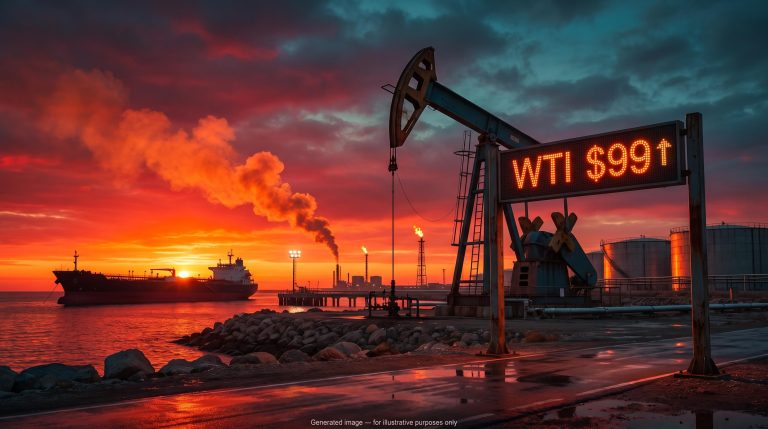
Commodities sent mixed signals. A Trump waiver on Russia sanctions and Houthi attacks on Saudi sites pulled oil in opposite directions, and sources disagree on key prices.
| Commodity | Move | Level | Note on source conflict |
|---|---|---|---|
| Brent | Lower | US$107.57-109.55 | Sources differ on level |
| WTI | Unclear | Unresolved | Sources conflict on level and direction |
| Gold | Unclear | Unresolved | Sources conflict on level and direction |
| Iron ore | +0.1% | US$90.95/t | No conflict |
| Copper / aluminium | +0.1% / +1.1% | Not specified | No conflict |
Check live oil and gold prices before acting on any figure here.
Tuesday watch list
Australia:
- Quarterly updates from BHP, Challenger, Hub24 and Yancoal
- AGMs including Judo Capital, Bendigo and Adelaide Bank, Codan and PWR Holdings
United States:
- September housing starts and building permits
- Earnings from GE Aerospace, Netflix, 3M, Chubb, GM, United Airlines, Halliburton and Hasbro
- SpaceX’s first results as a public company, after Tuesday’s US close
- Meta and Tesla on Thursday morning, Australian time
What the rebound settles, and what Tuesday will test
Monday settled one question. Local money is hiding in banks and energy, not chasing tech. It left two open: whether AI financing risk has eased, and how far French fiscal stress spreads through European lenders.
Tuesday brings the next tests. BHP’s production figures and Challenger’s update arrive locally, and SpaceX reports after the US close. If you are positioned in banks, check how far the expected lower open actually lands. If you hold AI exposure, watch credit yields as closely as share prices.
This article is for informational purposes only and should not be considered financial advice. Investors should conduct their own research and consult with financial professionals before making investment decisions. Past performance does not guarantee future results. Forward-looking statements are speculative and subject to change based on market developments.