Record Highs Are Not the Risk Most Investors Think They Are
7 hrs ago


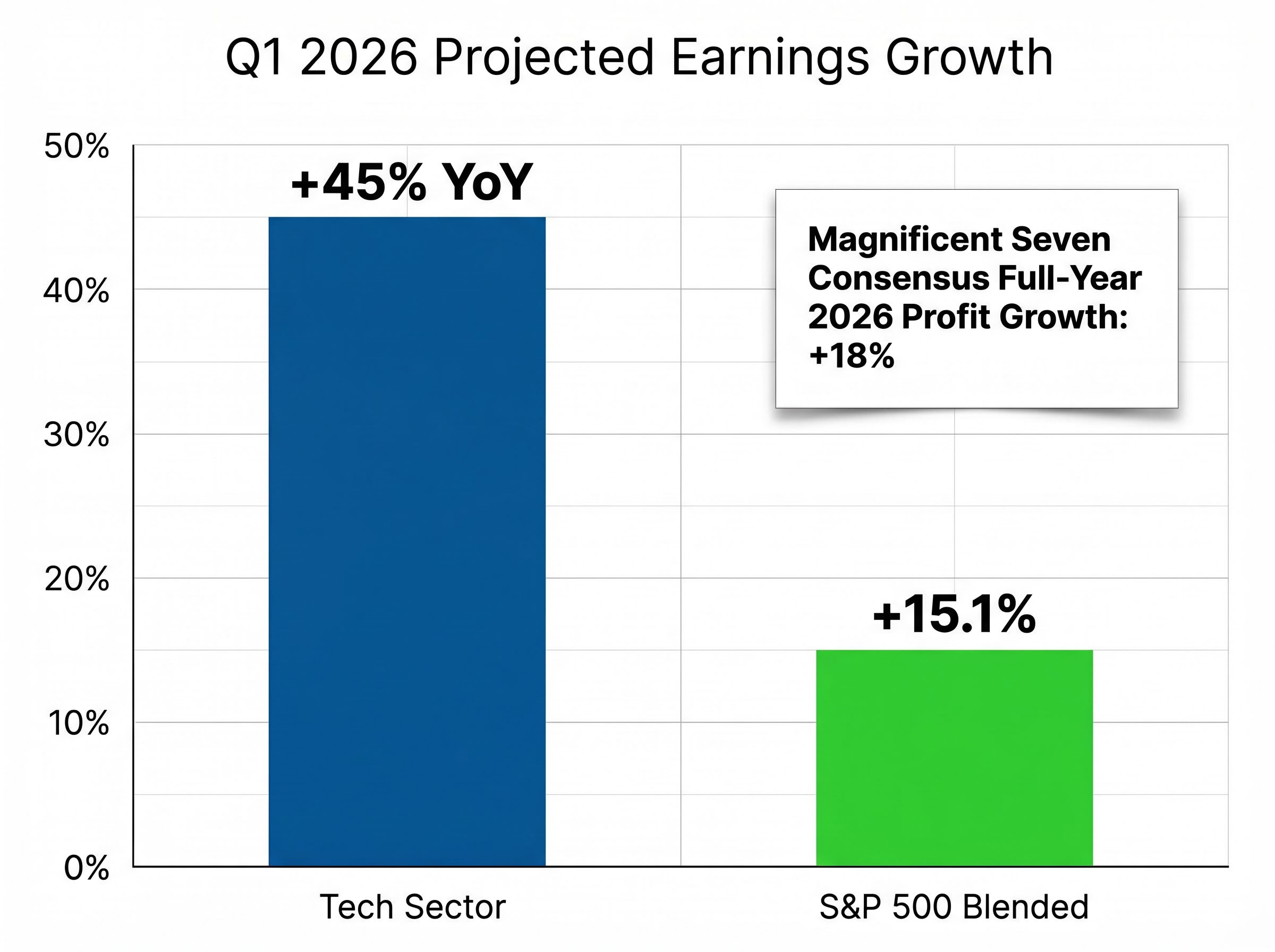
“`json { “fact_checked_full_article”: “Five of the seven largest technology stocks on Earth report earnings on the same day this week, and some market commentary suggests options markets may be pricing in post-earnings swings as large as 7% for the most volatile name in the group.\n\nWednesday, 29 April 2026, is the single most concentrated earnings day of the Q1 2026 season. Meta, Amazon, Alphabet, Microsoft, and Apple all release results simultaneously. Tesla reported last week; Nvidia does not report until May. The week arrives with S&P 500 blended earnings growth standing at +15.1% on roughly 10% of companies reported, while tech sector earnings are projected to grow +45% year over year, a bar that demands validation from the companies responsible for the bulk of that figure.\n\nWhat follows breaks down what options markets are projecting for each stock’s post-earnings price swing, why the spread between Meta and Apple is so wide, what Apple’s Tim Cook succession announcement adds to the mix, and what investors should monitor on earnings calls beyond the headline numbers.\n\n## How options-implied moves work and why they matter to investors\n\nMeta’s implied move of more than 7% is a number that has circulated in pre-earnings commentary all week. But what does it actually mean?\n\nAn options-implied move is derived from the price of at-the-money options contracts straddling an earnings date. It represents the magnitude of price movement that the market is collectively pricing in, calculated from the cost of buying both a call and a put at the same strike and expiry. The more expensive that straddle, the larger the expected swing.\n\nThree things an implied move tells an investor:\n\n- Magnitude expectation, not direction. A 7% implied move means the market expects the stock to move roughly 7% in either direction. It says nothing about whether the move is up or down.\n- A collective uncertainty measure. A higher implied move signals more unresolved investor questions about a company’s results or guidance, not necessarily a higher probability of a negative outcome.\n- A potential underpricing signal. When implied moves trail historical post-earnings averages, actual results frequently produce larger swings than the options market anticipated. In Q4 2025, approximately 86% of Magnificent Seven companies posted positive EPS surprises, a reminder that implied volatility captures magnitude, not outcome.\n\n### Reading the signal without mistaking it for a forecast\n\nA high implied move is not a warning to sell, and a low implied move is not a green light. Apple’s implied move of roughly 2.2% reflects market confidence in earnings predictability, but that low figure does not account for the narrative weight of a CEO transition announced just nine days earlier. The number measures expected price dispersion, not the significance of the report itself.\n\n## The week Wall Street has been waiting for: five Magnificent Seven names on one day\n\nThe concentration of this reporting moment is without precedent this earnings season. All five releases land on a single trading session, meaning the after-hours tape on Wednesday will carry more index-level weight than any session since the last round of megacap results.\n\nThe full Magnificent Seven reporting schedule:\n\n1. Tesla: reported 22 April 2026\n2. Meta: reports 29 April 2026\n3. Amazon: reports 29 April 2026\n4. Alphabet: reports 29 April 2026\n5. Microsoft: reports 29 April 2026\n6. Apple: reports 29 April 2026\n7. Nvidia: expected May 2026 (around 20 May)\n\nApproximately half of the Russell 1000 is reporting this week, and the Russell 1000 covers roughly 93% of total US equity market capitalisation. The S&P 500 blended earnings growth rate sits at +15.1%, with a beat rate of approximately 76.8% on both EPS and revenues so far.\n\n
| Company | Reporting Date | Status |
|---|---|---|
| Tesla | 22 April 2026 | Reported |
| Meta | 29 April 2026 | Scheduled |
| Amazon | 29 April 2026 | Scheduled |
| Alphabet | 29 April 2026 | Scheduled |
| Microsoft | 29 April 2026 | Scheduled |
| Apple | 29 April 2026 | Scheduled |
| Nvidia | ~20 May 2026 | Pending |
\n
\n\nFor investors holding any broad US equity exposure, the individual stock moves on Wednesday could ripple across the entire market.\n\n## What options markets are pricing in for each stock\n\nThe implied-move spectrum across the five 29 April reporters reveals how differently the market assesses each company’s earnings uncertainty.\n\n
| Company | Implied Move (%) | Reporting Date |
|---|---|---|
| Meta | ~7%+ | 29 April 2026 |
| Amazon | per market estimates | 29 April 2026 |
| Microsoft | per market estimates | 29 April 2026 |
| Alphabet | per market estimates | 29 April 2026 |
| Apple | ~2.2% | 29 April 2026 |
\n
\n\nEvery figure represents a projected price swing in either direction, not a directional bet. Meta at more than 7% carries the widest range, reflecting the largest cluster of unresolved questions around advertising revenue trajectory and AI monetisation. Apple at 2.2% sits at the opposite end, where the market appears to view earnings as more predictable, though that reading may underweight the leadership transition narrative.\n\n> Some market commentary has noted that implied moves for this cohort reflect magnitude expectations rather than directional predictions, and that options pricing may be understating the potential for post-earnings swings relative to historical patterns. In other words, the actual moves on Wednesday could exceed what the straddle market is currently suggesting.\n\nThe ranking tells investors which companies carry the most unresolved questions heading into Wednesday, and which the market believes will deliver the fewest surprises.\n\n## Apple’s Q1 report: strategic focus amid leadership transition\n\nOn 20 April 2026, Apple announced that Tim Cook will transition to Executive Chairman of the Board, effective 1 September 2026. John Ternus, currently Senior Vice President of Hardware Engineering, will become CEO on the same date.\n\n> Apple leadership transition: Tim Cook moves to Executive Chairman; John Ternus becomes CEO. Both changes take effect 1 September 2026.\n> Source: Apple Newsroom, 20 April 2026\n\nThe announcement landed just nine days before Apple’s Q1 2026 earnings, making the 29 April report the first financial release since the succession was confirmed. Apple’s low implied move of approximately 2.2% suggests markets view the transition as orderly and well-telegraphed rather than disruptive. Yet the earnings call commentary may carry outsized narrative weight precisely because it arrives at this inflection.\n\nInvestor watch items on Apple’s Q1 call:\n\n- How Cook and the board frame the transition timeline and strategic continuity\n- Any commentary on AI product roadmap priorities under incoming CEO Ternus\n- Whether capital return guidance (buybacks and dividends) shifts in language or scale\n\nEven with the lowest implied volatility in the group, Apple’s call could set the tone for how the market prices the company’s next chapter.\n\n## The real test: whether AI spending is translating into earnings\n\nBeneath the individual implied-move figures sits a single question that connects all five reports: is the billions deployed on artificial intelligence infrastructure converting into measurable revenue?\n\nThe tech sector is projected to deliver +45% year-over-year earnings growth for Q1 2026. The broader S&P 500 blended figure is +15.1%. That gap illustrates how much of the market’s earnings momentum depends on tech delivering.\n\n> Tech sector projected Q1 2026 earnings growth: +45% year over year. S&P 500 blended growth: +15.1%. The distance between those two figures represents the weight the market has placed on the AI investment thesis.\n\nMeta’s consensus EPS estimate of $6.67 on revenue of $55.4 billion sets a concrete benchmark. Advertising revenue strength at both Meta and Alphabet will be monitored as a proxy for whether AI-driven ad targeting products are producing incremental returns. Magnificent Seven consensus profit growth for full-year 2026 stands at +18%, a figure that requires Q1 results to stay on track.\n\nPre-earnings analyst previews have framed agentic AI return on investment as the \”gut check\” for the sector. Wednesday’s results will either reinforce the thesis or introduce doubt.\n\n### What to watch on the earnings calls beyond the headline numbers\n\nThree categories of disclosure will matter more than the headline EPS prints:\n\n- AI capital expenditure guidance updates. Any shift in committed spending levels or timelines for AI infrastructure deployment will signal management confidence in the return profile.\n- AI product revenue disclosures. Specific revenue attribution from AI-driven products, particularly in advertising and cloud services, would provide the first hard data points on monetisation.\n- Tariff exposure commentary. The broader macro backdrop includes tariff risk across the group’s global supply chains, and analysts expect multiple management teams to address the impact on forward guidance.\n\nAnalyst AI capex guidance estimates from major banks were anticipated but not yet published as of 27 April 2026, meaning the earnings calls themselves will serve as a primary data source for recalibrating the investment case.\n\n## Where this leaves investors heading into Wednesday\n\nWednesday, 29 April 2026, represents the most concentrated single-day earnings event for US equity markets this season. Five of the seven largest technology companies report simultaneously, with implied moves ranging from Meta’s more than 7% to Apple’s 2.2%, and Amazon, Microsoft, and Alphabet arrayed between them.\n\nThose figures reflect unresolved investor questions about AI return on investment, advertising resilience, and, in Apple’s case, leadership continuity under a newly announced CEO transition. Actual results and post-earnings stock moves will update the picture rapidly. For many investors, the guidance language on Wednesday’s calls may matter more than the headline EPS figures themselves.\n\n> This article is for informational purposes only and should not be considered financial advice. Investors should conduct their own research and consult with financial professionals before making investment decisions. Forward-looking statements regarding earnings projections and AI investment returns are speculative and subject to change based on market developments and company performance.” } “`
For investors trying to determine how Wednesday’s results should change their positioning, our full explainer on when to re-enter tech equities in 2026 lays out two actionable frameworks: patient accumulation awaiting a Q1 2027 free cash flow confirmation signal from hyperscalers, and contrarian positioning in memory and semiconductor names showing triple-digit earnings growth and defined technical support levels.
Hyperscaler AI capital expenditure ROI is the unresolved question sitting beneath all five reports: consensus capex for 2026 has reached $527 billion with no major provider yet announcing a path to proportionate returns, which is exactly the validation gap Wednesday’s calls are expected to either narrow or widen.
Apple stock valuation at a 34x earnings multiple already embeds a significant premium for AI execution, meaning any guidance commentary that softens the timeline for Siri improvements or the Google Gemini partnership could compress that multiple faster than a headline EPS miss would.
The $2.51 trillion rally in Magnificent Seven market capitalisation over just eight trading days in April 2026 was driven entirely by sentiment shifts and fund flows before a single Q1 earnings figure was confirmed, which is precisely why Wednesday’s simultaneous releases carry so much correction or validation potential.
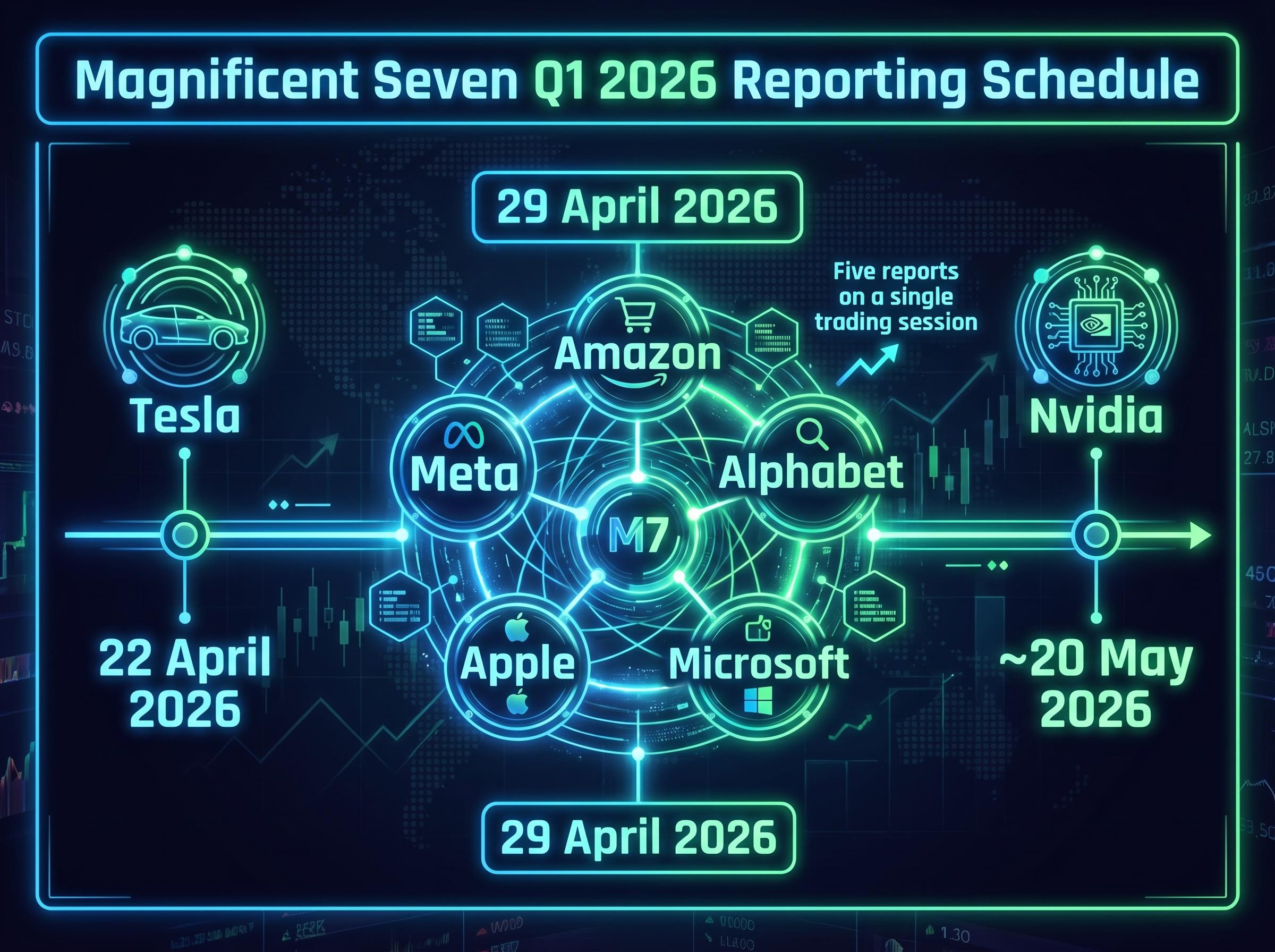
Tesla reported on 22 April 2026, while Meta, Amazon, Alphabet, Microsoft, and Apple all report on 29 April 2026. Nvidia is expected to report around 20 May 2026.
An options-implied move reflects the magnitude of price swing the market is pricing in ahead of an earnings release, calculated from the cost of a straddle (buying both a call and a put at the same strike). It signals the expected size of the move in either direction, not whether the stock will rise or fall.
Meta's implied move of more than 7% reflects a larger cluster of unresolved investor questions around advertising revenue trajectory and AI monetisation, while Apple's implied move of approximately 2.2% reflects market confidence in earnings predictability, even though Apple has a CEO transition announced just nine days before its report.
Investors should focus on AI capital expenditure guidance updates, specific revenue attribution from AI-driven products in advertising and cloud services, and any commentary on tariff exposure affecting forward guidance across the group's global supply chains.
The tech sector is projected to deliver plus 45% year-over-year earnings growth for Q1 2026, compared to a blended S&P 500 growth rate of plus 15.1%, highlighting how much of the market's overall earnings momentum depends on megacap technology companies delivering on their results.