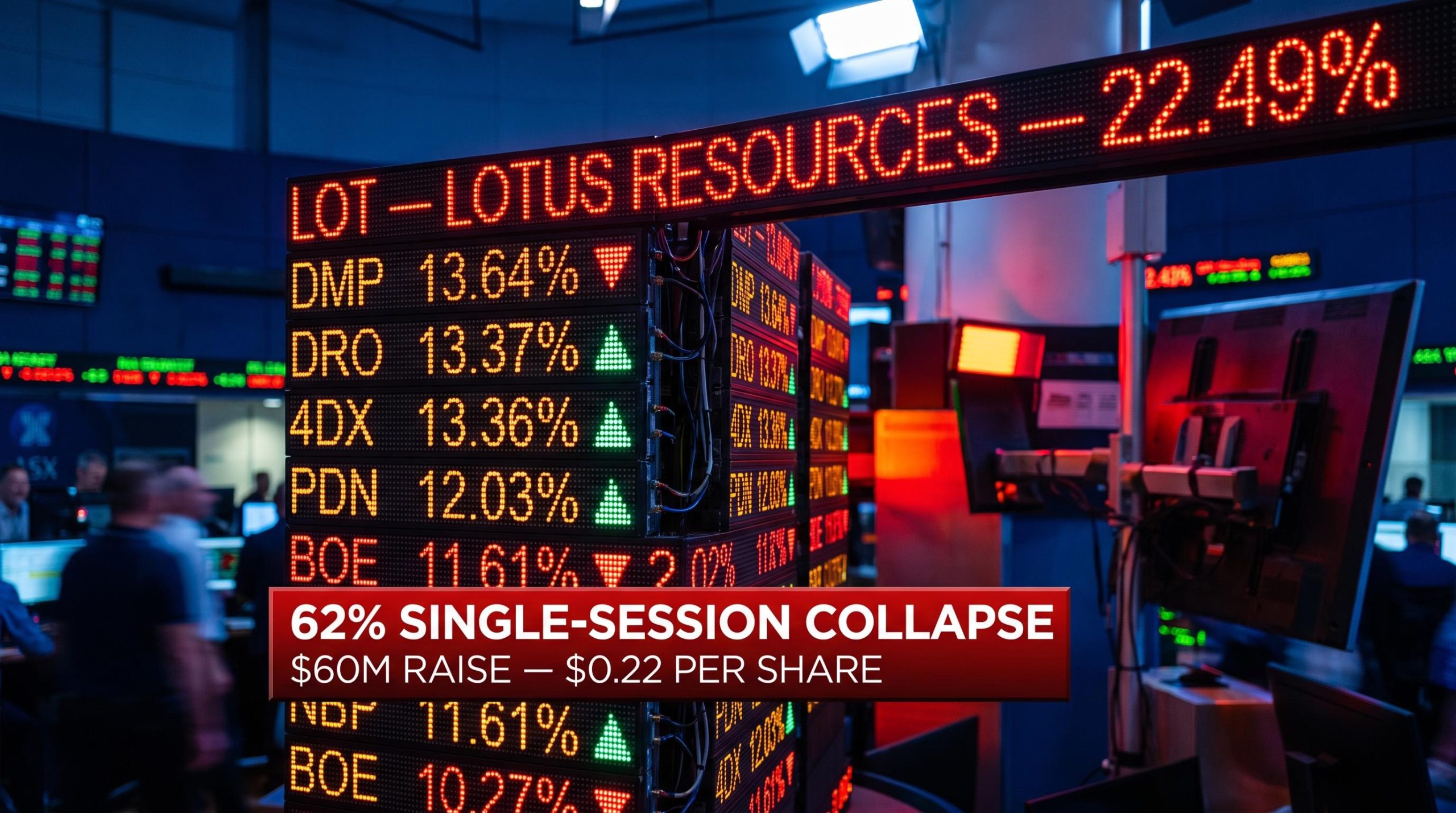
The ASIC short-position snapshot for Week 32, covering data as of 27 July 2026, arrived on 3 August 2026 alongside one of the sharpest single-session collapses the ASX has produced this year. Lotus Resources still sits at the top of the most shorted list with 22.49% of its shares held short, more than nine percentage points clear of any other name.
But the number carries a caveat that matters more than the number itself. The data cutoff and the 62% share price collapse triggered by a heavily discounted capital raise occurred on the same day. That means the official figures reflect what short sellers were doing before the event, not how they responded to it.
Here is what the current ASX most shorted stocks data shows, why three distinct bearish themes are running through the top ten simultaneously, and why the Week 33 release will carry more signal than any single weekly update in recent memory.
Week 32 top ten: the full short-position table
Lotus Resources at 22.49% is not simply the most shorted stock on the ASX. It is structurally isolated from the rest of the list. The gap between first and second place, more than nine percentage points, tells you that institutional bearish conviction in this single name operates on a different scale entirely. Domino’s Pizza in second place at 13.64% is heavily shorted by any normal standard; next to Lotus, it looks moderate.
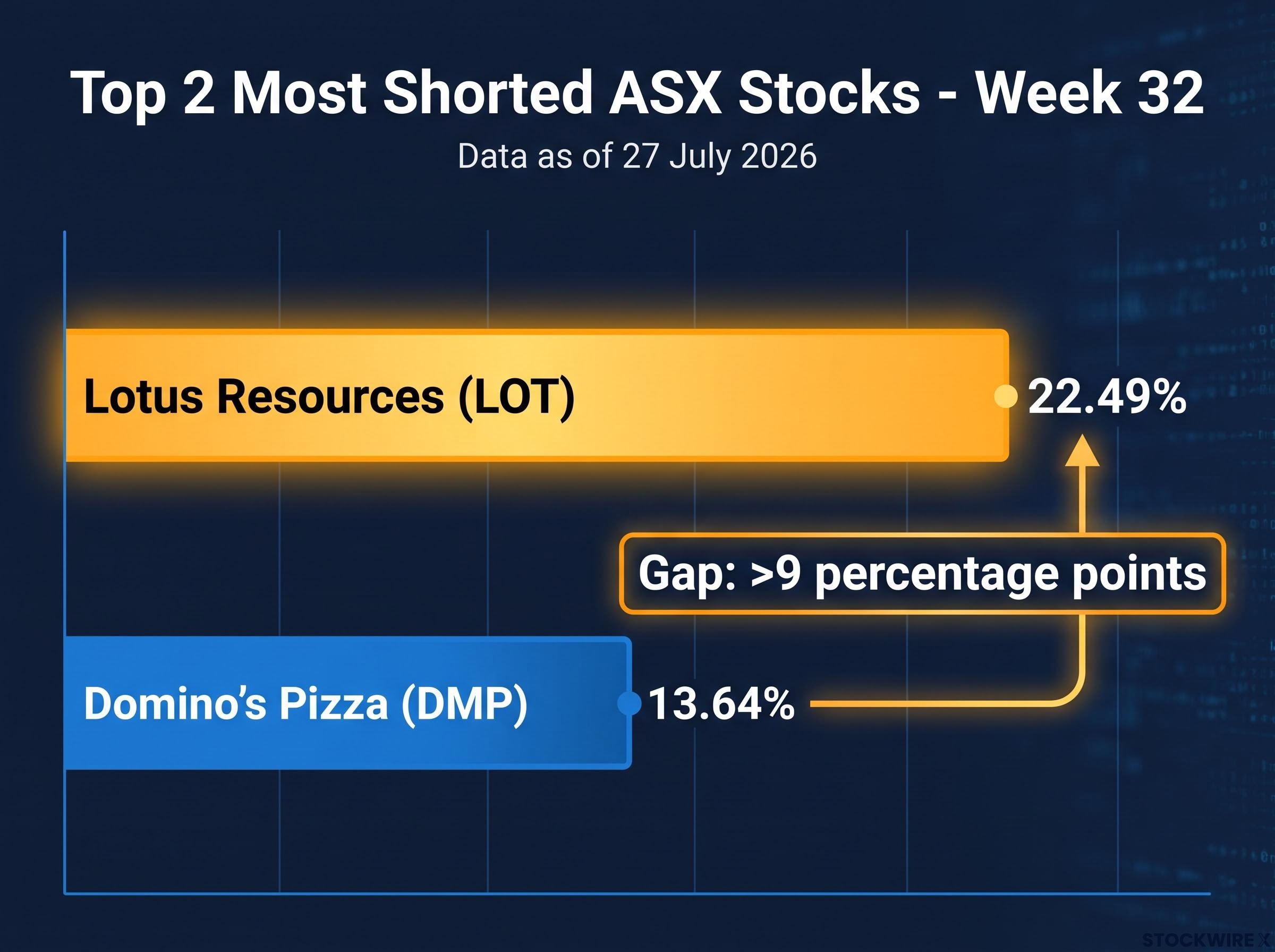
The full Week 32 data, drawn from ASIC short-position disclosures as of 27 July 2026 and published 3 August 2026 via the Market Index Short Seller Series, is set out below.
| Rank | Company | ASX Code | Short Position | Week-on-Week | Month-on-Month |
|---|---|---|---|---|---|
| 1 | Lotus Resources | LOT | 22.49% | ▼ 0.31% | ▼ 0.33% |
| 2 | Domino’s Pizza | DMP | 13.64% | ▼ 0.15% | ▼ 0.30% |
| 3 | DroneShield | DRO | 13.37% | ▲ 0.26% | ▲ 1.63% |
| 4 | 4DMedical | 4DX | 13.36% | ▲ 0.22% | ▲ 2.40% |
| 5 | Flight Centre Travel | FLT | 12.34% | ▼ 0.04% | ▲ 0.92% |
| 6 | Paladin Energy | PDN | 12.03% | ▲ 0.43% | ▲ 0.48% |
| 7 | Telix Pharmaceuticals | TLX | 11.67% | ▼ 0.01% | ▼ 0.56% |
| 8 | Boss Energy | BOE | 11.61% | ▼ 0.35% | ▼ 2.02% |
| 9 | CAR Group | CAR | 11.47% | ▼ 0.12% | ▼ 0.06% |
| 10 | Healius | HLS | 10.79% | ▲ 0.55% | ▲ 0.52% |
Look at the directional arrows, not just the headline percentages. This is not a uniform bearish picture. Some positions are building; others are unwinding.
- Largest monthly increases: 4DMedical (+2.40%), DroneShield (+1.63%), Flight Centre (+0.92%)
- Largest monthly decrease: Boss Energy (-2.02%)
When big ASX news breaks, our subscribers know first
Lotus Resources: why the real data story is still one week away
On 27 July 2026, Lotus Resources raised $60 million at $0.22 per share, a discount of approximately 66% to prior trading levels. The dilution was severe: the new shares issued roughly doubled the existing share count. The stock fell 62% in a single session.
That collapse happened on the same day as the Week 32 ASIC data cutoff. The 0.31% week-on-week decrease in Lotus’s short position is pre-event noise. It tells you nothing about how short sellers responded to the capital raise itself.
How ASIC’s reporting lag shapes what you can and cannot read from this data
Australian short sellers must disclose their positions by the end of the third business day after the transaction date (known as T+3). ASIC then aggregates these disclosures before publishing, producing a total lag of approximately four business days between trading activity and public data. This applies to every stock on the ASX, not just Lotus. Every weekly short-position snapshot is, by design, a photograph of a moment that has already passed.
For Lotus, that lag is unusually consequential. The Week 33 data will be the first release to capture how sophisticated traders actually responded to the collapse and the dilution.
For investors wanting to trace how Lotus Resources reached 22.49%, our dedicated guide to Lotus Resources short history covers the May 2026 period when short interest first surged 6.15 percentage points in a single month following a production retraction and leadership overhaul at Kayelekera.
If Lotus’s short percentage falls sharply in Week 33, it signals short covering: traders who were already short closing profitable positions after the price decline. If the percentage rises, it signals new bearish conviction, with traders opening fresh short positions after the dilutive raise. The direction of that single number will tell you more about institutional sentiment around Lotus than any commentary published this week.
Top-ten boundary shifts: reading what the new composition reveals
The top ten is not a fixed register. It is a pressure ranking, and the names that cross in and out of it carry specific information about where institutional bearish attention is moving.
This week, the movement at the boundary involved two names heading in opposite directions:
- Healius (HLS) entered the top ten at rank 10 with a short position of 10.79%, up 0.55 percentage points week-on-week and 0.52 percentage points month-on-month. Both movements clear the approximately 0.5% threshold that flags meaningful short-interest change rather than routine fluctuation.
- Treasury Wine Estates (TWE) dropped out after its short interest eased just enough to fall below the top-ten threshold. Independent ASIC-based trackers still show TWE carrying double-digit short interest, placing it on the watchlist rather than out of scope.
Healius is not a new short-seller target. The bearish thesis centres on margin pressure in its pathology and imaging operations, with persistent concerns about structural profitability. The stock crossing the 10% short-interest threshold with building momentum on both timeframes places it in the same scrutiny bracket as Australia’s most heavily shorted names, at a time when its business fundamentals remain under pressure.
Three short themes running simultaneously through the ASX
The top ten is not a random collection of names. Three distinct bearish narratives are operating at different intensities, and understanding which theme a stock belongs to changes how you should interpret its short-interest movement.
Uranium cluster: diverging paths within a single sector
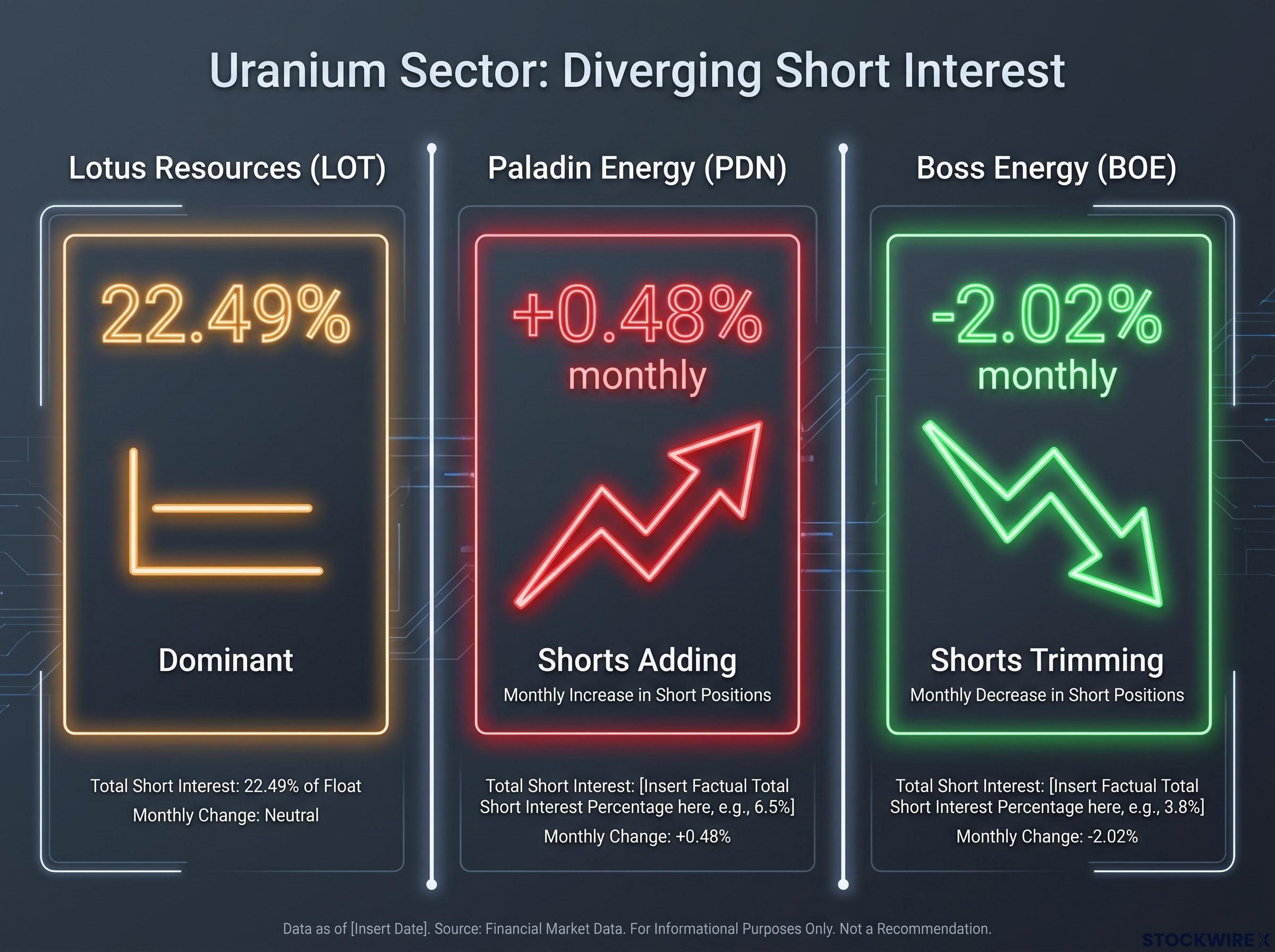
Three uranium names sit in the top ten, but their trajectories are pulling apart:
- Lotus Resources (LOT): 22.49%, dominant but pre-event. The real signal arrives in Week 33.
- Paladin Energy (PDN): 12.03%, up 0.43% weekly and 0.48% monthly. A steadily building short thesis.
- Boss Energy (BOE): 11.61%, down 0.35% weekly and 2.02% monthly, the largest monthly reduction in the entire top ten.
The uranium sector is not attracting one uniform bearish view. Paladin’s shorts are adding. Boss’s shorts are trimming. The sector carries three separate sub-theses, not one.
The uranium short thesis that now spans Lotus, Paladin, and Boss Energy has precedent in mid-2026 data showing institutional bears building fresh positions across five ASX uranium stocks in a single week, with Deep Yellow leading at 2.30 percentage points in seven days, reflecting a tactical view that uranium equity valuations had run ahead of near-term fundamentals.
Growth and tech adjacents: the most actively building theme
- 4DMedical (4DX): 13.36%, up 2.40% monthly, the largest single monthly short build in the top ten.
- DroneShield (DRO): 13.37%, up 1.63% monthly.
Short sellers are not just holding positions in these names. They are actively adding. That is a materially different risk signal than stable high short interest, because it means bearish conviction is intensifying rather than simply persisting.
Consumer, travel, and healthcare: persistent pressure plus a new entrant
- Domino’s Pizza (DMP): 13.64%, marginally easing but still the second-most shorted stock on the ASX.
- Flight Centre Travel (FLT): 12.34%, flat weekly but up 0.92% monthly, a building medium-term trend.
- Telix Pharmaceuticals (TLX): 11.67%, gradually moderating on both timeframes.
- Healius (HLS): 10.79%, the week’s notable new addition with building momentum.
What short-selling data actually measures (and what it does not)
Short selling works in three steps:
- A trader borrows shares from another holder.
- The trader sells those borrowed shares at the current market price.
- The trader later repurchases the shares (ideally at a lower price) to return them, pocketing the difference if the price has fallen.
High short interest tells you that a concentrated group of market participants, typically institutional investors, have committed capital to a bearish thesis on a stock. It does not guarantee a price decline. If the bearish thesis proves wrong and the price rises, short sellers face pressure to buy back shares quickly to limit losses, which can itself accelerate a price increase (a short squeeze).
Squeeze vulnerability on the ASX is most acute when short interest exceeds 10% of issued shares and a catalyst capable of undermining the bearish thesis arrives without warning, a combination that drove Polynovo up intraday on no material news and forced Guzman Y Gomez bears to cover rapidly after a US market exit announcement.
ASIC short-selling disclosure rules require positions above 0.01% of a company’s issued shares to be reported within three business days of the transaction, a transparency standard that gives ASX short-selling data greater granularity than most comparable international markets.
ASIC requires Australian short sellers to disclose positions above 0.01% of a company’s issued shares, making ASX short-selling data more transparent than most international markets.
For the Week 32 snapshot, the weekly comparison spans the seven-day period ending 27 July 2026 (from 20 July), while the monthly comparison runs back to 29 June 2026. Because of the T+3 disclosure rule and ASIC’s aggregation step, the data always reflects a snapshot that is approximately four business days old by the time you read it. A high short position tells you where informed capital was positioned, not necessarily where it sits right now.
Short interest as an early warning signal has empirical support in the ASX context: Lotus Resources carried approximately 11% short interest in the weeks before its April 2026 collapse, and Generation Development Group more than doubled its short interest over five weeks before institutional selling confirmed the bearish thesis.
This article is for informational purposes only and should not be considered financial advice. Investors should conduct their own research and consult with financial professionals before making investment decisions.
Five names to watch when the Week 33 data lands
- Lotus Resources (LOT): The dominant unknown. At 22.49% pre-event, the Week 33 figure will reveal whether short sellers treated the 62% collapse as a profit-taking exit or a catalyst to deepen exposure. No other name in the top ten carries this level of binary uncertainty.
- Healius (HLS): A new top-ten entrant at 10.79% with both weekly (+0.55%) and monthly (+0.52%) builds above the meaningful-movement threshold. Acceleration in Week 33 would confirm deepening bearish conviction in diagnostics.
- 4DMedical (4DX): The largest monthly short build in the current top ten at +2.40%. Continuation would confirm an established, thematic short thesis rather than a one-off positioning shift.
- DroneShield (DRO): A clear rising trend on both timeframes (+0.26% weekly, +1.63% monthly). Week 33 will clarify whether the build reflects a sustained bearish thesis or temporary positioning.
- Boss Energy (BOE): The largest monthly short reduction at -2.02%. Continued easing would signal broader uranium sector repositioning distinct from the Lotus and Paladin narratives.
What Week 33 will actually tell us about where bearish conviction is heading
Two signals define the Week 32 snapshot. The first is the Lotus Resources number that captures everything except what matters most: the market’s response to a 62% collapse and a $60 million dilutive raise. The second is the broader pattern of diverging trajectories across the top ten, where uranium, growth-tech, and consumer-healthcare themes are each moving to their own internal logic rather than in lockstep.
The Week 33 data will test whether those individual theses are hardening or softening. When it lands, return to the five names above with their specific directional criteria in mind. The number that moves is the signal. The direction it moves is the story.
—