
On 22 May 2026, Guzman Y Gomez shares surged more than 20% intraday on news that would normally worry investors: the company was retreating from the United States market entirely. That counterintuitive reaction is worth understanding. The same week, Polynovo had quietly shed 2.47 percentage points of short interest following a series of unexplained price surges that prompted a formal ASX query. Neither story is simply about those two companies. Both are instructive windows into how short covering works on the ASX, and why heavily shorted stocks can produce violent upside moves that catch unprepared investors off guard. What follows explains the mechanics behind short covering and short squeezes, walks through what happened with Polynovo and Guzman Y Gomez in May 2026, and identifies the signals Australian investors can watch to anticipate when a heavily shorted stock might be about to move sharply.
Why short sellers create the conditions for their own undoing
Short selling is a strategy built on borrowed time, and borrowed shares. To understand why short-covering events produce such sharp price moves, the mechanics of the strategy itself need to be clear.
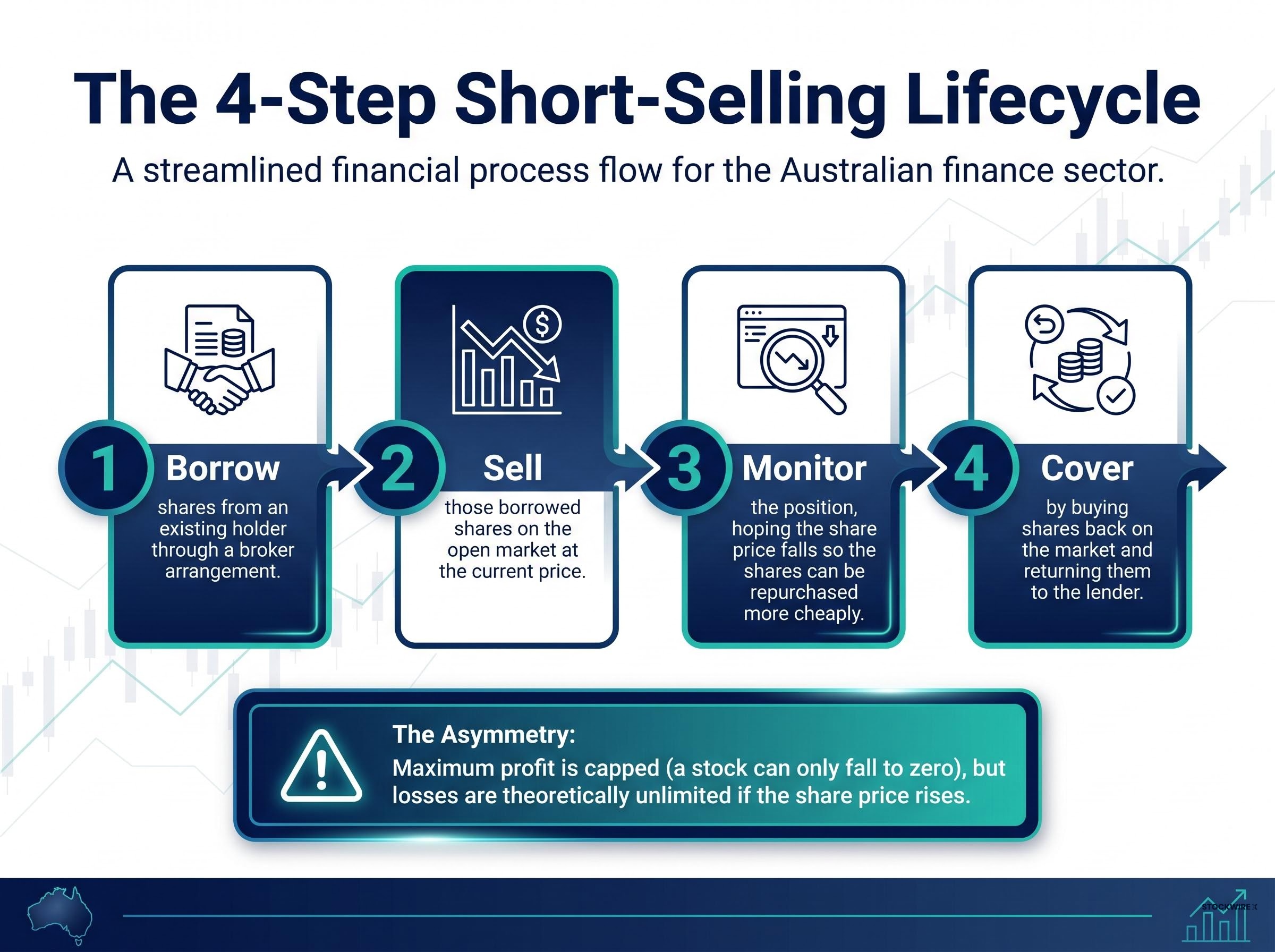
The short-selling lifecycle unfolds in four steps:
- Borrow shares from an existing holder through a broker arrangement.
- Sell those borrowed shares on the open market at the current price.
- Monitor the position, hoping the share price falls so the shares can be repurchased more cheaply.
- Cover by buying shares back on the market and returning them to the lender, pocketing the difference if the price fell, or absorbing a loss if it rose.
The asymmetry embedded in this structure is significant. A short seller’s maximum profit is capped (a stock can only fall to zero), but losses are theoretically unlimited if the share price rises. Every dollar of upside movement deepens the loss on an open short position.
This asymmetry matters because ASX short position data is publicly reported. ASIC hosts official short position reports, and the ASX publishes daily gross short sales figures, meaning market participants can see which stocks carry elevated short interest.
The ASIC short position reports table aggregates daily short-position filings from individual short sellers across all ASX-listed securities, providing the primary data source from which short interest percentages like those recorded for Polynovo and Guzman Y Gomez are derived.
When covering becomes a cascade
A rising share price forces short sellers into a binary choice: hold the position and accept growing paper losses, or cover by buying shares back. Covering means purchasing shares on the open market, which itself adds buying pressure.
When multiple short sellers cover simultaneously, that buying pressure becomes self-reinforcing. Each round of covering pushes the price higher, which pressures additional short sellers to cover, which pushes the price higher again. This feedback loop is the mechanism behind a short squeeze.
Supply and demand mechanics determine why covering adds more upward pressure than ordinary buying: when short sellers purchase shares to close positions, they are compelled buyers with no flexibility on timing, which means their demand hits the market regardless of the prevailing price, creating inelastic buying pressure that ordinary investors can defer or avoid.
When big ASX news breaks, our subscribers know first
What short interest data actually measures, and what it misses
Short interest represents the percentage of a company’s issued shares that are currently sold short. A reading above 10% typically signals meaningful bearish positioning; it indicates a substantial portion of market participants have placed capital behind the expectation that the stock will fall.
A distinction worth holding onto: A declining short interest figure (short sellers covering) and a rising share price (new buyers entering) can occur simultaneously during a covering event. Separating which force is driving the price at any given moment is difficult in real time, and treating every price rise during a short-covering period as purely mechanical overstates the signal.
The data infrastructure for monitoring short interest on the ASX is publicly accessible. ASIC hosts the official short position reports table, and the ASX publishes daily gross short sales figures. However, these figures come with limitations:
- Reporting lag: Short position data is not real-time; published figures may reflect positioning from days earlier.
- No reason for covering: The data shows that short interest declined, but not why a short seller closed a position.
- Absolute level versus direction: A stock with 10% short interest that is declining tells a different story than one at 10% that is rising. The direction of change matters as much as the level.
ASIC reporting lag of four business days means the short interest figures in any published weekly table reflect positioning decisions made nearly a week earlier, a delay that matters most for fast-moving names like Lotus Resources, which retracted production data and saw short interest surge 5.41 percentage points in a single month before the published figures confirmed the institutional positioning that had already been established.
As of 25 May 2026, Droneshield (10.88%) and Guzman Y Gomez (12.59%) held the highest absolute short interest levels among the most actively shorted ASX names, even after the week’s declines. Those figures reflect positions that remained open, not positions that had been resolved.
The Polynovo case: unexplained surges, an ASX query, and 3.14 percentage points of short interest unwinding
Polynovo’s short interest peaked at 14.61% on 12 May 2026, placing it among the most heavily shorted stocks on the ASX. That figure alone made it a candidate for covering-driven volatility. What happened next made it a case study.
The stock had been moving sharply for weeks before the short interest data caught up. In early April 2026, shares rose 12.3% over two days. On 13 April 2026, they gained another 9.3%. Then on 14 May 2026, the stock surged 14.8% in a single session.
No material company news accompanied any of these moves. Polynovo had not released a market update since its first-half fiscal 2026 results on 20 February 2026.
| Date | Event | Price Move | Short Interest |
|---|---|---|---|
| Early April 2026 | Unexplained two-day rally | +12.3% | Elevated (above 14%) |
| 13 April 2026 | Further unexplained surge | +9.3% | Elevated (above 14%) |
| 12 May 2026 | Short interest peak | N/A | 14.61% |
| 14 May 2026 | Largest single-day surge; ASX price query issued | +14.8% | Declining |
| 25 May 2026 | Short interest reported | N/A | 11.15% |
Following the 14 May surge, the ASX issued a formal price query. Polynovo responded that it had no knowledge of any material information that could have prompted the move.
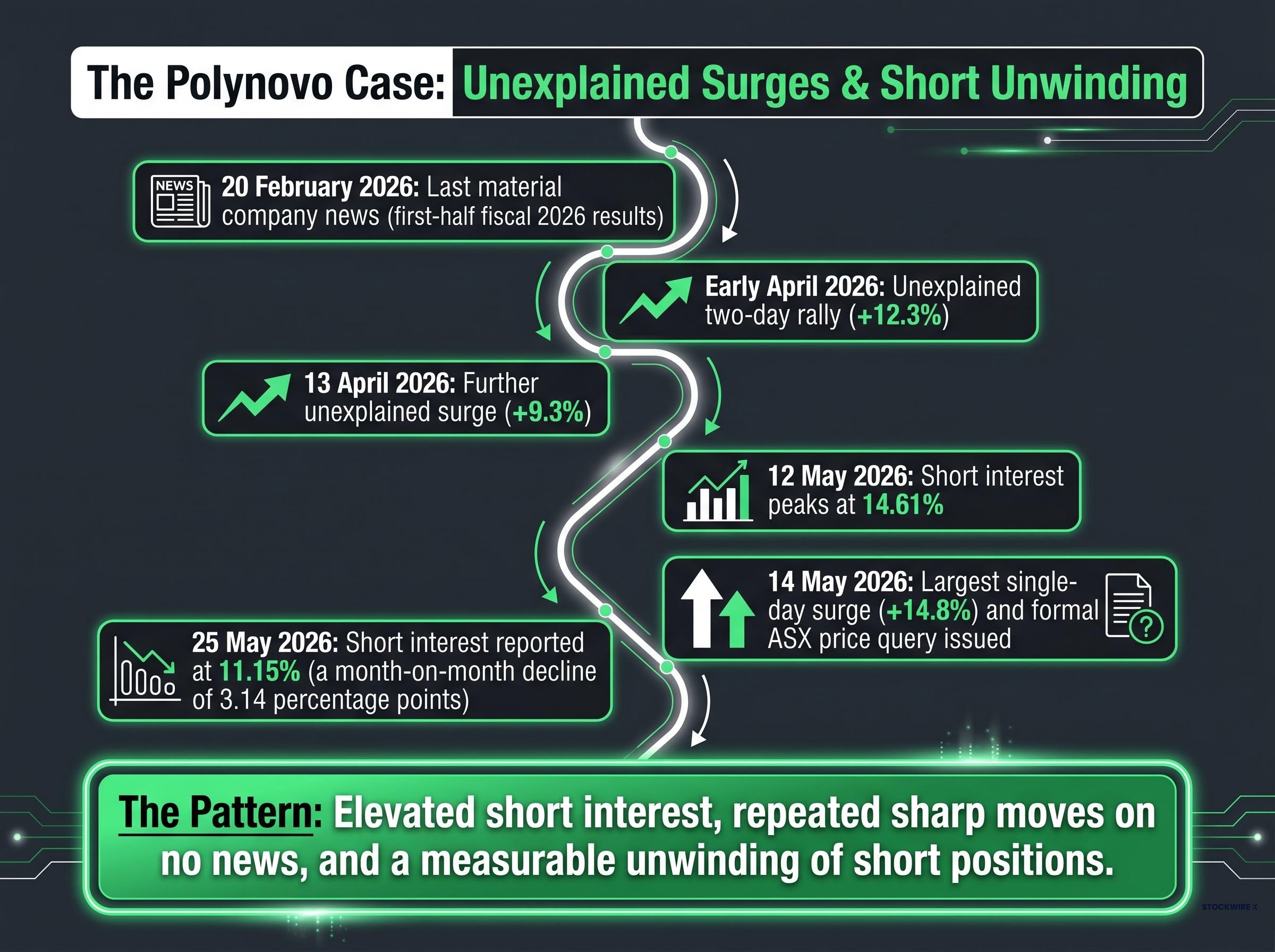
That response is significant. With no news catalyst and a company that explicitly confirmed it had nothing to disclose, the short-covering thesis becomes the most structurally coherent explanation available. Short interest fell from 14.61% to 11.15% over the period, a month-on-month decline of 3.14 percentage points. The pattern fits: elevated short interest, repeated sharp moves on no news, and a measurable unwinding of short positions across the same timeframe.
Guzman Y Gomez: when bad news triggers a short-covering rally
Guzman Y Gomez announced on 22 May 2026 that it would exit the United States market. On paper, abandoning an international expansion programme reads as a strategic setback.
The market disagreed, at least initially. Shares hit an intraday high of +20.2% before closing +9.2% on the day.
The gap between the +20.2% intraday high and the +9.2% close reflects the partial nature of short covering: some short sellers rushed to close positions in the initial spike, while others held, and the buying pressure faded as the most urgent covering was completed.
The short interest data reinforces this reading. Guzman Y Gomez’s week-on-week short interest fell 1.49 percentage points, the second-largest weekly decline among heavily shorted ASX names. Yet on a month-on-month basis, short interest was still slightly higher (+0.51%), indicating bearish positions had been building for weeks before the announcement provided a catalyst to reconsider.
That sequence reframes how catalysts work in heavily shorted stocks. The US exit did not need to be unambiguously positive to trigger covering. It only needed to undermine the specific bearish thesis short sellers were positioned around, in this case, the risk and capital drag of US expansion.
Post-downgrade short accumulation on the ASX follows a consistent pattern: institutional short sellers treat an earnings-driven selloff as a confirmed entry signal rather than a reason to cover, with ASIC data showing short interest building in Accent Group, G8 Education, and Bank of Queensland in the same week each stock fell between 9% and 31% on downgrade announcements.
The two case studies operated through different mechanisms:
- Polynovo: No news catalyst, gradual short-interest erosion over weeks, self-reinforcing price moves as covering fed further covering.
- Guzman Y Gomez: A specific catalyst event, an immediate price spike concentrated in a single session, and partial covering that left substantial short interest still open.
Both produced sharp upside moves. Both were driven by short sellers buying back shares. The trigger differed, but the structural mechanics were the same.
Reading the broader pattern: what the 25 May 2026 ASX data reveals
Polynovo and Guzman Y Gomez recorded the largest short-interest declines for the week ending 25 May 2026, but they were not the only names where short sellers were closing positions. Nine other ASX stocks recorded meaningful declines in the same period.
| Company | Short Interest (25 May 2026) | Week-on-Week Change | Month-on-Month Change |
|---|---|---|---|
| Polynovo | 11.15% | -2.47% | -3.14% |
| Guzman Y Gomez | 12.59% | -1.49% | +0.51% |
| Nanosonics | 8.94% | -1.23% | -1.47% |
| Catapult Sports | 5.05% | -0.99% | -1.36% |
| Aeris Resources | 3.24% | -0.72% | -0.20% |
| Clarity Pharmaceuticals | 7.86% | -0.67% | -0.51% |
| Karoon Energy | 3.56% | -0.58% | -0.59% |
| Droneshield | 10.88% | -0.57% | -0.51% |
| Life360 | 1.15% | -0.57% | -0.08% |
| REA Group | 4.91% | -0.52% | -0.55% |
| Suncorp Group | 1.21% | -0.50% | -0.53% |
Several patterns stand out:
- Growth-name clustering: Nanosonics (-1.23%), Catapult Sports (-0.99%), and Clarity Pharmaceuticals (-0.67%) are all growth-oriented names. The concentration of short covering across this cohort is consistent with a broader sentiment shift, not purely stock-specific events.
- High absolute residuals: Droneshield (10.88%) and Guzman Y Gomez (12.59%) retained the highest absolute short interest levels on the list despite the week’s declines. The bearish positioning in these names was reduced but far from resolved.
- Incremental versus structural moves: Life360 (1.15%) and Suncorp Group (1.21%) had low absolute short interest levels, suggesting their weekly declines represent routine position adjustments rather than meaningful shifts in bearish conviction.
The S&P/ASX 200 rose 0.9% in the week ending 29 May 2026, according to the ASX Weekly Market Wrap. A rising broader market may have contributed to short sellers across multiple names reassessing the risk-reward of holding their positions open.
What investors should watch before a short squeeze develops
The Polynovo and Guzman Y Gomez cases were observable before they occurred, at least in their preconditions. Three factors consistently precede short-covering events:
- Elevated short interest: A short interest level above 10% of issued shares signals a large pool of borrowed stock that must eventually be returned. Polynovo’s peak of 14.61% and Guzman Y Gomez’s 12.59% both exceeded this threshold.
- A catalyst that could invalidate the bearish thesis: Short sellers are positioned around a specific negative expectation. Any development that undermines that expectation, whether positive news, a strategic pivot, or even the absence of expected bad news, can prompt covering.
- Low liquidity relative to the short position: When the number of shares sold short is large compared to typical daily trading volume, covering becomes harder to execute without moving the price.
Investors can monitor ASX short interest data through two publicly accessible sources:
ASIC short position reporting operates on a transaction-granular basis, requiring disclosure of every on-market short sale regardless of size, a design that makes Australia’s regime more comprehensive than equivalent US or UK systems but also more dependent on accurate data submission from market participants.
- ASIC’s short position reports table, which aggregates short-position reports from individual short sellers.
- The ASX’s daily gross short sales reports, available on the ASX’s reports and statistics page.
Identifying these preconditions is not a trading strategy in itself. Short sellers may be correct in their thesis, and prices can fall further before any covering occurs. The value lies in understanding why a stock has moved sharply when it does, and in distinguishing a mechanical short-covering rally from a fundamental re-rating.
This article is for informational purposes only and should not be considered financial advice. Investors should conduct their own research and consult with financial professionals before making investment decisions.
Short covering rewards observers, not just participants
Short covering amplifies price moves because it adds mechanical buying pressure on top of any fundamental demand. The effect is predictable in structure, even when the specific timing is not. Polynovo’s gradual, news-free unwinding and Guzman Y Gomez’s catalyst-driven spike were different in tempo but identical in mechanics: short sellers buying back shares they had borrowed, pushing prices higher in the process.
The ASX’s data transparency gives retail investors the same visibility into short interest levels that institutional participants have access to. ASIC’s short position reports and the ASX’s daily short sales data are freely available and worth incorporating into any watchlist monitoring process.
As of 25 May 2026, Droneshield (10.88%) and Guzman Y Gomez (12.59%) still carried elevated short interest. The structural conditions for further short-covering events in these names had not been fully resolved. Whether those conditions produce another sharp move depends on catalysts that have not yet arrived, but the preconditions remain visible to anyone watching the data.