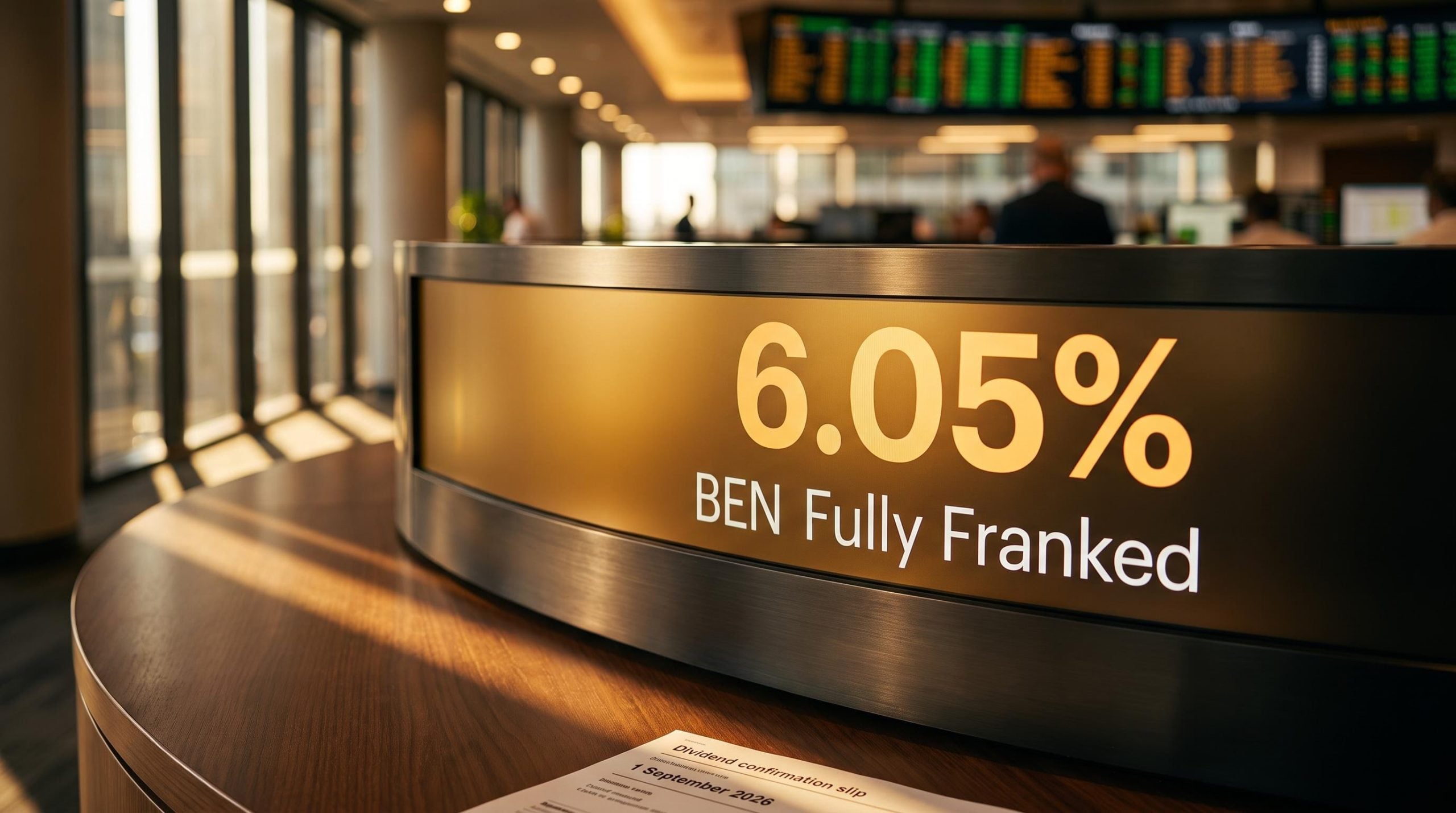
Bendigo and Adelaide Bank has reported cash earnings of A$530.2 million for the year ended 30 June 2026 and declared a 33 cent fully franked final dividend, bringing the annual payout to 63 cents per share. On the current share price, the trailing yield works out to roughly 6.05%. The ex-dividend date is 1 September 2026, one week from today.
Fully franked yields at or above 6% are rare among ASX 200 banks in the current environment. For income-focused investors, particularly SMSFs and retirees relying on franking credit refunds, the FY2026 result raises two immediate questions: how durable is that income stream, and what trade-offs come with it?
Here is what the numbers actually tell you about whether BEN belongs in an income portfolio, and what you need to know before the ex-dividend window closes.
BEN posts A$530 million cash profit as second-half momentum builds
The headline is 3% cash earnings growth. That is modest, and on its own it would not generate much enthusiasm.
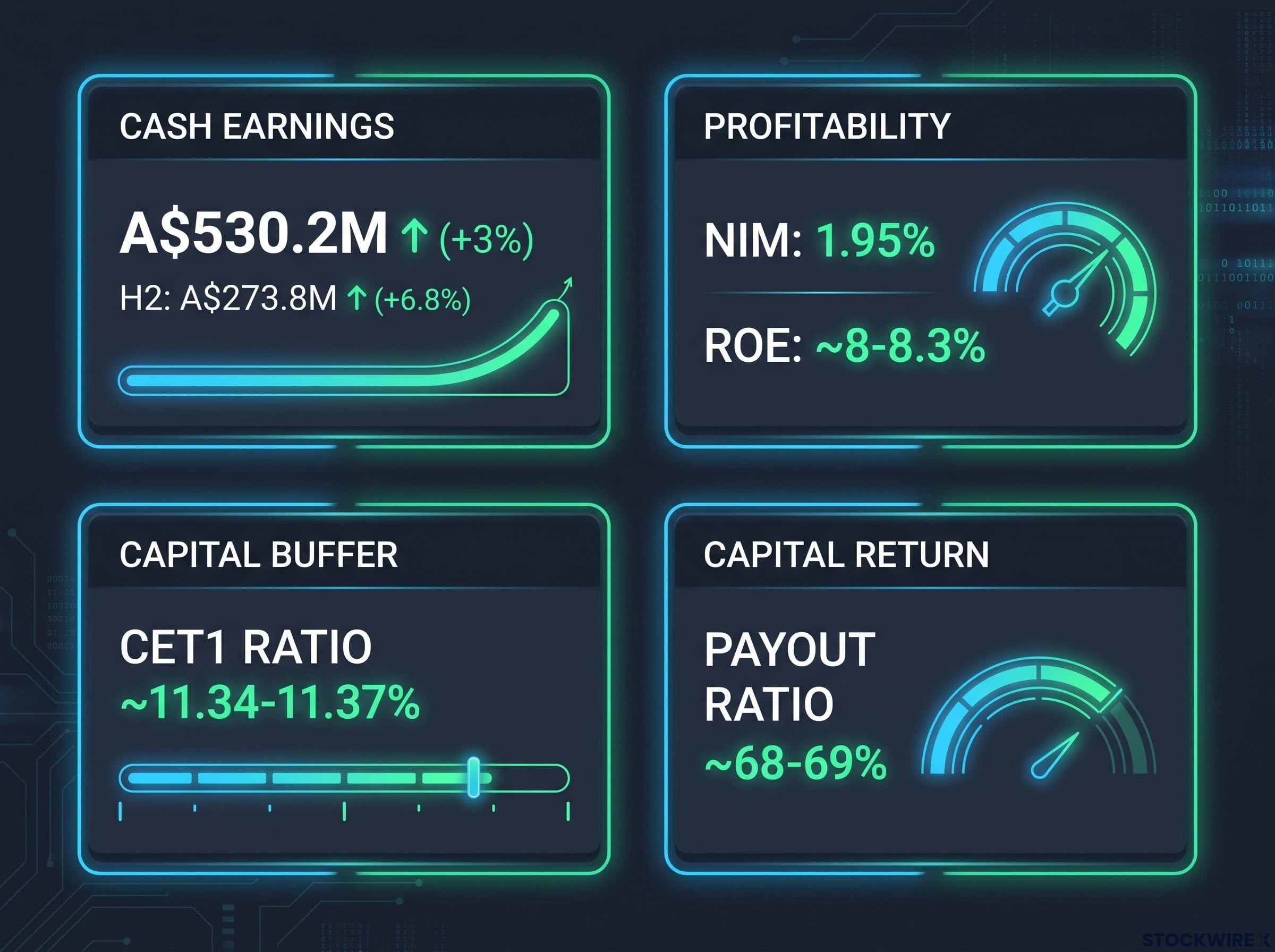
The more revealing figure sits underneath it. The second half delivered cash earnings of A$273.8 million, which was 6.8% ahead of the first half of FY2026. The business was not flat for twelve months; it was accelerating.
A$530.2 million in cash earnings, up 3% on FY2025, with second-half momentum at 6.8% growth.
Full-year statutory net profit after tax came in at A$375.1 million, compared with a A$97.1 million loss in FY2025. That prior-year loss was driven almost entirely by a A$539.5 million goodwill impairment charge, so the rebound reflects a return to normalised profitability rather than a step-change in the business. Strip out the impairment noise, and the underlying trajectory is steady improvement rather than dramatic turnaround.
Margin and volume trends
Net interest margin (the gap between what a bank earns on loans and pays on deposits) improved to approximately 1.95% for the full year and 1.98% in the second half.
- Lending balances grew 3.5% over the second half of FY2026
- Customer deposits reached approximately A$74.1 billion, up 2.2% over the same period
The second-half acceleration is the number that matters most here. It tells you the business was building through the year, which is a more favourable read on dividend sustainability than a flat annual growth rate would suggest on its own.
When big ASX news breaks, our subscribers know first
A 63 cent fully franked dividend and everything income investors need to know before 1 September
The final dividend is 33 cents per share, fully franked. Adding the 30 cent interim dividend from March 2026 brings the total for the year to 63 cents per share, a figure the bank has maintained consistently since 2024.
Three dates matter:
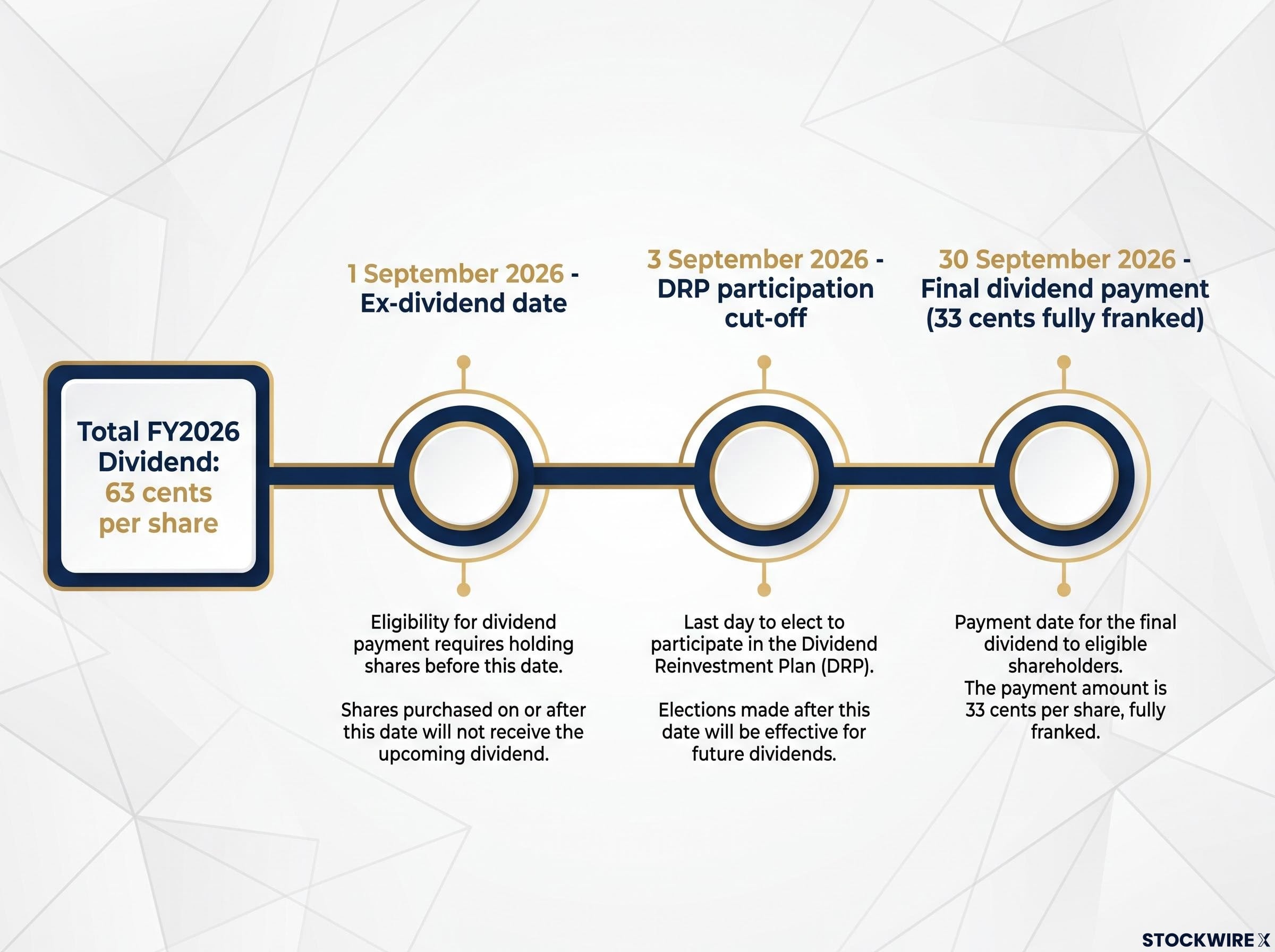
- Ex-dividend date: 1 September 2026
- DRP participation cut-off: 3 September 2026
- Payment date: 30 September 2026
Investors who prefer not to take cash can elect to receive additional BEN shares instead through the Dividend Reinvestment Plan (DRP).
ASX dividend ex-date mechanics follow T+2 settlement rules that create a one-business-day gap between the ex-dividend date and the record date, meaning the last day to buy BEN shares and qualify for the 33 cent final dividend is the trading day before 1 September 2026.
| Event | Date | Detail |
|---|---|---|
| Ex-dividend date | 1 September 2026 | Must be on register before this date to receive dividend |
| DRP participation cut-off | 3 September 2026 | Deadline to elect shares in lieu of cash |
| Final dividend payment | 30 September 2026 | 33 cents per share, fully franked |
~6.05% trailing yield, fully franked.
The payout ratio sits at approximately 68-69% of cash earnings. That is deliberately income-skewed, and it is one reason BEN appears on so many income-focused watchlists.
For an SMSF in pension phase, the effective yield is materially higher than 6.05%. Full franking means the franking credits attached to each dividend can be refunded in cash by the ATO. On a 33 cent fully franked dividend, the franking credit is approximately 14.1 cents, which means the grossed-up dividend value is closer to 47 cents for that final payment alone. That cash refund is what lifts the effective yield well above the nominal figure for low-tax and zero-tax investors.
What the payout ratio and capital position say about dividend durability
A 6% yield is only attractive if it is repeatable. The capital and cost data give you the evidence to form a view on that.
A payout ratio of 68-69% is sustainable at current earnings growth rates. It is not stretched, but it does leave limited headroom to grow the dividend meaningfully without faster underlying profit expansion. At 3% cash earnings growth, the maths of a near-70% payout ratio is simple: the dividend holds, but it does not climb.
The CET1 ratio (a measure of a bank’s core capital relative to its risk-weighted assets) sits at approximately 11.34-11.37%, a genuine buffer that supports the current payout while reflecting management’s prioritisation of balance-sheet resilience.
| Metric | FY2026 Value | Context |
|---|---|---|
| Payout ratio | ~68-69% of cash earnings | Sustainable but limited room for dividend growth |
| CET1 ratio | ~11.34-11.37% | Strong capital buffer supporting current payout |
| Return on equity | ~8-8.3% | Below major-bank levels; constrains capital returns |
| Cost-to-income ratio | Low-60% range (63.0% in 1H) | Improving, but high relative to major-bank peers |
Cost discipline and the risk-remediation drag
Operating expenses fell 2.1% in the second half versus the first half of FY2026, a constructive signal. But the full-year cost-to-income ratio in the low-60% range remains high relative to major-bank peers, and full-year operating expenses still grew 4.2%.
The figure to watch most closely sits in the risk-remediation line:
- Risk-remediation costs: approximately A$49 million pre-tax
- After-tax impact: approximately A$9.8 million, equating to around 9% of cash earnings
That 9% drag is where the dividend story could shift in either direction. If the risk-remediation programme concludes and that cost line reduces, there is a credible path to either dividend growth or improved return on equity. If it persists or expands, the payout ratio starts to look less comfortable at current earnings levels.
How BEN sits among ASX 200 income options, and who this result is actually for
At 6.05%, fully franked, BEN’s trailing yield puts it in a very short list of ASX 200 blue-chip stocks that clear the 6% threshold. That is a genuinely high number for an established bank. But it comes with a regional-bank risk profile that is meaningfully different from the major four, carrying distinct credit-cycle sensitivity and scale disadvantages that the headline yield does not immediately communicate.
A broader ASX bank yield comparison across the six major listed banks in August 2026 shows BEN’s 6.05% sitting near the top of the fully franked peer group, with only BOQ’s 6.26% clearing a higher threshold and carrying a history of dividend variability that BEN has largely avoided in recent years.
BEN is a natural fit for a specific investor profile:
- Retirees seeking reliable, tax-effective income with a predictable payment schedule
- SMSFs in pension phase who can convert franking credits into cash refunds, lifting effective yield well above the nominal figure
- Conservative income investors who accept modest capital growth expectations in exchange for yield stability
- Diversified income portfolios where BEN serves as a yield anchor alongside holdings with higher growth potential
The return on equity of 8-8.3% is the structural reason BEN is an income holding rather than a growth holding. Major banks typically deliver higher ROE, which supports stronger capital appreciation over time. Without acceleration in underlying profit growth, near-term share price gains are likely to remain modest.
The distinction between total return versus yield matters directly for BEN: with an ROE of 8-8.3% constraining capital appreciation, investors accepting modest share price growth in exchange for income stability are making a deliberate trade-off that yield-only framing does not fully capture.
BEN is a yield anchor, not a compounding machine, and the FY2026 result confirms rather than changes that positioning.
Watchpoints for the year ahead:
- Progress on risk-remediation cost reduction
- Net interest margin trajectory as lending and deposit competition intensifies
- Whether second-half cost discipline carries into FY2027
- Capital allocation decisions: dividend growth versus balance-sheet strengthening versus accelerated programme completion
What BEN’s FY2026 result means for income investors before the window closes
The FY2026 result neither upgrades nor downgrades the BEN income thesis. It validates it. Modest but real earnings growth, a durable fully franked yield, and a balance sheet that supports the current payout without requiring heroic assumptions about profit acceleration.
The decision for investors is not whether BEN has changed. It is whether the existing profile fits your portfolio needs at the current price and yield.
Three variables will determine whether the income story strengthens or stalls in FY2027:
- Risk-remediation costs: whether the approximately A$49 million pre-tax drag begins to reduce
- Net interest margin direction: whether the 1.98% second-half margin holds as competition for deposits intensifies
- Cost discipline: whether the second-half improvement in operating expenses proves structural or temporary
The ex-dividend date is 1 September 2026, one week from publication. Investors assessing whether to act before that date should verify the current share price and consult their adviser or broker.
For SMSF trustees and retirees wanting to confirm their eligibility before the 1 September ex-dividend date, our full explainer on franking credit eligibility rules covers the 45-day holding period requirement, the small shareholder exemption, and the ATO’s automatic refund process introduced in the 2024-25 tax year.
The annual dividend is 63 cents per share, fully franked, with second-half earnings momentum of 6.8% providing a more constructive backdrop than the 3% full-year headline suggests. For the right investor, that combination remains one of the more defensible income propositions on the ASX 200.
This article is for informational purposes only and should not be considered financial advice. Investors should conduct their own research and consult with financial professionals before making investment decisions. Past performance does not guarantee future results.