
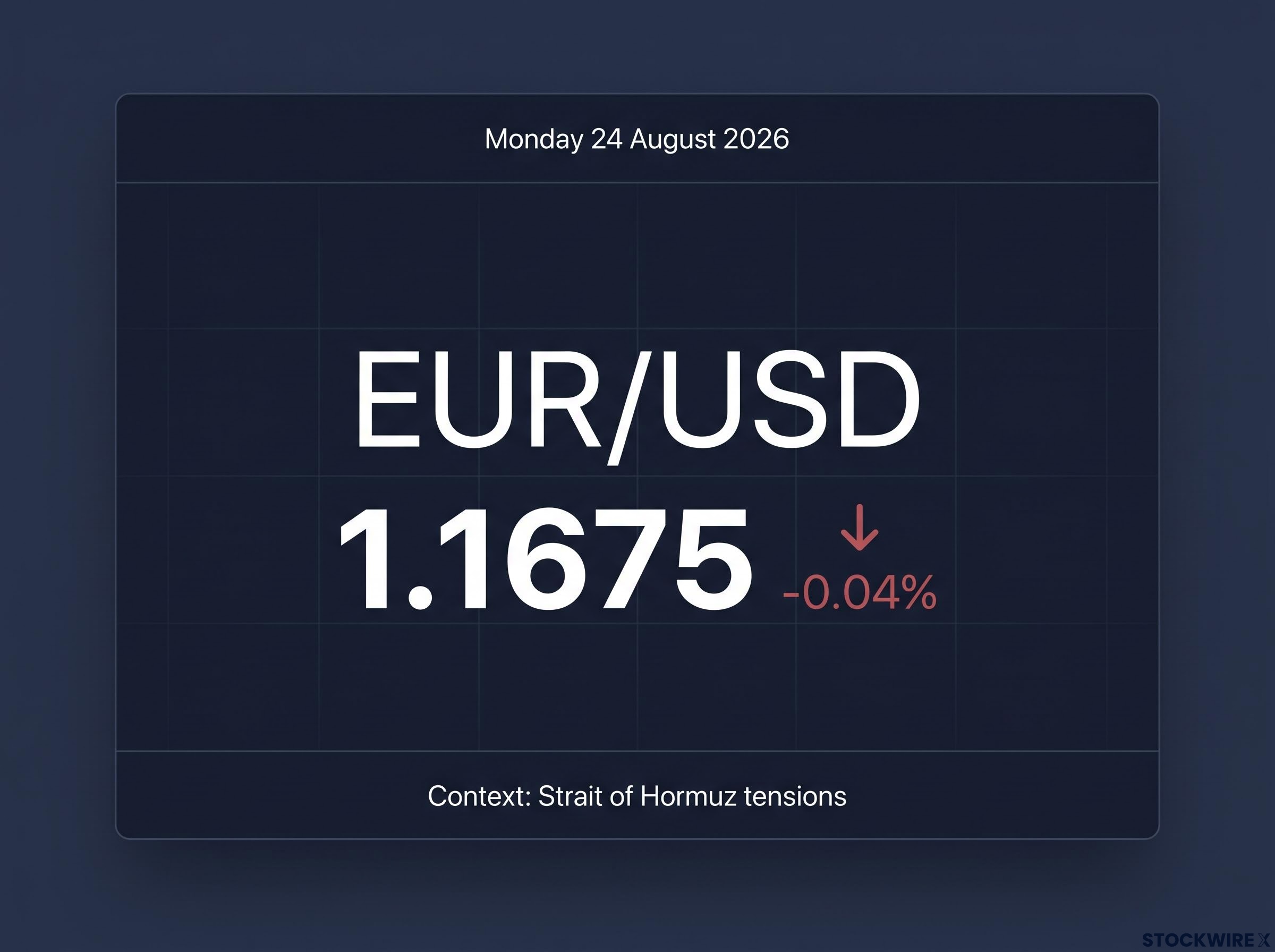
EUR/USD edged down 0.04%, changing hands at around 1.1675 on Monday 24 August 2026, after European Central Bank (ECB) Executive Board member Piero Cipollone spoke to Italian outlet ilsussidiario.net and assessed that Strait of Hormuz tensions producing a stagflationary outcome in the euro area remains a highly unlikely scenario.
The comment matters because stagflation, a combination of stagnant growth and accelerating inflation, is the scenario that would force the ECB into its most uncomfortable policy trade-off: choosing between fighting prices and protecting growth. With energy prices elevated by Hormuz tensions, markets have been watching for any sign the ECB sees that trap forming. Cipollone’s answer was unambiguous: it does not.
Here is what the ECB’s signal actually tells you about where EUR/USD goes from here, which conditions would change that assessment, and why the catalysts that matter most this week are being set in Washington, not Frankfurt.
EUR/USD slips as Cipollone rules out stagflation spiral
The pair drifted lower on Monday rather than rallying on reassurance, and that reaction is itself the story worth reading. EUR/USD was changing hands near 1.1675, marking a 0.04% loss on the day, after Cipollone’s interview was published on the sidelines of the Rimini Meeting.
Cipollone stated that the risk of the Strait of Hormuz crisis producing stagflation in the euro area is “rather remote,” adding that there are signs the crisis could soon be resolved, with oil prices already pointing in that direction.
A central banker publicly dismissing a tail risk would, in a different rate environment, be a signal to buy the currency. The euro’s failure to catch a bid tells you something specific: the market had already moved past stagflation as its base case for Europe. Removing the fear did not shift expectations toward renewed ECB hawkishness, which is the only channel through which the euro picks up rate-differential support against the dollar.
The supply-side stagflation threat Cipollone addressed on Monday has already produced measurable portfolio repricing globally, with Barclays strategists identifying the April-to-July 2026 rally in financial and cyclical sectors as the composition most exposed should Brent crude sustain in the $90-$100 range on unresolved geopolitical supply constraints.
For anyone watching the pair, the flat reaction confirms an asymmetry. Stability is priced in. The euro needs a positive surprise to move higher, and Monday’s remarks were not it.
Why the ECB is not alarmed by the energy shock
Cipollone’s confidence is not rhetorical. It rests on a specific analytical framework the ECB uses to distinguish between an energy price shock that passes through the economy temporarily and one that embeds itself permanently in wages and prices.
The transmission channel works like this: Hormuz tensions push up crude prices, which raise input costs for European manufacturers and transport operators, which in turn lift consumer prices. That first round of passthrough is visible in the data and the ECB acknowledges it. The question is whether a second round follows, where workers demand higher wages to compensate for lost purchasing power, and businesses raise prices further to cover those wage increases, creating a self-reinforcing loop.
The analytical tension at the core of Monday’s remarks is not new: the ECB rate response to supply shocks has been contested since eurozone energy prices first surged in early 2026, with critics arguing that tightening monetary policy cannot produce more oil supply or reopen disrupted shipping lanes.
Stagflation (a period where inflation stays elevated while the economy stagnates simultaneously) is what happens when that second round takes hold and the central bank cannot cut rates to support growth without risking even higher prices.
Cipollone’s assessment, grounded in the June 2026 Eurosystem staff macroeconomic projections, is that the data is tracking the ECB’s baseline scenario. Inflation remains “a long way” from the adverse and severe stress scenarios the bank models internally. He characterised current monetary policy as needing to be “well calibrated” in the context of supply-side shocks, a phrase that signals patience rather than panic.
The ECB is watching three specific conditions that would change that assessment:
- Energy price passthrough to production costs: Present but contained within baseline expectations
- Wage settlement trends: No evidence of the accelerating pay demands that would signal second-round effects embedding
- Second-round effects in services pricing: The critical channel where energy costs translate into broader inflation, and currently not visible in the data
The absence of second-round effects is the specific condition keeping the ECB in its current “well calibrated” posture rather than pivoting toward either tighter or looser policy. If you are tracking the ECB’s next move, those three data points are where a shift would become visible first.
What actually drives EUR/USD from here
With the ECB leg of the equation now signalling stability and optionality, the directional risk for EUR/USD this week concentrates almost entirely on the U.S. side.
Cipollone’s remarks removed one source of uncertainty: the possibility that the ECB would be forced into an emergency policy response to a stagflationary spiral. That is off the table for now. What remains is the rate differential between the Fed and the ECB, and the next data points that could widen or narrow it are all American.
Jackson Hole Fed communication this week carries unusually high signal value in the Warsh era, where forward guidance has been formally abandoned and every major event has become genuinely live for rate expectations, removing the policy buffer that previously dampened EUR/USD reactions to central bank gatherings.
Three U.S.-side catalysts carry the most weight for EUR/USD positioning this week:
- Jackson Hole Symposium messaging: The annual gathering of central bankers, typically held in late August, is the Fed’s most closely watched communication event outside of rate decisions. Any shift in language on the pace or timing of rate cuts could reprice the dollar materially.
- U.S. inflation data releases: Upcoming prints will either confirm or challenge the Fed’s current rate path expectations. A surprise in either direction moves the dollar.
- Tariff and trade policy developments: Further U.S. tariff escalation targeting European exports is the one variable that could interact with energy price risk to darken the eurozone growth outlook, even if Cipollone’s stagflation dismissal holds domestically.
For EUR/USD positioning, Cipollone’s remarks reduce one tail risk but leave the pair’s direction entirely contingent on how U.S. data and Fed messaging land this week.
What the ECB signal changes, and what it does not
Monday’s remarks settled one specific question: stagflation is not the ECB’s working assumption, and the data does not support treating it as a near-term risk. That is a meaningful narrowing of the uncertainty set.
What it did not settle is where ECB rates go next. Cipollone’s “well calibrated” formulation signals a watching posture. The ECB is neither pre-committing to cuts nor signalling further hikes. It is sitting in a data-dependent middle ground, which is itself a policy posture the market can price.
The 0.04% slip on a day of reassurance tells you the remaining uncertainty in the pair lives on the U.S. side. The ECB leg is now the more stable variable. If you are framing your EUR/USD exposure for the rest of this week, that is where your attention should concentrate: Jackson Hole, U.S. inflation, and whether tariff policy introduces a growth shock the ECB has not yet priced.
Investors tracking the U.S. side of the EUR/USD equation will find our full explainer on the dollar’s 2026 rate-differential rally covers Morningstar’s overvaluation estimate, the June FOMC catalyst, and the structural headwinds that could compress the yield advantage driving current dollar strength.
This article is for informational purposes only and should not be considered financial advice. Investors should conduct their own research and consult with financial professionals before making investment decisions.
Forward-looking statements regarding ECB policy, Fed communication, and currency pair movements are speculative and subject to change based on market developments and incoming data.