In Q1 2026, international exchange-traded funds overtook domestic funds as the most purchased ETF category on the Selfwealth by Syfe platform, a single data point that captures a broader shift in how Australian portfolios are being built. The crossing came against a backdrop of persistent inflation, elevated interest rates, and geopolitical friction that has pushed retail investors to look beyond an ASX structurally concentrated in financials and resources. The Selfwealth by Syfe Quarterly Investor Pulse (April 2026) offers rare generational granularity on this shift, revealing not just what Australians say they plan to invest in, but how they actually allocated capital across the quarter. What follows is a generationally segmented map of Q1 2026 portfolio construction behaviour, the structural forces converging across age groups, and what the data signals about where Australian investment trends are heading.
International ETFs just overtook domestic funds. Here is what actually shifted
The overtake was not sudden. International ETFs had been closing the gap on domestic equivalents for several quarters, but Q1 2026 marked the point where the line crossed on the Selfwealth by Syfe platform. For a market where home bias has historically defined retail portfolios, this is a directional change worth measuring.
The broader market data confirms the scale. Vanguard MSCI Index International Shares ETF (VGS) led all ETF inflows nationally with $361 million in January 2026 alone. ETFs now represent 17% of the average Australian investor’s portfolio, a record high, and 80% of ETF investors plan to increase their holdings in 2026.
In March 2026, the Australian ETF market recorded $5.6 billion in net inflows, the third-highest monthly figure on record.
Three structural drivers sit beneath this shift:
- ASX concentration constraints: The domestic market’s heavy weighting toward financials and resources limits sector diversification for investors relying solely on Australian equities
- Diversification demand: Global exposure across sectors and geographies has become the primary cited driver of ETF adoption among retail investors
- Platform accessibility: Digital platforms have reduced the friction and cost of accessing international ETFs, removing barriers that once kept retail capital onshore
The logic is not fashionable. It is arithmetic. An index dominated by two sectors creates a structural ceiling on diversification, and Australian investors are responding with their capital.
The structural ceiling created by ASX home bias, a decades-long tendency for Australian retail portfolios to sit overwhelmingly in domestic equities, is precisely what the Q1 2026 data suggests is breaking down, with international ETF inflows now outpacing domestic equivalents on a sustained basis rather than as a one-quarter anomaly.
When big ASX news breaks, our subscribers know first
Gold’s retreat and the rotation it is revealing
Gold buying activity fell below 70% of total gold-related trades on the platform in Q1 2026, down from elevated levels during the late 2025 period of heightened geopolitical uncertainty. Read in isolation, this looks like a loss of conviction.
Read alongside the destination of the capital, it looks like something else entirely.
Investors rotated out of defensive gold positioning and toward financial sector stocks and growth-focused assets, a pattern the data presents as a sentiment improvement indicator. The shift suggests that Q1 2026 diversification behaviour was not purely defensive. There was a simultaneous move toward growth exposure.
Betashares Global Gold Miners ETF (MNRS) returned 100.83% as at 31 March 2026, driven by central bank buying and commodity price surges.
Gold’s performance remained strong even as retail buying activity declined, a divergence that reveals the nature of the rotation. Investors were not fleeing a poor performer. They were rebalancing away from a trade that had already delivered.
- Cyclical role: Gold functions as an uncertainty hedge; buying rises and falls with confidence cycles, and Q1 2026’s decline reflects improved sentiment rather than a structural abandonment
- Structural role: ETFs serve as long-term core holdings built around diversification and compounding; demand for these products is less sensitive to short-term sentiment shifts
The gold data, in other words, matters less for what it says about gold and more for what it reveals about where conviction was moving.
The generational split that is quietly converging
The Selfwealth by Syfe platform data breaks portfolio construction down by generation, and the initial picture looks like familiar territory. Millennials hold the heaviest ETF weighting at approximately 70%. Gen Z splits roughly 50/50 between ETFs and individual equities. Baby Boomers remain primarily stock-focused but are progressively adding ETF exposure.
The surprise sits in the middle of the table.
| Generation | Approximate ETF allocation | Approximate equities allocation | Defining characteristic |
|---|---|---|---|
| Baby Boomers | Lower, growing | Majority | Primarily individual stocks; progressively adding ETFs |
| Gen X | ~50% | ~50% | Balanced split mirroring Gen Z |
| Millennials | ~70% | ~30% | Most ETF-committed cohort |
| Gen Z | ~50% | ~50% | Disciplined split; mirrors Gen X pattern |
Gen Z and Gen X share a near-identical allocation structure. That disrupts the assumption that younger investors are purely passive-ETF buyers; Gen Z is maintaining active equity exposure at a level that mirrors the generation with the most investing experience outside the Boomer cohort.
Gen Z’s disciplined 50/50 split also reflects a documented tendency toward dip-buying during volatility, a behaviour pattern distinct from the passive accumulation model that defines Millennial ETF adoption, and one that helps explain why the younger cohort maintains active equity exposure at levels that mirror the most experienced non-Boomer generation.
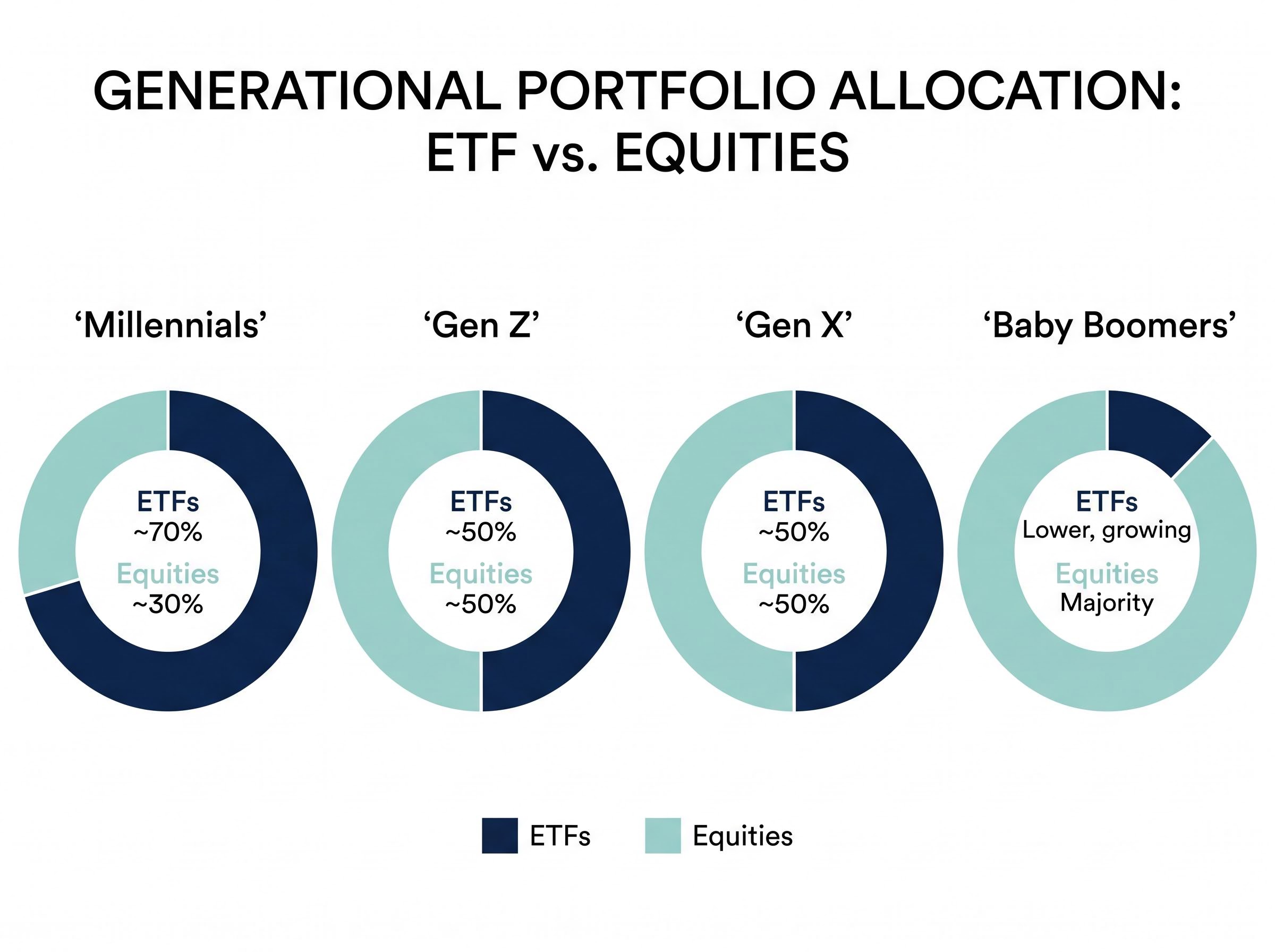
Millennials stand apart as the most ETF-committed generation, a position driven by life stage: peak accumulation years, long time horizons, and deep comfort with digital platforms converge to make broad, low-cost index exposure the natural default.
Why the gap is narrowing across all cohorts
The differences remain real, but they are compressing. Reduced barriers to entry, greater access to financial information, and digital platform growth are structural forces pulling all generations toward more similar portfolio shapes. Baby Boomers are adding ETFs. Gen Z is adopting them alongside active stock selection. The movement is directionally consistent.
Betashares forecasts 300,000 new ETF investors in 2026, pushing total participation beyond three million. That broadening base is not concentrated in one age group. It is distributed across all of them.
What ETFs actually are, and why they suit every generation differently
An exchange-traded fund is an investment product that tracks a specific index, sector, or theme and trades on a stock exchange in the same way an individual share does. A single ETF purchase provides exposure to dozens or hundreds of underlying securities, delivering diversification, low cost, and transparency in one instrument.
The distinction between domestic and international ETFs matters for Australian investors. Domestic ETFs such as VAS (Australia’s largest by assets at $23.32 billion) and A200 track the ASX. International ETFs such as VGS (which led January 2026 inflows at $361 million) and IVV provide access to global developed markets and the S&P 500 respectively.
Diversification across global markets and sectors is the primary driver of ETF adoption among Australian investors, according to industry survey data.
Four characteristics consistently emerge as the reasons investors cite for choosing ETFs:
- Diversification: Broad market exposure through a single holding
- Low cost: Management fees typically well below actively managed alternatives
- Simplicity: One purchase replaces the need to research and monitor multiple individual positions
- Long-term core suitability: ETFs function as foundational portfolio holdings designed for compounding over years, not trading over weeks
These characteristics explain why ETFs appeal across generational lines, even as each cohort weights them differently. A Millennial in peak accumulation may build an entire portfolio around international ETFs. A Baby Boomer may add a domestic ETF to complement an existing stock portfolio. The product fits both use cases because the mechanics are the same; only the allocation percentage changes.
The speed of the market has changed, and so has investor behaviour
Two data points from the Selfwealth by Syfe platform illustrate how quickly Australian retail investors now respond to macroeconomic events:
- Trading volumes doubled during the US tariff announcement in April 2025, as investors moved to reposition portfolios in response to trade policy shifts
- Platform activity declined more than 20% following the RBA rate hike in March 2026, as investors stepped back from markets amid monetary tightening
The mechanism is straightforward. Information that previously took days or weeks to be reflected in market prices is now incorporated almost immediately, driven by real-time data access, mobile platforms, and a generation of investors who monitor portfolios continuously. The RBA’s February 2026 Statement on Monetary Policy assumes the cash rate will rise by approximately 60 basis points by end-2026, a trajectory that provides ongoing catalysts for this kind of rapid behavioural response.
The RBA’s February 2026 Statement on Monetary Policy projects a cash rate increase of approximately 60 basis points by end-2026, a trajectory that gives retail investors a forward-looking framework for anticipating the kind of platform activity declines observed after the March 2026 rate decision.
Geopolitical tensions, including the Iran conflict, were cited as drivers of the March 2026 inflow surge that produced the $5.6 billion monthly figure. Capital moved fast, and it moved toward diversification.
Reacting versus rebalancing: where the line sits
There is a tension between this reactive pattern and the disciplined ETF-first construction behaviour documented in earlier sections. The same investors building long-term, diversified portfolios through international ETFs are also doubling their trading activity in response to a single tariff headline.
The distinction between reactive trading and strategic rebalancing matters. Reactive trading involves buying or selling in direct response to a single headline, often reversing the position days later. Strategic rebalancing involves adjusting allocations because a long-term view has genuinely changed, for example shifting from unhedged to hedged international exposure after a sustained currency move.
The Selfwealth by Syfe platform recommends dollar-cost averaging and recurring investment approaches as structural methods for maintaining discipline across volatile periods, a framework designed to keep the long-term allocation strategy intact even when short-term impulses are strongest.
Dollar-cost averaging into diversified index products is the framework most consistently recommended for investors navigating the tension between reactive market participation and long-term accumulation strategy, providing a structural discipline that absorbs volatility without requiring investors to predict entry points.
The structural forces that make this convergence durable, not cyclical
The generational convergence and international ETF shift documented in Q1 2026 data could be dismissed as products of a specific market moment: a geopolitical shock, a rate cycle, a tariff headline. The structural evidence points elsewhere.
Three forces are pulling Australian retail investing toward its current shape, and none of them are reversible:
- Digital platform accessibility: The cost and complexity of accessing international ETFs has fallen permanently, removing barriers that once kept retail capital concentrated in domestic equities
- Democratised financial information: The information asymmetry that historically favoured institutional investors has narrowed to the point where retail investors can access the same data, analysis, and commentary in real time
- ETF product fit with long-horizon preferences: The product structure of ETFs, low-cost, diversified, and designed for compounding, aligns with the investment approach that the majority of new market entrants adopt by default
The scale of new participation reinforces this reading. Betashares forecasts 300,000 new ETF investors in 2026, with total participation exceeding three million.
The Betashares and Investment Trends ETF Report, published in late 2025, provides the industry survey data underpinning both the 300,000 new investor forecast and the finding that 80% of existing ETF holders plan to increase allocations in 2026, figures that frame the current participation surge as a measured projection rather than speculative extrapolation.
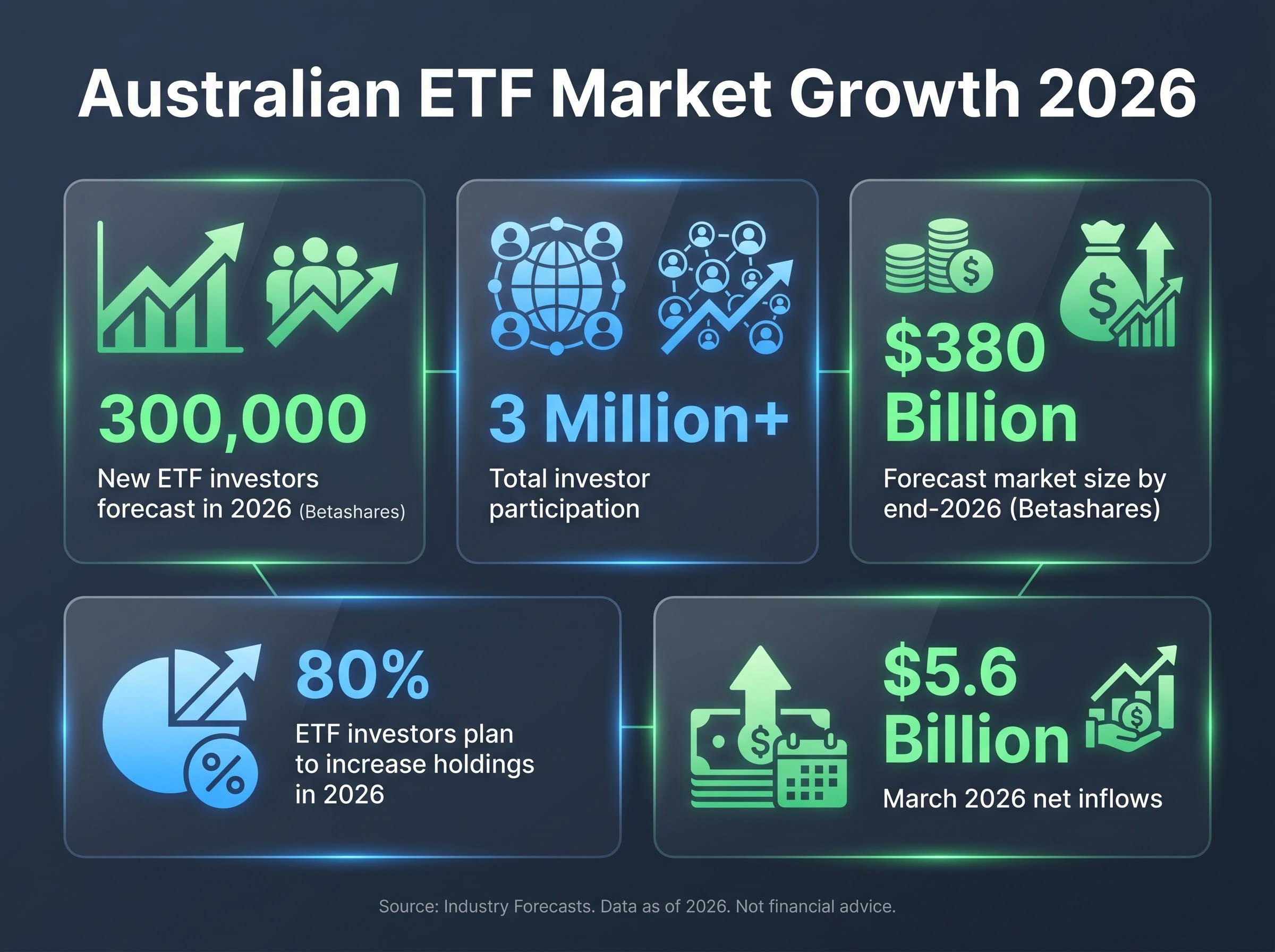
Betashares forecasts total ETF market growth to $380 billion by end-2026, a figure that reflects both new capital inflows and the broadening investor base.
Currency-hedging behaviour adds a further layer. Hedged international ETFs returned approximately 2.9% in early 2026, while unhedged equivalents posted negative returns amid AUD strength. The shift toward hedged products (such as QHAL over its unhedged counterpart QUAL) indicates that retail investors are becoming more sophisticated in their execution, not just more numerous in their participation.
The currency dynamic underlying hedged versus unhedged international exposure became materially consequential in early 2026, as AUD strength against the USD penalised unhedged positions while the Hormuz crisis introduced a new variable into energy-sensitive currency valuations that traditional rate-differential frameworks had not accounted for.
A market in structural motion, not just cyclical noise
The Q1 2026 data describes a market in structural transition. International ETFs have overtaken domestic funds as the most purchased category. Millennials are allocating approximately 70% to ETFs while Gen Z maintains a disciplined 50/50 split. Gold buying has declined not because gold failed, but because confidence improved and capital rotated toward growth. And the same investors building long-term portfolios are trading at double their normal volumes when a tariff headline lands.
These patterns are not contradictions. They are the composite portrait of an investor base that is growing larger, more globally diversified, and more sophisticated in its product selection, while still susceptible to the behavioural pull of event-driven markets. The RBA rate trajectory (approximately 60 basis points of hikes assumed by end-2026) and the geopolitical backdrop suggest the forces driving ETF adoption are not abating.
80% of ETF investors plan to increase their holdings in 2026, a figure that frames the three million investor milestone as a floor rather than a ceiling.
This article is for informational purposes only and should not be considered financial advice. Investors should conduct their own research and consult with financial professionals before making investment decisions. Past performance does not guarantee future results. Financial projections are subject to market conditions and various risk factors.