Global oil prices surged past $118 per barrel in the first quarter of 2026, yet Australian retail capital simultaneously flooded into international equities. This stark contrast between energy market anxiety and aggressive equity acquisition highlights an investment environment pulling in two distinct directions. Domestically, the Reserve Bank of Australia (RBA) continues to battle sticky inflation with consecutive cash rate increases that pressure local valuations.
Caught between these local constraints and international momentum, traditional reactive trading frameworks are underperforming. Establishing resilient investing strategies offers the most reliable method to replace emotional market timing with systematic portfolio management. The current transition from the macroeconomic volatility of early 2026 into the second quarter demands a recalibrated approach to asset allocation.
Navigating the RBA Policy Crosscurrents and Commodity Shocks
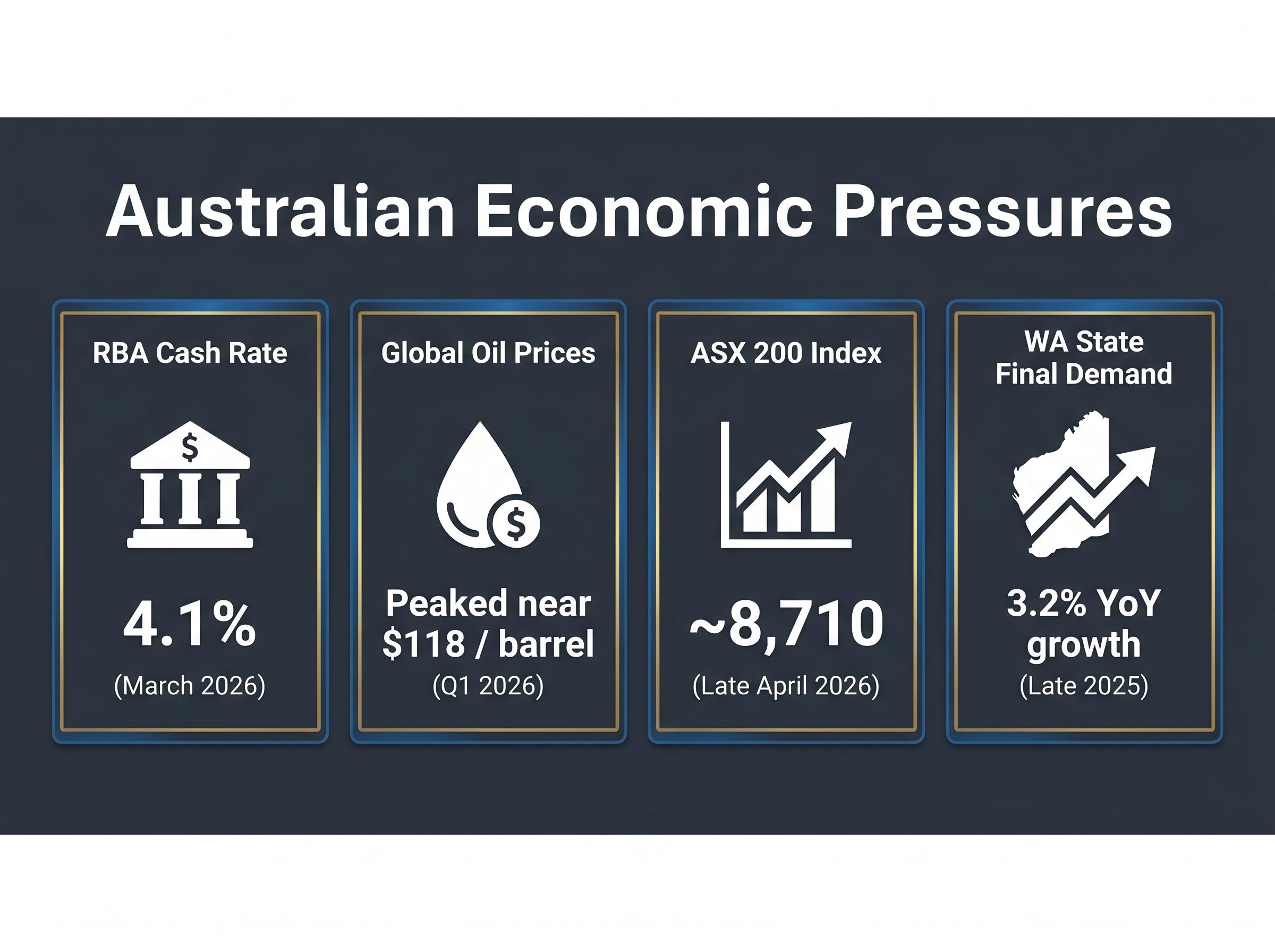
The Australian economic conditions are currently defined by the friction between persistent localized inflation and unexpectedly strong private demand. The RBA responded to these capacity constraints by pushing the cash rate to 4.1% in March 2026, following consecutive 25-basis-point hikes.
The official RBA monetary policy decision cited persistent core inflation and greater capacity pressures as the primary drivers behind this target adjustment.
Elevated government spending is actively supporting aggregate demand, which in turn curbs the volatility of consumer spending but complicates the central bank’s inflation mandate. Western Australia State Final Demand registered 3.2% year-over-year growth in late 2025, illustrating the localized economic momentum complicating national monetary policy.
RBA Monetary Policy Update The Reserve Bank of Australia’s February 2026 Statement on Monetary Policy noted that the economy remains “further from balance,” with gross domestic product growth running above potential due to strong private demand.
The Impact of Global Commodity Shocks and Geopolitics
The cascading impact of energy markets further destabilized early 2026 valuations. Brent crude oil prices spiked over 90% in the first quarter, peaking near $118 per barrel before settling.
This energy surge rippled through broader Australian market sentiment, applying downward pressure on technology sector valuations while bolstering traditional resource equities. By late April 2026, the ASX 200 index was hovering around 8,710, reflecting a market absorbing these compounded shocks.
International trade developments accelerated this local volatility. Recent American trade duty declarations triggered instantaneous valuation adjustments across local brokerage platforms. Transaction quantities surged following the international tariff news, as traders scrambled to reprice domestic assets exposed to United States supply chains.
When big ASX news breaks, our subscribers know first
The Capital Rotation Away from Safe Havens
Institutional and retail capital flows are actively migrating away from defensive positions and back toward expansionary markets. Investors are transitioning their enthusiasm away from precious metals as global sentiment shows marginal improvement. Spot gold prices hovered near $4,598 USD per ounce in late April 2026, but transaction volumes tell a different story. According to platform data, gold-related asset purchasing volume has fallen beneath 70% of overall platform transaction activity after reaching a peak in late 2025.
Capital is instead finding its way into international exchange-traded products despite the backdrop of global conflict. Australian investors directed $6.9 billion into international equity exchange-traded funds (ETFs) during the first quarter of 2026. This record-breaking inflow indicates a clear preference for geographic diversification over domestic safe havens.
A significant portion of this capital has rotated specifically into international technology funds, effectively using offshore exposure as a modern hedge against the heavily concentrated Australian financial and mining sectors.
An emerging trend is the rotation of profits out of volatile United States technology positions and back into steady domestic Australian shares. By observing where aggregate capital is flowing, market participants can benchmark their own asset allocation against broader confidence levels.
| Asset Class | Q1 2026 Capital Flow Trend | Investor Sentiment Indicator |
|---|---|---|
| International ETFs | $6.9B record inflows | High preference for geographic expansion |
| Gold Transactions | Dropped below 70% platform activity | Decreasing reliance on defensive assets |
| Domestic Equities | Receiving rotated U.S. tech profits | Return to steady local income generation |
The Mechanics of Systematic Wealth Accumulation
High-level macroeconomic volatility demands a foundational transition toward automated, emotion-free wealth building frameworks. When central banks alter monetary policy rapidly, reactive trading often leads to poor capital allocation and crystallized losses. Evidence of this reactive investor paralysis surfaced in early 2026, with platform trading engagement dropping immediately following the Australian central bank rate increases.
Dollar-cost averaging into diversified index products offers a structural defence against the risk of mistiming a volatile market. This systematic approach involves investing a fixed amount of capital at regular intervals, regardless of whether the ASX 200 is peaking or contracting. State Street Global Advisors released first-quarter forecasts predicting steady global growth, a macroeconomic outlook that fundamentally supports the logic of passive index accumulation.
Recent State Street Global Advisors strategy commentary notes that traditional fixed income allocations struggle to provide sufficient stability during high inflation periods, making diversified global equity accumulation essential for long-term growth.
Disciplined capital deployment remains the most commercially viable defence against sudden interest rate announcements and reactive global news cycles.
The primary benefits of implementing an automated recurring transaction system include: Removal of emotional decision-making during sudden market drawdowns. Consistent cost averaging across both market peaks and temporary troughs. * Accelerated compounding efficiency through uninterrupted capital deployment.
Generational Divides in Modern Asset Allocation
Different age brackets approach geographic diversification and single equity risk with distinct philosophies. Older demographic cohorts traditionally favour direct stock picking and heavy concentrations in domestic dividend-paying equities. Conversely, younger platform users are actively broadening their geographic reach to mitigate their reliance on the concentrated Australian market.
Millennial investors demonstrate a heavy reliance on exchange-traded instruments to achieve this structural diversification. According to platform data, this cohort currently dedicates roughly 70% of its investment allocations to broad-market index products. According to platform data, Generation Z and Generation X participants maintain a different balance, holding approximately equal 50/50 capital divisions between single equities and diversified ETFs.
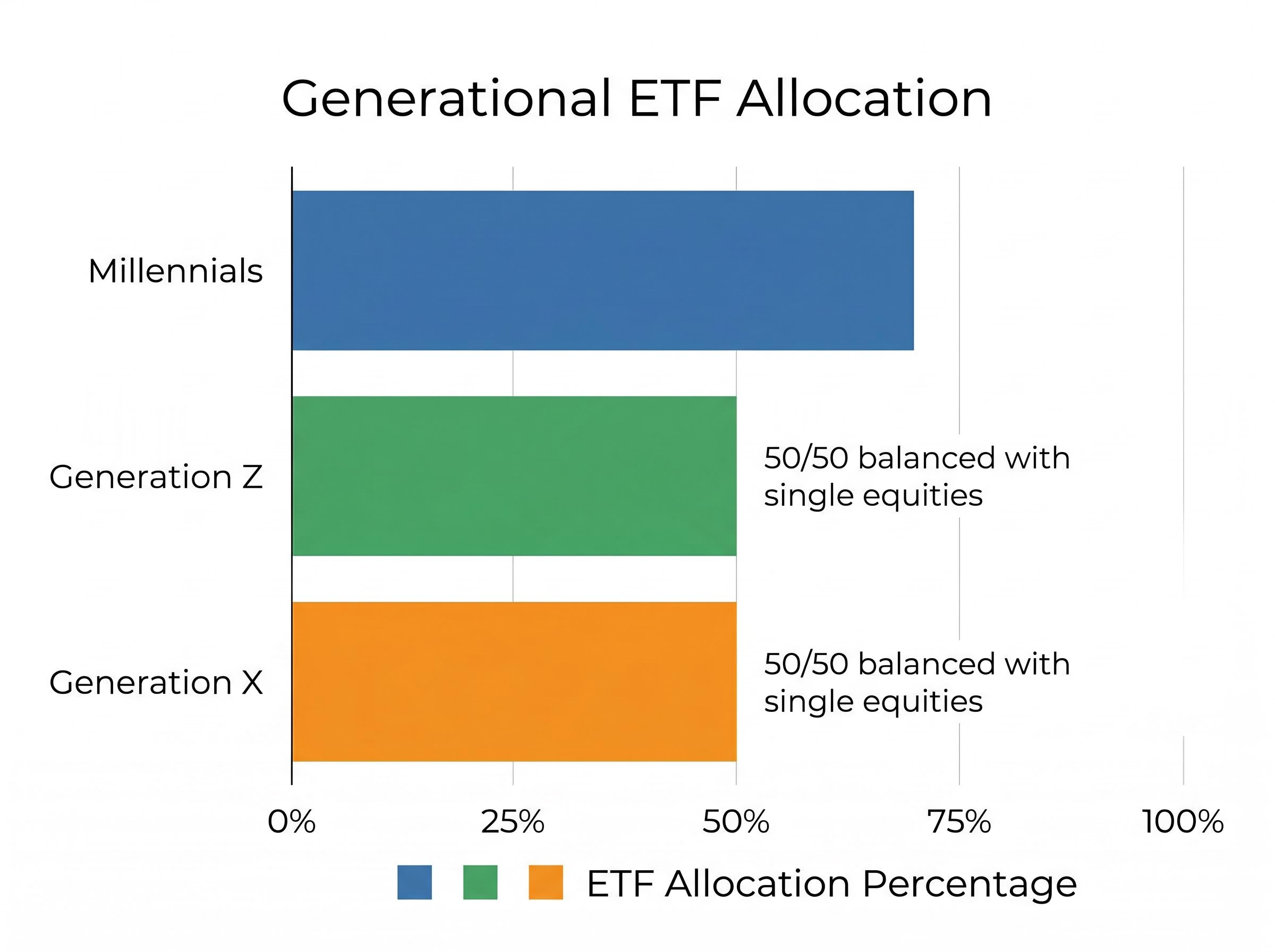
Foreign-focused ETFs surpassed their local equivalents to become the most frequently acquired asset class across platforms in early 2026. Tracking these demographic trends provides tangible social proof regarding the efficacy of modern index-tracking products versus legacy stock-picking methods.
Investors exploring how different demographics are navigating this volatility will find our dedicated guide to generational investing trends highly useful, as it examines the specific offshore sectors younger cohorts are targeting to bypass domestic concentration risk.
| Generation | Primary Asset Preference | ETF Allocation Percentage |
|---|---|---|
| Millennials | International ETFs | 70% |
| Generation Z | Balanced Single Stock / Index | 50% |
| Generation X | Balanced Single Stock / Index | 50% |
Constructing a Resilient Portfolio for a High-Rate Economy
The current economic environment requires specific, defensible portfolio adjustment criteria suited for an ongoing high-rate Australian market. KPMG noted in its first-quarter 2026 outlook that defensive positioning against further monetary tightening remains thoroughly warranted.
Commercial brokerage platforms that facilitate automated indexing are capturing the majority of retail capital flows. Vanguard currently maintains a dominant 27.5% share of the Australian market, reflecting the broader structural shift toward low-cost index products.
Major brokerages universally advise investors to prioritize long-term portfolio resilience over attempting to time rapid intraday market shifts. The most effective commercial frameworks balance steady domestic income assets with international growth opportunities. Applying systematic selection criteria ensures a portfolio can absorb inflation shocks while participating in global recoveries.
Tracking specific ASX sector resilience during inflationary periods reveals that energy, utilities, and financials typically maintain stronger pricing power than consumer-facing industries.
Actionable portfolio construction steps for the current high-rate environment:
- Evaluate automated trading platforms based on their recurring investment fee structures.
- Balance domestic Australian dividend exposure with international growth ETFs.
- Set fixed allocation percentages to prevent emotional overallocation during sector-specific news events.
Sustaining Wealth Through Disciplined Execution
The recent migration of capital out of protective precious metals and into diversified global equities provides a clear signal of underlying economic resilience. While central bank policy adjustments and international tariff negotiations will continue to cause short-term friction, the broader trajectory points toward sustained market expansion. Automated investment systems protect retail participants against the emotional errors that typically accompany this type of macroeconomic friction.
Now is the time to review current asset allocations, eliminate speculative holdings, and implement recurring investment mandates across diversified index products.
Taking proactive steps to recalibrate your portfolio away from highly leveraged enterprises ensures your capital remains anchored to high-margin, low-debt equities with genuine pricing power.
This article is for informational purposes only and should not be considered financial advice. Investors should conduct their own research and consult with financial professionals before making investment decisions.