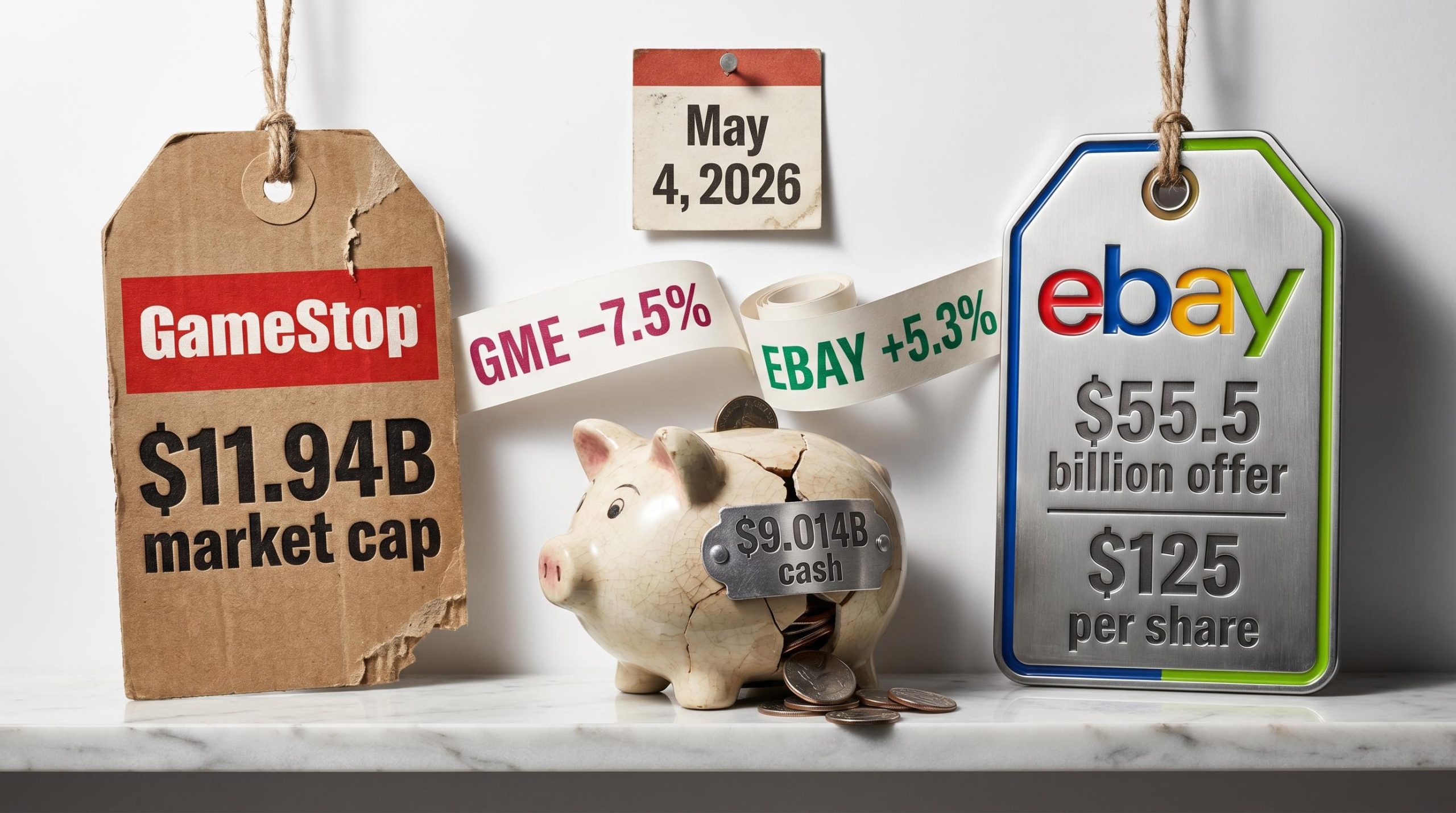
A company with an $11.94 billion market cap just offered $55.5 billion for a company worth more than four times as much. On 4 May 2026, GameStop submitted an unsolicited bid to acquire eBay at $125 per share, and markets responded with immediate, contrasting verdicts on who stands to benefit. The announcement sent GameStop shares down 7.5% and eBay shares up 5.3% in the same session, a split-screen reaction that captures the central tension: institutional scepticism toward the acquirer, and target-side enthusiasm for the premium.
The GameStop eBay acquisition bid is backed by a $20 billion TD financing commitment and GameStop’s $9 billion cash reserve, but leaves a roughly $26.5 billion funding gap that would require enormous share issuance to close. What follows breaks down the deal structure, explains what the market reaction signals about acquirer-versus-target dynamics, and provides context for how hostile M&A mechanics actually work, including what happens next if eBay’s board does not engage.
The deal on the table: $125 a share, a 46% premium, and a $26.5 billion problem
The headline numbers tell their own story. GameStop has offered $125.00 per share for eBay, valuing the target at approximately $55.5 billion. That price represents two distinct premiums, and the distinction matters:
- 46% premium to eBay’s closing price on 4 February 2026, the date GameStop began building its stake. In M&A, this “unaffected price” is the standard reference for evaluating an unsolicited bid.
- 20% premium to eBay’s 3 May 2026 closing price, the near-term market comparison that reflects how much of the bid’s value had already been priced in through stake accumulation rumours.
The financing arithmetic is where the tension sharpens. GameStop held $9.014 billion in cash as of 31 January 2026. The TD commitment letter adds $20 billion. Together, that provides roughly $29 billion in committed resources against a $55.5 billion price tag.
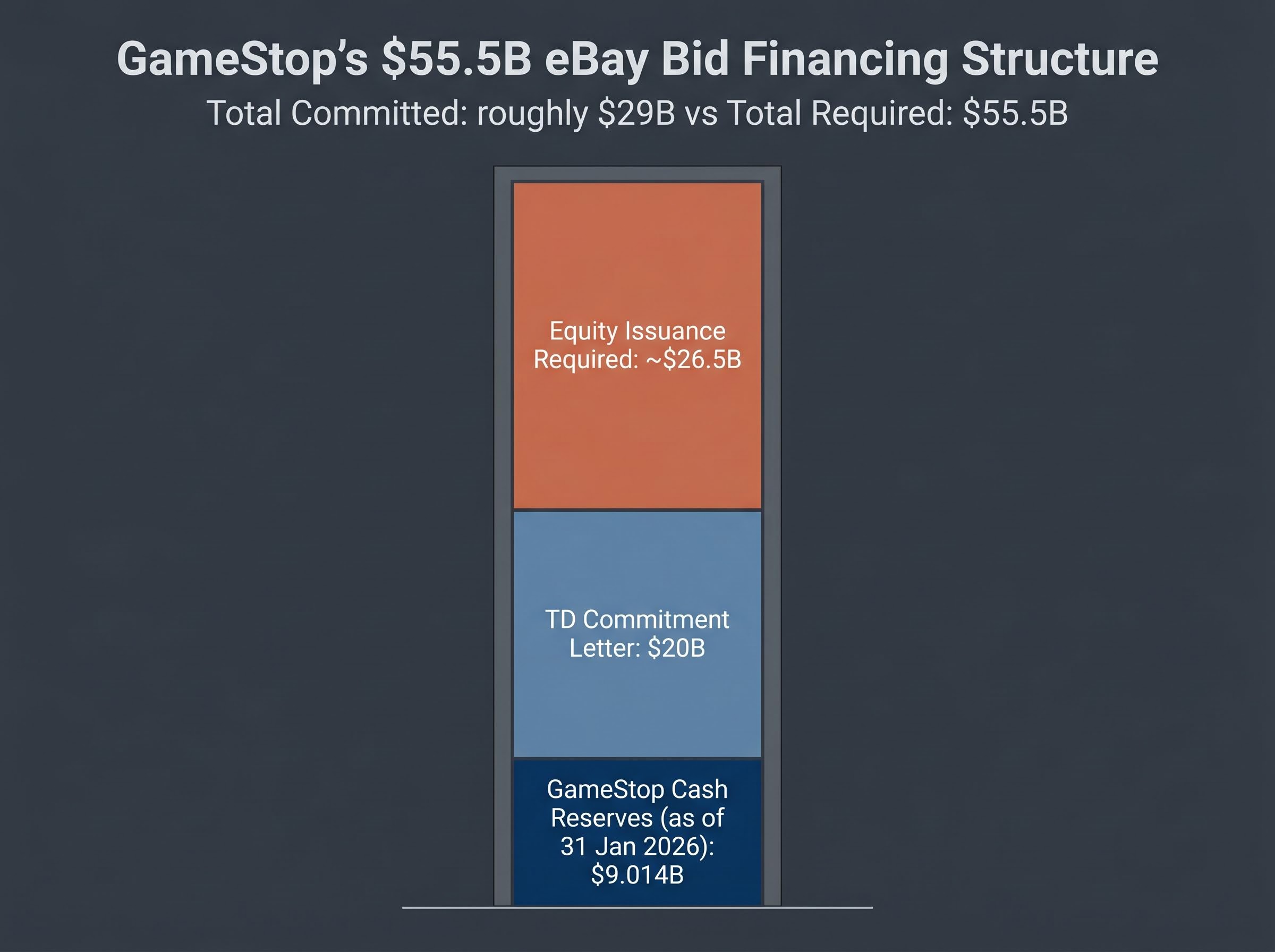
The remaining gap, approximately $26.5 billion, would need to come primarily from stock issuance. For a company with a pre-announcement market cap of $11.94 billion, that implies dilution on a scale that has drawn immediate scepticism.
| Financing Component | Amount | Status |
|---|---|---|
| GameStop cash reserves | $9.014B | On balance sheet (31 January 2026) |
| TD commitment letter | $20B | Committed, conditional |
| Equity issuance required | ~$26.5B | Unfunded; dependent on stock price |
When big ASX news breaks, our subscribers know first
Why markets moved in opposite directions the moment the bid was announced
The price action on 4 May 2026 delivered the market’s verdict before a single analyst note was published.
GameStop fell 7.5% while eBay rose 5.3% in the same session, a divergence that captures the market’s immediate assessment of who benefits from the deal and who bears the cost.
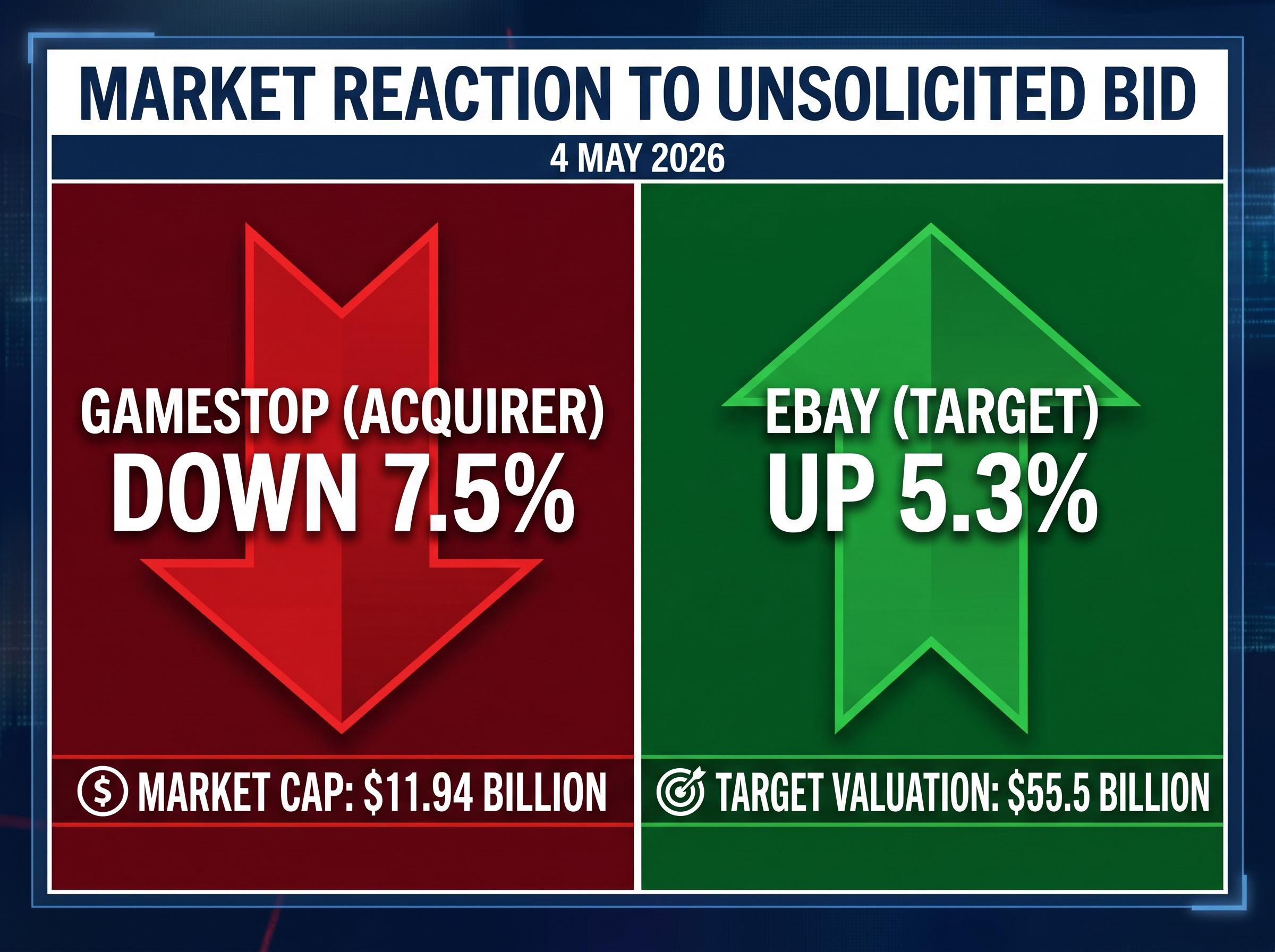
GameStop shareholders sold because the arithmetic points to severe dilution. The deal is approximately 4.6 times GameStop’s own market cap, meaning the stock-based consideration required to close the gap would dramatically expand the company’s share count. Every new share issued to fund the acquisition reduces the value of existing holdings.
eBay shareholders bought because the bid, regardless of its probability of closing, repriced the stock upward. A $125 offer on a stock trading near $104 creates a floor that persists as long as the bid remains live or a competing offer emerges.
NBER research on hostile takeover outcomes consistently shows that target shareholders capture the majority of the value in unsolicited bid scenarios, with premiums averaging 30% to 50% above unaffected prices, while acquirer shareholders frequently bear the cost through dilution and integration risk.
The institutional dimension compounds the problem for GameStop. eBay’s shareholder base includes large professional investors with no appetite for meme-stock exposure. Receiving GameStop equity as deal consideration would mean swapping a stable e-commerce holding for one of the most volatile names in the market, an unattractive exchange for most institutional portfolios.
How unsolicited bids work, and why eBay’s board is not obligated to say yes
An unsolicited bid, sometimes called a hostile bid, is a proposal submitted directly to a target company’s board without prior negotiation or invitation. It differs from a friendly merger, where both sides agree on terms before any public announcement. GameStop’s offer to eBay fits squarely in the unsolicited category: the proposal arrived without eBay’s prior engagement, and as of 4 May 2026, eBay had confirmed receipt but had not issued a formal strategic response.
What eBay’s board is legally required to consider
eBay’s directors have a fiduciary duty to act in the interest of shareholders. That means evaluating the financial adequacy of the $125 offer, assessing whether it reflects fair value, and considering whether engaging with the bidder or seeking alternatives would better serve shareholders. It does not mean the board must accept. Directors can formally reject an unsolicited bid without triggering legal liability, provided the decision is reasoned and documented. GameStop began building its approximately 5% eBay stake around 4 February 2026, giving the board several months of awareness before the formal proposal.
The hostile escalation toolkit
If eBay’s board declines to engage, GameStop has a defined set of escalation options:
- Unsolicited proposal letter: The current stage. The bidder formally notifies the target board and makes the offer public.
- Tender offer direct to shareholders: The bidder bypasses the board entirely, offering to purchase shares directly from individual eBay shareholders at the stated price.
- Proxy contest: The bidder nominates a competing slate of director candidates and asks shareholders to vote the incumbent board out. eBay’s 2026 Annual General Meeting on 17 June 2026 is the nearest calendar pressure point for this route.
Ryan Cohen has signalled willingness to pursue direct shareholder outreach and potentially go hostile if eBay’s board does not engage, meaning the story does not end with a rejected letter.
Proxy contest mechanics are rarely theoretical: the Lululemon proxy fight launched by founder Chip Wilson in early 2026, following a $17 billion equity value collapse, illustrates how a challenger slate nomination, a staggered board structure, and failed settlement negotiations can define whether a dissident investor succeeds or stalls at an annual meeting.
Ryan Cohen’s strategic thesis and why analysts are not convinced
Cohen’s stated rationale frames eBay as an “anti-Amazon fortress,” a large-scale marketplace and advertising technology platform capable of competing with Amazon’s e-commerce dominance. The acquisition thesis rests on three stated pillars:
- Marketplace scale: eBay’s existing global buyer and seller network provides immediate reach that GameStop could not build organically.
- Ad tech and agentic commerce: eBay’s developing artificial intelligence and agentic commerce capabilities, where AI agents act on behalf of buyers and sellers, represent strategic assets Cohen views as undervalued.
- Amazon competitive positioning: Cohen’s vision positions the combined entity as a credible counterweight to Amazon’s marketplace dominance.
eBay’s recommerce positioning has been actively evolving through 2026, most visibly through its $1.2 billion acquisition of Depop from Etsy, a move that brought a Gen Z resale audience generating $1 billion in gross merchandise sales directly onto eBay’s platform and strengthened the marketplace infrastructure Cohen now frames as an undervalued strategic asset.
GameStop’s financial case: The company projects $2 billion in cost synergies that would lift eBay’s earnings per share from $4.26 to $7.79. These are GameStop’s own projections, as stated in the company’s announcement materials, and have not been independently validated.
The broader analyst consensus has been sceptical. The $2 billion synergy figure has been widely characterised as unsubstantiated, with no detailed modelling released to support it. No major financial institution has publicly endorsed the transaction as financially viable. The structural mismatch, a company valued at roughly $12 billion attempting to acquire one valued at nearly $49 billion, remains the central objection. Vision and execution operate on different timescales, and the numbers, as presented, have not bridged the gap.
What comes next, and what investors in both stocks should watch
The bid is live, but the process that determines its fate has barely begun. Three near-term milestones will shape whether this story escalates or quietly dissolves:
- eBay’s formal board response: As of 4 May 2026, no formal acceptance, rejection, or counter-proposal had been issued. The board’s first public move will set the tone for everything that follows.
- June 17 AGM proxy window: eBay’s Annual General Meeting on 17 June 2026 represents the nearest deadline for GameStop to mount a proxy contest if the board refuses to engage. The window for nominating a competing director slate is narrowing.
- SEC stake-building disclosure review: GameStop began accumulating its approximately 5% eBay stake around 4 February 2026. The timing and disclosure of that accumulation could attract regulatory scrutiny from the Securities and Exchange Commission.
SEC beneficial ownership reporting rules under Sections 13(d) and 13(g) of the Exchange Act require any investor crossing the 5% ownership threshold to file within strict deadlines, and the timing of GameStop’s disclosures as it built its eBay stake will be a focal point for any regulatory review of the accumulation period.
Proxy advisory firms ISS and Glass Lewis had not issued formal recommendations as of 4 May 2026. Antitrust risk is assessed as minimal given limited competitive overlap between the two companies. The dilution overhang for GameStop shareholders persists as the dominant concern: if the deal proceeds on proposed terms, the scale of required stock issuance would fundamentally reshape GameStop’s capital structure.
The financing gap signals that analysts and institutional investors will be watching most closely include any additional debt commitment disclosures, revised share issuance estimates, and formal statements from TD Securities on the conditions attached to its $20 billion commitment letter.
A meme stock attempts a $56 billion deal: the bigger picture for retail investors
The distance between GameStop’s 2021 identity and its 2026 financial position is real. A company that faced near-bankruptcy during the short squeeze era now holds $9.014 billion in cash. That transformation is what makes a $55.5 billion bid structurally possible, even if most observers view it as improbable.
Retail investor sentiment reflects that duality. The hashtag #GMEbay trended on X (Twitter) on 4 May 2026, carrying both enthusiastic support for Cohen’s ambition and genuine scepticism about dilution and execution. The mood is more divided than the 2021 YOLO era; no comparable frenzy in options activity has been observed.
From $9 billion in cash to a $56 billion bid: GameStop’s financial transformation has enabled a level of strategic ambition that would have been unthinkable three years ago, regardless of whether the deal closes.
The broader pattern is instructive. Unsolicited bids frequently fail, but they almost always reprice the target’s shares upward and raise strategic questions about the acquirer’s capital allocation priorities. Cohen has built a real war chest. Whether that translates to credibility in institutional M&A markets, where deal financing must survive scrutiny from bankers, regulators, and target-company shareholders, is the question this process will answer.
The bid’s odds are long, but eBay shareholders are already winning
A company valued at roughly $12 billion has proposed to buy one valued at nearly $49 billion. The financing mathematics require a level of dilution that most market observers view as prohibitive, and no major institution has publicly backed the deal’s financial viability. Those are the structural realities.
The watchlist for both sets of shareholders is clear. eBay holders have captured a 5.3% gain and retain upside optionality if the board negotiates a higher price or a third-party bidder emerges. GameStop holders face dilution risk if the deal proceeds and reputational risk to the company’s capital allocation credibility if it collapses publicly.
Regardless of outcome, the bid has already accomplished something measurable: it has put eBay in play and forced its board into a formal strategic review posture. The process that follows, from board response to AGM deadline to potential regulatory inquiry, will determine whether this was a serious acquisition attempt or a signal that repriced eBay’s stock and raised questions about GameStop’s ambitions that the market will take years to answer.
For investors who want to review the timeline from the moment the offer became public, our full explainer on the initial bid announcement covers the after-hours share surge, the TD Bank debt commitment structure, and the key questions around Hart-Scott-Rodino antitrust filings and shareholder vote timelines that will govern any formal process.
This article is for informational purposes only and should not be considered financial advice. Investors should conduct their own research and consult with financial professionals before making investment decisions. Forward-looking statements regarding deal outcomes, synergy projections, and share price movements are speculative and subject to change based on market developments, regulatory actions, and company decisions.