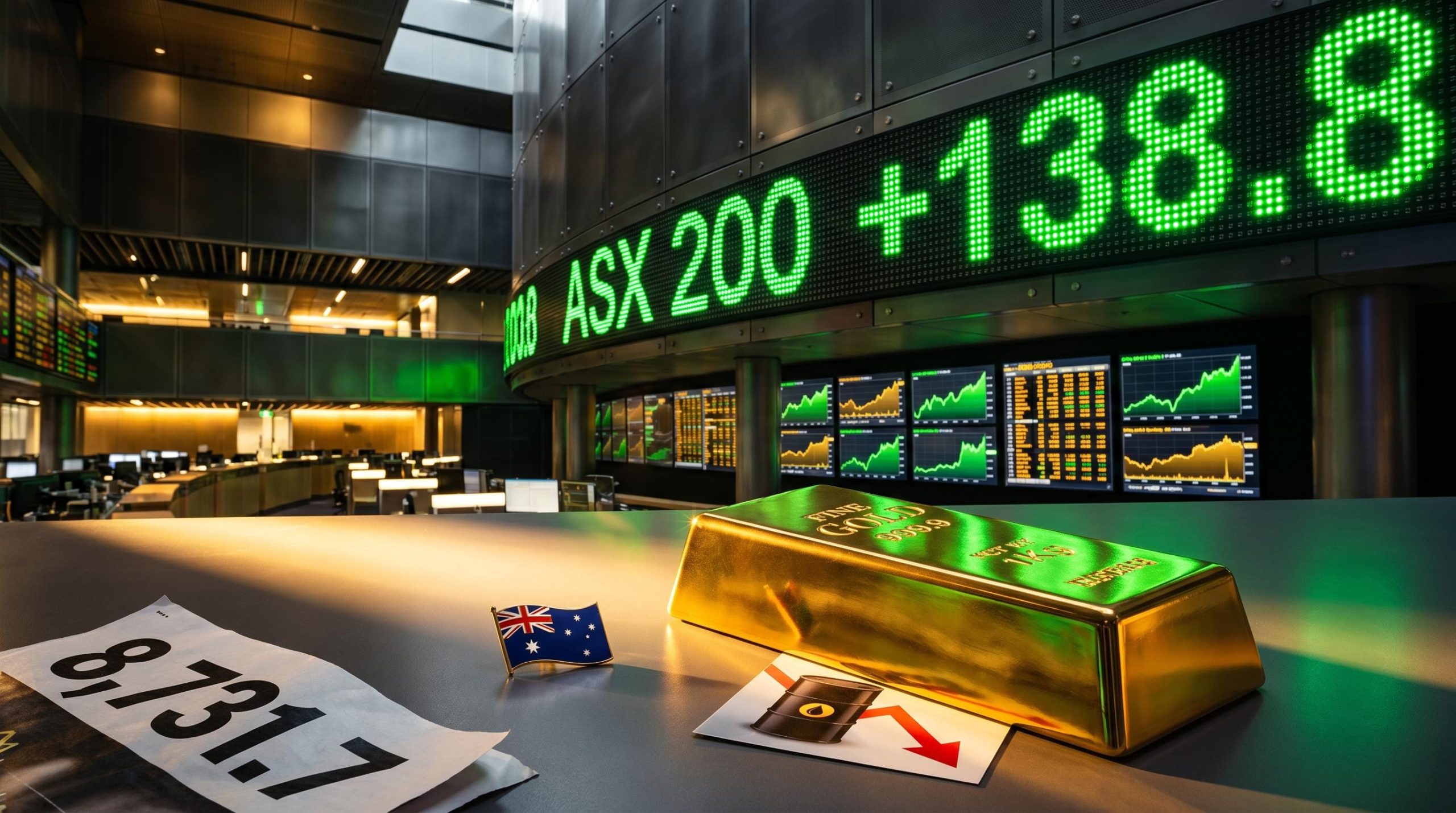
The ASX 200 surged 138.8 points on Friday 29 May 2026, delivering its strongest single-session gain in weeks as reports of a tentative 60-day US-Iran ceasefire extension swept through commodity and equity markets. The move nearly reversed the prior session’s losses in a single afternoon, with the benchmark closing at 8,731.7 and finishing the week at its intraweek high.
Advancing stocks in the S&P/ASX 300 outnumbered decliners by a ratio of 233 to 50. The Emerging Companies index surged 3.05%, while the Small Ordinaries and All Technology indices each added 2.28%, signalling broad-based participation rather than a narrow large-cap rally.
What follows breaks down the geopolitical catalyst behind Friday’s move, which sectors captured the rotation and which were left behind, the individual stocks that posted the session’s largest gains and losses, and what the week’s closing shape may signal for ASX investors heading into the weekend.
Ceasefire reports sent crude lower and risk appetite surging
Reports of a tentative 60-day US-Iran ceasefire extension provided the session’s primary catalyst. The ceasefire was described as a market-moving report rather than a formally verified diplomatic outcome, and no official confirmation had been issued as of Friday’s close.
Reuters reporting on oil futures confirmed that crude prices fell on hopes for a potential deal to extend the US-Iran ceasefire, providing direct market context for the commodity-led transmission that drove Friday’s broad ASX rally.
The transmission mechanism from geopolitics to equity prices followed a clear sequence. Falling crude prices eased near-term inflation expectations, which pushed bond yields lower. Lower yields, in turn, reduced the opportunity cost of holding non-yielding assets like gold and compressed the discount rate applied to growth equities, lifting technology, real estate, and small-cap names simultaneously.
Friday’s session shares its structural template with the Iran relief rally of 19 May, when the ASX 200 gained 99.4 points on Trump stepping back from strikes; that session, however, was led by Consumer Staples and Financials rather than gold and materials, illustrating how the same geopolitical catalyst can produce different sector winners depending on which transmission channel dominates.
The ceasefire extension was described as tentative as of 29 May 2026, with no formal diplomatic announcement confirmed. Market pricing reflected the report’s implications, not a verified diplomatic outcome.
Key commodity and futures moves on the session:
- ICE Brent crude futures: -1.3% to US$91.50/bbl, a five-week low
- COMEX gold futures: +0.5% to US$4,555/oz
- COMEX silver futures: +0.3% to US$76.14/oz
- AUD/USD: -0.02% to 0.7162
- US futures at session time: S&P 500 at 7,591.25 (+0.13%), Dow at 50,783.0 (+0.08%), Nasdaq at 30,338.25 (+0.10%)
When big ASX news breaks, our subscribers know first
What the XJO’s Friday close at its session peak actually means
The benchmark did not merely rally. It closed at its absolute session high of 8,731.7, and that high also marked the intraweek peak of the weekly candle. The weekly range spanned approximately 2.0% from low to high, with all of the closing strength concentrated at the top of that range.
For the week, the XJO gained 74.7 points, or 0.86%. Breadth confirmed the signal: 233 advancers versus 50 decliners across the S&P/ASX 300, with smaller names outperforming their large-cap counterparts by a wide margin.
| Index | Close | Change (pts) | Change (%) |
|---|---|---|---|
| S&P/ASX 200 (XJO) | 8,731.7 | +138.8 | +1.62% |
| All Ordinaries | 8,965.0 | — | +1.65% |
| Small Ordinaries | — | — | +2.28% |
| All Technology | — | — | +2.28% |
| Emerging Companies | — | — | +3.05% |
A session that closes at its peak on a weekly candle that also closes at its high is a pattern technically oriented investors treat as constructive for near-term momentum. The breadth data corroborates the signal by showing the move extended well beyond the large-cap benchmark.
Gold, materials, and lithium led the sector sweep
Gold was the session’s standout sector story. The ASX Gold Sub-Index (XGD) advanced 4.5%, with the bond yield decline mechanism described above directly supporting non-yielding precious metals. The move recovered just over half of the prior session’s decline.
Top gold movers:
- St Barbara (SBM): +10.6% to $0.575
- Resolute Mining (RSG): +8.0% to $1.285
- West African Resources (WAF): +7.8% to $3.17
- Perseus Mining (PRU): +6.4% to $5.17
- Newmont (NEM): +3.8%
The broader Materials sector (XMJ) followed at +2.9%, with base metals and iron ore names rebounding sharply. Alcoa gained 4.6%, Sims added 3.6%, Sandfire Resources rose 3.4%, South32 climbed 3.0%, BHP added 2.9%, and Fortescue gained 2.4%.
Lithium stocks extended their recent run on rising commodity prices. GFEX lithium carbonate futures added 1.2% to CNY 179,740/tonne, while Australian spodumene concentrate rose 1.8% to US$2,610/tonne. Vulcan Energy surged 9.6%, PMET gained 6.6%, Elevra added 4.4%, Mineral Resources rose 3.8%, IGO climbed 3.6%, and Pilbara Minerals added 2.5%.
The lithium sector re-rating that pushed Liontown Resources, Pilbara Minerals, and Mineral Resources to 52-week highs in early May was driven by lithium carbonate averaging US$15,000 per tonne and 2.1 million Chinese EV sales in Q1 2026, providing the demand backdrop against which Friday’s spodumene and GFEX price moves should be read.
| Sector / Sub-Sector | Best Performer | Gain | Sector Move |
|---|---|---|---|
| Gold (XGD) | St Barbara | +10.6% | +4.5% |
| Materials (XMJ) | Alcoa | +4.6% | +2.9% |
| Lithium | Vulcan Energy | +9.6% | N/A (sub-sector) |
The breadth of named movers across gold, base metals, and lithium indicates a sector-wide re-rating rather than isolated stock-specific bounces.
Travel, real estate, and tech joined the winners; energy and utilities did not
The sectors that gained
Travel stocks rallied as ceasefire optimism raised the prospect of eased aviation disruption across the Middle East. Flight Centre surged 8.2% to $10.93, Virgin Australia gained 6.2% to $2.20, and Qantas added 3.2%, lifting the Consumer Discretionary sector (XDJ) by 1.6%.
Real Estate (XPJ) advanced 1.9% as falling bond yields restored the relative attractiveness of property trust distributions. Goodman Group and Abacus Storage King each rose 2.9%.
Information Technology (XIJ) gained 1.7%. Lower yields reduce the discount rate applied to high-growth, long-duration earnings, benefiting names like Siteminder (+6.7%), Megaport (+5.4%), Codan (+3.9%), and Macquarie Technology (+3.5%).
The two sectors left behind
Energy (XEJ) slipped 0.1% as falling crude prices weighed directly on oil producers. Viva Energy dropped 1.9% to $2.12, Yancoal fell 1.7% to $6.77, and Beach Energy declined 1.4%.
Utilities (XUJ) shed 0.3%, with AGL Energy losing 0.8% as capital rotated away from defensive positioning.
The Financials sector recovered in absolute terms but underperformed the benchmark for a sixth consecutive session, a streak that investors monitoring domestic rate sensitivity may wish to note.
| Sector | Change (%) | Notable Mover | Individual Move (%) |
|---|---|---|---|
| Consumer Discretionary (XDJ) | +1.6% | Flight Centre | +8.2% |
| Real Estate (XPJ) | +1.9% | Goodman Group | +2.9% |
| Information Technology (XIJ) | +1.7% | Siteminder | +6.7% |
| Energy (XEJ) | -0.1% | Viva Energy | -1.9% |
| Utilities (XUJ) | -0.3% | AGL Energy | -0.8% |
The session’s biggest individual movers and what drove them
Defence and drone stocks produced some of the day’s largest percentage gains. Elsight led the ASX, surging 20.2% to $7.61 after securing a follow-on US public safety order valued at approximately US$2 million, compared to the initial US$460,000 purchase in January 2026. White House commentary regarding drone-manufacturing funding amplified the broader sub-sector, with Electro Optic Systems jumping 16.2% to $11.13.
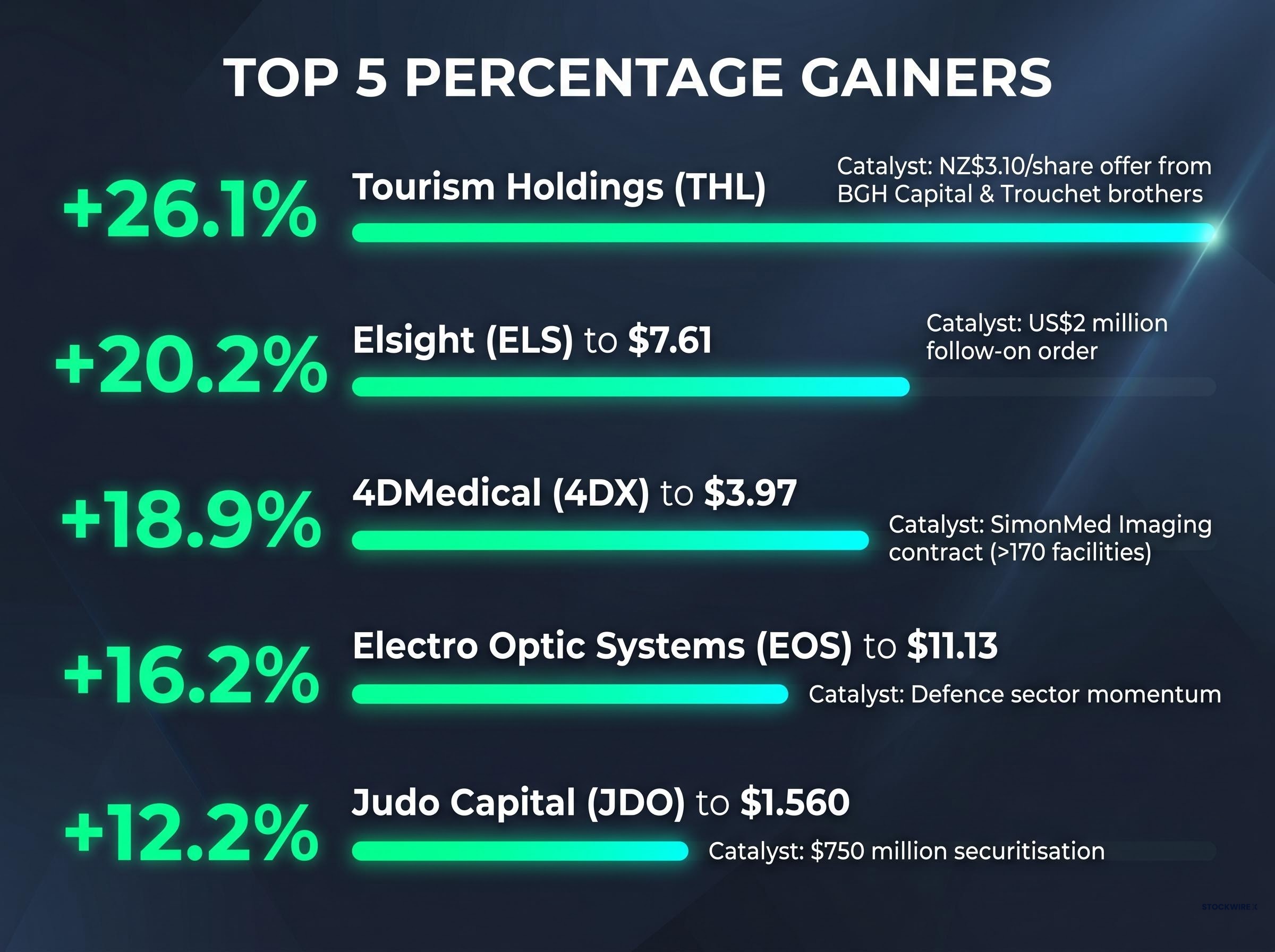
The session’s top five gainers by percentage:
- Tourism Holdings (THL): +26.1% after BGH Capital and the Trouchet brothers raised their takeover offer to NZ$3.10/share. The consortium holds 19.9%, with a further 16% of shareholders supportive of due diligence.
- Elsight (ELS): +20.2% on the US follow-on order.
- 4DMedical (4DX): +18.9% to $3.97 after securing a contract with SimonMed Imaging, which operates more than 170 US outpatient facilities.
- Electro Optic Systems (EOS): +16.2% on broader defence sector momentum.
- Judo Capital (JDO): +12.2% to $1.560 after completing a $750 million securitisation (upsized from $500 million), lifting its CET1 ratio to 13.2% from 12.6%.
Broker upgrades also contributed. Morgans upgraded Tabcorp to Buy (price target $1.07, from $1.20), citing an approximately 40% share price decline. Macquarie upgraded HealthCo Healthcare REIT to Outperform (target $0.83, from $0.67).
Among the session’s notable decliners:
- IDP Education (IEL): -16.2% to $2.23, a 52-week low. Macquarie downgraded to Underperform, cutting its price target to $2.35 from $5.45, citing weak visa activity and currency headwinds.
- Champion Iron (CIA): -6.9% to $4.45 after Jarden downgraded to Neutral (target $5.00, from $5.50).
- Dexus (DXS): -5.4% to $5.61 after the NSW Supreme Court dismissed its application to block the forced sale of a 27.3% stake in Australia Pacific Airports Corporation.
- Bubs Australia (BUB): -2.1% on FY26 guidance of $105-$115 million revenue and underlying EBITDA of $4-$8 million, weighed by freight and supply headwinds.
Macquarie cut its price target on IDP Education to $2.35 from $5.45, the starkest single analyst action of the session, as the stock fell to a 52-week low.
How risk-on sessions like this one work on the ASX
What triggers the rotation
A risk-on session occurs when capital rotates from defensive positions (utilities, cash, high-yield bonds) into growth-sensitive assets such as resources, technology, travel, and small caps. The trigger is typically an event that reduces perceived risk in the market, whether a geopolitical de-escalation, a favourable central bank signal, or an economic data release that eases recession fears.
Friday’s ceasefire reports provided that trigger. Reduced Middle East tension pushed crude prices lower, which eased inflation expectations and, in turn, pulled bond yields down. Lower yields then supported asset classes across the board: gold (because the opportunity cost of holding a non-yielding asset falls), real estate (because property trust distributions become relatively more attractive), and technology (because lower discount rates increase the present value of future earnings).
Lower yields reduce the discount rate applied to future earnings, mechanically lifting the present value of long-duration cash flows even when underlying earnings estimates are unchanged, which is why technology and real estate respond so sharply to a single session of bond yield compression.
Why some sectors win and others lose
The same catalyst that lifts most of the ASX simultaneously weighs on the energy sub-sector. Falling crude prices reduce revenue expectations for oil and gas producers, making energy the natural loser in a ceasefire-driven session. Utilities tend to underperform because investors rotate away from defensive holdings when risk appetite rises.
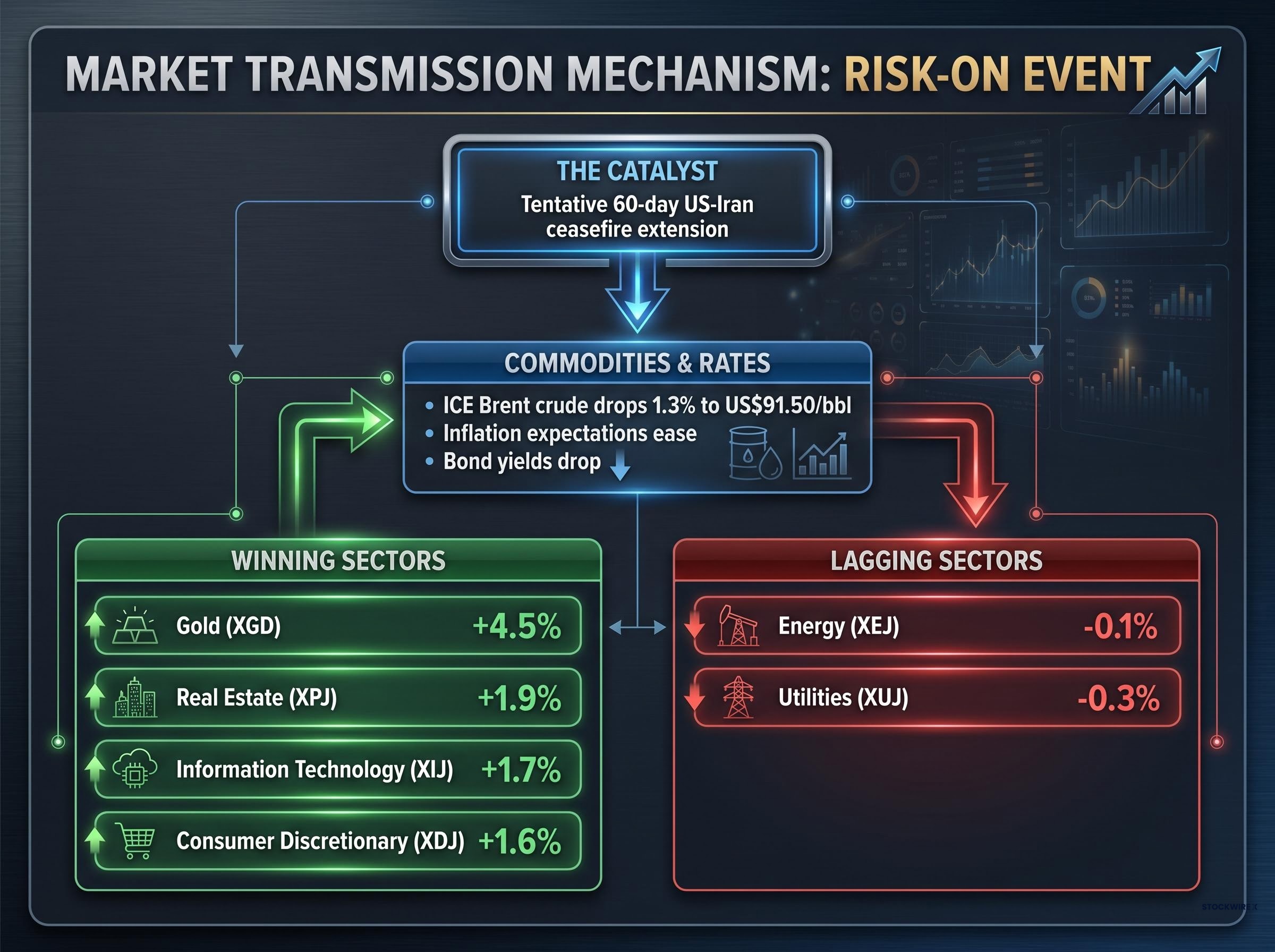
- Step 1: Geopolitical de-escalation reduces perceived risk
- Step 2: Crude prices and bond yields decline
- Step 3: Capital rotates into growth-sensitive assets; defensive and oil-exposed sectors lag
Small caps and emerging companies tend to outperform large caps in strong risk-on sessions because smaller names carry higher sensitivity to shifts in risk appetite. Friday’s data illustrated this clearly: the Emerging Companies index surged 3.05% compared to the XJO’s 1.62% gain. The Financials sector’s sixth consecutive session of underperformance relative to the benchmark serves as a reminder that sector-specific dynamics can persist even within a broadly positive session.
What Friday’s close at the week’s high tells ASX investors going into the weekend
The XJO closed at 8,731.7, at its session peak and at the intraweek high of the weekly candle, approximately 2.0% above the week’s low.
For technically minded investors, a weekly candle that closes at its high is a constructive signal. It suggests buying pressure strengthened into the close rather than fading, and that sellers did not re-emerge at elevated levels. The weekly gain of 74.7 points (+0.86%) was delivered almost entirely in Friday’s session.
The durability of Friday’s rally, however, rests partly on a catalyst that remained unconfirmed. The ceasefire extension was described as tentative as of the close, with no formal diplomatic announcement verified. Weekend news flow will either validate or undercut the positioning that drove the session.
ASX 200 earnings delivery risk is the other side of Friday’s constructive close: with the forward P/E sitting at the upper boundary of the range historically consistent with 5%-6% Australian bond yields and the equity risk premium at roughly 80 basis points, the index has limited valuation buffer if the ceasefire catalyst proves transient and earnings guidance disappoints.
Three variables are likely to shape the open next week: confirmation or denial of the US-Iran ceasefire, follow-through in commodity prices (particularly crude and gold), and any development in the Financials sector’s persistent underperformance relative to the benchmark across six consecutive sessions.
This article is for informational purposes only and should not be considered financial advice. Investors should conduct their own research and consult with financial professionals before making investment decisions.