Two weeks ago, traders put the odds of a Federal Reserve rate hike on 29 July at roughly 10%. As of today, those odds sit near 36%. That kind of repricing does not happen on a whim. It tells you something specific about how the inflation and geopolitical picture has shifted, and how seriously professional markets are now treating Wednesday’s Federal Open Market Committee (FOMC) meeting.
The decision itself matters, but so does everything around it. The policy statement’s language, the vote tally, and the tone of the press conference will collectively reveal more about the Fed’s direction than the headline rate number alone. Even a hold at the current 3.50%-3.75% target range carries information, if you know where to look.
Here is what you need to interpret Wednesday’s outcome clearly, regardless of which way it goes: the probability picture, what the sharpest analyst desks are actually forecasting, what the inflation data says and does not say, and what it all means for your borrowing costs through 2027.
Why markets are suddenly treating a July hike as a real possibility
The repricing started with a number and accelerated with a reason.
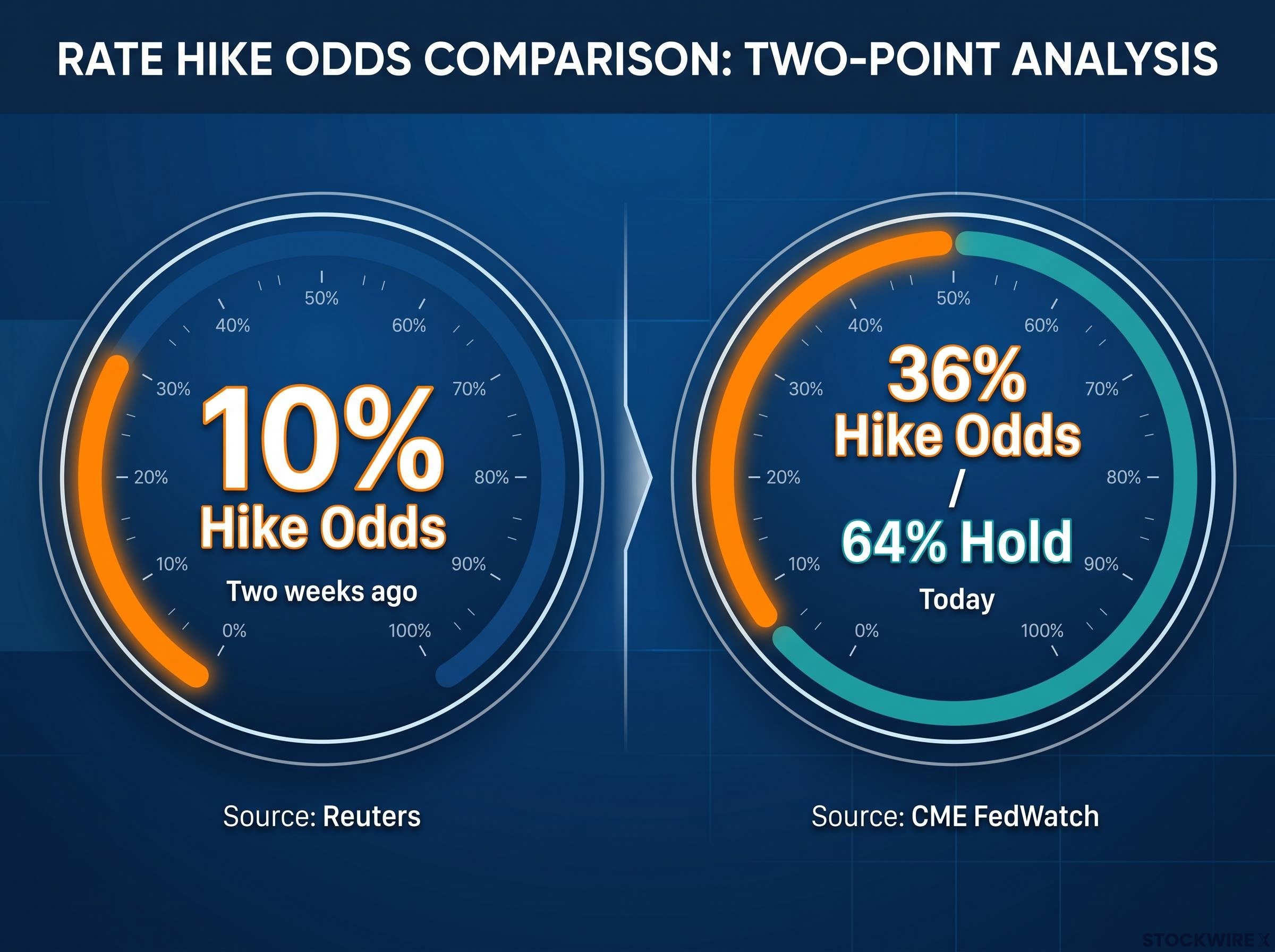
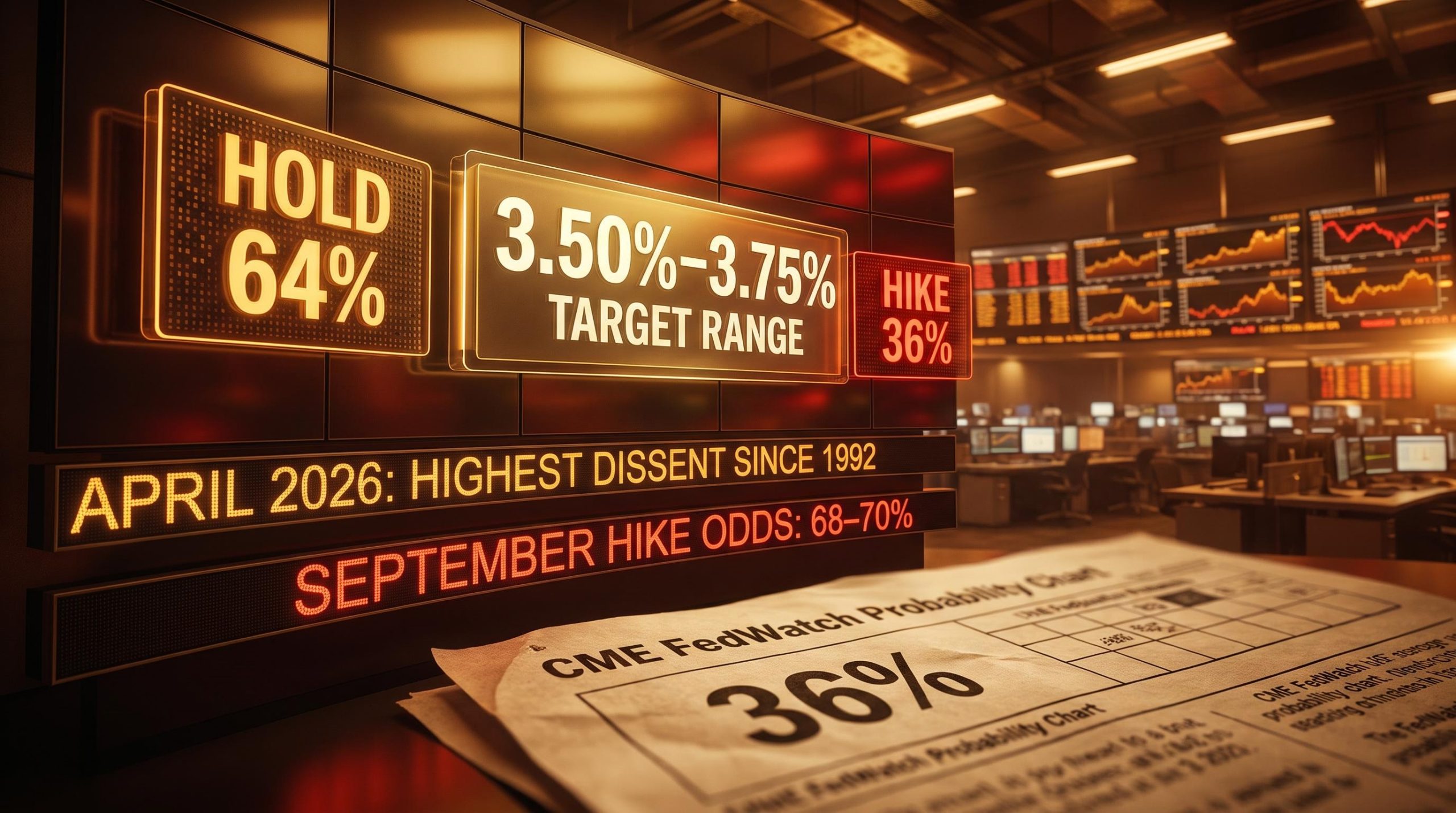
Current CME FedWatch implied odds: approximately 64% hold / 36% hike at the July FOMC meeting.
Two weeks ago, Reuters reported hike odds sitting near 10%. Today, CME FedWatch-style tools show roughly 30-38% implied probability of a move higher. Two forces drove the shift:
- Oil prices and Middle East tensions: Renewed conflict involving Iran pushed crude higher and raised perceived inflation risk, directly feeding into rate expectations.
- Elevated core inflation context: While June readings improved, the broader backdrop of above-target core personal consumption expenditures (core PCE, the Fed’s preferred inflation gauge) kept the hiking debate alive.
A 36% implied probability is not a coin flip. But it is high enough, this close to decision day, to mean that markets are genuinely divided. Wednesday’s outcome, whichever way it lands, will carry real informational weight about where the Fed heads next.
When big ASX news breaks, our subscribers know first
What Goldman Sachs analysts are actually saying
Goldman Sachs economist David Mericle has described the July decision as carrying an unusual degree of uncertainty, a characterisation that stands out from a desk that ordinarily stakes out a clear directional view well before a meeting date arrives. Goldman’s base case has three components:
- The Fed holds rates at 3.50%-3.75%
- The policy statement signals greater concern about upside inflation risks, taking on a more cautious tone around the geopolitical backdrop
- The Committee records at least one formal vote in favour of raising rates, even as the majority opts to hold
That framing is less a prediction than a reading guide. It tells you what Goldman considers the most likely combination of signals, and it implicitly tells you how to interpret the alternatives.
Where the broader analyst community stands
Goldman’s view is not an outlier. BofA Global Research and Deutsche Bank both characterise July as a close call but maintain a hold as their base case, with September identified as the earliest plausible start to renewed tightening.
Economists surveyed by FactSet and cited by CBS likewise expect the fed funds rate to stay at 3.50%-3.75%. The Fed’s own June 2026 minutes reinforce this: the Committee’s modal expectation is to hold the current range into early 2027, with only one cut pencilled in for Q2 2027.
When the best-resourced research desks in finance are hedging their language this close to a meeting, it signals that even they are not confident. That raises the stakes for reading Wednesday’s statement carefully rather than just scanning the headline.
The inflation data that reduced the case for hiking now
According to Goldman Sachs analysts, the June inflation figures came in softer than feared, and that improvement has taken some of the urgency out of the argument for moving rates higher this week. David Mericle’s team anticipates that the June core PCE data, scheduled for publication in the week of 27 July, will mark the beginning of a gentler trajectory for that measure.
June core CPI came in at 0.0% month-over-month, the largest downside miss relative to consensus in over a year, pulling the annual core rate to 2.6% and directly supplying the softer inflation reading that Goldman Sachs analysts cited as reducing the urgency for an immediate July hike.
But the broader picture is harder to read cleanly.
| Factor | Current Signal | Implication for July Decision |
|---|---|---|
| June inflation data | Moving favourably | Reduces case for immediate hike |
| Core PCE broader context | Elevated relative to target | Keeps the debate live |
| Oil prices / geopolitics | Upward pressure from Middle East tensions | Raises forward inflation risk |
U.S. News reports that inflation has “improved somewhat,” but its trajectory remains heavily dependent on oil prices. That dependency is precisely why renewed Middle East tensions have fed directly into higher hike odds.
For anyone watching their mortgage rate, car loan costs, or business borrowing, the inflation picture is the single most important input into when relief might arrive. Right now, it is pointing in a better direction, but not a definitive one.
How the Fed uses forward communication to avoid catching markets off guard
The Federal Reserve does not like surprises, and it has built an institutional infrastructure to prevent them.
Recent meetings have consistently delivered decisions that were already substantially priced in by markets. The June 2026 meeting itself matched expectations of no change. That pattern is not accidental. It reflects a deliberate communication strategy designed to prevent disorderly market reactions to untelegraphed policy shifts.
Goldman Sachs analysts note that the Fed’s historical pattern of avoiding surprise rate increases further reduces the likelihood of a hike at this particular meeting.
Apply that logic to Wednesday. Markets currently lean 64-70% toward a hold. Official Fed guidance has not actively prepared investors for a July hike. No speeches, no trial balloons, no carefully planted media signals. A surprise move would break from established institutional behaviour in a way the Committee has carefully avoided.
That communication discipline is itself a form of information. If the Fed does hike on Wednesday without having signalled it clearly, that break from pattern would tell you something important: that inflation concerns have escalated to a level where the Committee judged the cost of surprising markets was lower than the cost of waiting.
FOMC statement language carries most of the market-moving weight at a meeting where the rate outcome is already substantially priced in; the inflation confidence phrasing and labour market characterisation in Wednesday’s release are the two paragraphs that will determine how markets reprice September and December.
What dissenting votes reveal about the debate inside the Fed
Most readers will see a headline on Wednesday that says either “Fed holds rates” or “Fed raises rates.” The more revealing number may be the one underneath: the vote tally.
At the April 2026 FOMC meeting, the Fed held rates at 3.50%-3.75% but recorded the highest level of dissent since 1992. A dissenting vote means a Committee member formally voted against the majority decision, in this case voting to raise rates when the majority chose to hold. That episode demonstrated that a hold decision can coexist with deep internal division about the right course of action.
The April dissent record established the baseline for interpreting Wednesday’s vote tally: four formal objections at a single meeting, the most since 1992, demonstrated that a hold decision and deep internal disagreement about the rate path can coexist, and the same dynamic is in play heading into July.
According to Goldman Sachs, the Committee is likely to see minority support for a hike recorded in this week’s vote tally, even if the overall decision comes down in favour of holding. That dissent would confirm something specific: the tightening debate is live and unresolved, and September is not merely a hypothetical but an active decision point.
Here is what to check immediately when the announcement drops on Wednesday:
- The headline rate decision: hold or hike
- The vote tally and any dissenting votes, specifically whether dissenters favoured a hike
- The specific language in the policy statement regarding inflation risk and future meetings
A hold with one or more hawkish dissents is a materially different outcome from a clean unanimous hold. That distinction shapes how markets price September and everything beyond it.
September is the meeting that matters more, and Wednesday will shape how markets price it
Wednesday is consequential. But the meeting that may matter more is September.
BofA Global Research, Deutsche Bank, and data reported by Reuters and Forbes all point to September as the earliest plausible start to renewed tightening, with implied hike odds for that meeting reportedly running around 68-70% in some measures.
Wednesday’s statement language, vote tally, and press conference tone will be parsed closely for three forward signals that will shape September pricing:
- Statement language on inflation risk: Does it escalate or maintain current framing?
- Vote tally and dissent count: One dissenter or three? The number matters.
- Press conference tone on future meeting optionality: Does the chair leave September explicitly open?
Goldman Sachs frames the current stance clearly: “a hold is not a cut.” Financial conditions remain restrictive at 3.50%-3.75%, and no cuts are projected for 2026.
For anyone with a variable-rate mortgage, home equity line, or small business loan tied to the prime rate, the practical message is that relief is not coming in 2026. The real question Wednesday answers is whether the pressure intensifies in September or holds steady a little longer.
What Wednesday’s outcome means for borrowing costs, regardless of which way it goes
The two scenarios carry different immediate signals but converge on the same medium-term reality.
| Scenario | Immediate Rate Impact | Borrowing Cost Effect | What It Signals for September |
|---|---|---|---|
| Fed holds at 3.50%-3.75% | No change to target range | Current restrictive conditions persist | September remains the live decision point |
| Fed hikes beyond 3.75% | Immediate increase in target range | Higher rates flow through to mortgages, business credit, consumer loans | Additional September hike becomes more likely |
Goldman Sachs analysts observe that elevated borrowing costs function as an inflation brake, but that this mechanism comes at a cost to growth momentum and employment conditions. That trade-off sits at the heart of every decision the Committee is currently weighing, and it remains present whether rates move on Wednesday or hold steady.
In both scenarios, borrowing costs remain elevated across interest-sensitive sectors, particularly housing and long-duration corporate investment.
The 2027 timeline and what it means for planning
No cuts are projected for 2026 under any current scenario, according to the Fed’s June 2026 minutes. The first projected reduction does not appear until Q2 2027 at the earliest, and that timeline could shift further out if September brings a hike or geopolitical pressures keep oil prices elevated.
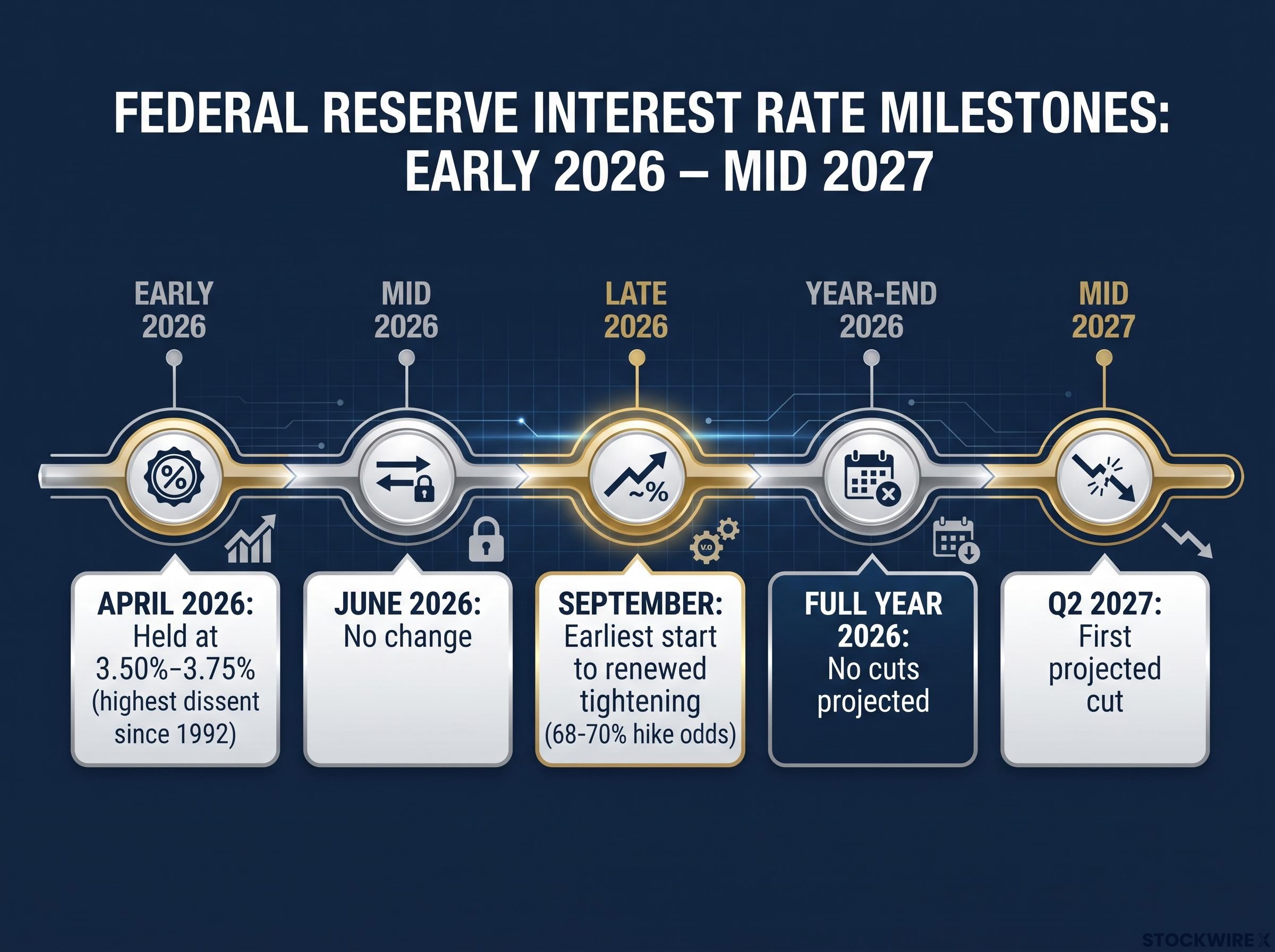
Whether the Fed holds or hikes on Wednesday, the rate environment stays restrictive through at least mid-2027. If you are planning a major borrowing decision, whether a home purchase, a business expansion, or a refinancing, calibrate your timeline to rates that will not ease before then.
For readers wanting to model the direct household cost of rates staying restrictive through mid-2027, our dedicated guide to Treasury yields and mortgage rates walks through the specific spread mechanics and shows what each half-point yield move adds to monthly payments on a standard loan balance.
This article is for informational purposes only and should not be considered financial advice. Investors should conduct their own research and consult with financial professionals before making investment decisions. Forward-looking statements regarding Federal Reserve policy, rate projections, and economic conditions are subject to change based on evolving data, geopolitical developments, and Committee deliberations.
—