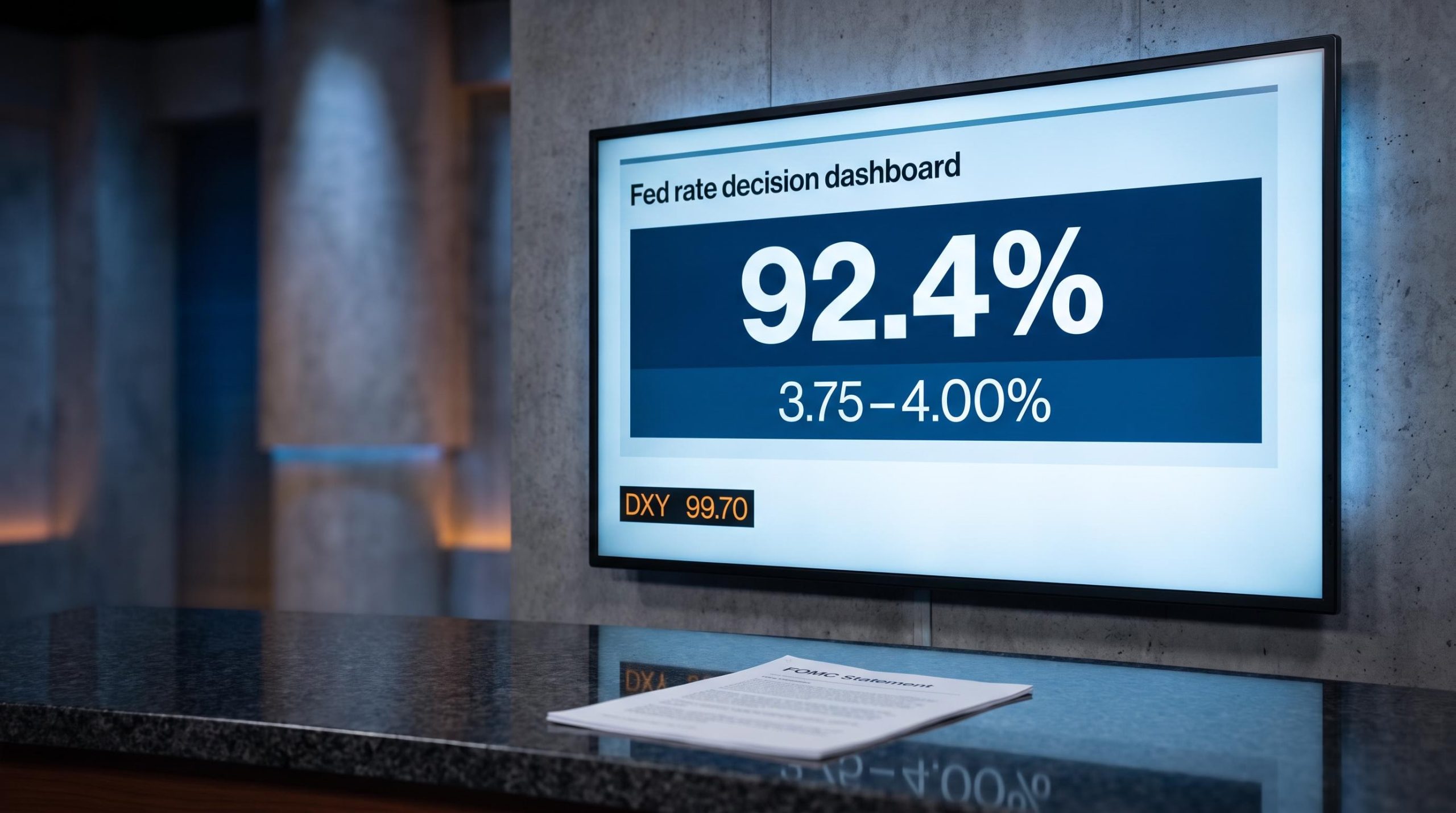
Markets have priced a 92.4% probability of a Fed rate hike today, and that near-certainty is exactly what makes the press conference more important than the decision itself. The rate is almost certainly moving. What is not certain is where it goes next, and Chair Kevin Warsh has made a point of not saying.
The Federal Reserve enters 16 September with the federal funds rate sitting at 3.50-3.75%, a July meeting that ended in a rare 9-3 dissent with three members already pushing for today’s move, and a US Dollar Index that has logged three straight sessions of gains. The decision will almost certainly deliver 25 basis points. The analytical question is what the decision, the statement language, and the press conference reveal about October and December.
Here is how to read today beyond the rate number itself: what market pricing already reflects, what the dollar’s technical position tells you about the expectations baked in, what to listen for when Warsh speaks, and where the credible risks to the consensus path actually sit.
Why 92.4% is not a sure thing, and what the remaining uncertainty means
A probability of 92.4% feels like a done deal. It is not, and treating it as settled means missing the point of the next few hours.
The conviction built fast, and it built on data rather than Fed signalling. That progression matters, because it tells you where the information is actually coming from.
- 31 August 2026: 65.9% odds of a hike
- 11 September 2026: 85.6% odds
- 15 September 2026: 89.8% (Investing.com Fed Rate Monitor)
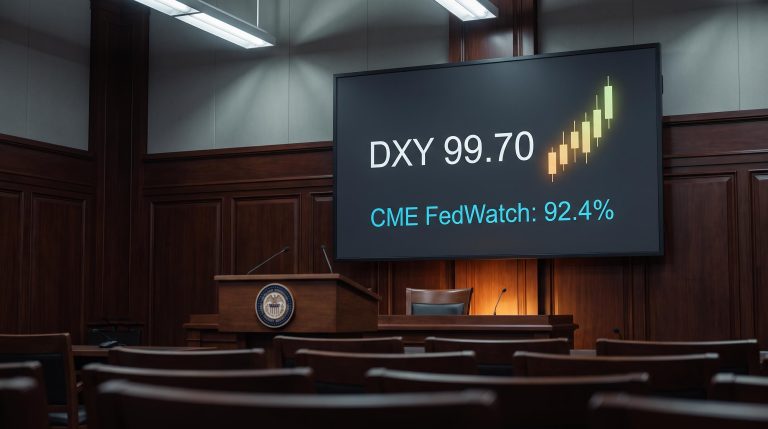
- Decision day, CME FedWatch: 92.4% probability of a move to 3.75-4.00%
- Decision day, Investing.com: 89.8% probability
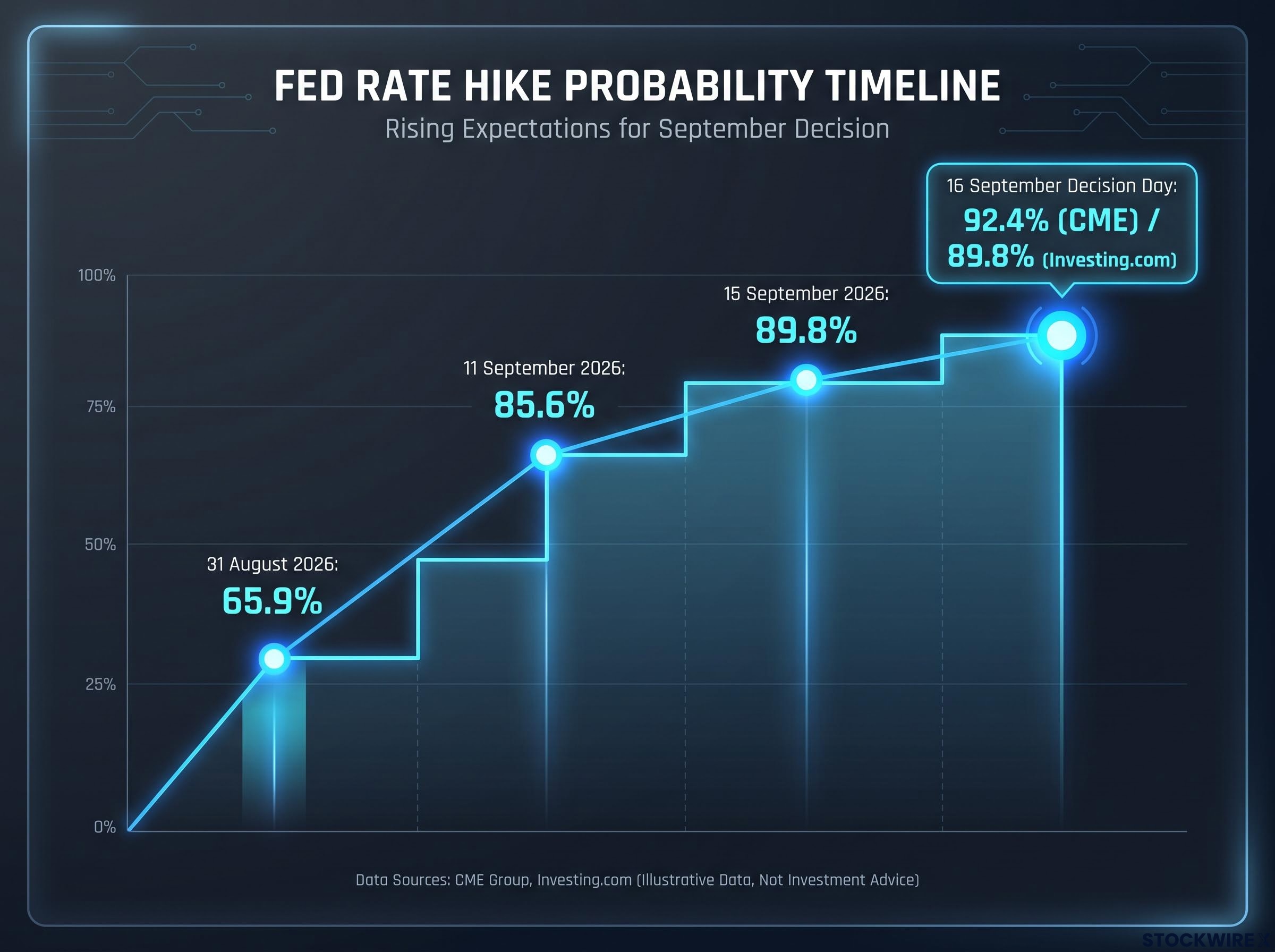
The gap between the two decision-day readings, 92.4% on CME FedWatch versus 89.8% on Investing.com’s monitor, is not a contradiction. It reflects intraday timing and differences in how each source derives probabilities from futures pricing. Both point to the same conclusion.
What drove the final surge was inflation data released the prior week that came in above consensus, not anything the Fed said. That distinction is the whole game today.
The remaining 7.6% is not noise. It is a real-time measure of what it would take to surprise the market, and a hold at this point would be genuinely disruptive precisely because so little of it is priced in.
The July baseline On 29 July 2026, the FOMC voted 9-3 to hold. The three dissenters, Beth Hammack, Neel Kashkari and Lorie Logan, wanted a 25 basis point hike then. Three votes for a move were already on the table before today.
Here is what this tells you about how to read the announcement. Because the inflation data did the convincing, and Warsh pre-signalled nothing, his press conference carries more weight than usual. A hike confirms the consensus and delivers almost no new information. The signal lives in any deviation from it, or in the language of the statement itself.
When big ASX news breaks, our subscribers know first
What the dollar’s three-session winning streak is actually pricing in
The US Dollar Index (DXY), which measures the dollar against a basket of major currencies, sat near 99.70 during Asian trading on decision day. That is not a momentum trade running hot. It is the market telling you what it already expects the Fed to do.
Three consecutive sessions of gains at this level communicates a consensus that is already long dollars heading into the decision. The question is not whether the DXY reflects a hike. It does. The question is whether it reflects the right forward path.
The technical picture reads as a live market opinion on what Warsh is about to say.
| Indicator | Current Reading | Implication |
|---|---|---|
| DXY spot | ~99.70 | Consensus positioned long dollars into the decision |
| 14-day RSI | ~56 | Bullish but not overbought; room to extend |
| FXS Fed Sentiment Index | ~125.7 | Stabilisation; policy expectations no longer dragging |
| 50-period EMA | ~99.64 | Immediate downside support |
| 9-period EMA | ~99.35 | Secondary support if the press conference disappoints |
The Relative Strength Index (RSI), a momentum gauge that runs from 0 to 100, sits near 56. That reading matters because it puts the dollar in bullish territory without hitting overbought exhaustion. There is still room to appreciate if Warsh signals a hawkish path.
The two moving-average supports are the levels to watch if he disappoints. Hold above the 50-period EMA near 99.64 and the market stays positioned for more tightening. Break below the 9-period EMA near 99.35 and you are watching the October probability reprice in real time.
What sits underneath the dollar’s strength is a structural yield advantage.
The yield gap driving flows US 10-year Treasury yields sit near 4.4%, against roughly 2.8% for German Bunds and around 1.5% for Japanese government bonds. Capital chases the differential, and the differential favours the dollar.
The yield premium driving dollar flows reflects a structural advantage that extends well beyond the fed funds rate itself: the 10-year Treasury near 4.4% sits roughly 160 basis points above German Bunds and nearly 300 basis points above Japanese government bonds, compressing currency hedging costs and attracting cross-border capital at a pace that amplifies every hawkish Fed signal.
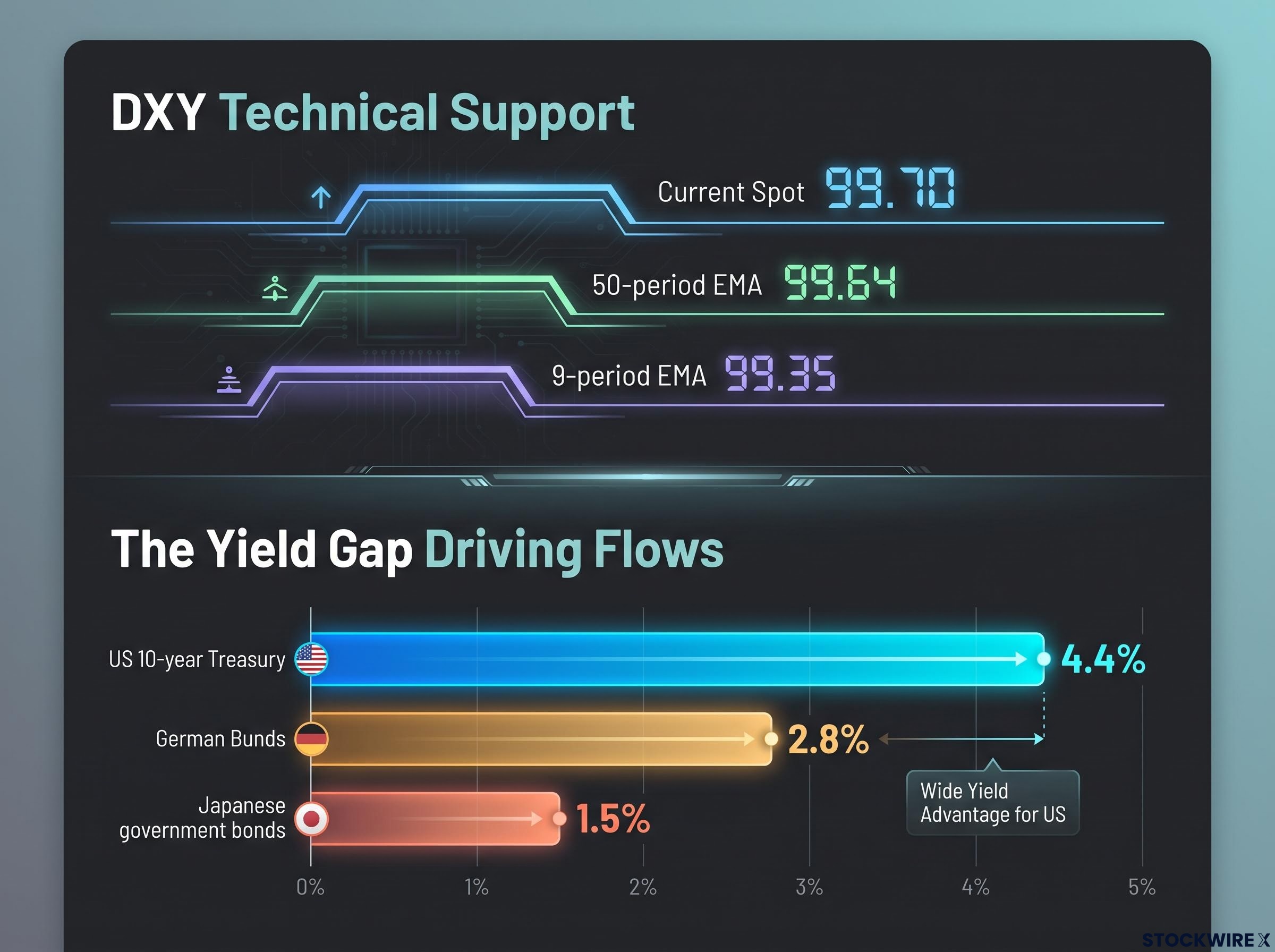
Here is the read for you. An RSI of 56 with two nearby supports tells you the dollar can extend on a hawkish surprise but is not running on fumes. A hold or dovish language would likely break toward those EMA levels quickly, so keep those numbers in view during the press conference. The reaction will be asymmetric if anything deviates from the script.
How Warsh’s rejection of forward guidance changes what you should listen for
Most Fed chairs spend the press conference telling markets, however carefully, where they are leaning. Warsh has structurally decided not to. That turns the press conference from a performance you watch into an information problem you have to solve.
At Jackson Hole on 28 August 2026, he set out the doctrine plainly.
Warsh’s break with the forward guidance regime was not improvised at the podium: he explicitly rejected it at his first FOMC press conference in June, withheld his own dot plot projection from the SEP, and launched five internal task forces to overhaul the entire communication architecture.
Warsh at Jackson Hole Forward guidance, he argued, should be “limited and circumscribed.” His stated aim is a quieter Fed that reacts to data rather than steering markets.
He has declined to preview decisions to lawmakers and pushed to strip forward-looking language from FOMC statements. The practical effect is that the statement itself will tell you less than it used to. The signal has to be inferred from the reaction function, meaning the set of economic conditions that would trigger the next move.
Institutional opinion on whether this is healthy is split. The Brookings Institution frames it as forcing markets to reverse-engineer the reaction function from which data Warsh chooses to emphasise. Bloomberg Opinion argues the opposite, that an underspecified reaction function raises volatility risk around every decision because nobody knows the trigger conditions.
The analyst camps are just as divided:
- Hawkish: Bank of America expects the Warsh Fed to hike multiple times through 2026 to curb inflation.
- Dovish: Weakening payrolls will eventually force cuts, rendering hawkish rhetoric performative.
Here is where to focus when he speaks. The valuable signal is not whether he names October or December. It is which economic variables he treats as the threshold for the next move. Anchor on inflation and that is hawkish. Pivot to labour market fragility and the October probability reprices lower immediately.
What the “quieter Fed” doctrine means in practice
Without explicit dot-plot guidance from Warsh himself, other participants’ projections carry more weight. The Summary of Economic Projections (SEP), the Fed’s published forecasts of where officials expect rates and the economy to go, becomes relatively more informative about the spread of views on the Committee.
The vote count matters more than usual too. A unanimous or near-unanimous hike is more hawkish than a hike with dissents favouring a hold.
Set that against the July baseline. That meeting split 9-3, with three members already wanting the move that arrives today. Watch whether today’s tally tightens around the decision or fractures the other way.
The credible risks to the consensus rate path beyond today
The bear case against more tightening is not a contrarian pose. It is a set of conditions the data could legitimately trigger, and it deserves to hold your consensus view a little more loosely.
The strongest version comes from Vice Chair Michelle Bowman, who cited “signs of fragility” in the labour market. His argument rests on the vacancy-to-unemployed ratio, the number of job openings for each unemployed worker.
Waller’s labour-market signal The ratio has moved closer to 1:1 now. A tighter ratio means less slack cushioning the labour market against another hike.
History complicates the case for layering on more. The 2022-23 cycle delivered 525 basis points of hikes over 16 months, the fastest tightening since the FOMC began explicitly targeting rates in 1982. Most tightening episodes since 1945 have averaged around 225 basis points. Building further onto that base demands justification.
| Cycle | Total Hikes | Character |
|---|---|---|
| 1980-81 (Volcker) | Peaked near 20% | Broke entrenched inflation at severe economic cost |
| 2004-06 | Gradual, measured | Restrictive territory preceded later stress |
| 2015-18 | Slow normalisation | Forced into easing as growth softened |
| 2022-23 | 525 bp / 16 months | Fastest since 1982 |
The risks cluster into four areas:
- Labour market: Vice Chair Michelle Bowman cited “signs of fragility” in January 2026, pointing to falling job openings and soft hiring.
- Debt-service burden: Net federal interest costs are reported to exceed $1.1 trillion on more than $40 trillion of debt.
- Supply-driven inflation: San Francisco Fed research suggests financial stress tends to flare when tightening responds to supply shocks.
- Financial stability: Deeper restriction raises recession risk across historical cycles.
The counter-case is real. Atlanta Fed President Raphael Bostic frames price stability as the more pressing threat, and for most of the Committee the employment-side risk is not yet dominant while core inflation trends up.
Inflation composition matters to today’s decision in ways the headline CPI number obscures: August 2026 core CPI held at 2.4% and continued decelerating even as the headline reached 3.4%, driven by energy and telecoms supply shocks that rate tools have no transmission mechanism to correct.
Here is why this matters to you. With the cycle already built on 525 basis points and the vacancy ratio near 1:1, the cost of one more hike is not symmetric. Undershooting on inflation is recoverable. Triggering a labour market break at this level of cumulative restriction is not. If you are tracking October or December, watch payrolls and job openings as the leading indicators for whether the consensus holds.
What today’s decision settles and what it leaves open
Today’s hike, if delivered as expected, resolves almost nothing about the path forward. The real decision is whether October becomes a live meeting, and that verdict gets written in the September payrolls report and the next inflation print, not at the podium today.
Three variables will determine whether October or December delivers another move:
- Inflation trajectory: whether the next reading extends or reverses the recent above-consensus surprise.
- Labour market data: payrolls and job openings through September and October.
- Vote count and statement language: how the Committee split today and how much forward-looking wording survives.
The DXY doubles as your real-time tracking instrument. A sustained hold above the 50-period EMA near 99.64 signals markets remain positioned for more tightening. A break below the 9-period EMA near 99.35 signals the October probability is repricing lower.
The Warsh doctrine is the constraint framing all of it. Without explicit guidance, each data release becomes its own micro-event, and the market’s ability to predict the next move is deliberately capped. Readers who know which variables to watch after today are ahead of those waiting for the next meeting to re-engage, because the information that drives October pricing arrives in October’s first two weeks.
For investors tracking October and December beyond today’s decision, our deep-dive into the Fed’s rate path uncertainty examines how major banks currently disagree by 50 basis points on the terminal rate and what the precedent of a near-unanimous market consensus being overturned in September 2025 reveals about the limits of futures-implied probabilities.
This article is for informational purposes only and should not be considered financial advice. Investors should conduct their own research and consult with financial professionals before making investment decisions. Past performance does not guarantee future results, and forward-looking statements are speculative and subject to change based on market developments.