Markets have already made up their minds about today’s rate hike. A CME FedWatch probability of 92.4% for a 25 basis point increase means the decision itself carries almost no surprise. What happens in the press conference is the entire story.
With the Fed funds target range set to move from 3.50%-3.75% to 3.75%-4.00%, the hike is baked into the dollar’s six-session winning streak and the US Dollar Index (DXY) reading near 99.70. The genuine analytical question is what Chair Kevin Warsh says, and declines to say, about where rates head from here.
That question matters more than usual because Warsh has explicitly declared the Fed has “dropped forward guidance.” The interpretive burden now shifts entirely to traders parsing tone, omissions, and the shape of his language. Here is what the rate decision, the DXY setup, and Warsh’s communication posture together reveal about where today’s real risk sits, and what to watch in the hours after the announcement.
Why 92% certainty still leaves room for a market surprise
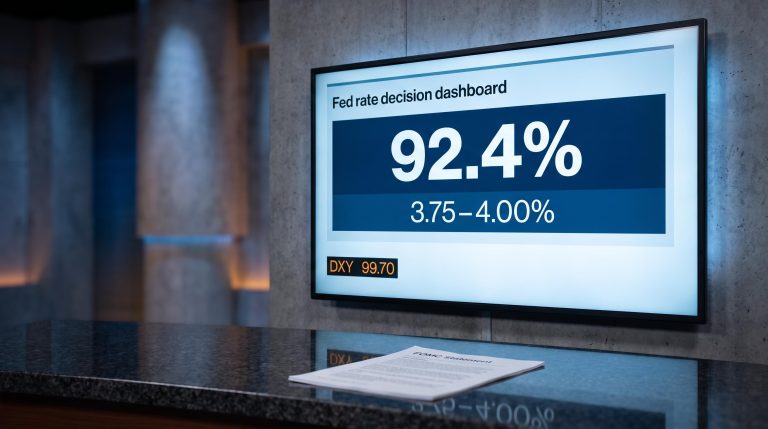
Start with the operational reality. According to CME FedWatch data cited by FXStreet, markets have priced a 92.4% probability of a 25 basis point hike to 3.75%-4.00% at today’s meeting. When a decision is this fully priced, the mechanics of the vote itself become close to irrelevant to price action.
The convergence toward that number happened fast. The evidence lines up tightly across sources:
- 92% hike probability (Mitrade/FxStreet, 15 September 2026)
- 94.5% hike probability (Barchart/Goldman Sachs, 14 September 2026)
- 92.5% hike probability (Yahoo/Investing.com, 14 September 2026)
- Roughly 59.4% probability in an earlier snapshot (Fortune and Coinness, 7 September 2026)
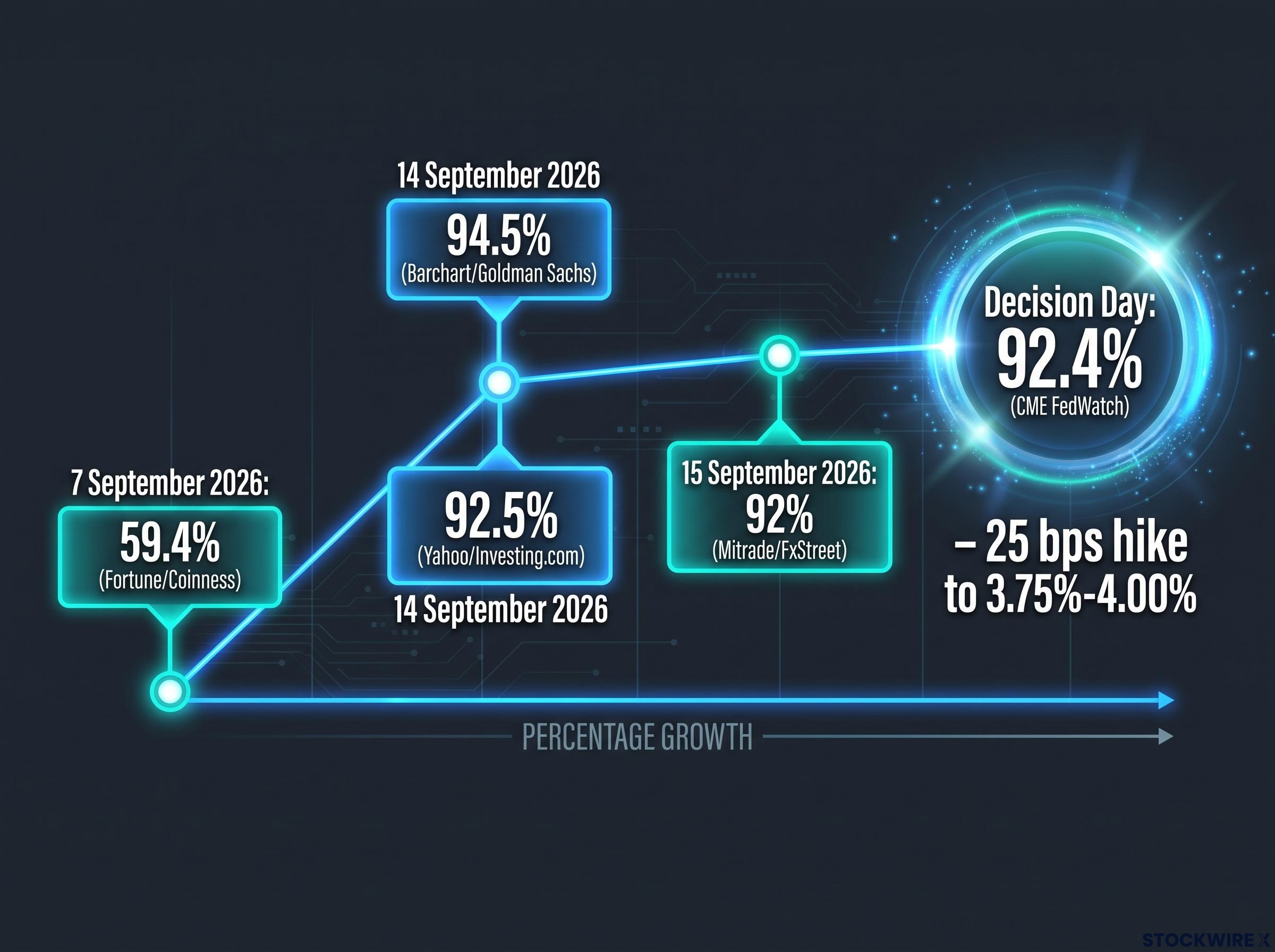
That jump from the mid-50s to the low-to-mid 90s in barely a week tells you something specific about what moved. Inflation data released the prior week came in above consensus forecasts, and that single catalyst crystallised near-unanimous pricing. The economic sequence did the work: hotter inflation, firmer tightening conviction, a hike that markets now treat as a formality.
The anchor statistic: CME FedWatch put the probability of a 25 basis point hike at 92.4% on the day of the decision, up from roughly 59.4% on 7 September 2026.
Here is what that convergence does to your risk today. A fully priced event transfers all of its market impact away from the rate decision and onto the press conference and any forward-looking tone. The dollar and rate markets have already absorbed the hike.
So the real exposure today is not to whether Warsh delivers 25 basis points. It is to whatever he says, or pointedly leaves unsaid, about October and December. The probability figure tells you where certainty sits. It does nothing to tell you where the surprise could come from, and that distinction is the difference between reacting to noise and positioning around what actually moves the dollar.
When big ASX news breaks, our subscribers know first
The DXY’s six-session run: what the technicals are, and are not, telling you
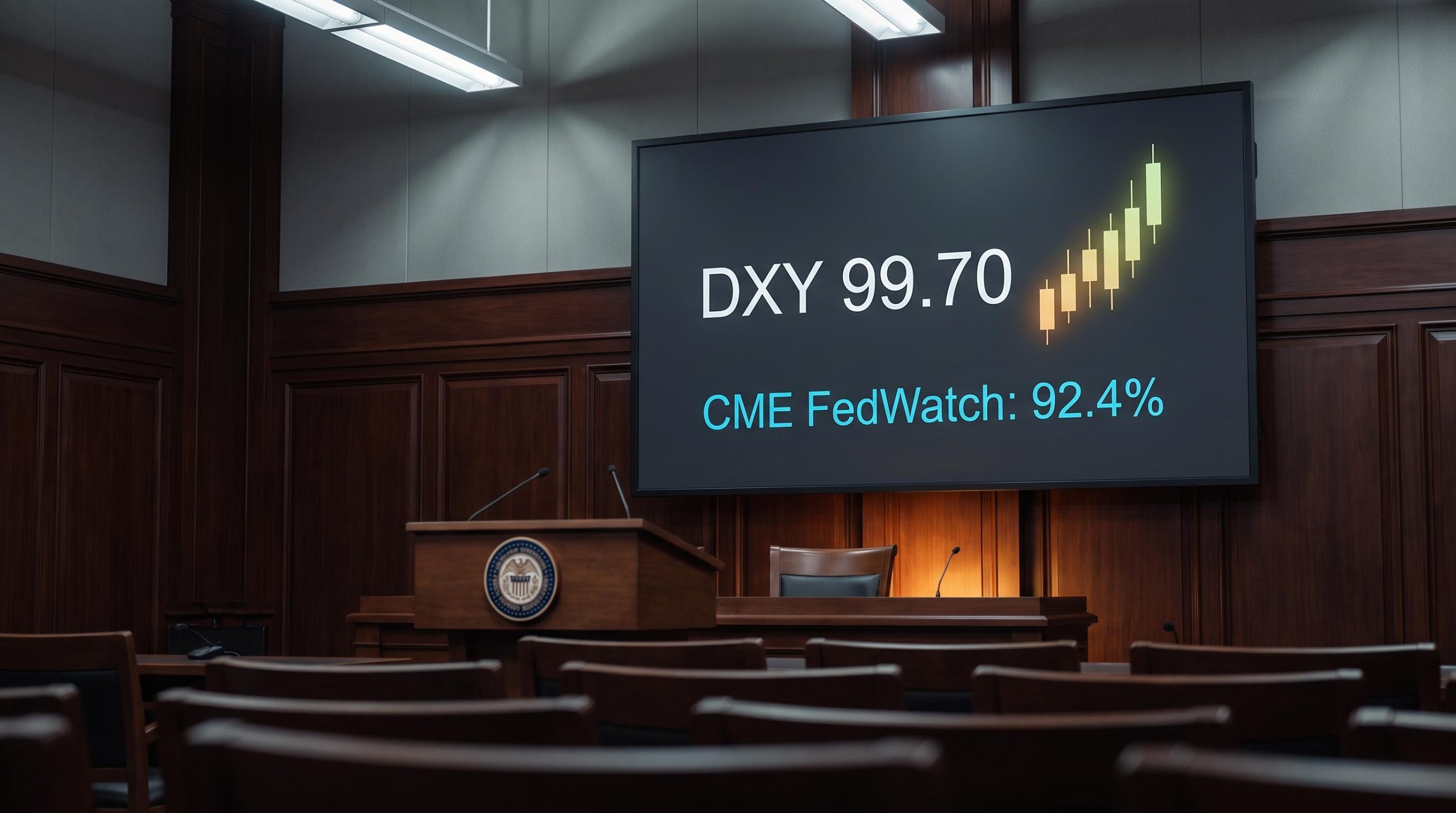
The dollar arrives at today’s decision on its strongest footing in weeks. The DXY extended gains for a sixth consecutive session, hovering near 99.70 during Asian trading on Wednesday. Reuters recorded an intraday high of 99.735 on 14 September, with the index at 99.39 described as its highest level since 2 September.
The momentum picture reads as constructive without being stretched. The 14-day Relative Strength Index (RSI), a momentum gauge that measures whether an asset has been bought or sold too aggressively over a set period, sits near 56. That places the dollar in bullish territory but well short of the overbought zone above 70, which means the rally has technical room to extend rather than looking exhausted.
Support levels give the setup structure. The 50-period exponential moving average (EMA) near 99.64 marks immediate support, with the nine-period EMA around 99.35 as a secondary floor. Those are the lines to watch if the press conference triggers a reversal.
Technicals describe the move. They do not explain it. Three competing frameworks are circulating for why the dollar has rallied, and each deserves fair weight before you decide which one is driving:
Jackson Hole’s DXY impact offers a direct precedent for today’s setup: Warsh’s 28 August warning that roughly half the PCE basket was still running above 3% triggered the DXY’s sharpest single-session advance in weeks, rebounding from 98.8 to an intraday high near 99.73, the same resistance zone the index is now testing ahead of the September decision.
- Rate-hike conviction and higher-for-longer. The dollar reflects confidence in further tightening and a sustained elevated rate environment. Research has documented a close relationship between the DXY and market pricing of the Fed funds rate one year out, anchoring this reading.
- Safe-haven flows. A Brookings Institution paper on the global transmission of Fed hikes finds that when the Fed raises rates, investors often shed risky assets, tightening global conditions and pushing capital into US assets. Under this reading, the dollar climbs because risk appetite falls, not purely because rate differentials widen.
- Crowded positioning and two-way risk. The rally partly reflects a crowded long-dollar trade, leaving bulls exposed if the narrative shifts.
The third reading: positioning risk and two-way exposure
The positioning framework is where the ambiguity lives. A 28 June 2026 research note titled “When the Tide Recedes” argues that tighter global conditions support the dollar near term, but that history shows Fed tightening cycles seldom produce prolonged one-directional DXY moves. Elevated-uncertainty periods often evolve into extended trading ranges rather than clean trends.
A CEMLA study reinforces the caution, finding that aggressive Fed hikes in 1988, 1994, 1999, 2004 and 2016 did not produce uniform dollar appreciation. Add the specific near-term risks: rate rises from the European Central Bank, Bank of Japan and Bank of England eroding the dollar’s carry advantage; a potential dovish tone from Warsh; and SocGen’s finding, echoed in a September 2026 Forex.com piece, that tightening cycles produce variable rather than linear dollar outcomes.
The historical tightening cycles the article references carry a complication that CEMLA’s uniform-appreciation finding does not fully capture: fiscal dominance constraints mean each 1-percentage-point increase in the average rate on federal debt now costs approximately 1.2% of GDP annually, compared to just 0.3% in 1981, which places a structural ceiling on how aggressively the current cycle can extend even if Warsh’s tone stays hawkish.
An RSI of 56 and a six-session streak suggest the rally can extend. What the three-framework analysis tells you is that the dollar’s next move after the press conference is genuinely open, not a continuation trade to assume.
Warsh’s press conference and the end of forward guidance as a market tool
To understand why today’s press conference is structurally different from any Fed briefing in over a decade, you need to grasp what Warsh has already changed since taking office. He was sworn in on 22 May 2026, with a term running through May 2030, and he has spent his early months dismantling the communication framework markets relied on under his predecessors.
Forward guidance is the practice of a central bank telling markets in advance where it expects to steer rates, through tools like the “dot plot” of individual policymaker projections. Warsh has been explicit that this is over. At his first meeting in June 2026, he held rates at 3.50%-3.75% and, per Reuters, stated that “forward guidance isn’t the business we should be in.” The Hill quoted him more bluntly: “we’ve dropped forward guidance.”
He drove the point home at Jackson Hole on 28 August 2026, saying forward guidance “has outstayed its welcome” in normal times.
The defining quote: Warsh joked that markets could “call it an outline, call it a trail map, just don’t call it forward guidance.” (Reuters, Jackson Hole, 28 August 2026)
This marks a deliberate return to something closer to Alan Greenspan’s studied opacity, and a sharp break from the dot-plot era that defined the post-financial-crisis Fed. That shift makes press-conference nuance more important, and more ambiguous, than at any point in recent memory. The reactions have been pointed:
- Bloomberg Opinion argues Warsh is effectively outsourcing monetary policy to financial markets by refusing to spell out a reaction function.
- Associated Press warns that retreating from guidance could produce more violent swings in stock and bond prices.
- Silicon Valley Bank frames the tenure as a new era in which investors must rely on their own macro analysis rather than Fed roadmaps.
- Forbes describes the stance as forcing markets to do their own homework and discover interest-rate prices rather than lean on Fed signals.
The concern that scrapping guidance amplifies volatility also has a counter-reading: guidance reversals under prior chairs, from Bernanke’s taper signals to Powell’s transitory language, produced their own credibility damage, and the 10-year Treasury yield moved just 0.14 percentage points over the three-day window after Warsh’s July press conference, a result that contradicts the market-disruption thesis.
The tension is that Warsh has not gone silent. The Economist and Yahoo Finance note that even without explicit guidance, he still offers what commentators call a “firm steer” that the next move is upward. ING shifted to expecting a September hike specifically after his Jackson Hole address, which tells you the market can read direction from him even when he refuses to commit to a path.
For anyone trading rates, the dollar or equities around today’s decision, this changes the operative skill. The dot plots and explicit rate-path language that moved markets under Powell are no longer the tool. What Warsh declines to commit to is now as informative as what he states, and today’s press conference asks you to listen for the absence as much as the substance.
What the tightening path and historical precedent actually say about risk from here
Step back from today’s single hike, and the analyst community turns out to be far from aligned on what comes next. The range of institutional forecasts spans meaningfully different destinations for the end-2026 rate level, from those expecting continued tightening beyond today’s hike to those leaning toward a higher-for-longer plateau near the current range.
That divergence is the real signal. It tells you the important variable today is not whether the hike lands, but whether Warsh’s language points toward October being live or toward a deliberate pause, because those two outcomes produce very different setups for the dollar and rates into year-end.
History adds two cautions. A Federal Reserve FEDS Note from 31 May 2024 finds that inflation control is more achievable when central banks tighten early, and that waiting until inflation runs high requires more aggressive tightening with greater risk to growth and jobs. That is directly relevant to a cycle where inflation ran well above target before hikes began. The specific risks that could interrupt the path are concrete:
- Housing stress: A March 2024 Forbes analysis notes that rapid hikes doubled mortgage rates within six months, adding hundreds of billions in annual interest costs for borrowers and collapsing affordability.
- Global dollar-debt vulnerability: The Brookings Institution warns that large stocks of dollar-denominated debt outside the US create balance-sheet strain as rates rise, pulling capital into US safe assets and tightening global conditions.
- Overtightening into lagged effects: The full impact of prior hikes may not yet have landed, raising the risk of tightening into a slowdown already in motion.
What past tightening cycles tell you about the pivot trade
The historical record points somewhere unexpected. SocGen’s July 2024 analysis of dollar responses to Fed policy turns shows that major dollar moves, including the declines of 1985-87 and 2001-08, came with a lag after the pivot, not at individual hike announcements. The 28 June 2026 research note reaches a similar conclusion: the eventual communication of a pause tends to be the bigger inflection point for the dollar than any single rate rise.
CEMLA’s finding that aggressive hikes in 1988, 1994, 1999, 2004 and 2016 did not produce uniform dollar appreciation reinforces the point. The current rally’s durability depends on Warsh’s continued hawkish posture, not on the rate level alone.
The read for you is that the hike is the least uncertain part of today. The genuine risk, for dollar positions, rate exposure and equity portfolios, sits in the tail scenarios on either side of where the path goes from here.
What to watch for after the announcement, and what it changes
Pull the threads together, and today resolves into a small set of concrete signals rather than a single number. The hike is priced. The dollar is technically constructive but positioned in a crowded trade. The communication framework has changed structurally. That leaves three things to watch in Warsh’s press conference, ordered by how quickly they become available:
- October liveness. Any language framing October as a genuine live meeting versus wording that implies a deliberate pause. This shapes the near-term rate path more than today’s vote.
- Statement language on trajectory. Whether the statement omits any reference to the future path of hikes, consistent with Warsh’s guidance philosophy, or slips in an implicit steer that markets can read.
- DXY reaction in the first 30-60 minutes. The price response will reveal whether the market reads the press conference as more or less hawkish than already priced. Watch the 50-period EMA near 99.64 and the nine-period EMA around 99.35 as the floor if a dovish surprise sparks a reversal.
For investors wanting a deeper technical framework around the specific levels in play, our full explainer on DXY support and resistance levels maps how every prior support flipped to resistance in August and identifies the 200-day EMA near 99.70-99.75 as the structural line bulls must reclaim on a closing basis before any trend recovery is confirmed.
The two tail scenarios frame the risk. A press conference that reads as hawkish, October live and no softening, extends the dollar rally and adds pressure on emerging-market dollar debt and rate-sensitive sectors. A briefing that reads as deliberately ambiguous or softer than expected could trigger a sharp reversal, precisely because the long-dollar trade is so crowded.
The defining frame: Warsh has said markets should respond to economic data “in the direction and magnitude they see fit.” (Fortune, 4 August 2026)
What does not change, regardless of today’s outcome, is the structure. As the Associated Press cautioned, reduced guidance can amplify swings in stocks and bonds, which means the press-conference reaction may be louder than the hike deserves. The interpretive work now belongs to the market, and that skill grows more valuable with each meeting.
This article is for informational purposes only and should not be considered financial advice. Investors should conduct their own research and consult with financial professionals before making investment decisions.
Past performance does not guarantee future results. Financial projections are subject to market conditions and various risk factors, and the forward-looking scenarios described here are speculative and subject to change based on market developments.