
The US Senate voted 49 to 50 on Tuesday to block the Digital Asset Market Clarity Act from reaching the floor, and within minutes Bitcoin was sliding and Coinbase shares were in freefall. One procedural vote effectively ended the most advanced crypto legislation in American history.
The CLARITY Act had cleared the House in July 2025 with a bipartisan 294-134 majority, the furthest any comprehensive crypto market-structure bill had ever advanced through Congress.
Its Senate defeat does more than shelve a single bill. It leaves US digital asset markets operating under the same fragmented, enforcement-driven regime that has kept institutional capital cautious for years and left exchanges like Coinbase exposed to regulatory risk with no statutory ceiling in sight.
Here is what you need to know before making any moves based on Tuesday’s result: what the vote actually decided, how markets priced it, what the failure changes for the regulatory environment in practical terms, and what the road ahead looks like for anyone holding crypto equities or Bitcoin.
A 49-50 vote, and crypto’s defining legislation is dead for 2026
The vote that killed the CLARITY Act was not a vote on the bill itself. It was a cloture vote, a procedural step that requires 60 votes to move a measure past debate and onto the Senate floor.
At 49 yea and 50 nay, the bill fell eleven votes short of the threshold. This was never a near-miss. It was a wall the legislation could not climb.
| Metric | Result |
|---|---|
| Cloture threshold required | 60 votes |
| Final Senate vote (15 September 2026) | 49 yea / 50 nay |
| House passage (July 2025) | 294-134 (bipartisan) |
| Republican senators voting nay | 4 (Collins, Hawley, Moran, Tillis) |
What makes the result sting is the partisan fracture underneath it. All 49 yea votes came from Republicans. Every Democrat and independent present voted against advancing the bill.
That alignment is the real story. A measure that passed the House with broad cross-party support arrived in the Senate as a party-line fight, and it could not survive the transition.
Four Republicans then broke ranks and voted against their own party’s bill:
- Susan Collins (Maine)
- Josh Hawley (Missouri)
- Jerry Moran (Kansas)
- Thom Tillis (North Carolina)
The vote that decided it 49 yea, 50 nay. 60 required.
Senator Tillis entered a motion to reconsider shortly after the vote, which preserves a narrow procedural avenue for a second attempt. For readers watching this as a signal of revival, temper the reading. The bill needed 60 votes and secured 49 from a single party. A motion to reconsider does not rebuild that gap.
The market had, to a degree, seen this coming. Bernstein put passage odds at roughly 31% in early August, and by 18 August 2026 some analysts had cut their estimates to around 10%. The outcome confirmed the pessimism rather than shocking the room.
When big ASX news breaks, our subscribers know first
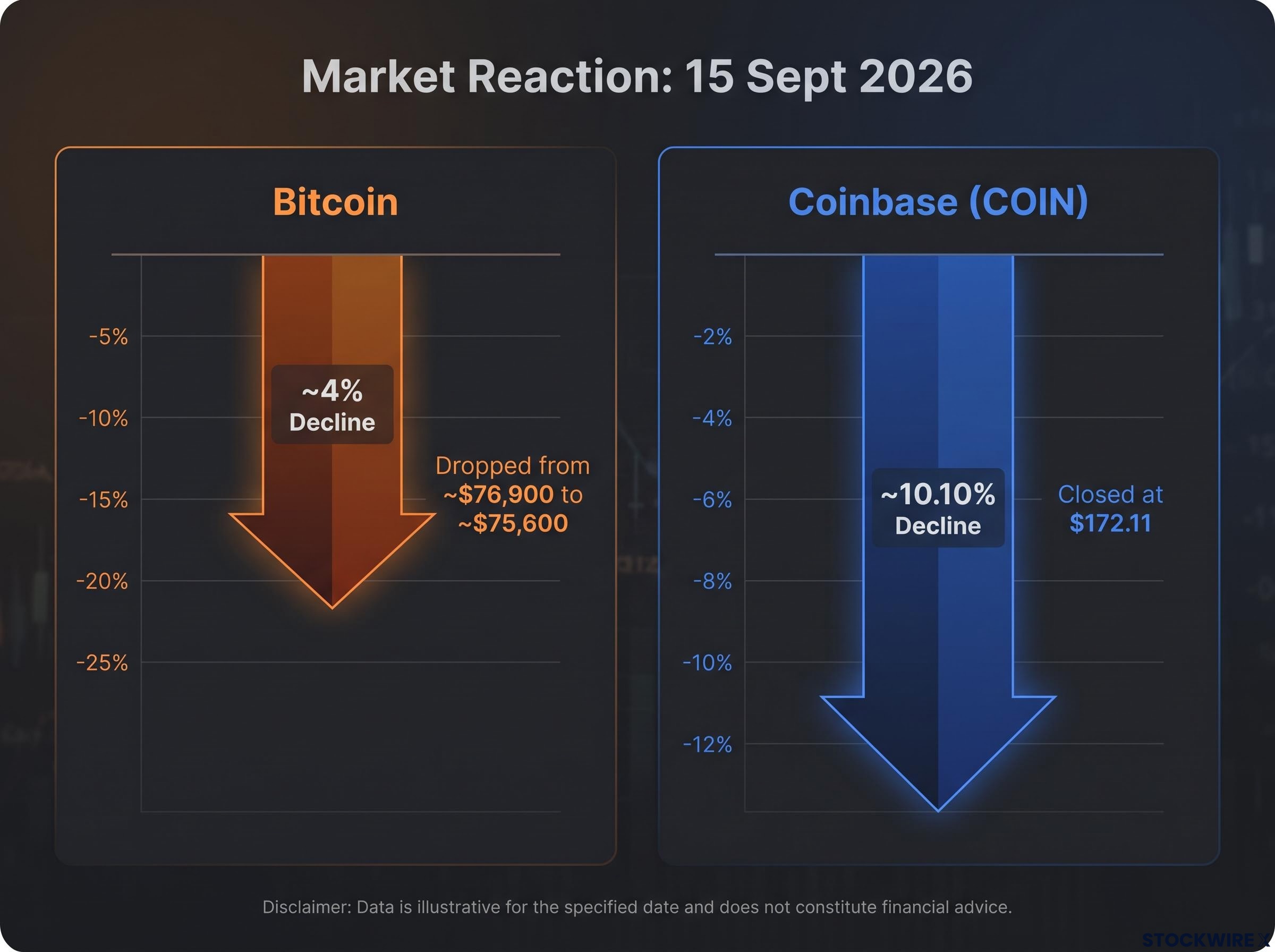
Bitcoin dropped 4%. Coinbase dropped 10%. The gap tells you something important.
Bitcoin was trading around $76,000 as the vote unfolded. When the “no” tally passed 40, it dropped rapidly from roughly $76,900 to a session low near $75,600, closing the day down approximately 4%.
Coinbase (COIN) fell more than twice as hard. The stock closed at $172.11, a single-session decline of approximately 10.10%, dragging fellow crypto-linked names like Circle down with it.
| Asset | 15 Sept move | YTD to 15 Sept | Primary sensitivity driver |
|---|---|---|---|
| Bitcoin | ~4% decline | Global multi-jurisdiction asset | Broad crypto sentiment, macro |
| Coinbase (COIN) | ~10.1% decline | ~23.89% decline | US regulation, trading volume, listings |
Bitcoin fell approximately 4%. Coinbase fell approximately 10%. One vote, two very different positions.
Why the gap? Because buying Coinbase is not the same bet as buying Bitcoin. Coinbase’s revenue depends on US trading volume and the tokens it can safely list, and both of those contract when regulatory uncertainty rises.
Bitcoin, by contrast, is a global asset priced across multiple jurisdictions. A US Senate vote matters to it, but it does not define its regulatory fate the way it defines a US-domiciled exchange’s business model.
Bitcoin’s correlation with risk assets has strengthened over time, which helps explain why a US Senate vote on domestic exchange regulation moved the asset at all; a purer store-of-value instrument with no institutional equity linkage would have absorbed Tuesday’s result with a much narrower price reaction.
That is the framework worth keeping. Whenever you see an exchange equity move sharply more than the underlying asset on a policy headline, you are watching leveraged regulatory exposure at work. The spread is not noise. It is the amplification built into the equity.
What Coinbase’s financials say about regulatory dependency
Coinbase is loss-making on paper but generating cash, and the distinction matters for how you read its risk.
In Q2 2026, the company posted a GAAP net loss of approximately $359 million on revenue of roughly $1.22 billion, a decline of about 18.5% year-on-year and a miss against expectations. Yet it produced free cash flow of approximately $197.3 million, a 16.2% margin, and its Q1 2026 operating cash flow came in at roughly $182.7 million.
The takeaway is that Coinbase is operationally viable, not fragile. It held approximately $13.15 billion in cash and equivalents at 30 June 2026, giving it runway.
But that revenue line falling 18.5% in a single year shows how tightly the top line tracks market conditions, and by extension the regulatory climate that shapes them. When trading dries up, so does Coinbase’s income.
What the defeat actually changes for US crypto markets
The failed vote does not create uncertainty. It preserves a specific set of conditions that were already in place.
The SEC Crypto Task Force remains the primary mechanism through which the Commission is currently shaping digital asset policy in the absence of legislation, issuing staff guidance and coordinating enforcement priorities that exchanges must navigate without the statutory certainty the CLARITY Act would have provided.
With no unified market-structure statute, US exchanges remain governed by an overlapping patchwork rather than clear legislative rules:
- SEC enforcement actions under securities law
- CFTC oversight of derivatives
- State money-transmitter licensing requirements
- Bank Secrecy Act obligations
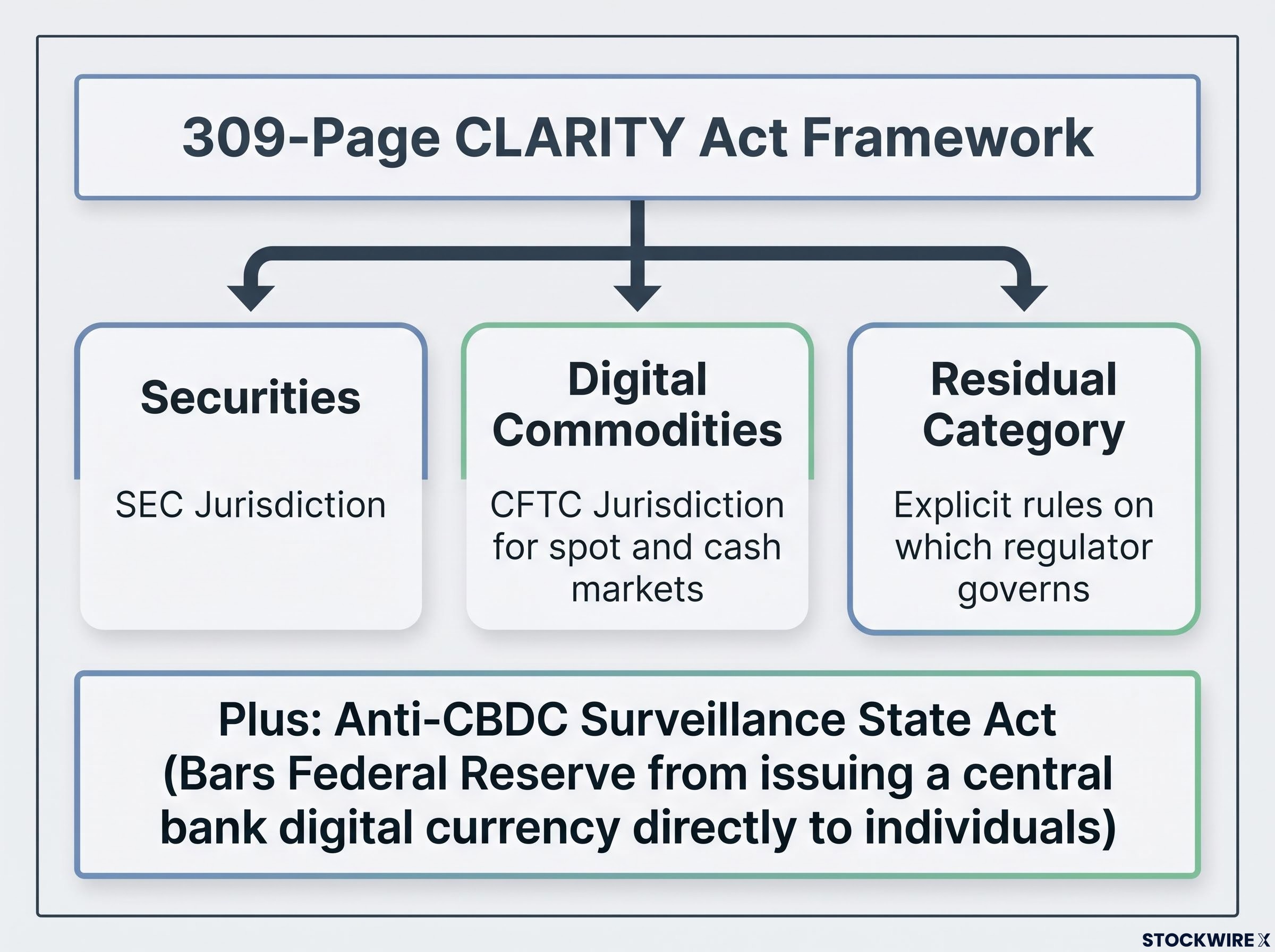
The CLARITY Act would have replaced much of that ambiguity with a defined structure. Its 309-page framework sorted digital assets into three categories:
The CLARITY Act’s defeat leaves a gap the GENIUS Act cannot fill on its own: the GENIUS Act created a live stablecoin regulatory framework for payment tokens, but the broader three-category digital-asset taxonomy that would have governed spot commodity markets and exchange operations remained contingent on the bill that just failed.
- Securities: remaining under Securities and Exchange Commission (SEC) jurisdiction
- Digital commodities: placed under exclusive Commodity Futures Trading Commission (CFTC) jurisdiction for spot and cash markets
- A residual category: with explicit rules on which regulator governs which activity
Crucially for exchanges, the bill would have created a registration pathway allowing them to operate as digital commodity trading venues under CFTC rules. That would have sharply reduced the risk of everyday token listings being retroactively deemed unregistered securities by the SEC. That risk now remains fully in place.
The bill was broad. It even included an “Anti-CBDC Surveillance State Act” provision that would have barred the Federal Reserve from issuing a central bank digital currency directly to individuals. All of it fell with the cloture vote.
Congressional Research Service and Datawallet analysis both point to the same consequence: unresolved SEC-CFTC boundaries and continued enforcement-based regulation have kept “institutional capital on the sidelines.”
That last point is the one investors should sit with. Large investors prefer clear statutory regimes, and without one, US institutional adoption keeps flowing into ETF wrappers and offshore venues rather than direct spot market participation.
For anyone holding US crypto equities, that means the regulatory ceiling on exchange business models stays undefined by statute. It is precisely the condition that keeps big money in ETFs rather than moving it into the spot markets, and the exchanges that serve them, that crypto equity valuations often assume will grow.
What happens next, and what the political timeline actually looks like
Tillis’s motion to reconsider is real, but it is thin. It keeps a procedural door open without providing any reason to expect it will be walked through in 2026. Post-vote analysis broadly treats the year’s legislative window as effectively closed.
Step back and the pattern is clear. The CLARITY Act is the most advanced crypto bill ever to clear a single chamber of Congress, and it still could not survive the Senate stage. That continues a long history in which US crypto rules are set by agency enforcement and court interpretation rather than by statute.
The market had been lowering its expectations for months:
Galaxy Research put passage at roughly 50-50 in June. Bernstein cut it to approximately 31% in August. By 18 August, some analysts were down to about 10%.
The August recess made it worse. The Senate left Washington without scheduling a vote, described by Reuters as a “blow” and by Politico as a “setback.” By the time September’s vote arrived, it was already a delayed and diminished attempt.
For a genuine revival, the structural conditions that killed the bill would need to shift. That means:
- A changed Senate composition heading into a new Congress
- Bipartisan buy-in on the floor, not just support within committee
- A scheduled reset, such as a new Congress opening, that clears the procedural calendar
The relevant question for investors is not whether the CLARITY Act specifically returns. It is whether those conditions, Senate makeup and cross-party consensus, are likely to change before the next Congress. The answer shapes the regulatory risk premium already sitting inside crypto equity prices, and right now those conditions look unlikely to move quickly.
The concept of a regulatory risk premium sitting inside equity prices is not unique to crypto; AI semiconductor valuations absorbed a comparable repricing in early September 2026 when a single week of negative regulatory signals erased billions in market value before any earnings deterioration had occurred.
This article is for informational purposes only and should not be considered financial advice. Investors should conduct their own research and consult with financial professionals before making investment decisions.
What Tuesday’s vote changed, and what it did not
The vote did not touch Bitcoin’s global supply schedule, Coinbase’s cash position, or the long-horizon case for digital assets. What it changed is narrower and specific: the regulatory conditions under which US-domiciled exchanges operate, and the timeline for institutional capital moving into spot markets.
The clearest lesson sits in that 4% versus 10% spread. Exchange equities like Coinbase carry regulatory risk that Bitcoin itself does not, and that distinction matters when you size a position or interpret a price move in either direction.
The framework for sizing a Bitcoin position against other risk assets matters more in a post-CLARITY environment, where the regulatory ceiling on spot market participation remains undefined and the case for holding exchange equities versus the underlying asset carries a different risk calculus than it did before Tuesday.
From here, three things are worth watching: Senate composition heading into the next Congress, any renewed bipartisan effort on a revised market-structure bill, and any SEC or CFTC enforcement actions that fill the vacuum the CLARITY Act’s defeat leaves open.
One vote closed a legislative window. It did not close the story.