The Federal Reserve has not moved its policy rate. Financial conditions have tightened anyway, and the instrument doing the work is the bond market itself.
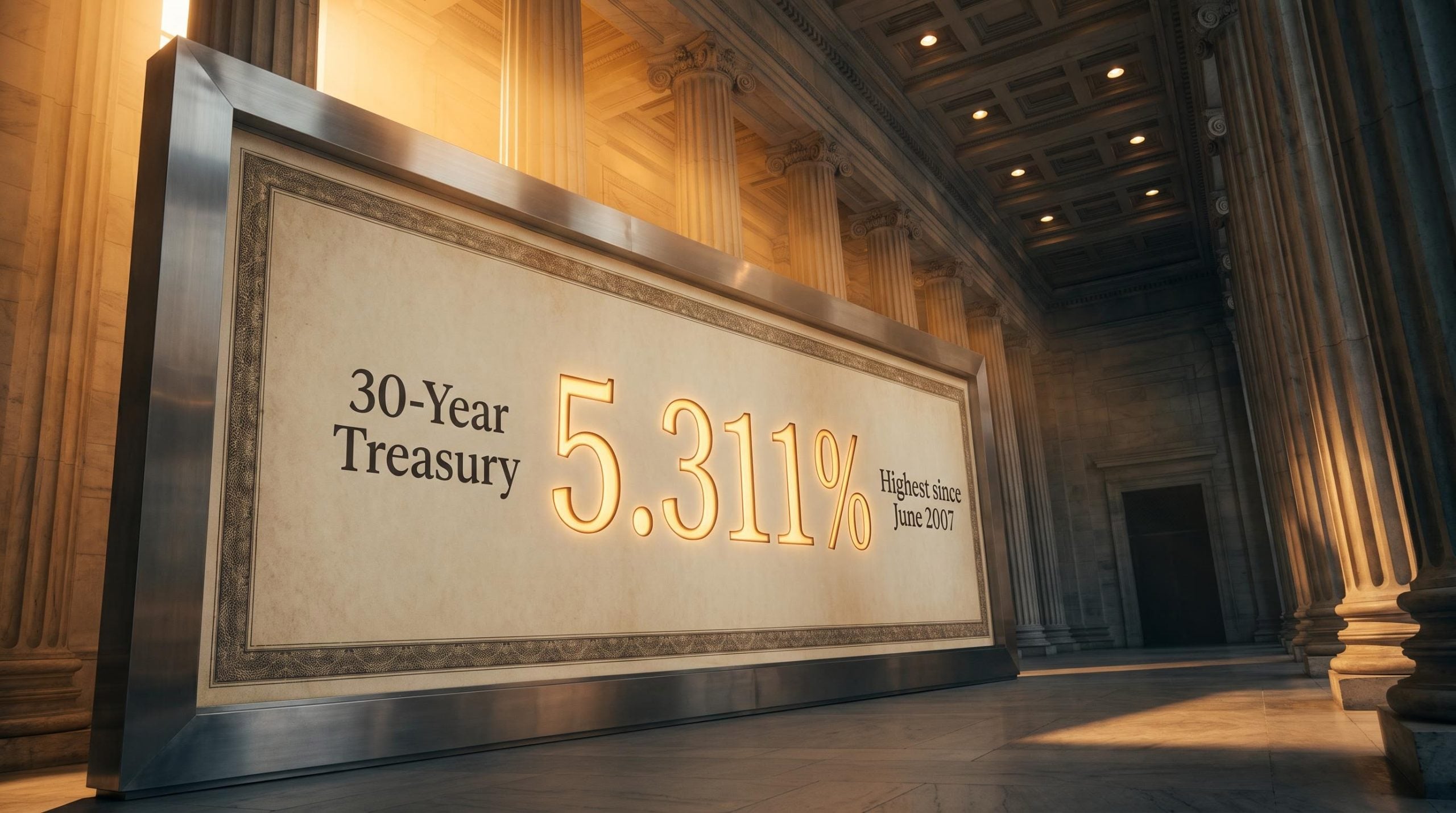
The 30-year Treasury yield crossed 5.311% intraday on 17 August 2026, its highest level since June 2007. That move, and the broader climb in long-dated yields since the start of the year, has raised borrowing costs across the economy without a single vote from the Federal Open Market Committee.
This creates a rate environment most investors do not model for: the policy rate holds, yet the cost of money keeps rising. The impact of Treasury yields on Fed decisions runs in an unusual direction right now, with the market tightening on the central bank’s behalf. After reading this, you will know whether the current yield rise is a signal the Fed must respond to, or a force that actually lowers the urgency for it to act.
What Treasury yields at these levels actually mean for financial conditions
Start with the numbers, because the levels themselves carry the argument.
- 10-year Treasury yield: 4.79% (7 September 2026, per TradingEconomics)
- 30-year Treasury yield: 5.24% (4 September 2026, per YCharts)
- 30-year intraday high: 5.311% (17 August 2026), the highest since June 2007
These readings are broadly corroborated across data providers. FRED reported the 10-year at 4.77% on 3 September 2026, and Wall Street Journal data placed it near 4.78% in the same week.
The 30-year at 5.311% is not just a high print for this cycle. It is the highest level since the summer before the global financial crisis, a generational marker for anyone pricing long-dated debt.
Financial conditions tighten whenever long-term borrowing costs rise, regardless of where the Fed sets its overnight rate. The Fed funds rate governs the very short end of the curve. Almost nothing in the real economy prices off it directly.
These readings are not abstract data for traders because bond yield mechanics establish the baseline from which every dollar-denominated borrowing cost is calculated; as real yields climb, the transmission into corporate debt, mortgages, and equity discount rates follows automatically.
The tightening is already priced into what you borrow
The long end is where real-economy borrowing costs are set. Mortgages, corporate bonds, and any dollar-denominated obligation priced off Treasuries reprice as these yields climb.
That is the point most investors watching the Fed funds rate have missed. The cumulative rise in long yields since early 2026 represents a tightening impulse that, in practical terms, rivals what several conventional rate hikes would deliver.
So the readings above are not abstract data for traders. They are the rate at which the US government, and every borrower priced off it, is now refinancing. Higher costs are flowing directly into the mortgage you might carry and the corporate debt sitting in your portfolio, whether or not the Fed ever meets to make it official.
When big ASX news breaks, our subscribers know first
Why the source of the yield rise changes everything
Here is where most coverage flattens the story. “Yields are rising” is treated as one thing. It is actually two very different things, and the difference decides whether the Fed needs to act at all.
Long-term yields decompose into two parts. The first is the expected future path of short-term interest rates. The second is the term premium, the extra compensation investors demand for holding a long-dated bond and bearing the risk that rates move against them over its life.
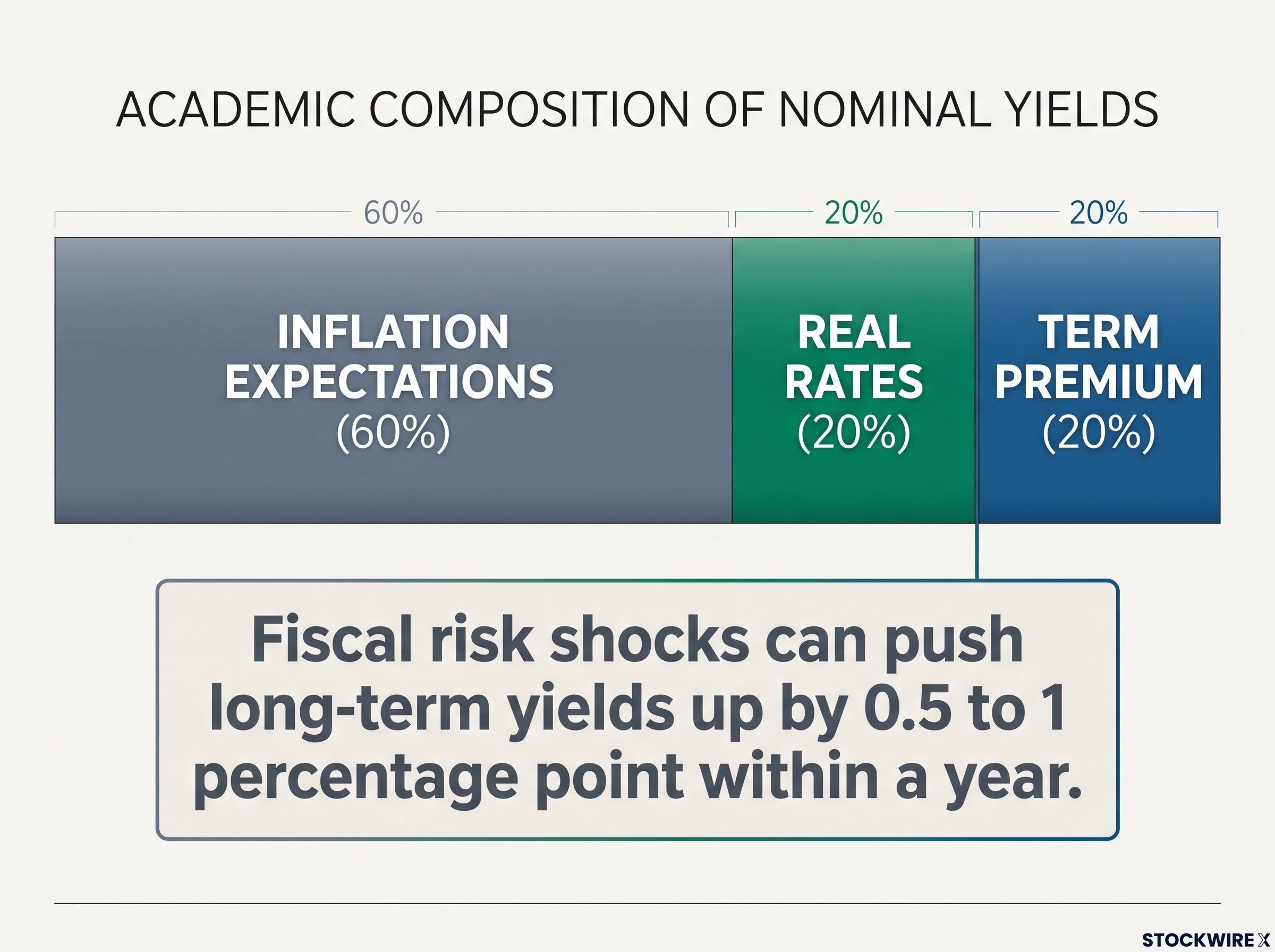
Academic work suggests inflation expectations have historically accounted for roughly 60% of nominal yields, with real rates and the term premium contributing about 20% each. But term premia account for most of the actual time-series variation in Treasury yields, according to Federal Reserve and New York Fed research. When yields swing, the term premium is usually doing the swinging.
Now the two drivers, and why they point in opposite policy directions.
| Inflation-driven yield rise | Term-premium-driven yield rise |
|---|---|
| Driver: markets expect higher future inflation | Driver: fiscal risk and heavy Treasury supply |
| Policy signal: inflation is re-accelerating | Policy signal: markets are pricing debt risk, not prices |
| Fed response required: yes, hike to restore credibility | Fed response required: not automatically |
| Bond market implication: duration is a losing bet | Bond market implication: tightening happens without the Fed |
The current move is predominantly a term premium story. It is tied to a worsening fiscal outlook and heavy Treasury issuance, not a fresh re-acceleration in inflation expectations. US 10-year real yields sit around 2.1% to 2.2%, near the highest of this cycle, which tells you real rates are carrying part of the load too.
Studies cited by Fed researchers show that shocks to fiscal risk can push long-term sovereign yields up by 0.5 to 1 percentage point within a year, dampening growth without any change in short-term rates.
For you, this distinction is the analytical edge. A term-premium-driven rise tells you the market is pricing fiscal risk, not imminent Fed hikes. That has very different implications for how you position duration and how you think about equity multiples than an inflation-expectations story would.
How the New York Fed measures term premium
The standard tool for splitting yields into their components is the ACM model, named for its authors Adrian, Crump and Moench. It estimates the term premium by modelling how expected future short rates and the risk compensation piece each contribute to observed yields. The New York Fed publishes these estimates publicly and updates them regularly, so any reader who wants to track whether the term premium is driving a yield move has a reference point rather than having to guess.
The New York Fed ACM term premium estimates decompose observed Treasury yields into their expected short-rate and risk-compensation components, giving investors a publicly updated reference for tracking whether fiscal risk or inflation expectations are driving any given yield move.
What Kevin Warsh said at Jackson Hole, and what it signals
Fed Chair Kevin Warsh delivered his inaugural Jackson Hole address on 28 August 2026. Read as a set of diagnostic signals rather than a speech, his framing tells you a great deal about where the rate path is heading.
His first signal was a warning against confusing past data with present conditions. Backward-looking inflation reports have cooled somewhat, he acknowledged, but underlying trends have not meaningfully improved, and in his view inflation remains too high.
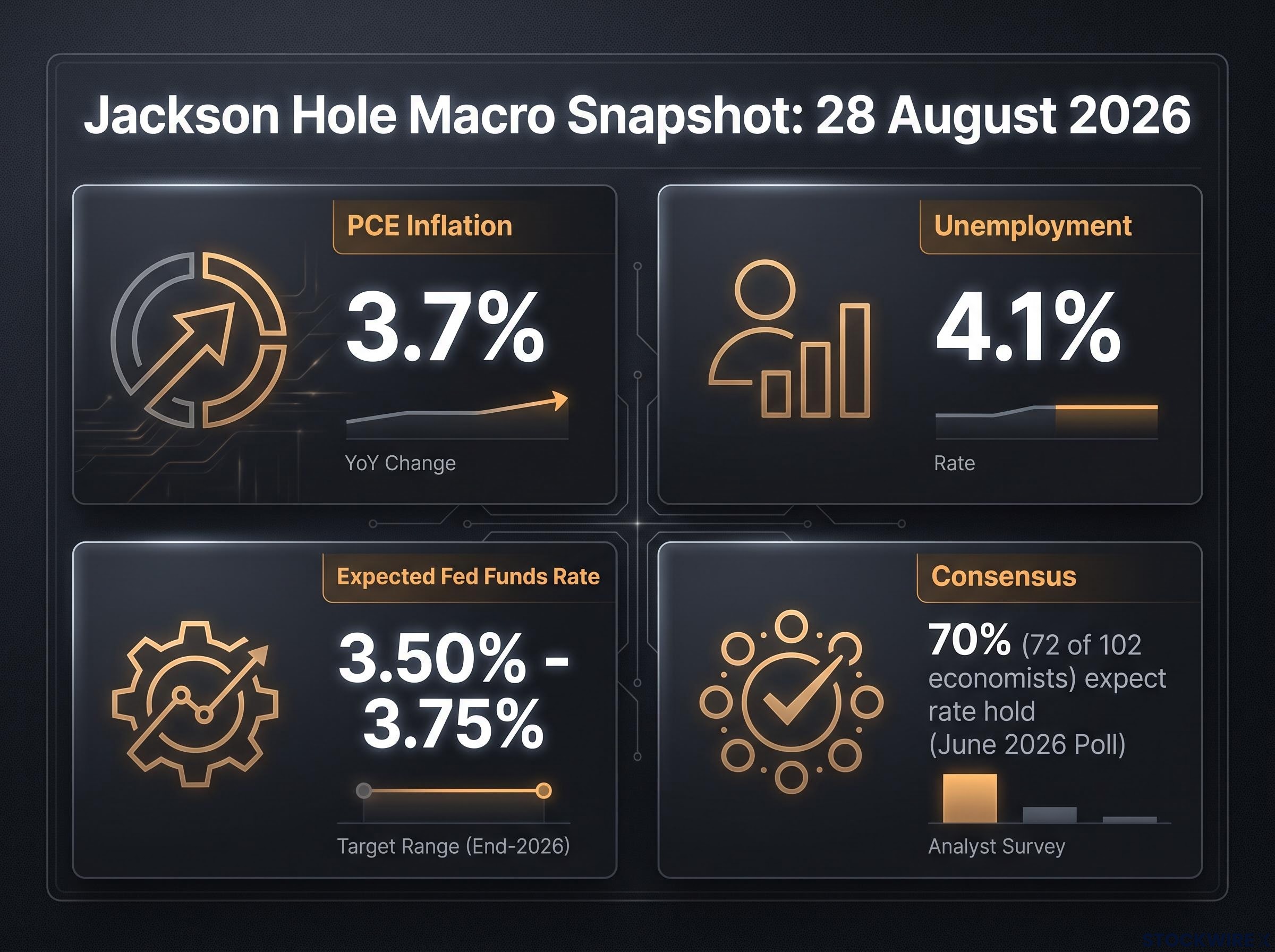
His second signal was a candid read on how restrictive policy actually is. With PCE inflation at 3.7% and unemployment around 4.1%, Warsh said he would be hard-pressed to describe broad financial conditions as restrictive. That matters, because a Fed chair who does not see current settings as tight enough has, in principle, room to argue for more.
Then came the pivot that captures the whole debate.
Warsh noted that rising market yields are tightening policy on the Fed’s behalf, reducing the urgency for immediate rate hikes while keeping future ones on the table if conditions require.
His final signal concerned tools and expectations. Warsh described short-term interest rates as the Fed’s predominant lever, but he made clear he does not want a regime where markets look to the central bank for their next trade. He would rather let markets interpret incoming data than lean on forward guidance.
Forward guidance removal is the structural context behind Warsh’s deliberate refusal to preview rate decisions, a shift that TD Securities analysts identified as creating asymmetric repricing risk for investors positioned for dovish signals ahead of September.
What this tells you is that the Fed is content to watch yield-driven tightening do work it would otherwise have to do itself. That lowers the probability of a near-term hike. It does not close the door, because Warsh explicitly kept it open should market conditions reverse and those fiscal-driven yields fall back.
For anyone reading Fed communications through year-end, this is the interpretive frame. A hold from here is not complacency. It is the Fed accepting a substitute for its own action, and watching to see whether that substitute holds.
How yield-driven tightening transmits into the real economy
Move from the abstract to the concrete, because the tightening already underway does not wait for a Fed announcement to bite.
- Housing and mortgage rates: Higher long-term yields feed directly into mortgage rates, cooling housing demand as borrowing gets more expensive.
- Corporate borrowing costs: Yields pass through to corporate debt at close to a one-for-one rate, raising the cost of financing investment and refinancing existing obligations.
- Equity multiples and the dollar: Rising real yields compress equity price-to-earnings multiples, while a stronger dollar amplifies tightening globally by raising dollar-funding costs abroad.
Mortgage rate transmission from the 10-year Treasury yield operates through a historical spread of approximately 2 percentage points, meaning the climb in long yields since early 2026 has already delivered a measurable monthly cost increase for any borrower who has repriced since the move began.
Context helps here. Conventional Fed tightening cycles have averaged 23 months with a cumulative 4-percentage-point increase in the policy rate. Market-driven tightening can deliver a comparable squeeze far faster, as the 2023 Treasury Tantrum showed when markets tightened conditions ahead of any formal policy move.
The consensus reflects this. NBC’s fixed-income strategists anticipate the Fed will hold through year-end, and a Reuters poll from June 2026 found nearly 70% of economists (72 of 102) expecting the fed funds rate to stay in its 3.50% to 3.75% range for the rest of the year.
The practical takeaway is that you should not wait for a Fed decision to feel the effect of current yields. The tightening is already flowing through mortgage rates and corporate financing costs, shaping investment and consumption decisions now.
| Tightening source | Key characteristic | Reversal risk |
|---|---|---|
| Fed rate hike | Deliberate, signalled, slow to unwind | Low; requires a policy decision to reverse |
| Market-driven yield rise | Fast, sentiment-linked, not centrally controlled | High; can reverse quickly on a shift in risk mood |
What happens if yields fall back
Here is the scenario most investors under-price. If fiscal risk sentiment improves and term premia compress, long yields could retreat and financial conditions loosen with no Fed action at all. That would strip away the market-based tightening the Fed is currently relying on. If inflation has not resolved by then, the central bank loses its market-provided cover and faces renewed pressure to hike into the very conditions it had been happy to leave to the bond market.
What this rate environment actually requires from investors right now
The picture holds together in three layers. Yields are elevated and tightening conditions meaningfully. The dominant driver is the term premium, tied to fiscal risk, not an inflation re-acceleration. And the Fed is on hold but not indifferent to how this resolves.
Two scenarios diverge from here. If yields hold or rise further, duration stays painful and equity multiples remain under pressure. If yields reverse sharply, the tightening evaporates and the Fed’s calculus changes overnight.
For readers wanting to understand the institutional mechanics behind these decisions, our full explainer on how the FOMC works covers the voting structure, the dual mandate, and how rate tools and balance sheet operations each transmit into financial conditions.
The asymmetric risk is the second scenario: market-driven tightening unwinding before inflation is resolved. That is the outcome carrying the most policy uncertainty, and it is worth pricing rather than assuming yields sit at these levels indefinitely.
Three variables to monitor:
- The term premium trajectory, using the New York Fed’s published estimates
- The PCE inflation trend relative to Warsh’s 3.7% baseline
- Any shift in fiscal risk sentiment that could pull long yields lower
This article is for informational purposes only and should not be considered financial advice. Investors should conduct their own research and consult with financial professionals before making investment decisions. Past performance does not guarantee future results, and these forward-looking scenarios are speculative and subject to change based on market developments.