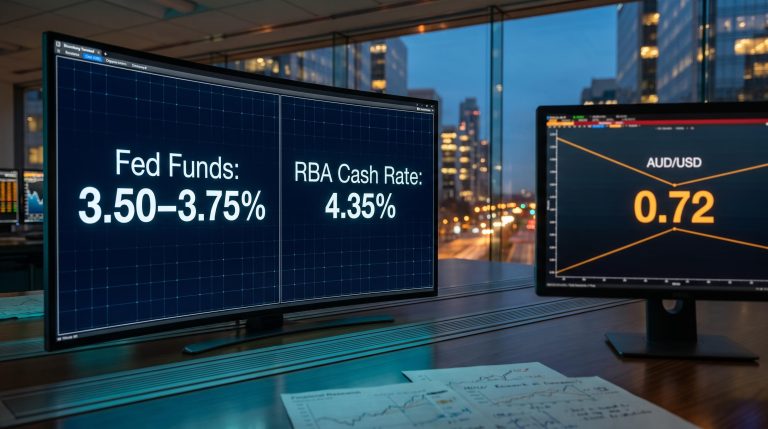
The U.S. dollar has climbed in six straight sessions, yet the professional economists who watch the Federal Reserve most closely put the odds at roughly seven in ten that the central bank does not raise rates at all when it decides today.
That gap between what markets are pricing and what forecasters actually expect is where the real risk sits.
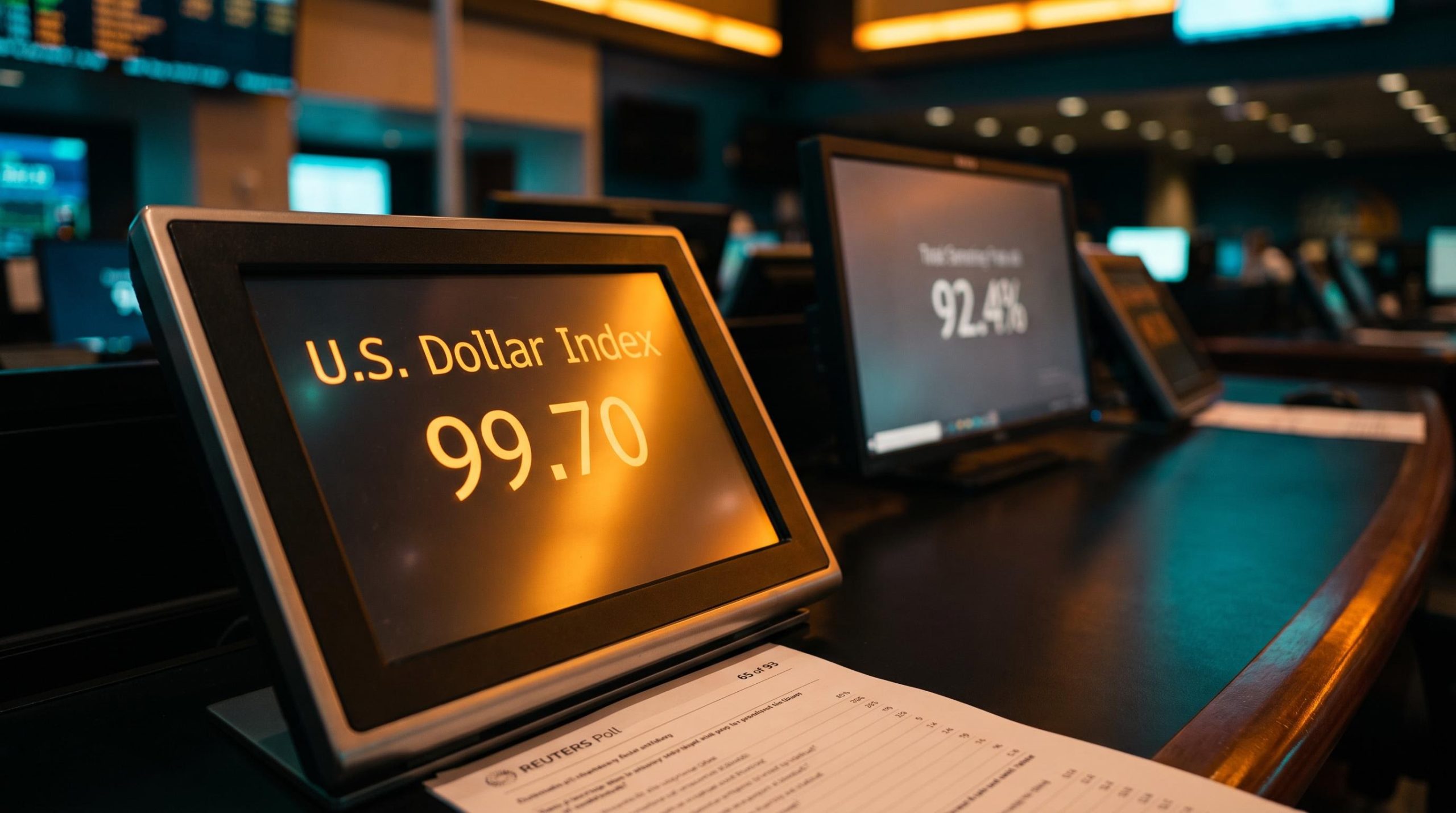
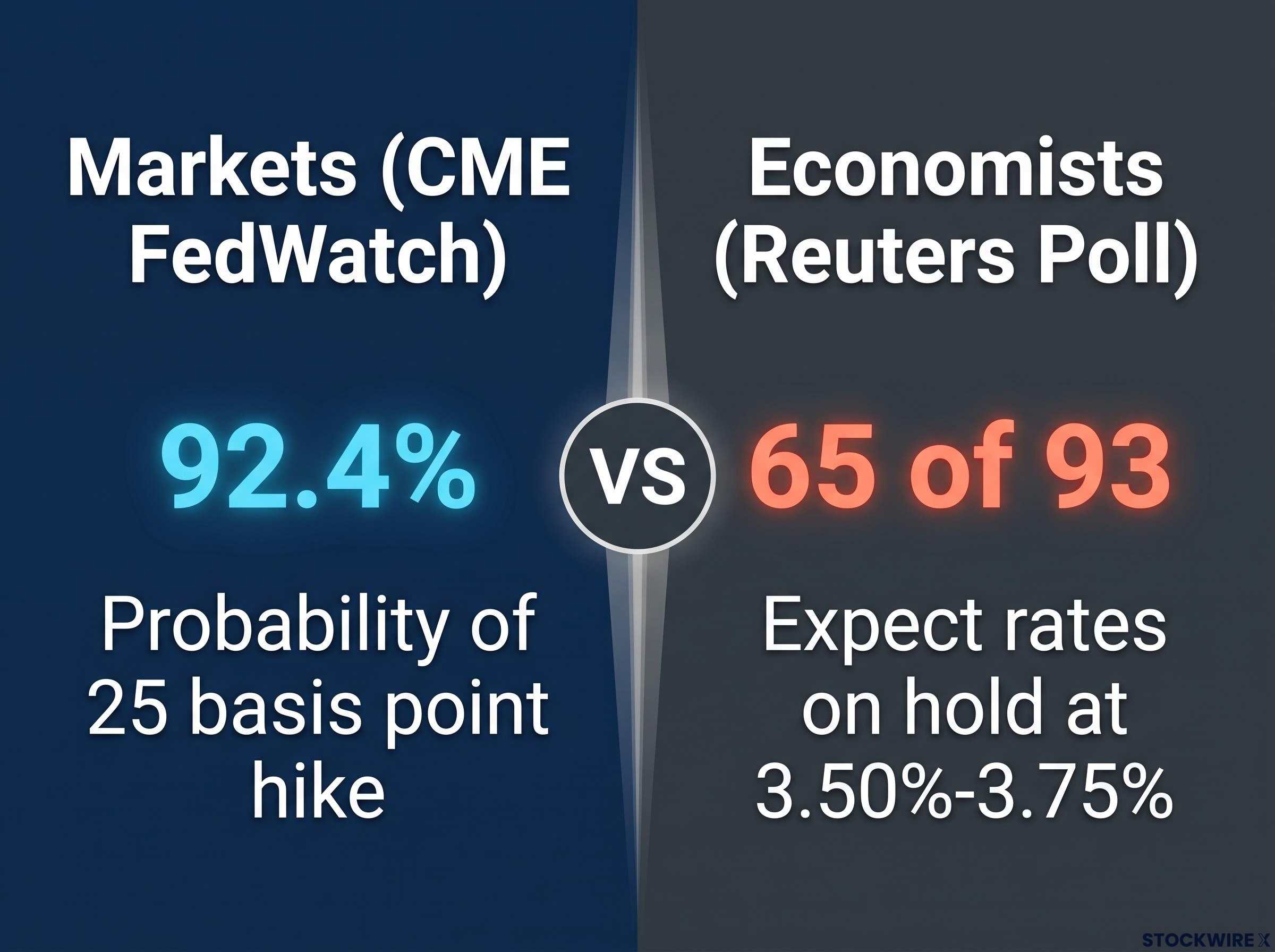
The U.S. Dollar Index (DXY) touched 99.70 in Asian trading, lifted by above-consensus inflation figures, a stronger-than-expected August jobs report, and safe-haven demand tied to Middle East tensions. CME FedWatch is reading a 92.4% probability of a 25 basis point hike today.
But a Reuters poll of 93 economists conducted earlier this month found 65 of them expecting rates to stay on hold. One side is going to be wrong, and the dollar’s next move depends entirely on which.
This piece breaks down what is driving the rally, how a Fed rate decision transmits to the dollar, where the technical picture sits heading into the announcement, and which signals from Chair Kevin Warsh’s press conference to treat as buy or sell triggers. After reading, you will have a framework for reading the decision in real time.
Three forces pushed the dollar to a six-session winning streak
Six consecutive up-sessions is not a random walk. Three distinct forces converged to push DXY to 99.70 during the Asian session, and each one arrived on its own timeline.
The first was labour data. In August, U.S. employers added 162,000 jobs against a 56,000 consensus forecast (Reuters, 4 September 2026). A beat of that scale forced a rapid repricing of hike odds, because a labour market running that hot gives the Fed cover to keep tightening.
Rate hike odds swung from a near coin-flip to above 92% in under two weeks, a repricing driven by August payrolls printing at more than triple the consensus forecast and PPI confirming inflation well above the Fed’s 2% target, compressing the uncertainty that had kept positioning cautious through early September.
The BLS August employment situation report is the primary data source behind the 162,000 payroll print that catalysed the dollar’s opening leg higher, and the full release contains the household survey and labour force participation detail that the Fed’s internal forecasters would have weighed alongside the headline number.
The second was communication. Chair Warsh’s remarks at Jackson Hole in late August lifted CME FedWatch odds for a September hike from roughly 35% to 57.5% in a single session, driving the index to 99.69 for its biggest daily gain since mid-June (Reuters, 28 August 2026). That move tells you how sensitive the dollar has become to Warsh’s specific choice of words.
The third was safe-haven flow. Middle East tensions have pushed oil prices higher, and that works through two channels at once. Higher oil feeds inflation expectations, which supports Treasury yields, while the risk aversion itself pushes global capital toward the dollar as a haven.
Here are the three drivers, each with its quantitative anchor:
- Labour data: August payrolls of 162,000 against a 56,000 consensus, sharply lifting hike expectations
- Warsh communication: Jackson Hole remarks moved CME hike odds from roughly 35% to 57.5% in one session
- Safe-haven flows: Middle East tensions and rising oil feeding both inflation expectations and risk-off demand for USD
Bank of America strategist Alex Cohen set the tone earlier in the cycle, characterising the June FOMC under Warsh in blunt terms.
The June meeting was “unambiguously hawkish and thus unambiguously dollar positive,” said Alex Cohen, strategist at Bank of America.
The structure matters for how you watch this. A rally standing on three separate legs, labour, monetary communication, and geopolitics, is harder to knock over with a single data reversal. But it also means that if two of those supports soften at once, the fall could be faster than a single-thesis trade would suggest.
When big ASX news breaks, our subscribers know first
Why 92.4% is not the same as a sure thing: the economist-market divergence
The headline number looks like certainty. Look closer, and it is a wager the professionals are quietly fading.
CME FedWatch: 92.4% Market-implied probability of a 25 basis point hike as of mid-September. Near-certainty on paper.
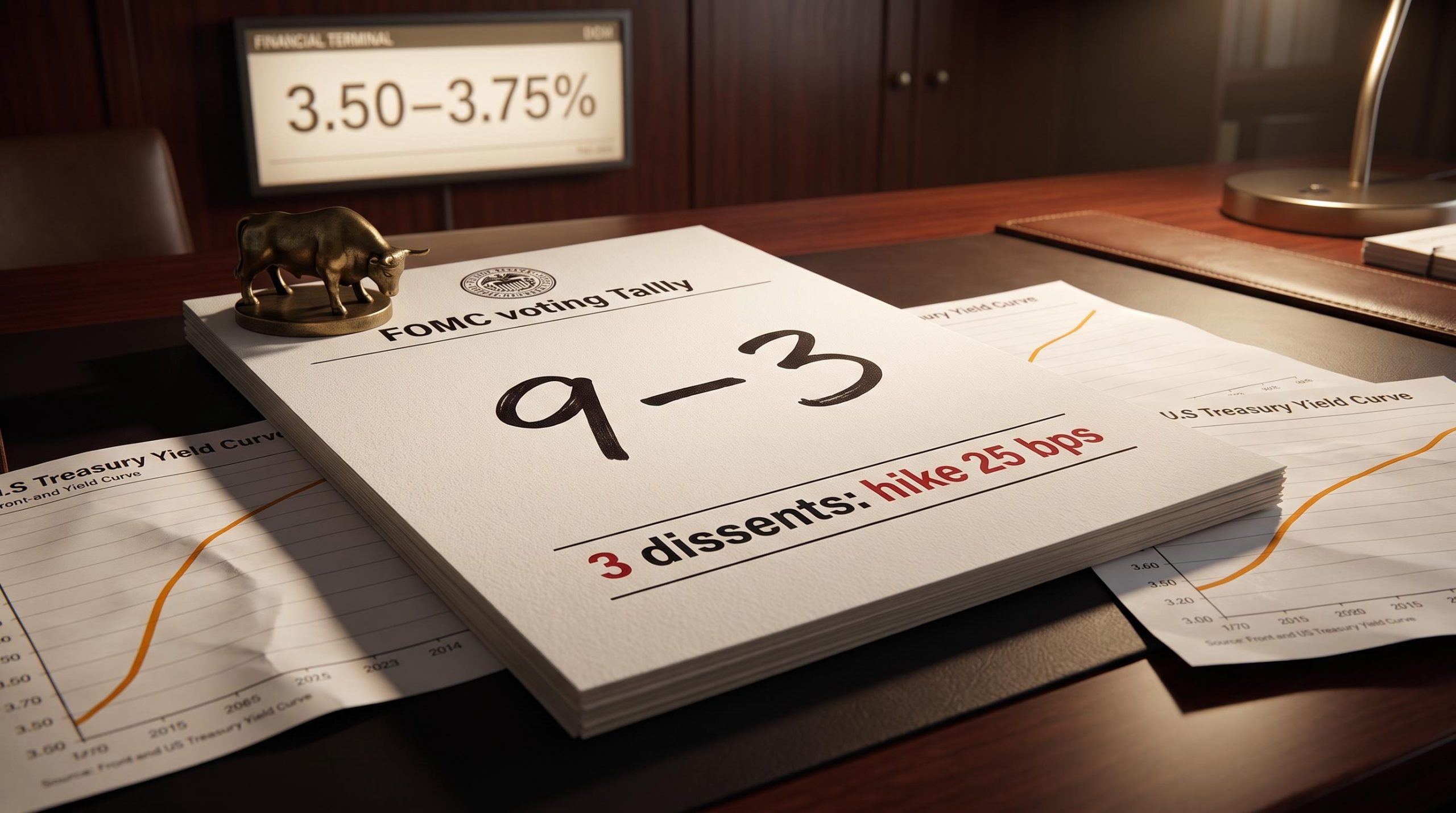
Set that against the forecasters. A Reuters poll of 93 economists conducted between 4 and 9 September found 65 of them, roughly 70%, expecting the Fed to leave rates unchanged at 3.50%-3.75% today. Around 56% expect rates to stay on hold for the remainder of 2026.
That is a genuine structural split, not a rounding difference. Markets and economists are looking at the same data and reaching opposite conclusions about the September decision.
The tension between dot plot vs market pricing is particularly sharp entering today’s decision: the June SEP’s near-even 9/8/1 split among FOMC participants on hikes versus no change versus a cut makes the dot plot median a signal of committee uncertainty rather than directional conviction, which is one reason the Reuters poll and CME FedWatch diverge so sharply.
Here is why the divergence matters mechanically. When markets have already priced a hike at 92.4%, the dollar has largely banked that outcome. A hike that simply confirms expectations adds no new positive, so the dollar’s reaction depends on the guidance relative to that pricing, not relative to zero.
That produces a sharp asymmetry in outcomes:
| Scenario | Market pricing alignment | Likely DXY reaction | Key signal to watch |
|---|---|---|---|
| Hike plus hawkish guidance | Exceeds priced-in base case | Extension higher, break toward 100.00 | Explicit concern about persistent inflation |
| Hike plus neutral guidance | Matches priced-in base case | Limited upside, possible fade | Data-dependence language, no forward commitment |
| Hold or dovish guidance | Undershoots priced-in base case | Sharp reversal lower | Downside growth risks, tolerance for a pause |
The Christopher Waller episode is a live calibration of that third column. On 4 September, dovish-leaning comments from the Fed governor led traders to trim hike bets and weighed on the dollar within hours (Investing.com). A single official shifted the tape.
Above-consensus inflation data the prior week strengthened the hike case and helped push the market toward that 92.4% reading. So the near-certainty is real in the pricing. It is the interpretation of what comes next where the room for a surprise lives.
What this tells you is that the hike itself is already in the dollar’s price. The move you need to trade today comes from the guidance, which means the press conference deserves more of your attention than the rate announcement.
How the Fed’s rate decision reaches the dollar (and why it does not always move the way you expect)
Textbook logic says a rate hike lifts a currency. So why do dollar selloffs so often follow the exact hike traders were waiting for?
The core channel is straightforward. Higher U.S. interest rates raise the yield on dollar-denominated assets, and that yield advantage attracts capital inflows that bid the currency higher. More return for the same dollar draws money in.
The complication is timing. When a hike is priced at 92%, the actual decision removes uncertainty rather than adding a fresh positive. That is the “buy the rumour, sell the news” dynamic, and it explains why the dollar can soften immediately after an announcement that matched expectations perfectly.
Policy divergence adds another layer. The dollar’s strength against the euro and pound depends not only on where the Fed goes, but on how far ahead of the European Central Bank (ECB) and Bank of England it appears to be moving. FXEmpire described the DXY fundamental bias as “moderately bullish” on 14 September, citing elevated Fed hike expectations and exactly this divergence.
Global central bank divergence amplifies every Fed move because the dollar’s strength is relative, not absolute: when the ECB is forecast to hike into near-recession conditions and the BOJ is tightening faster than expected, a Fed hold lands differently on DXY than it would in a synchronised global easing environment.
Here are the four channels that carry a rate decision into the dollar:
- Yield differential: Higher U.S. rates lift the return on dollar assets relative to foreign alternatives
- Capital flow: That yield advantage draws global capital into USD-denominated markets
- Policy divergence: The dollar’s edge depends on the Fed’s lead over the ECB and Bank of England, not its absolute rate
- Forward expectations: Markets trade the expected path for October and December, not just today’s move
At 125.7, the FXS Fed Sentiment Index indicated that rate expectations had settled into a range where they were no longer pulling the dollar lower, providing a stable floor beneath the six-session advance.
What the 2004-2007 cycle tells us about sustained tightening paths
History offers a useful reference point. Across the June 2004 to June 2007 tightening cycle, incremental 25 basis point hikes steadily supported the dollar when the Fed’s communication stayed clear and predictable. The dollar earned its strength when the path was legible.
Ambiguity was the disruptor. Where guidance turned uncertain, volatility followed even when the hikes themselves were delivered as expected. The lesson is that clarity, not the raw rate, did the heavy lifting.
The spillover effects ran wider. Research studying that cycle notes that emerging market currencies with weaker external balances bore the sharpest pressure from U.S. tightening. A 2018 Federal Reserve staff memo found that a 100 basis point upside surprise to the expected U.S. policy path is associated with roughly 6% average depreciation in emerging market currencies. Second-order equity effects included rotation out of growth stocks and into value and financials.
The Federal Reserve FEDS Note on U.S. rates and emerging market currencies provides the empirical basis for the 6% average depreciation estimate cited for a 100 basis point upside policy surprise, drawing on the taper tantrum episode and subsequent tightening cycles to isolate the transmission channel from U.S. rate expectations to EM exchange rates.
The takeaway for today is direct. The dollar’s direction after this decision depends less on whether the Fed hikes and more on whether Warsh shifts the expected path for the two meetings that follow, which is precisely why the press conference is the higher-stakes event.
What the DXY chart says about the dollar’s near-term ceiling
The fundamentals point higher. The chart says the dollar is running into traffic just below a number that traders watch closely.
DXY sat at 99.70 during the Asian session, with a 14-day Relative Strength Index (RSI) near 56. RSI measures the speed of recent price moves on a scale of 0 to 100, and a reading of 56 is bullish territory without being overbought, which starts around 70. The index was holding above its 9-day exponential moving average (EMA) near 99.35 and its 50-day EMA around 99.64, and the FXS Fed Sentiment Index at 125.7 reinforced the constructive setup.
The levels above and below current price tell the near-term story:
| Level | Type | Technical basis | Significance |
|---|---|---|---|
| 100.00 | Resistance | Psychological round number | Break signals trend extension on hawkish guidance |
| 99.77 | Resistance | 100-day moving average (OCBC) | First overhead barrier above current price |
| 99.70 | Current | Spot (Asian session) | Momentum present, conviction not yet confirmed |
| 99.64 | Support | 50-day EMA, congestion zone | Immediate floor and near-term pivot |
| 99.12-99.35 | Support | 9-day EMA band | First line of defence on disappointment |
| 98.60-98.70 | Support | 50% Fibonacci retracement | Likely target on a dovish surprise |
The RSI reading is the tell. At 56, there is room to run toward the overbought 70 zone if the hike lands with genuinely hawkish guidance. But from a base this middling, a dovish surprise could roll RSI back toward the neutral 50 line and below within a session.
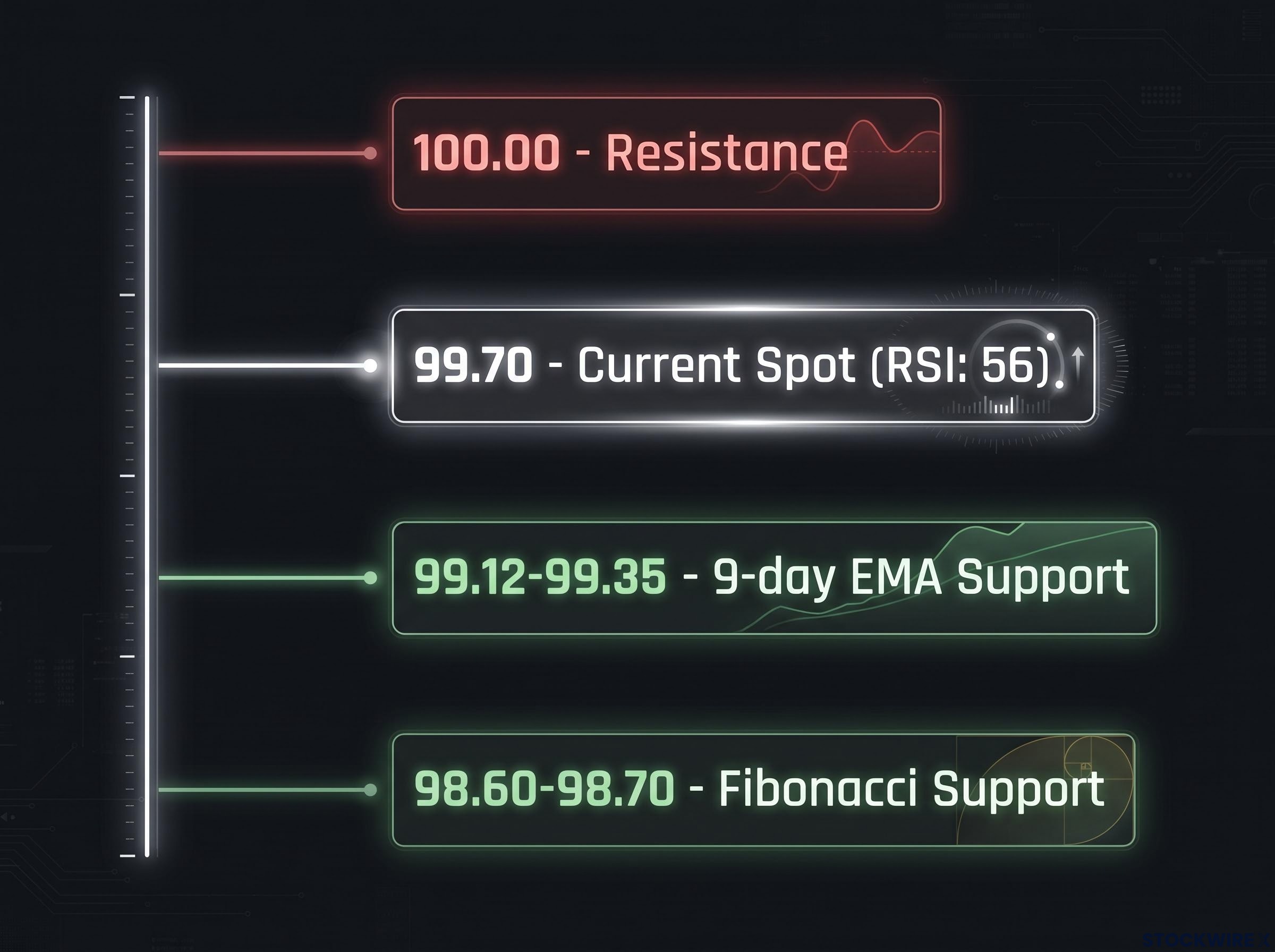
Put the momentum and the position together, and the picture is one of push without full conviction. Price hovering just under 100.00 with RSI at 56 says the bulls have the ball but have not yet committed.
Here is what that means if you are managing short-term dollar exposure. A hawkish press conference gives bulls the room to force 100.00, while a dovish surprise from this level could trigger a rapid retreat to the 98.60-98.70 Fibonacci support, a move of roughly 100 pips. A sustained break above 100.00 is your trend-extension signal; a close below 99.35 is your reversal signal.
What Warsh says next matters more than what the Fed just did
The rate decision is the event everyone is watching. The press conference is the event that will actually move the dollar.
Warsh dismantled the forward guidance regime at his first FOMC press conference in June 2026, which is precisely why each press conference now carries more market-moving weight than it did under his predecessors: there is no pre-committed path to anchor expectations between meetings.
With a hike priced at 92.4% implied odds, the decision itself is largely banked. The next meaningful move comes from how Warsh characterises October and December, against a calendar that runs to the 27-28 October and 8-9 December FOMC meetings.
The precedents show how much a single voice can shift. Warsh’s hawkish Jackson Hole speech moved CME odds from roughly 35% to 57.5% in one session and lifted DXY to 99.69. Waller’s dovish-leaning comments on 4 September visibly trimmed hike bets and weighed on the dollar. Same institution, opposite direction, both driven by tone rather than an actual rate change.
Hawkish signals that support a dollar extension
Listen for language that signals more tightening ahead. The benchmark for impact is the Jackson Hole speech, and a comparable tone would give bulls room to force a break through 100.00.
- Explicit emphasis on persistent inflation risks or discomfort with above-target price levels
- A stated readiness to move at consecutive meetings rather than pausing
- Framing that treats further hikes as the base case rather than a contingency
Dovish signals that could unwind the six-session rally
The opposite cues would pull the premium out fast. Recall that around 56% of polled economists already expect rates on hold for the rest of 2026, so the market is carrying a more aggressive path than forecasters believe. That leaves crowded long-dollar positioning exposed.
- Heavy emphasis on data-dependence with no forward commitment
- Explicit concern about downside growth risks
- Signalling comfort with a gradual, wait-and-see approach
The external variables can amplify either outcome. If oil prices retreat or Middle East tensions ease, the safe-haven and inflation supports for the dollar soften at the same time, which would sharpen a dovish reaction. A more aggressive tightening signal from the ECB or Bank of England would narrow the policy divergence and erode a key DXY support (FXEmpire, 14 September).
The six-session streak reflects expectations, not outcomes. After today, the rally either earns its gains through confirmed forward guidance or hands the hike premium back to the traders who positioned early. Knowing which words resolve that question turns a live event into a decision framework rather than noise.
This article is for informational purposes only and should not be considered financial advice. Investors should conduct their own research and consult with financial professionals before making investment decisions.
Past performance does not guarantee future results. Financial projections are subject to market conditions and various risk factors, and the scenarios described here are speculative and subject to change based on the Fed’s decision, forward guidance, and broader market developments.