On the same day the Bureau of Labor Statistics reported the US economy added 162,000 jobs in August, President Trump went to Truth Social to demand the Federal Reserve slash interest rates. He then threatened to cut trade with any country running a surplus with the United States if the central bank refused.
The combination is jarring. A better-than-expected jobs print normally reduces the pressure on the Fed to ease, yet it arrived paired with a presidential ultimatum that ties the nation’s trade relationships directly to the central bank’s rate decisions.
That linkage is new. Trump has attacked Fed independence before, but connecting rate policy to bilateral trade flows as leverage is a qualitative step beyond his prior pressure campaign.
What follows unpacks what Trump actually said, why the economics behind his argument sit awkwardly against how central banking works, what institutional risks flow from this kind of intervention, and where markets are actually pricing rates for the rest of 2026. Each part of that picture matters for understanding what this moment means and what, if anything, is likely to change.
Trump’s ultimatum: praise the jobs numbers, then demand a rate cut anyway
The August report gave Trump an economy to boast about. It also handed the Fed a reason to hold rather than cut, and that is the contradiction sitting at the centre of the day.
The Bureau of Labor Statistics reported on 4 September 2026 that nonfarm payrolls rose by 162,000 in August, with the unemployment rate steady at 4.1%. That reversed the previous month’s contraction, when the July release on 7 August 2026 showed payrolls falling by 23,000.
- August 2026 nonfarm payrolls: +162,000
- July 2026 nonfarm payrolls: -23,000
- Unemployment rate (July and August 2026): 4.1%
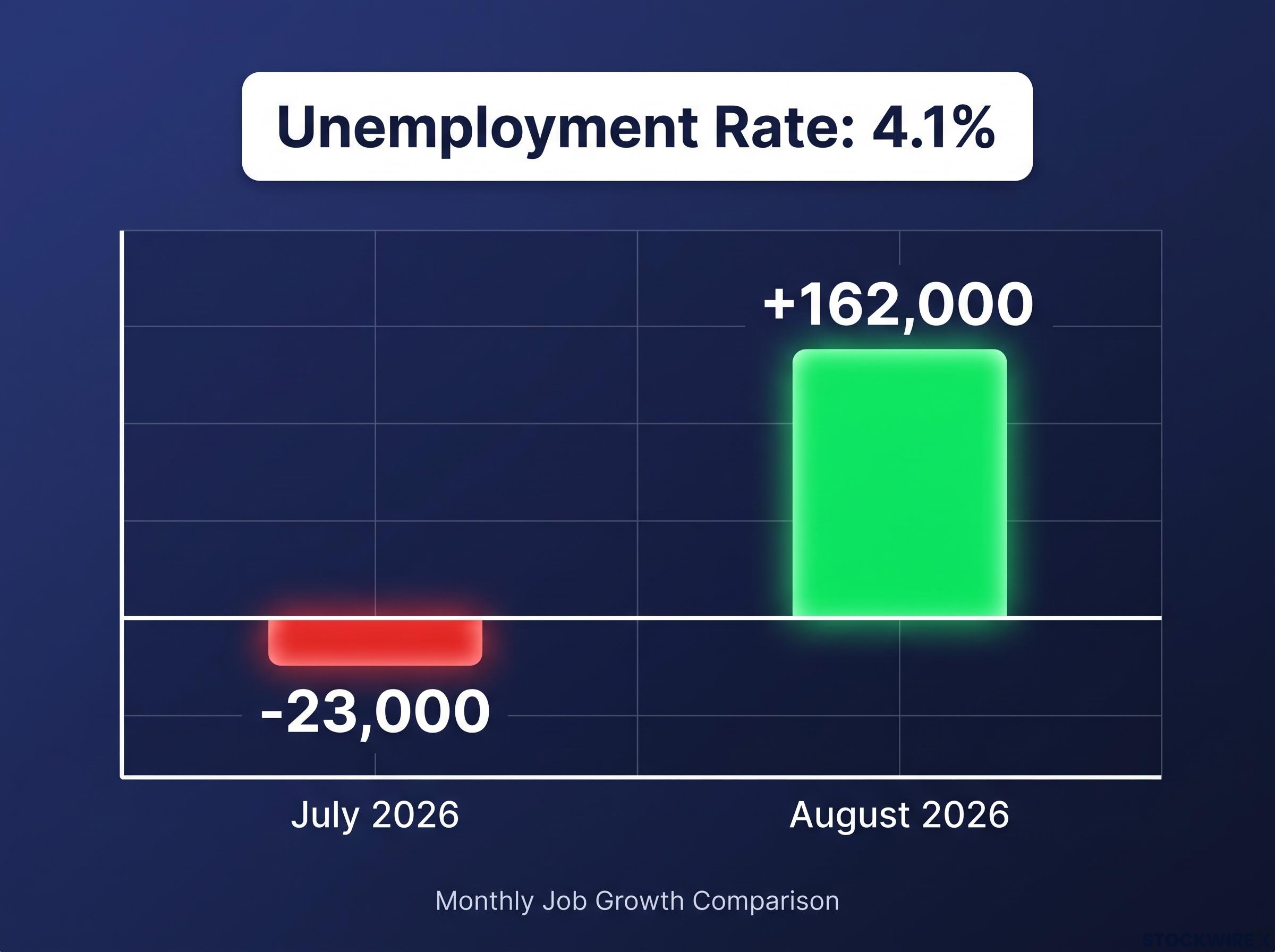
Trump himself called the August figure “much stronger than expected.” Then he used that strength as the reason the Fed should ease aggressively.
The headline 162,000 figure is the number Trump cited, but payrolls report internals, including average hourly earnings, prior-month revisions, and the labour force participation rate, carry more weight for the Fed’s actual deliberations than the number that lands in a Truth Social post.
His argument ran through creditworthiness. “Lower the interest rates because the U.S.A. is a much stronger credit than it was just a short time ago,” he wrote, before declaring: “A STRONG COUNTRY MEANS A LOWER INTEREST RATE, IT’S A BETTER CREDIT.” The conclusion, addressed to Fed chair Kevin Warsh, was blunt: “We should have the LOWEST RATE of any country in the World.”
The logic Trump is building is that a strong economy equals strong credit equals an entitlement to the world’s cheapest borrowing costs. That inverts the conventional relationship. A strengthening jobs market is usually the reason a central bank holds or tightens, because faster hiring can feed inflation. Trump is reading the same data as a mandate to slash.
That inversion is the tension driving the day’s story, and it matters because everything downstream, from the trade threat to the market reaction, depends on whether you accept his framing or the Fed’s.
When big ASX news breaks, our subscribers know first
The trade linkage threat and why it is a departure from prior pressure
Here is where a routine complaint became something markets have to price differently.
LOWER THE RATE OR I’LL STOP TRADING WITH COUNTRIES WITH WHICH WE HAVE A DEFICIT
Trump warned he would halt trade with countries where the US runs a trade deficit if the Fed did not cut rates. CNBC characterised the threat as cutting off trade with deficit countries should the central bank fail to act. The Standard reproduced the caps-locked wording above, framing it as a possible substitute for tariff measures.
The move carries a two-audience message. The Fed is the nominal target, but surplus-country trading partners are simultaneously being put on notice, tied to a monetary decision they have no part in making.
What distinguishes this from Trump’s earlier Fed attacks
Trump’s pressure on the central bank is not new. He has publicly criticised Fed decisions, backed an attempt to remove a board member, and called for specific rate cuts at specific meetings. Notably, he described Warsh in favourable terms even while issuing this ultimatum, signalling the pressure is aimed at the institution’s decision rather than the chair personally.
Those earlier moves were pressure on the Fed’s personnel and its communication. This is different in kind.
The Supreme Court’s 5-4 Fed independence ruling in Trump v. Cook on 29 June 2026 already established that removing a sitting governor requires documented allegations, a formal response period, and a defined deadline, each judicially reviewable, making the board composition strategy that motivated Cook’s removal significantly harder to execute.
The trade threat attaches a consequence the Fed cannot address. A rate decision is within the central bank’s control; the state of US trade relationships is not. By coupling the two, Trump creates a category of uncertainty where a Fed decision could be perceived as affecting trade outcomes regardless of the Fed’s own intentions.
For a reader trying to work out whether this is political noise or a genuine policy signal, that is the pivot. Bolting trade consequences onto a monetary outcome turns a familiar presidential grievance into a multi-market risk event, one that touches rate expectations, currency markets, and bilateral trade all at once. That breadth is why it cannot be dismissed as simply more of the same rhetoric.
What economists and institutional observers say about political pressure on the central bank
The financial establishment does not treat this category of pressure lightly, and the breadth of the concern is the clearest measure of how seriously it is taken.
The Federal Reserve’s own published guidance on Federal Reserve independence from political pressure explains that while the central bank is accountable to Congress, its monetary policy decisions are deliberately insulated from the executive branch, a structural feature that underpins the credibility markets assign to its rate decisions.
- A Reuters poll of economists in July 2025 found over 70% believed the Fed’s independence was increasingly jeopardised by political intervention, with many “very troubled” by the trend.
- A CNBC Fed Survey in September 2025 reported that 82% of economists, fund managers, and strategists believed Trump’s actions were aimed at restricting or abolishing the Fed’s autonomy.
- A J.P. Morgan research note, summarised by Fox Business, warned that undermining the central bank’s independence raises the risk of inflation and politically driven policy errors.
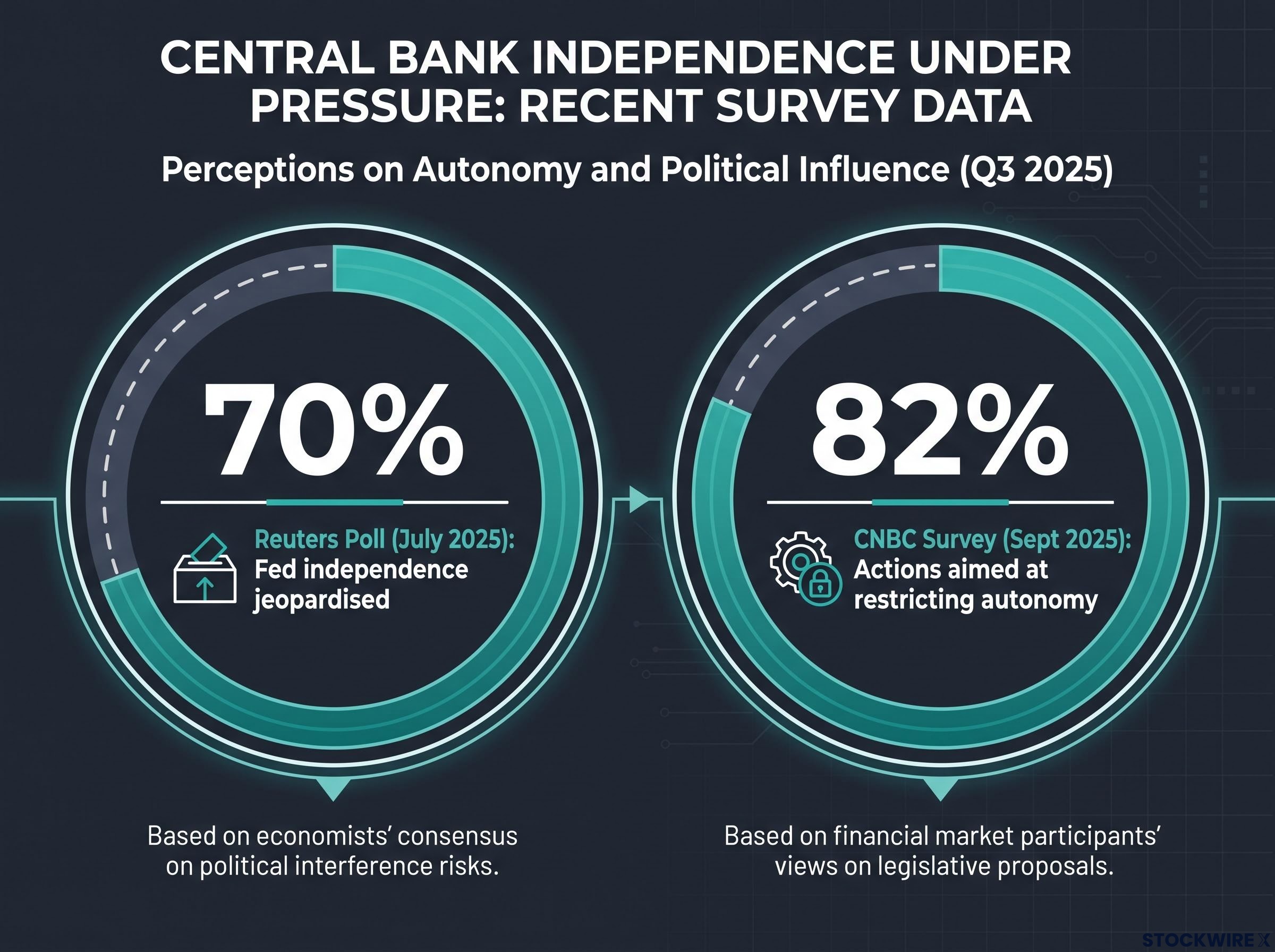
The consensus is not really about constitutional principle. It is about a concrete feedback loop.
Economist Carola Binder told Bloomberg that “mere criticism” of the Fed by political leaders can be inflationary, because it shifts expectations about future policy before any rate decision is even made.
That is the counterintuitive part. Investors can begin pricing in politically driven decisions rather than economic fundamentals, and once expectations move, the effect is real regardless of what the Fed actually does.
Associated Press reporting from 31 August 2025 put the practical stakes plainly. Analysts warned that a compliant Fed cutting rates sharply would likely produce higher inflation and, over time, higher borrowing costs on mortgages, auto loans, and business financing.
That is the loop worth understanding. Political pressure that succeeds in forcing rates down can generate the higher long-term borrowing costs it was meant to avoid. For borrowers and investors alike, it explains why markets treat presidential attacks on the Fed as a volatility signal even when they fully expect the institution to hold its ground.
Where markets are actually pricing rates for the rest of 2026
Set the rhetoric aside and look at the positioning. Market participants are not pricing in cuts, and the August jobs number only hardens that stance.
Reuters reported that Fed futures had “wiped out all bets on 2026 rate cuts.”
Rate hike odds collapsed to around 30% for September after softer July data, then the August 162,000 payrolls print reversed that direction, leaving the tightening bias intact even as the political pressure for cuts intensified in the same fortnight.
That commentary, from 28 May 2026, noted markets were instead pricing the next move as a possible hike within 12 months, with two-year Treasury yields trading above the policy rate. The August payrolls gain of 162,000, well above expectations, reinforces the case for holding or tightening rather than the aggressive easing Trump wants.
| Scenario | Probability / Signal | Source | Date |
|---|---|---|---|
| No change at next meeting | 76% | Kalshi / Polymarket | 29 July 2026 |
| 25 bps hike | 24% | Kalshi / Polymarket | 29 July 2026 |
| Any rate cut | ~0.2% | Kalshi / Polymarket | 29 July 2026 |
| Futures pointing to rising rates | Tightening bias | Forbes / CME FedWatch | 8 August 2026 |
The read is unambiguous. Prediction markets gave roughly 0.2% combined odds of any cut in late July, and even soft July data did not shift fixed-income futures away from a tightening bias, according to the CME FedWatch Tool.
Markets are not treating Trump’s demands as credible near-term guidance. The gap between the political pressure and the pricing is itself the signal, because a surprise capitulation by the Fed would deliver a sharper shock than continued stability.
There is a template for what that shock looks like. A Reuters Instant View from 12 January 2026 recorded an earlier escalation of the feud producing a weaker dollar, falling stock futures, and rising Treasury futures, a classic flight to safety on policy uncertainty. For anyone positioning ahead of the next meeting, futures traders are betting on stability or tightening, not on Trump’s preferred outcome.
What the Fed is likely to do, and what would have to change
The question that resolves the tension is narrower than it sounds. Not what Trump wants, and not what markets expect, but what would actually have to shift for the Fed’s own calculation to change.
Why the current data argues against cuts
The Fed’s mandate is price stability and maximum employment, not presidential approval. Measured against that framework, the August data actively weakens the case for cuts. Payrolls up 162,000 and unemployment at 4.1% are not the numbers that justify easing.
The institution also has a precedent for holding its nerve. Associated Press reporting from 18 September 2025 described the Fed cutting by a modest quarter-point while maintaining internal unity, a move markets read as a deliberate signal of autonomy under pressure. That gives the central bank a way to manage political friction without capitulating.
The bar for easing is asymmetric. Reuters noted that even July’s soft data “reduced some urgency” around hikes but did not trigger cuts, showing how much further conditions would have to deteriorate before the Fed moved.
What a data shift would look like
For a rate-cut cycle to become plausible, the data would need to turn decisively:
- Sustained payroll losses over several months, not a single soft print like July’s -23,000.
- A meaningful and sustained decline in CPI or PCE inflation toward or below the 2% target.
- Broader evidence of demand weakness rather than one-off volatility in the numbers.
Even then, the historical pattern points to gradualism. An Investopedia framework from 2024 suggested the Fed typically moves in quarter-point increments rather than the dramatic slashing Trump is demanding.
The takeaway for anyone watching rate-sensitive positions is conditional and clear. Absent a real deterioration in jobs or inflation, the Fed has both the precedent and the data cover to hold. Watch the next two or three payroll releases and CPI prints, not the Truth Social feed, for the signals that would actually move policy.
A linkage that markets will keep watching even if the Fed does not blink
Three forces point the same way. The jobs data argues against cuts, the expert consensus warns against politicised ones, and markets are not pricing them, with prediction markets giving any cut roughly 0.2% odds.
Yet the trade-linkage threat introduces a variable with no clean historical precedent. Whether or not the Fed acts, the framing of rate decisions as connected to trade outcomes is now part of the political environment, and markets will have to fold that framing into how they price uncertainty.
Foreign Treasury demand from major surplus countries has already shown structural erosion, with Goldman Sachs documenting that foreign official institutions sold Treasuries into stress events in March 2026 rather than buying them, a pattern that gives the trade-linkage threat a bond-market dimension beyond its immediate monetary policy framing.
The significance of 4 September 2026 is not whether the Fed cuts this month. On a 162,000 payrolls print, it almost certainly will not. The significance is that the architecture of presidential pressure on monetary policy now formally incorporates trade as a lever, a shift with implications for how both institutions behave over the longer term.
For investors, that adds a new input to the uncertainty premium on rate-sensitive assets. Alongside CPI and payrolls, the variables now worth monitoring are:
- The next payroll release and what it says about the labour market’s direction.
- The next FOMC meeting outcome and any sign of the Fed responding to political pressure.
- Whether the trade-linkage threat is operationalised, escalated, or quietly abandoned.
This article is for informational purposes only and should not be considered financial advice. Investors should conduct their own research and consult with financial professionals before making investment decisions.
Past performance does not guarantee future results. Financial projections are subject to market conditions and various risk factors, and forward-looking statements are speculative and subject to change based on market developments.