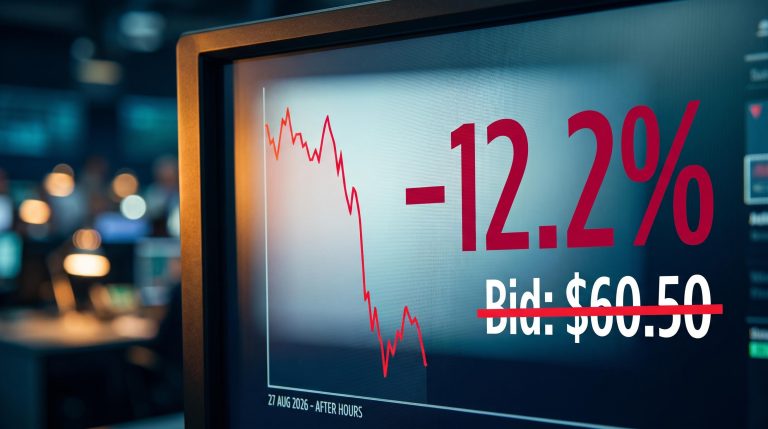
No new economic data. No numerical targets. No rate projections. Chair Kevin Warsh’s Jackson Hole keynote on 27 August contained none of the ingredients that traditionally move interest rate markets, yet CME-linked pricing for a September quarter-point hike jumped roughly 20 percentage points overnight.
That gap between what was said and what moved tells you something important about the monetary policy regime you are now operating in. The Fed has stopped telegraphing its intentions, and markets are being forced to extract signal from tone alone. The result is a repricing environment where a single speech, absent any fresh data, can shift the probability of a rate hike from roughly one-in-three to better than coin-flip odds.
Here is a framework for reading the newly opaque Fed communication strategy, separating the volatility noise from the actual data catalysts that will determine the 16 September rate decision, and understanding why the biggest omission from the speech may matter more than anything Warsh actually said.
How tone alone triggered a massive rate repricing
Before Warsh took the stage, futures markets priced a September hike at approximately 35.4%. By the close of the session, that figure had climbed into the mid-50s and sat just under 60%.
Pre-Jackson Hole positioning reflected a consensus that had fully absorbed softer July CPI and employment data, with September hike odds collapsing to approximately 30% by 14 August, a complete reversal from the near-certain hike consensus that held just weeks earlier and the baseline from which Warsh’s speech produced its 20-percentage-point repricing.
Nothing in the macro data changed. No inflation print landed. No payrolls report arrived early. The entire move was driven by what Warsh emphasised, what he refused to say, and how markets decoded both.
| Metric | Pre-Speech Status | Post-Speech Reality |
|---|---|---|
| September hike probability | ~35.4% | Mid-50s to ~60% |
| Market base case | Hold most likely | Quarter-point hike now base case |
| Near-term rate cuts | Marginal but priced | Effectively priced out |
A 20-percentage-point swing in rate expectations without a single new data point attached is not a normal market event. It is a direct consequence of a central bank that has deliberately removed the guardrails markets once relied on to position ahead of decisions.
“We’ve dropped forward guidance.” — Fed Chair Kevin Warsh, Jackson Hole Symposium, August 2026
That sentence, delivered without qualification, confirmed what markets had suspected since June: the Fed will no longer walk you gently toward its next move. Rate cuts have been pushed to the margins of near-term pricing. A quarter-point hike is now the working assumption.
What this repricing tells you about your own positioning is straightforward. Volatility is no longer an anomaly in rate markets. It is a structural feature of the new policy regime, and it will persist for as long as the Fed refuses to pre-commit to a path.
When big ASX news breaks, our subscribers know first
Understanding the mechanics of a no-guidance regime
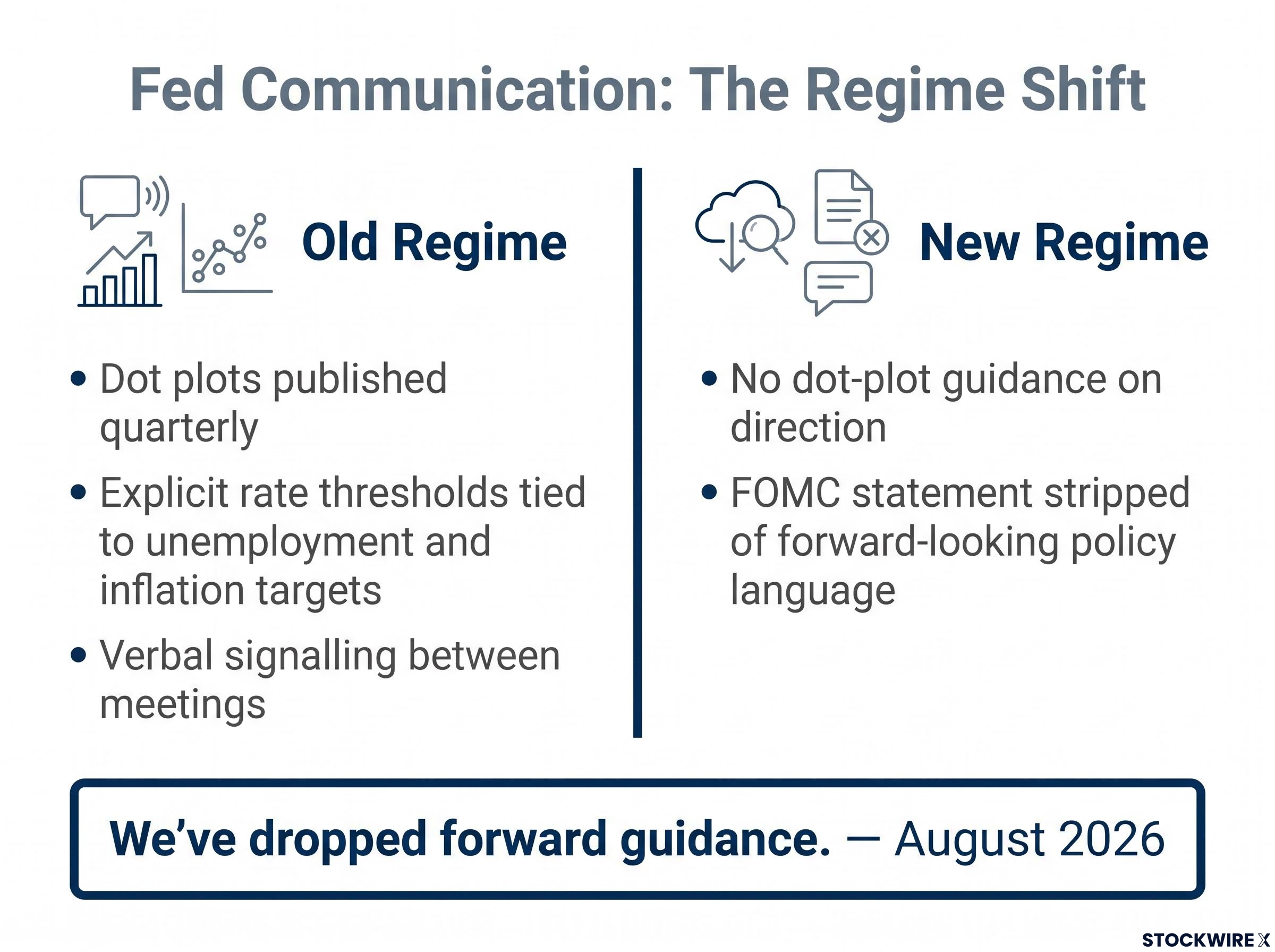
Forward guidance, in its previous form, meant the Federal Open Market Committee (FOMC), the group of Fed officials who vote on interest rates, would signal the likely direction of policy before acting. Dot plots (anonymous rate projections from each voting member) gave markets a probabilistic map. Explicit language about the “likely future course of monetary policy” appeared in post-meeting statements. Verbal hints from the chair in speeches and press conferences smoothed the path between decisions.
That machinery has been systematically dismantled. Here is what changed:
- Old regime: Dot plots published quarterly, explicit rate thresholds tied to unemployment and inflation targets, verbal signalling between meetings to steer expectations gradually.
- New regime: No dot-plot guidance on direction, FOMC statement stripped of forward-looking policy language, the chair’s public position that markets should respond to data “in the direction and magnitude they see fit.”
Warsh’s Jackson Hole address reinforced this shift. He noted that summer CPI and PCE (Personal Consumption Expenditures, the Fed’s preferred inflation measure) figures had surprised to the downside, yet stopped well short of declaring that the underlying disinflationary trend had durably improved. He characterised labour market conditions as consistent with the Fed’s full employment mandate, while declining to specify any reaction function, threshold, or trigger that would govern the Committee’s next move.
The historical arc of Fed forward guidance runs from the spare 130-word statements of 2002 through the near-895-word commitments of 2014, and the two clearest failures in that record, the 2013 taper tantrum and the 2021-2022 transitory episode, both originated from the gap between prior guidance and subsequent action rather than from the policy change itself.
In a regime where guidance has been removed, what the chair emphasises becomes the guidance by default. Stressing that disinflation is not yet convincing, while acknowledging a strong labour market and refusing to rule out further tightening, reads as hawkish even without a single explicit number.
The practical implication for you is clear. You can no longer wait for a verbal signal from policymakers before adjusting your positioning. Your own reading of incoming inflation and employment reports now carries the weight that Fed guidance used to bear.
The unmentioned Treasury buybacks and institutional boundaries
The most consequential element of the Jackson Hole address may be what Warsh chose not to say.
On 19 August, the Treasury announced it would raise the maximum size of its nominal long-end bond buyback operations from approximately $2 billion to at least $4 billion per operation, effectively doubling the ceiling. These enlarged operations run from 9 September through 4 November, covering the entire window surrounding the FOMC decision.
Treasury buybacks work by purchasing older, less liquid long-dated bonds from the market. The practical effect is to support prices at the long end of the yield curve and compress long-term yields, the exact opposite of the bond-market discipline Warsh has publicly praised.
Treasury buyback mechanics are frequently mischaracterised as monetary expansion: the programme swaps long-duration supply for short-duration supply without creating reserves, targeting yield levels, or reducing total federal debt outstanding, which is why the QE and yield-curve control analogies that circulated after the 19 August announcement are analytically incorrect.
Since taking the chair, Warsh has consistently framed higher long-term yields as a helpful complement to the policy rate, arguing that bond-market tightening restrains inflation and risk-taking in ways that reinforce the Fed’s work. He has also repeatedly called for a smaller state footprint across financial markets. A Treasury programme that increases direct intervention in long-term bond pricing works against both positions.
Warsh said nothing about it.
Interpreting the silence
Two theories circulate among strategists for why the buyback expansion went unmentioned.
The first is institutional boundary-keeping. Publicly acknowledging or critiquing a Treasury debt-management operation would blur the line between monetary policy and fiscal management. Warsh’s silence is consistent with a desire to preserve that separation, even when the two are working at cross-purposes.
The second is an operational look-through. Analysts have argued that while the buybacks may nudge long-end yields and liquidity conditions, they will not change the Fed’s September rate decision, which will be anchored in inflation and labour-market data. Warsh’s omission, under this reading, signals the Fed treats the buybacks as technical market engineering rather than a core macro input.
Either way, the institutional disconnect tells you something specific about your long-duration bond holdings. There is a structural buyer stepping into the market just as the Fed threatens further rate hikes. Overall financial conditions may remain looser than the Fed desires, and the yield curve’s shape heading into 16 September will reflect forces outside the FOMC’s control.
Mapping the data catalysts before the September decision
With forward guidance gone, the window between now and the FOMC decision contains a concentrated set of binary events. Each one carries outsized weight because no Fed official will contextualise the data for you before the meeting.
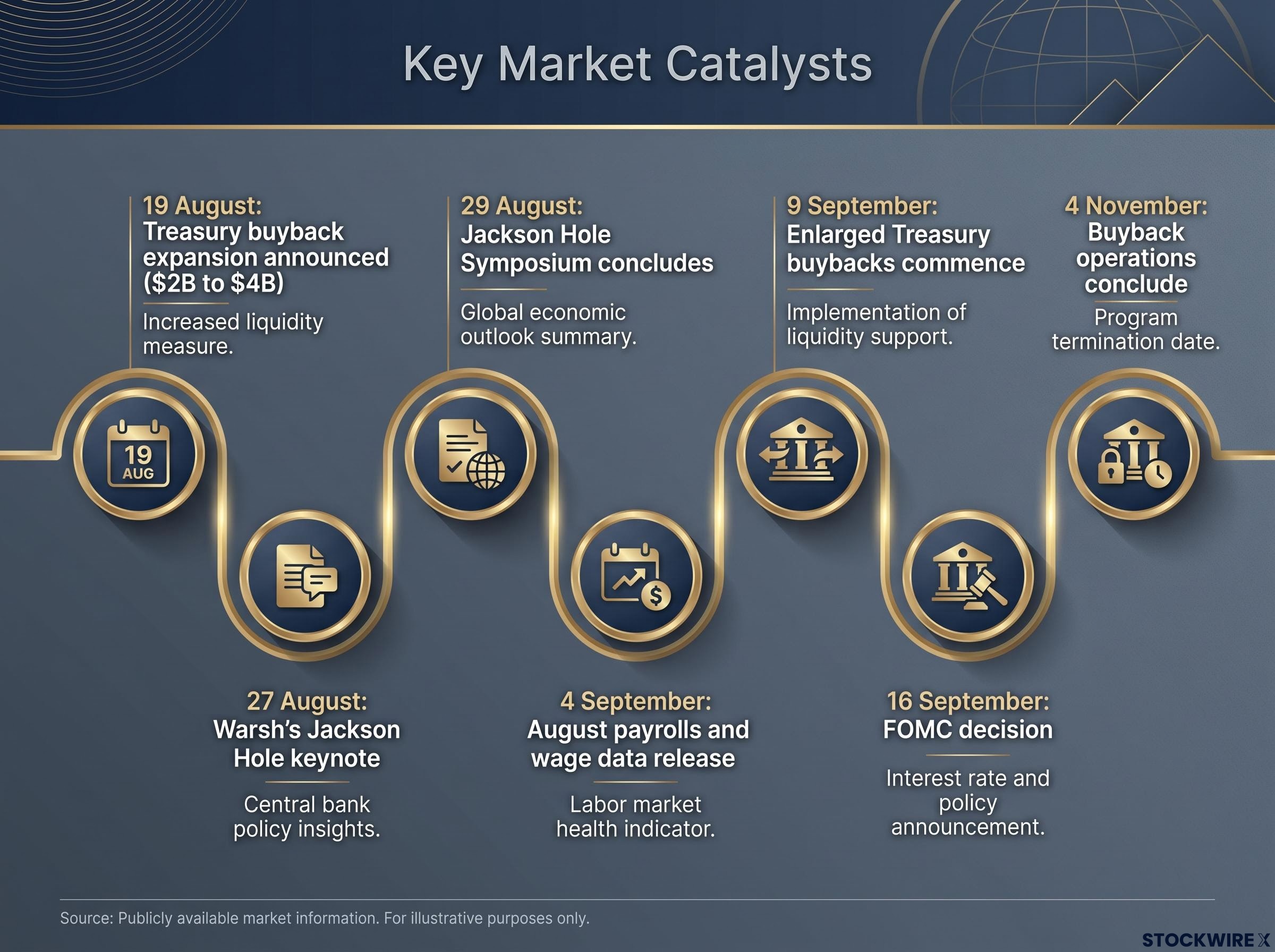
- 29 August: Jackson Hole Symposium concludes. Follow-up speeches from other voting FOMC members could either reinforce Warsh’s hawkish-by-omission tone or introduce a dovish counterweight that softens September odds. No new data is attached, but tone shifts from other voters carry material pricing power in this regime.
- 4 September: August payrolls and wage data release. This is the single most important input. Warsh described labour market conditions as broadly aligned with full employment targets. Any significant deterioration would challenge the hawkish read and could unwind a substantial portion of the hike probability. A strong print cements it.
- 9 September: First enlarged Treasury buyback operations commence. The market reaction to these initial operations, particularly moves in long-end yields and credit spreads, will reveal whether the programme materially eases financial conditions heading into the decision. The Fed may treat them as exogenous, but your portfolio will feel the effect regardless.
- 16 September: FOMC decision. This is the first rate call since June at which bond and equity markets must settle on a common reading of policy intent, with no dot plot, no reaction function, and no verbal pre-commitment to lean on.
Because the Fed will not pre-commit to a path, you should treat the 4 September payrolls report as the definitive binary trigger. It will either cement or collapse the current ~60% hike probability, and there will be no Fed commentary to soften the market’s reaction in either direction.
Positioning for the 16 September reality check
The core friction heading into September is structural, not cyclical. A central bank relying entirely on backward-looking data to justify its next move is operating alongside a Treasury actively managing forward-looking duration through expanded buybacks. Those two forces pull in opposite directions, and Warsh’s speech made no attempt to reconcile them.
The policy architecture behind the buyback expansion carries echoes of financial repression, the deliberate suppression of sovereign borrowing costs below market-clearing rates that characterised the 1942-1951 post-war period, a parallel that carries direct implications for real asset allocation when the programme is evaluated alongside a tightening monetary policy stance.
The 16 September meeting is the first genuine test of this opaque regime since June. Markets must price a rate decision without a dot plot, without verbal signalling, and without a disclosed reaction function. The only inputs that matter are the data releases between now and then, and the tone of any remaining FOMC member speeches before the blackout period begins.
The question you need to answer before that date is whether your portfolio can absorb the elevated volatility that comes when markets are forced to interpret intent from silence. Rate expectations moved 20 percentage points on a single speech. The payrolls report on 4 September could move them further, in either direction, with no Fed hand on the wheel.
This article is for informational purposes only and should not be considered financial advice. Investors should conduct their own research and consult with financial professionals before making investment decisions. Forward-looking statements regarding rate probabilities and market expectations are subject to change based on incoming economic data and policy developments.